


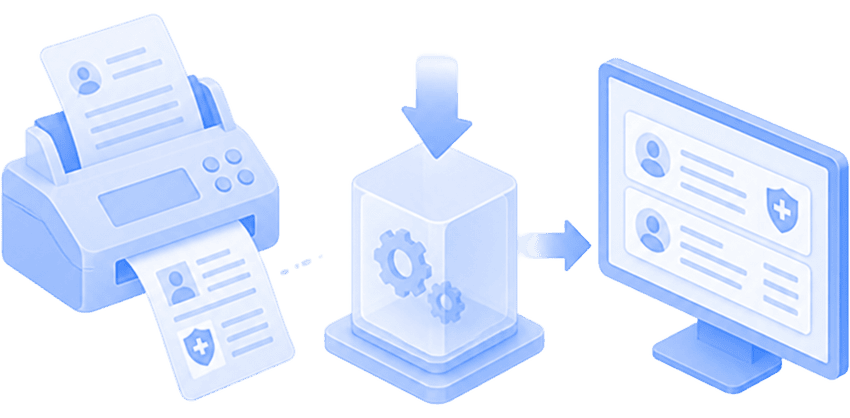


Faster Patient Intake
Automatic extraction removes the manual transcription step for incoming faxes and scans, freeing administrators to focus their time on reviewing AI suggestions and handling the cases that genuinely need their judgment.
The system pulls patient and insurance details straight from faxes, no typing required.
The system checks each new patient’s name and birth date against existing records.
The system splits and labels multi-page faxes by document type automatically.
As its provider base grew, a long-term HME/DME software partner saw manual fax and document intake become the bottleneck in an otherwise automated platform.
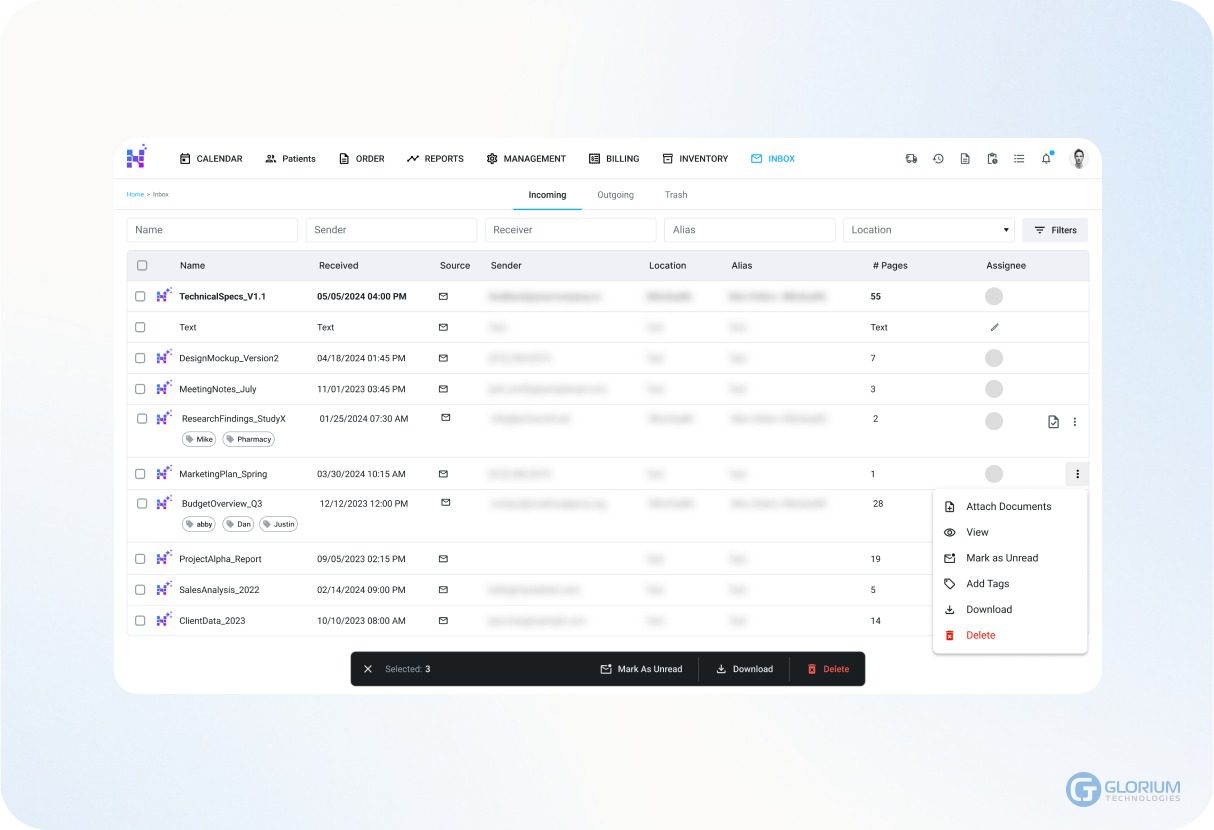
Facility administrators manually keyed patient demographics and insurance details out of incoming faxes, a slow process prone to transcription errors.
There was no automated way to tell whether a document belonged to an existing patient or required a new record, so staff had to search the system before filing anything.
Multi-page faxes containing several distinct documents, including medical records, insurance forms, and more, arrived unsorted and had to be manually split and categorized.
Insurance details such as payer name, policy number, and effective dates were transcribed by hand, introducing errors that carried downstream into billing.
Handwritten notes and low-quality scans slowed intake further, since staff had to interpret unclear text before a record could even be created.
The existing manual patient-creation form allowed duplicate records and incomplete responsible-party information for minors to slip through.
Building an AI Layer That Reads, Groups, Categorizes, and Pre-Fills before a Human Touches the Fax
We built an AI-powered document processing layer on top of the client’s existing .NET/C# and Angular platform, using Amazon Textract for text and data extraction and Amazon Bedrock for higher-level document reasoning. Incoming faxes and scans land in Amazon S3, move through an Amazon SQS-managed pipeline, and trigger .net/c# workloads that run the extraction and matching logic, keeping the AI processing decoupled from the platform’s core application code.
A Textract-plus-Bedrock pipeline extracts patient demographics and insurance details from faxes and PDFs, including handwritten notes and low-quality scans, then automatically splits multi-page faxes into distinct, correctly labeled documents even when the relevant pages aren’t consecutive.
Patient-matching logic determines whether an incoming document belongs to an existing patient or should trigger a new-patient suggestion, pre-filling the creation form, but the approve action stays locked until an administrator reviews and completes the required fields.
A multi-tab interface covering General Information, Address and Location, Contacts, Responsible Party, Employer Info, and Insurances speeds up manual entry, backed by a “Verify Patient” duplicate check, automatic address verification, and an automatic warning when responsible-party details are missing for a patient under 18.
Angular and PDF.js give administrators a side-by-side view of the source document and the AI’s extracted fields, so every suggestion is reviewed in context before approval.
From Fax to Filed Record, with a Checkpoint at Every Step
Automatic extraction removes the manual transcription step for incoming faxes and scans, freeing administrators to focus their time on reviewing AI suggestions and handling the cases that genuinely need their judgment.
The Verify Patient check runs against name and date of birth before any new record is created, keeping duplicate profiles out of the system and out of downstream billing and reporting.
Automatic splitting and type recognition sorts multi-page faxes into distinct, correctly labeled documents, even when pages are non-consecutive, so nothing gets misfiled or buried inside an unsorted fax.
An automatic warning flags missing responsible-party information for patients under 18 before the record is saved, closing a compliance gap that used to depend on staff catching it by hand.
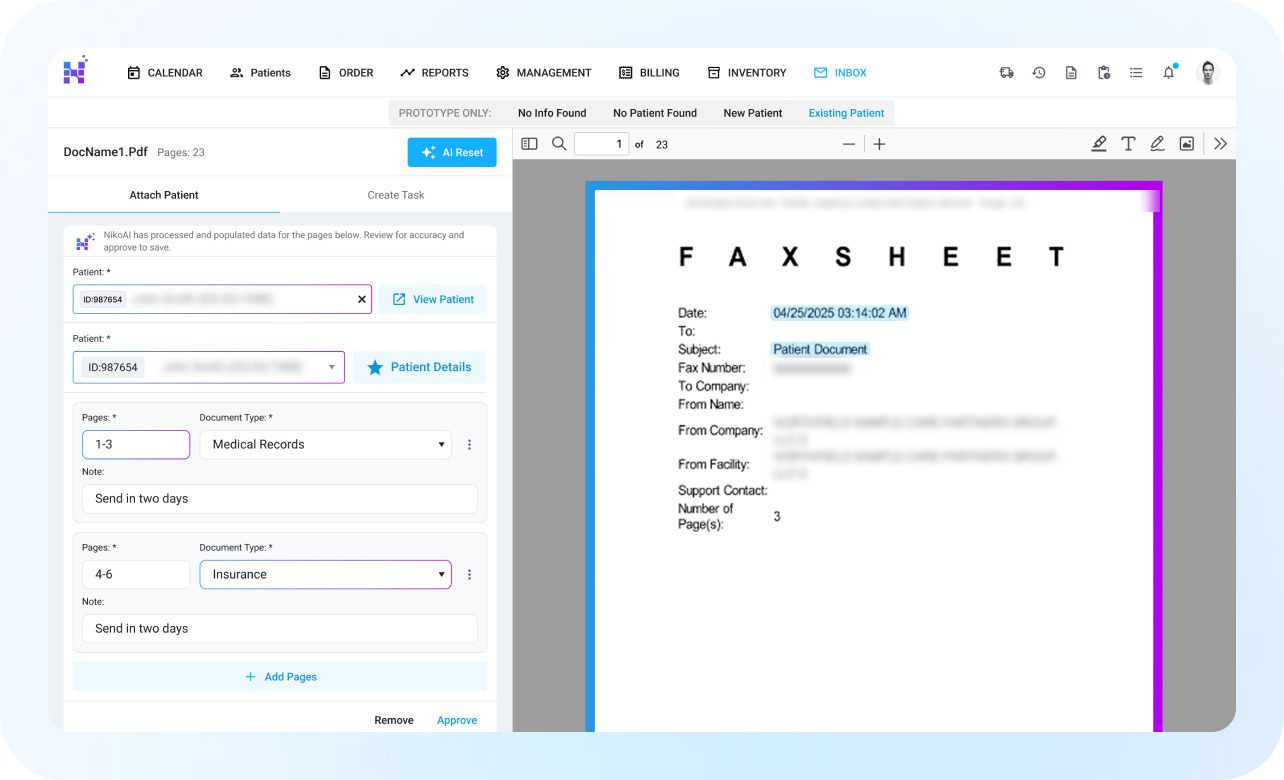
AI-suggested new patient records stay locked from approval until an administrator reviews and completes the required fields, keeping every new record accurate without slowing down the ones the AI gets right.
The Stack Behind the Extraction Pipeline
Swipe or scroll to see more →
| Layer | Technologies | Rationale |
|---|---|---|
| AI / Document Intelligence |   Amazon Textract, Amazon Bedrock | Extracts structured data from scans and faxes, including handwritten and low-quality documents, and reasons over document type and grouping. |
| Backend |    .NET / C#, PostgreSQL | Orchestrates the processing flow and stores extracted patient and document metadata. |
| Infrastructure |    Amazon S3, Amazon SQS, Amazon SNS | Event-driven pipeline that queues and processes incoming documents as they arrive. |
| Frontend |   Angular, PDF.js | Lets administrators review the source document alongside AI-extracted fields before approving. |
If your platform still depends on staff manually reading faxes, scans, or PDFs to create or update records, this project maps closely to your situation. It fits platforms serving HME/DME providers, healthcare administrators, or any operation where incoming paperwork needs to become structured data before it’s useful, especially where document quality varies and duplicate records are a recurring risk.
It speaks to teams weighing a fully custom AI build against a managed extraction approach, particularly where keeping the processing logic outside the core application matters for future maintainability.

Patient Data Extraction
AI Document Processing
Fax Intake Automation
Duplicate Record Detection
Compliance
HME/DME Platforms

Replace manual fax and scan processing with an AI pipeline that extracts, groups, categorizes, and pre-fills, while keeping a human checkpoint on every new record.