






Best Microsoft Dynamics 365 Business Central Partners for Growing Businesses
Updated February 19, 2026

 Summarize in ChatGPT
 Summarize in ChatGPT
As businesses mature, legacy systems and manual workarounds often become bottlenecks. What works for small teams (spreadsheets, separate accounting tools, older ERP systems, etc.) often struggles to scale as the business grows. As a result, teams spend more time reconciling numbers, double-checking data, and pouring energy into manual tasks. So, what’s the solution to this issue? How do growing businesses solve the problem of manual data reconciliation and productivity drains? Many growing companies find their answer in Dynamics 365 Business Central. The system moves your team away from manual entry and into an automated environment where data flows seamlessly across the company.
Finding the solution is easy; however, implementing Business Central is a complex, technical task. Often, businesses opt to work with licensed partners to implement the system properly, and the choice of partner directly affects how quickly and efficiently the system is introduced into your environment. But how do you choose the Business Central partner that matches your business needs?
To help you make the choice, we created this article that reviews Dynamics 365 Business Central partners that work with growing and mid-sized companies, their implementation approach, service suite, and more.
Content
Finding the right Microsoft Business Central partner is critical to your long-term success. We’ve curated the top seven partners, highlighting their unique implementation styles and industry specializations.
Focus Areas: Dynamics 365 Business Central implementation, ERP consulting, implementation, and ongoing support.
What Clients Appreciate About Glorium Technologies: End-to-end implementation approach, practical Business Central expertise, tailored solutions, clear project ownership, support beyond go-live.
Typical Project Scope: Dynamics 365 Business Central implementations for SMBs and growing mid-sized companies.
Minimum Project Size: $25,000+
Founded: 2010
Headquarters: Princeton, NJ, USA.
Development centers in Kyiv, Ukraine, and Kraków, Poland.
Glorium Technologies is a Microsoft Dynamics Business Central partner focused on full-cycle Business Central implementation. The team supports projects from early process analysis through configuration, customization, integration, and post–go-live support.
By merging domain-specific knowledge with high-tech engineering, they ensure that your Business Central environment is fully optimized to scale alongside your growth.
Contact:
+1-888-354-0883
contact@gloriumtech.com
Focus Areas: Dynamics 365 Business Central consulting, ERP implementation, system configuration, integrations, and ongoing support.
What Clients Appreciate About Dynamics Square: Clear implementation process, practical guidance, Microsoft-focused expertise, structured project delivery.
Typical Project Scope: Standard Dynamics 365 Business Central implementations and ERP consulting projects.
Headquarters: United States
Dynamics Square is a Dynamics Business Central partners, supporting companies through implementation, upgrades, and ongoing support. The team helps businesses unify data, make daily business operations simpler, and automate workflows as they migrate from legacy systems to cloud-based Dynamics 365 environments.
Most projects focus on standard Business Central implementation, system upgrades, and integrations within the Microsoft ecosystem.
Contact:
+1 312 488 1043
info@dynamicssquare.com

Focus Areas: Dynamics 365 Business Central and cloud ERP implementation, CRM solutions, analytics and automation, Power Platform services, industry-specific consulting.
What Clients Appreciate About Velosio: Broad Microsoft ecosystem expertise, business-focused consulting approach, clear communication, support across ERP, CRM, and data platforms.
Typical Project Scope: Cloud ERP and Business Central projects for mid-sized and emerging enterprise companies.
Founded: Over 30 years of experience in ERP and business applications.
Headquarters: United States
Velosio works with companies that are transitioning to modern cloud-based business systems, including Dynamics 365 Business Central. Among Microsoft Dynamics Business Central companies, Velosio is an expert in combining ERP projects with CRM, analytics, and productivity tools from the Microsoft ecosystem. Most projects focus on helping mid-sized teams update their core systems and get a clearer view of their data as the business grows.
Contact:
888.725.2555
insider@velosio.com
Focus Areas: Dynamics 365 Business Central and Dynamics 365 implementation, ERP and CRM consulting, system upgrades, managed services, analytics, and reporting.
What Clients Appreciate About Confiz: Structured implementation approach, strong Microsoft Dynamics expertise, clear system configuration, and long-term support options.
Typical Project Scope: Dynamics 365 implementation and support projects for mid-sized and enterprise organizations.
Headquarters: United States
Confiz works with companies adopting Microsoft Dynamics 365 solutions across ERP and CRM, including Business Central. It is known for handling standard implementation, upgrades, and managed support for companies that are on their way to cloud-based business systems.

Focus Areas: Dynamics 365 Business Central implementation, global and multi-entity deployments, supply chain management, omnichannel operations, and cloud ERP modernization.
What Clients Appreciate About Sunrise: Experience with complex setups, focus on scalability, strong industry knowledge, and clear system structure.
Typical Project Scope: Dynamics 365 Business Central implementations for companies expanding across regions, channels, or product lines.
Headquarters: United States
Sunrise works with companies that have outgrown older systems and need Dynamics 365 Business Central to support more complex operations. Among Microsoft Business Central partners, the company is often involved in projects with multi-country and multi-currency requirements. Most projects focus on consolidating finance, supply chain, and operations into a single cloud system and expanding it over time.
Contact:
+1 336-722-6741 (North America)
+41 91-682-85-84 (Locarno, Switzerland)
+31 20 3085482 (Amsterdam, Netherlands)
+86 29-6890-5086 (Asia)
info@sunrise.co

Focus Areas: Dynamics 365 Business Central and Dynamics 365 migration, cloud ERP modernization, system upgrades, consulting, and support.
What Clients Appreciate About AlfaPeople: Clear migration planning, structured approach, experience with legacy Dynamics systems, steady project execution.
Typical Project Scope: Migration and upgrade projects from older Microsoft Dynamics systems to Dynamics 365 Business Central or other Dynamics 365 solutions.
Headquarters: Denmark
Primarily, this company focuses on migration projects. The team works with companies running older Microsoft Dynamics systems and helps them migrate to Dynamics 365 in a controlled, predictable way.
Compared to partners that concentrate on building new setups from scratch, AlfaPeople’s work often centers on assessing existing systems. Simply put, they know how to migrate core data and processes to the cloud and gradually extend functionality after migration.
Contact:
+45 70 20 27 40
info@alfapeople.com

Focus Areas: Dynamics 365 implementation, Microsoft Dynamics consulting, workflow optimization, and post-go-live support.
What Clients Appreciate About SingleStone: Hands-on problem solving, practical process alignment, ongoing support, and system tweaks.
Typical Project Scope: Dynamics 365 deployments, migration support, and system refinement for mid-sized and larger organizations.
Headquarters: Richmond, VA, USA
They collaborate with companies that implement Microsoft Dynamics 365, including Business Central as part of the broader Dynamics 365 suite. The team focuses on making the technology match daily work and helping teams get more out of their investment.
SingleStone combines consulting and implementation work within the Microsoft ecosystem. The team not only sets up the system but also reviews existing processes to make sure it works in day-to-day use.
Dynamics 365 Business Central is a comprehensive business management solution that touches finance, reporting, supply chain management, and core business processes in your organization. For growing companies, these areas are closely connected, which means even small configuration decisions can affect operational efficiency down the line. That’s why the success of a Business Central implementation depends less on the software itself and more on the partner that guides the process.
According to Gartner, 75% of ERP implementations fail due to a lack of alignment between the business strategy and the implementation method. ERP is a strategic investment, and scenarios like this make it even more essential to create a clear ERP strategy and implementation approach, which is possible with a certified, experienced partner.
Leading Microsoft Dynamics ERP specialists, such as Glorium Technologies, focus on the discovery stage before introducing the full implementation approach, which is essential for proper planning. In addition to the discovery stage, the partners offer a comprehensive suite of services, including migration, integration, customization, and go-live support.
Here’s a simple comparison to illustrate the difference.
| Detail | DIY (Self-Implementation) | Generalist Provider | Strategic Certified Partner |
| 1. Strategy | Experimental; trial-and-error | Reactive; task-based only | Proven; methodology-driven |
| 2. Technical Logic | Basic/Default settings | Excessive customization | Scalable; best-practice focus |
| 3. Risk Profile | Critical; potential for financial non-compliance, data corruption, etc. | Moderate; technical debt | Low; structured governance |
| 4. Value Focus | Digitized manual habits | Slow, inconsistent returns | Rapid, optimized workflows |
| 5. User Adoption | Low; reliance on workarounds | Fragmented; poor training | High; role-based mastery |

Not all Microsoft Dynamics 365 partners approach implementation the same way. Some focus on fast setups and basic configurations; others work deeper with business logic and long-term scalability. Let’s look into the criteria that matter.
The first thing to assess is how deeply a partner works with Business Central implementation projects. Standard implementation usually covers core financials and basic workflows. However, more complex scenarios require a solid understanding of industry-specific processes and integrations with existing systems.
Some providers focus mainly on Business Central licensing or deliver standard implementation with minimal customization. Others can handle more advanced setups but operate within a narrow regional or industry scope.
At Glorium Technologies, the focus is on end-to-end Dynamics 365 Business Central implementation, from initial process analysis and system design to customization, integration, and long-term support. This model is particularly relevant for growing companies that plan to scale Business Central across departments over time.
As businesses grow, things change quickly. New teams, new entities, or expansion into other regions can complicate the system. Your Business Central partner should support growth without requiring constant reconfiguration.
Partners experienced with Dynamics 365 Business Central know how to structure data, permissions, and workflows in a way that supports future expansion. This approach helps teams see what’s happening across the business and adapt as needs change.
Go-live is just the beginning. What really matters is how the system is supported afterward. This includes small improvements, helping users when issues come up, and adjusting Business Central as day-to-day processes change. Partners that offer long-term managed services and consulting support act more like strategic collaborators. Simply put, they don’t step away after deployment. They are always involved and do their best to help teams get more value from the system and avoid common post-launch issues.
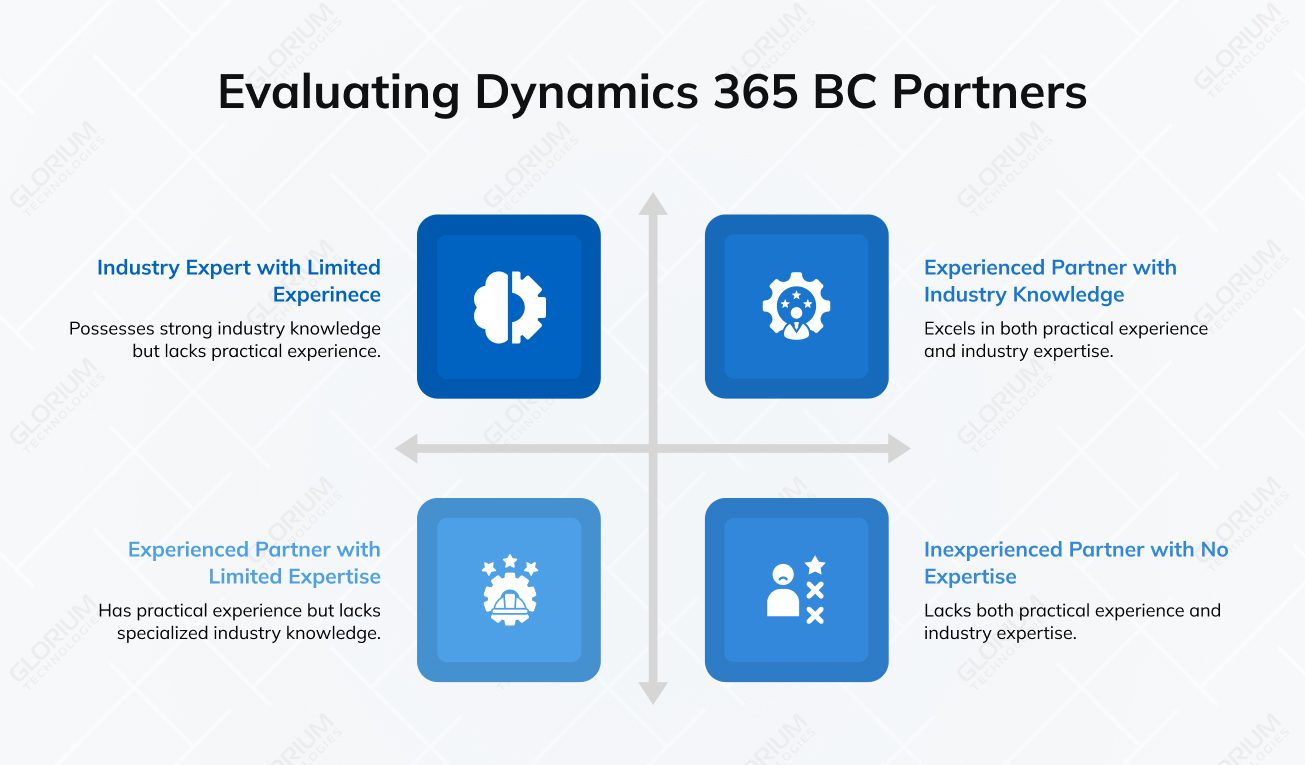
Many Microsoft Dynamics partners previously worked with Dynamics NAV, but that doesn’t necessarily mean they’re equally strong with Business Central in the Microsoft cloud. On top of that, you should find out whether the partner has handled similar implementations (similar team size, complexity, and business structure).
Here are some questions worth asking before you start:
Remember that concrete answers to these questions usually say more than presentations or sales materials. Plus, they help avoid issues later in the project. If you’re also thinking about cost, this guide breaks down what affects Business Central implementation pricing.
Glorium Technologies is often chosen when a Business Central project goes beyond basic configuration. The team works as an end-to-end Dynamics 365 Business Central implementation partner. You get support across system design, customization, integration, and long-term use. This approach helps companies avoid disconnected systems and build a setup that works long-term.
Interested in how this approach works in real life? Explore our recent case study of a mid-sized US food manufacturer that replaced disconnected tools like QuickBooks, spreadsheets, and a standalone WMS with Dynamics 365 Business Central. Glorium Technologies unified production, inventory, quality, and finance into a single system with real-time batch visibility and FEFO automation. The project reduced ingredient waste by 25%, cut production scheduling time by 40%, and improved traceability and compliance reporting.
Sounds like something you’d like to bring into your business? Talk to us. Schedule an introductory call with our experts, and take the first step toward finding the most suitable BC implementation partner.
A global Microsoft partner serves as a professional services firm that guides the Microsoft ERP project from planning to long-term use. Their primary goal is to provide technical solutions such as system configuration, custom development, and seamless integration with the Microsoft Power Platform. Moreover, Moreover, they ensure that cloud-based solutions allow business data to flow correctly across the entire business. At the same time, the partner helps align the system with business strategy, not just technical requirements.
First, you should review real project experience, particularly in your specific industry. Businesses should assess a partner’s consulting services, industry-specific solutions, experience with legacy ERP systems, and ability to work with existing solutions and support business growth. For specific cases, ensure they have experience migrating from legacy Microsoft Dynamics NAV environments. regarding their business central team’s project approach and how they provide ongoing support usually matter more than sales presentations.
Resellers mainly focus on licensing and basic setup; implementation partners handle the full delivery. These teams provide deep process analysis for streamlining business processes, automating workflows via Microsoft Azure, integrating with CRM solutions or Microsoft Office, and ensuring data security is maintained throughout the transition. This difference is vital for mid-sized businesses where the system must support complex daily operations rather than just basic accounting.
Not always. Some partners focus on standard setups; others bring deep expertise in more complex environments. Teams with experience in business intelligence solutions, custom development, and data analytics are usually better prepared for projects that involve multiple departments, locations, or regulatory requirements.
Certifications show that companies are aware of Microsoft technologies, but they don’t guarantee hands-on implementation skills needed for minimal disruption during a go-live. Real expertise is demonstrated through completed projects and experience delivering digital transformation services across different industries.
The thing is that they usually need more than a basic setup. End-to-end consultants help connect Business Central with other systems, support evolving processes, and guarantee the ERP continues to fit the business as it grows. This approach is common among top Microsoft Dynamics partners that focus on long-term value.