









Automated Valuation Model: How AI Estimates Property Value in Seconds
Updated July 17, 2026

 Summarize in ChatGPT
 Summarize in ChatGPT
Type an address into almost any real estate website, and a property value appears within a second. That instant number comes from an automated valuation model, the quiet engine that is now working behind a large share of everyday real estate decisions. Once a niche tool for institutional investors, the AVM has become part of how lenders size up collateral and how buyers form a first impression of a home’s value.
An AVM turns public records, recent sales, and property characteristics into a property value estimate without sending anyone to the front door. The approach has spread well beyond that early lending use, and artificial intelligence is now expanding what these models can do.
Content
An automated valuation model is a software system that estimates a property’s value using mathematical or statistical models rather than a physical inspection. The model pulls from large databases, compares a subject property against similar properties, and returns a figure in seconds. Appraisers, mortgage lenders, and real estate investors all treat AVM output as a fast reference point in their daily work.
Every automated valuation starts with data. The model gathers property details and market data, then applies an algorithm to weigh them against known sale prices nearby. Within moments, it returns both an estimate and a signal of how much to trust it.
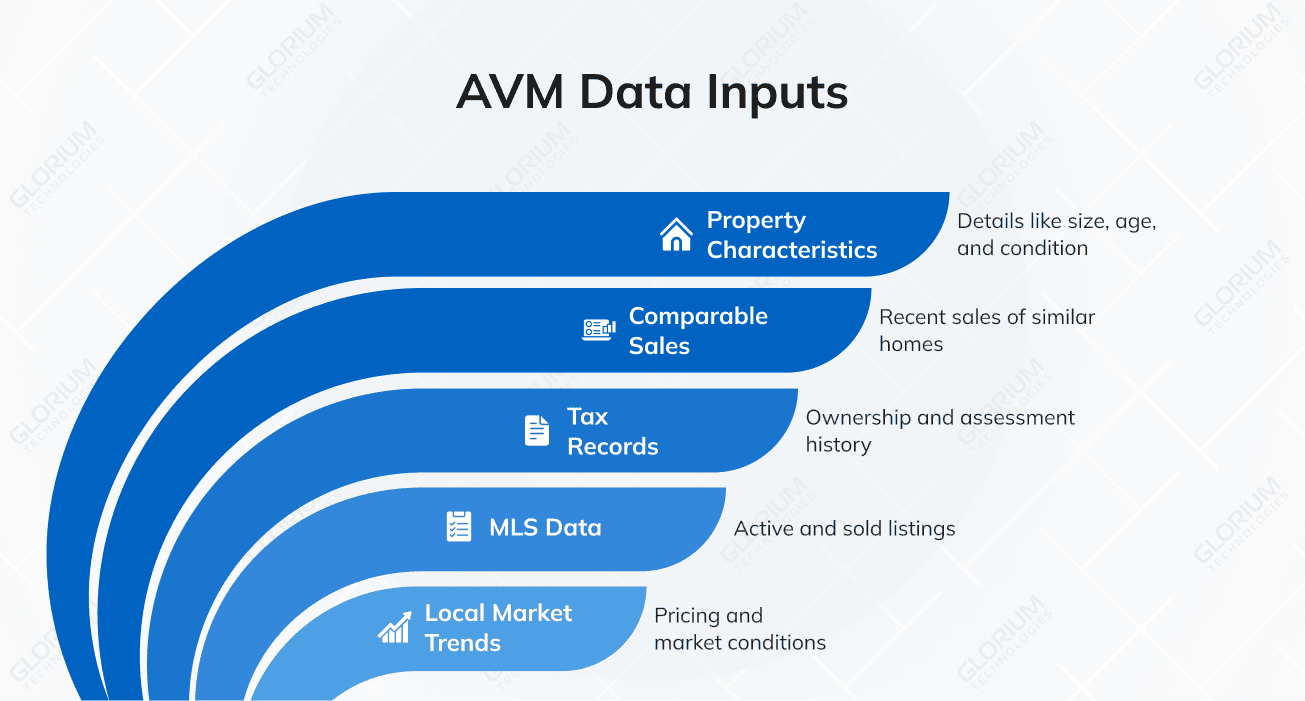
Common inputs include:
The system compares the data points across many properties and produces an estimate paired with a confidence score. That confidence score signals how much trust to place in the number, based on how much comparable activity and clean data the model had to work with. A high score usually means plenty of recent, similar sales. A low score is a prompt to look closer or seek a second opinion.
Most AVMs rely on one of two statistical techniques, and many blend both. Comparables-based models select comparable properties for each valuation, working much like a human appraiser applying the sales comparison approach. Hedonic models take a different route, using statistical modeling to assign a value to each property characteristic, then adding those parts together.
Blended systems run several methods, give each result a confidence score, and weight them into a single figure. This is why two AVM solutions can return different numbers for the same address. Each one uses its own proprietary algorithm and its own underlying data, so results naturally diverge.
The speed and low cost of automated valuation make it useful far beyond a single home search. Any workflow that needs a quick property value across multiple properties is a candidate. The settings below show where AVMs earn their place, and who relies on them.
Consumers meet AVMs first on listing portals, where a home value appears next to every address. Mortgage lenders use them earlier in loan origination, running an automated valuation during prequalification to gauge collateral value before ordering a full report. For home equity loans and some refinances, an AVM estimate can support the lending decision on its own, which trims cost and turnaround for lower-risk files.
Commercial teams apply AVMs to portfolio valuation and monitoring, tracking the value of many assets at once without commissioning individual reports. Banks and financial institutions lean on the same output for risk management, stress testing loan books as market conditions change. Glorium Technologies built one such tool for a commercial appraisal firm, an app that lets appraisers complete commercial appraisals from any device and keep every property parameter in one shared source of knowledge.
Real estate investors use automated valuation to filter long lists quickly, flagging pricing anomalies that hint at an opportunity worth chasing. Real estate agents lean on the same pricing trends when preparing a comparative market analysis or advising a seller on a listing price. In both cases, the AVM is a helpful starting point that narrows the field before deeper analysis begins.
Insurers use property value estimates for coverage decisions and claims support. Municipal offices apply mass appraisal techniques to value thousands of parcels for property tax purposes in a single pass. Property developers use the same fast estimates to check the feasibility of a site before committing capital. Broad coverage and consistency matter more than pinpoint precision in these high-volume settings.
A frequent question from home buyers is whether an AVM can replace a professional appraisal. The answer depends on the stakes. An automated valuation is fast and nearly free, whereas a traditional appraisal takes longer and costs a fee, since a licensed appraiser visits the property in person and accounts for its true condition.
The table below compares the two on the factors that shape most valuation decisions.
| Factor | Automated valuation model (AVM) | Traditional home appraisal |
| Speed | Seconds | Several days to two weeks |
| Cost | Free or low cost | A professional fee, often several hundred dollars |
| Method | Algorithms run on public data and comparable sales | On-site inspection by a licensed appraiser |
| Property condition | Assumes average condition | Assessed in person |
| Accuracy | Strong with good comps, weaker for unique homes | Reflects the property’s actual condition |
| Mortgage approval | Limited use for home purchase loans | Required for most purchase mortgages |
| Best used for | Screening, monitoring, early estimates | Home purchase, complex or high-value properties |
For a straightforward home in an active subdivision, an AVM and an appraisal often land close together. For a waterfront home, a custom build, or a property in a thin market, the human appraiser and their professional judgment still set the reliable number. Lenders generally will not rely solely on an automated valuation to approve a mortgage for a home purchase, and they treat the AVM as one input.
Early AVMs leaned on public record data and basic comparable sales math. Artificial intelligence has raised the ceiling on what these models can estimate and how quickly they adapt. Machine learning lets a model keep improving as new sales arrive.
Modern models use continuous machine learning to refine their weighting as fresh market data lands. Instead of a fixed formula, the model adjusts to local market trends and revises its estimates as conditions move. Faster adaptation matters most during periods of market volatility, when older approaches fall behind the market and lose accuracy.
Newer systems read images alongside text. Computer vision can assess a listing photo for finish quality or renovation signs, feeding a signal that older AVMs missed entirely. Multimodal machine learning, which processes photos and structured property data together, has improved valuation accuracy for homes where condition drives price. Glorium Technologies has worked on this frontier, building a real estate predictive insights platform that applies deep learning to forecast market movement and help clients predict likely sellers before they list.
As lenders and regulators rely more on model output, they want to understand why a model produced a given number. Explainability has become a priority for AVM development. The Financial Institutions Reform, Recovery, and Enforcement Act framework, together with newer federal quality-control rules, pushes vendors toward transparent and testable models. Independent third-party testing of AVM accuracy has become a standard expectation across the industry.
Practitioners who use these tools daily echo the same caution:
“Trust that it’s probably in the ballpark, but verify your findings.”
— Laurel, real estate investor and host of What Does AVM Stand For In Real Estate?
Accuracy is where AVMs draw the most debate. The honest picture is that a good automated valuation lands close in data-rich markets and grows shaky in thin ones. Understanding the metrics helps set fair expectations.
The industry judges models on a few figures. Median absolute percentage error, or MdAPE, shows how far a typical estimate sits from the eventual sale price. A related measure counts the share of estimates that fall within 10% of the sale price. The confidence score attached to each estimate, often derived from a forecast standard deviation, tells users when a number deserves a second look.
As of mid-2025, Zillow’s own data put the Zestimate’s national median error rate near 1.9% for on-market homes and roughly 7% for off-market homes, across about 116 million homes. Property data provider ATTOM, in its latest published AVM documentation, reports a national median absolute error of 4.3%, with 70% of its valuations landing within 10% of the sale price.
Several conditions push AVM estimates off target:
The Marketintelo analysis valued the global AVM market at about 4.2 billion dollars in 2025 and projected growth to 11.8 billion by 2034, a sign of how deeply lenders, insurers, and proptech companies now depend on automated valuation across property types.

The next wave of AVM development points toward richer data and clearer reasoning, with each trend below adding a data source or a safeguard that earlier models lacked.
Models are pulling in satellite imagery and geospatial layers to read factors a listing photo cannot show, from flood exposure to green space and proximity to amenities. These signals sharpen a property value estimate where location drives price.
Computer vision is moving from novelty to standard input. Reading listing photos for finish quality, condition, and renovation signs closes part of the gap that has long limited AVM accuracy on condition-sensitive homes.
Digital twins, detailed virtual replicas of a building, let a model reflect real structural detail. As more properties gain a twin, valuations capture layout, materials, and systems that public records miss.
AI now supports seller targeting, predicting which owners are likely to list, and dynamic pricing that updates a property value from real-time market signals.
The likely destination is a hybrid model that pairs machine speed with human review, with a licensed appraiser handling complex cases while automated systems cover routine ones. Across the industry, AI is steadily becoming a routine part of valuation workflows, which points toward this hybrid setup as the practical norm.
Turning any of this into working software takes a team that understands both real estate and machine learning. Glorium Technologies has built custom real estate and PropTech software since 2010, with dedicated strength in valuation, data, and applied AI.
Our work covers the exact building blocks an AVM needs. We built a commercial appraisal application that keeps every property parameter in one place and runs from any device, and a real estate predictive insights platform that applies deep learning to market forecasting. Behind both sit our machine learning and AI software development teams, who handle the data pipelines, model training, and confidence scoring that reliable valuation depends on.
Whether you are validating an MVP for a valuation startup or extending a platform you already run, we can help you scope, build, and ship. Contact us to talk through your product and map out the next steps.
Yes, in many cases. Lenders often accept an automated valuation for home equity loans, bridge loans, and some refinances, where the loan carries less risk than a purchase mortgage. For a standard home purchase, most lenders still require a full appraisal by a licensed appraiser.
A broker price opinion comes from a real estate agent who reviews comparable sales and local market conditions, sometimes with a drive-by look at the property. An AVM produces its estimate purely through algorithms and available data, with no human involved. Broker price opinions add local expertise, while AVMs add speed and scale.
Comparing multiple AVMs is a smart move. Since each model uses its own algorithm and underlying data, results vary, and a wide spread between them is a signal to dig deeper. Checking two or three, then reading each confidence score, gives a fairer sense of the range than trusting a single number.
Accurate property details help most. Correcting square footage, bedroom and bathroom counts, and recent renovations in public-facing records fixes inputs the model may have wrong. Because AVMs cannot see interior condition, sharing verified upgrades is the main way an owner can nudge an estimate toward fair market value.
They can, though residential remains the strongest use case because comparable sales are more plentiful. Commercial AVMs support portfolio valuation, lending, and monitoring across property types, though unusual assets and thin transaction data still call for a professional appraisal to confirm the figure.
Frequently, sometimes daily. Leading models refresh as new sales, listings, and market data arrive, and some revalidate against benchmarks every couple of days. The exact cadence depends on the provider and how much fresh data flows in for a given area.
Cost depends on data coverage, the modeling approach, and how much automation you need. A focused MVP that scores a single region costs far less than a national, multi-model platform with computer vision and live data feeds. A scoping session and a project estimate give the clearest picture before development starts.