








Machine Learning for Retail: From Pilot Projects to Profit
Updated September 21, 2026

 Summarize in ChatGPT
 Summarize in ChatGPT
Most retailers already own the data needed to forecast demand accurately, price against real elasticity, and catch fraud before it clears. That data sits unused in point-of-sale logs, warehouse systems, and abandoned carts while decisions across retail operations get made on last year’s averages. Machine learning in retail converts that backlog into decisions, and the gap between retailers who have done it and those who have not now shows up in margin.
The business case has stopped being speculative. NVIDIA’s January 2026 State of AI in Retail and CPG survey found 91% of retail and consumer packaged goods organizations actively using or assessing AI, 58% already deploying, and 89% reporting increased annual revenue. The question now is which decision to point a model at first, and what reaching production takes.
This guide answers both, covering where machine learning pays off across the retail industry, what each use case demands, which obstacles derail projects, and how to sequence a rollout so early wins fund later phases.
Content
Traditional retail systems follow instructions someone wrote years ago: reorder when stock drops below forty units, discount seasonal items in week ten. Machine learning in retail works differently. Engineers feed a model historical data; the algorithm finds relationships inside it, and the model applies those relationships to situations nobody explicitly programmed. Rules break when conditions shift, while machine learning models retrain on new data and keep pace with shifting customer preferences, customer expectations, and seasonal trends. Machine learning algorithms also process large volumes of data, weighing a hundred variables per decision and repeating that calculation for every SKU in every store, every night.
Most machine learning in retail applications falls into a few families. Supervised models predict a known target, such as next week’s unit sales for a SKU, where gradient-boosting libraries like XGBoost and LightGBM dominate and ARIMA or Prophet still suit clean seasonal series. Clustering models group shoppers by purchase patterns without anyone defining the groups in advance, and recommendation systems match products to people. Fraud work draws on both: supervised models trained on confirmed chargebacks do most of the lifting, with anomaly detection methods such as isolation forests covering patterns nobody has labeled yet.
Every ML solution runs on data collection that already happens inside a retail business:
Combining machine learning with unstructured data, such as reviews and support tickets, requires natural language processing to turn text into usable features, and sentiment analysis surfaces products that disappoint customers before returns data catches up. Volume rarely compensates for gaps: five years of clean transaction data beats ten years of patchy records.
The six use cases below account for most of the measurable return, each carrying a different data burden that decides how fast it ships.
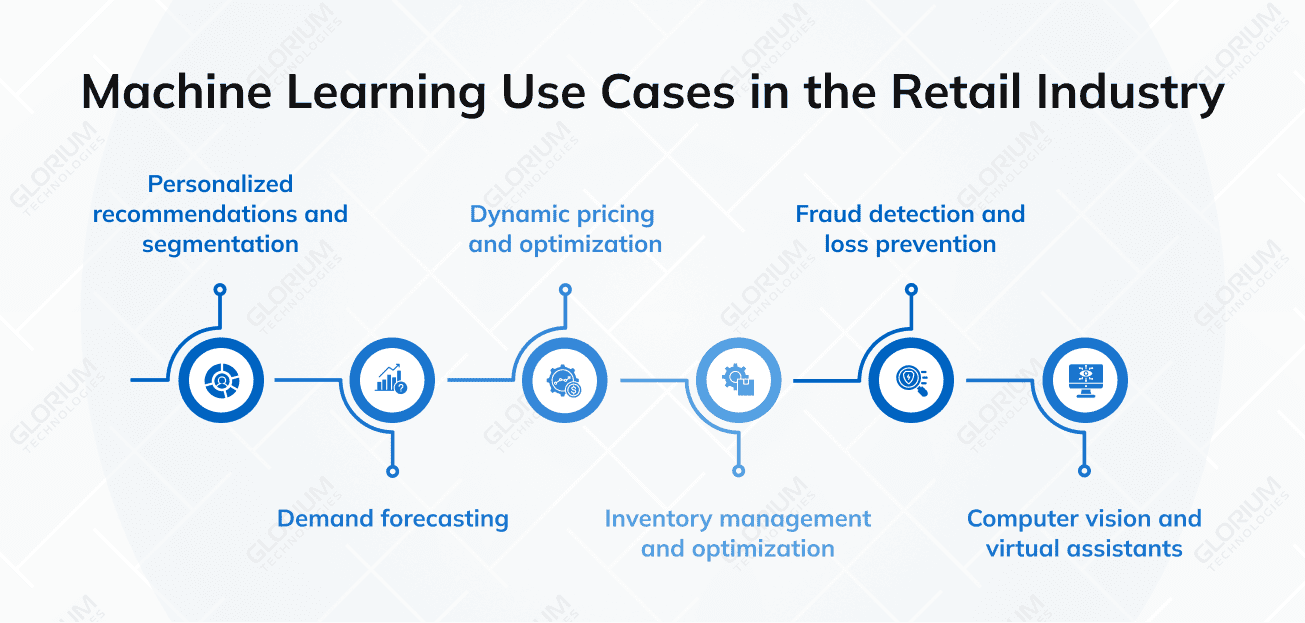
Recommendation engines analyze customer behavior across sessions and suggest what a shopper wants next. Three approaches dominate: collaborative filtering ranks items similar customers bought, content-based filtering matches product attributes to a shopper’s purchase history, and hybrid systems combine both to handle the cold-start problem.
Customer segmentation works alongside it. Instead of three or four demographic buckets, clustering algorithms mine customer data for dozens of micro-segments defined by behavior: frequency, basket size, category affinity, churn risk. Marketing campaigns then target each group with offers that fit, and marketing strategies built on those segments lift customer engagement instead of just click-through. Deloitte’s 2026 Global Retail Industry Outlook, drawn from 330 retail executives, reports that 67% expect AI-driven personalization capabilities within the next year.
Demand forecasting is where most retail businesses see the fastest payback. Machine learning models analyze historical sales data alongside promotions, weather, holidays, seasonal trends, and competitor activity to project future demand at SKU, store, and channel level, producing more accurate predictions than any single-signal statistical model. Walmart illustrates the ceiling with a multi-horizon recurrent neural network built in-house that predicts demand across several planning windows.
Smaller retail companies do not need that infrastructure. A gradient-boosting model trained on three years of sales data and a weather feed will outperform a spreadsheet baseline for most categories. The gains compound: lower safety stock for the same service level frees working capital, and fewer emergency shipments protect margin.
“If my data gets better, all of the other processes get more lean. I need less data cleaning. I can actually automate more, and much easier.”
Nicolas Kroeger, RETHINK Retail’s AI in Retail Conference during NRF 2026
Pricing optimization models estimate how demand responds to price, then recommend pricing strategies that hit a margin or volume target. Dynamic pricing runs the same logic in near real time as competitor pricing, inventory levels, and customer demand shift through the day. Online retail can move prices continuously; physical stores cannot. The same pricing strategies support markdown planning: when a slow-moving line will not clear at current velocity, an earlier, shallower discount recovers more margin than a deep end-of-season cut.
Reaching the aisle needs electronic shelf labels, and that infrastructure is arriving fast: Walmart has said its digital shelf labels will cover every US store by the end of 2026, with Kroger at about a quarter of its stores.
Guardrails matter more here than anywhere else in machine learning in retail. The FTC’s surveillance pricing study found intermediaries using signals as granular as mouse movement to tailor individual prices, and state legislation followed quickly: New York passed an Algorithmic Pricing Disclosure Act and Maryland restricted personalized pricing on groceries. Set price floors, cap movement per cycle, keep pricing consistent across customers in the same store, and document why the model changed a price. Personalized pricing on staples carries exposure the margin rarely justifies.
Forecasts create business value only when they change what gets ordered. Inventory optimization models convert predictions into replenishment quantities, safety stock levels, and allocation across stores and distribution centers.
Machine learning handles variables a planner cannot track manually: supplier lead time variability, cannibalization between similar products, and how promotions interact with stock cover. Automated replenishment is the endpoint, letting a lean team manage inventory levels across hundreds of retail operations while only exceptions reach a human, which is where most of the operational efficiency gain shows up.
The same models extend into supply chain operations, predicting supplier delays, scoring suppliers so an erratic one gets more buffer stock, and optimizing delivery routes against traffic, weather, and vehicle capacity. Walmart has described layering AI so its supply chain detects, diagnoses, and fixes problems without manual intervention. Supply chain data arrives from third parties in inconsistent formats, so expect integration to outweigh modeling.
Glorium Technologies built exactly this for a US medical equipment provider facing a retail-shaped problem: too much capital in the wrong stock, too many inefficient delivery runs. We developed an inventory management and delivery module on deep learning models, trained on scheduling data, location data, and demographics instead of sales history alone.
The models returned estimated expense reductions with confidence intervals attached, so planners saw a range of likely outcomes instead of a single number nobody trusted. And the output landed in an interactive analytics layer, where planners could query it directly. The client cut operational costs by optimizing allocation and delivery together, with service quality improving alongside.
Fraud detection models learn what normal purchasing behavior looks like from a customer’s purchase history and flag transactions that deviate: sudden shifts in payment volume, mismatched shipping and billing details, rapid testing of card numbers. Fraud detection at this scale finds data patterns no reviewer would catch manually.
The National Retail Federation’s National Retail Security Survey put total industry shrink at $112.1 billion in 2022, and its theft and violence research documents continued growth in organized retail crime. Every fraud model carries a threshold decision: tighten it, and you block more fraud along with more legitimate purchases.
Computer vision and virtual shopping assistants
Computer vision technology monitors shelves for gaps, tracks traffic through physical stores to inform store layouts, and detects suspicious movement at self-checkout. Visual search lets a shopper photograph an item and find catalog matches across an online storefront, earning its place where customers struggle to put what they want into words: fashion, furniture, home decor.
Fully autonomous stores are the harder version, and the record is mixed. Amazon pulled Just Walk Out from large-format grocery, announced in January 2026 that it was closing its Amazon Go and Amazon Fresh locations, and now licenses the technology to third parties, where it performs well in small formats like stadium concessions. Store format decides whether the economics hold up.
Natural language processing powers virtual shopping assistants that answer product questions, track orders, and guide customers through returns. Glorium Technologies builds these as AI chatbots for e-commerce, integrated with order systems so responses reflect live order data. Virtual assistants earn their place on volume. Absorbing routine customer interactions frees staff for conversations where a human helps. The split works cleanest on order-status and returns queries, which an assistant resolves end-to-end.
Visual and semantic search let shoppers describe what they want in their own terms. A customer uploads a photo, or types a loose phrase such as “warm jacket for a rainy commute,” and the model matches intent against product attributes instead of waiting for an exact keyword match. Search abandonment drops as a result, because a shopper who cannot name an item can still reach it, and discovery speeds up across a catalog far too large to browse. Brazilian retailer Grupo Casas Bahia rebuilt search on Google Cloud’s Retail API and cut total catalog loading time from 24 hours to four, while scaling daily updates from 100,000 SKUs to more than 7 million. Conversion from search rose 58%, and income per app user grew 28%. Product data sets the ceiling here: sparse attributes and inconsistent titles limit what any relevance model can rank.
The commercial case rests on four outcomes: fewer lost sales, less capital tied up in stock, higher margin per transaction, and lower cost to serve. McKinsey puts the industry-level prize at $400 billion to $660 billion annually for retail and consumer packaged goods, or 1.2% to 2% of yearly revenues. Individual retailers see narrower gains.
| Use case | Primary metric | Data required | Time to first result |
| Demand forecasting | Forecast accuracy, stockout rate | 2-3 years of sales data by SKU and location | 3-4 months |
| Inventory optimization | Inventory turns, carrying cost | Forecasts plus lead times and stock levels | 4-6 months |
| Personalized recommendations | Conversion rate, average order value | Session and purchase history, product catalog | 2-3 months |
| Customer segmentation | Campaign response, retention | Transaction history across channels | 6-10 weeks |
| Dynamic pricing | Gross margin, sell-through | Price and volume history, competitor feeds | 4-6 months |
| Fraud detection | Chargeback rate, shrink | Labeled transactions with confirmed fraud | 3-5 months |
Projects using data a retail business already collects reach production faster; those needing new hardware or labeled examples of rare events cost more. Building these retail solutions also pushes an organization toward data-driven decision-making: once a buying team has a baseline forecast to argue with, the discussion shifts from whose instinct to trust toward what the data analysis shows, turning routine reporting into decisions a buying team can defend. The effect compounds as more decisions move onto the same evidence base.
Most retail companies that fail at implementing machine learning do so for reasons unrelated to the algorithms. Knowing where machine learning in retail projects stalls lets a retail organization plan around the obstacles instead of discovering them at month five.
Data quality is the most common blocker. In NVIDIA’s 2026 survey, 48% named it their top challenge, ahead of the AI talent shortage at 38% and difficulty quantifying ROI at 30%.
Retail data fragments across channels by default. Store POS, the web storefront, marketplace listings, wholesale orders, and the warehouse system each hold part of the picture, often with conflicting identifiers for the same item. Reconciling those into one catalog routinely consumes more of a project than the modeling does, and skipping it caps accuracy no matter how good the algorithm is.
Many retail companies run core operations on platforms installed a decade ago, which rarely expose the APIs a machine learning pipeline needs. Practical routes around it include a read-only data layer beside the legacy system, batch extracts instead of live queries, and phased legacy modernization.
GDPR, CCPA, and comparable regimes govern how customer data is stored, processed, and used for automated decisions, and retailers handling card data carry PCI DSS obligations on top. Several techniques preserve personalization quality while reducing exposure: data masking and tokenization for training sets, differential privacy for aggregate analysis, and federated approaches that train across locations without centralizing raw records. Consent tracking and explainability cost far less to build in early than to retrofit.
A model that performed well in testing degrades as customer behavior shifts. Machine learning systems in production need monitoring that compares predictions against outcomes plus a retraining schedule, which is what MLOps tooling like SageMaker Pipelines, Vertex AI, or MLflow exists for. Track segment-level performance as well as the aggregate, since a model can look stable overall while degrading for one store format.
A model trained on skewed data produces skewed decisions, and in retail those decisions are visible to customers. A recommender built on data that overrepresents one segment underserves everyone else, and a pricing model can learn to charge more in ZIP codes correlating with protected characteristics without anyone intending that outcome. Given the regulatory attention on algorithmic pricing, bias belongs on the compliance checklist: audit training data for representation before launch, test outputs across customer segments as well as in aggregate, and record what the model does and why.
Vendor platforms cover common ground well. Building pays when the decision forms part of your competitive position.
| Factor | Points to buying | Points to building |
| Use case | Standard recommendations, basic forecasting | Unusual assortment logic, proprietary pricing |
| Integration | Mainstream POS and e-commerce platforms | Legacy systems with no vendor connectors |
| Differentiation | The model supports operations | The model is what competitors cannot copy |
| In-house skills | No data science team planned | Engineers who can own a model long term |
Most retailers run both. Where building wins, but ML hiring is the blocker, a dedicated development team supplies the capability without permanent headcount.
Successful programs start narrow, prove value against a baseline, and expand after the first model earns its keep. Retailers that scope the first project to one category and one team usually have a measurable result inside a quarter, and that result is what funds the next phase. Everything built along the way — the data pipeline, the identifier mapping, the monitoring — carries over to the second use case, so the second one ships faster than the first. The six steps below follow that sequence.
The use cases above are settled technology; the argument has moved from whether they work to who has deployed them. What follows is the layer forming on top, and the timelines are shorter than most retail roadmaps assume.
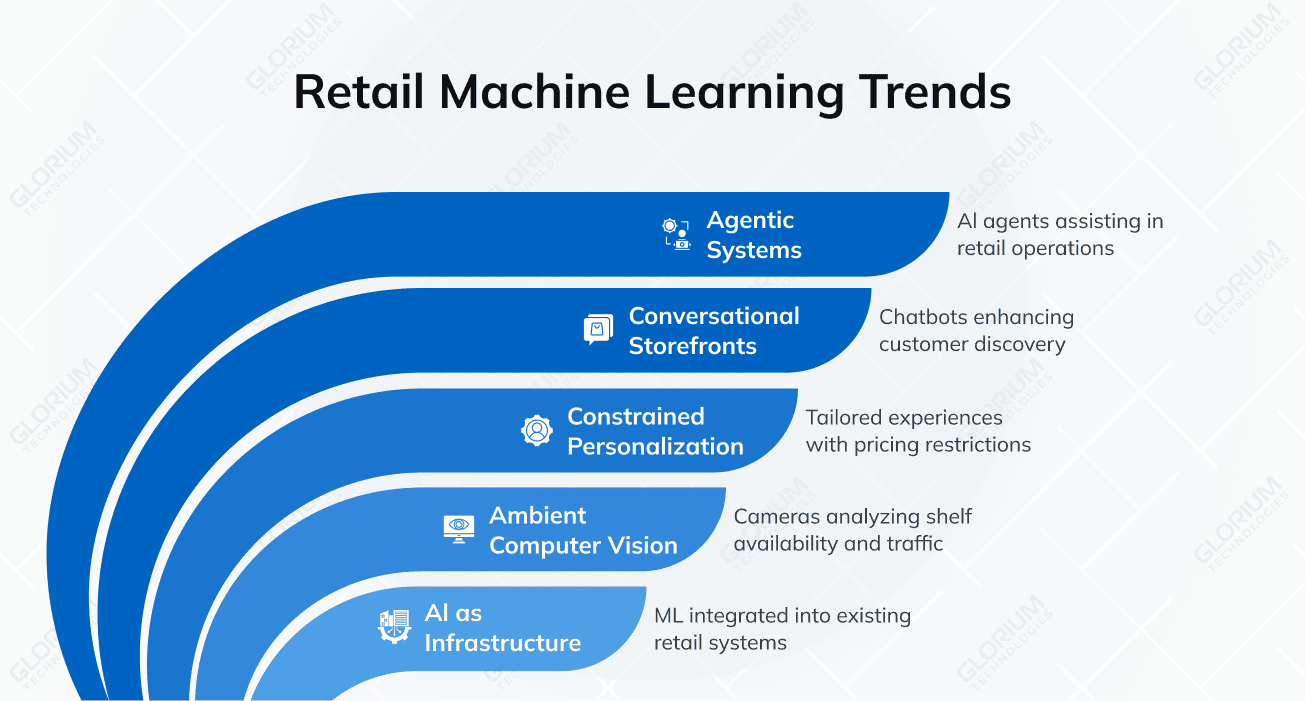
Every trend below already runs in production somewhere, which separates them from the perpetual five-years-away list:
None of these replace the fundamentals. Retailers with clean data analytics and working forecasting models adopt each wave faster.
Strip away the vendor names and the regulatory detail, and machine learning in retail is a narrow discipline: pick a decision that costs money, prove a model beats what you do today, and put the answer where someone can act on it. The retailers pulling ahead fixed their data, shipped one thing, measured it against a real baseline, and repeated.
That sequence is hard to run alone, because the difficult parts sit outside data science. Reconciling product identifiers across five systems, opening a decade-old POS platform, and getting a forecast into the tool a category manager already has open are integration problems, and they decide whether a model ever changes anything in day-to-day retail operations.
Glorium Technologies has spent more than 16 years building custom software, with more than 100 clients and 80 industry awards behind that work. Our teams cover the full path an ML solution takes into retail operations: data engineering and integration, machine learning development,</span >data science consulting, and the retail platform work that puts predictions in front of people who act on them.
Whether you need a scoped proof of concept, a full AI in retail roadmap, or engineers embedded alongside your team, we can shape the work with you. Get in touch for a call with our team.
Two to three years covering at least two full seasonal cycles is the practical minimum. Shorter histories work for fast-moving items with high transaction volume, since the model sees many observations per week. Sales history is also not the only usable input: Glorium Technologies regularly trains forecasting models on scheduling, location, and demographic signals alongside transactions, which matters if your sales history is thin but your operational data is rich.
Three things protect you. Keep training data in your own warehouse so the vendor never becomes the only place your history lives. Get contractual clarity on what happens to tuned models if you leave. And keep the integration layer under your control, since it’s what makes switching expensive. Glorium Technologies builds it client-owned by default, which keeps the platform decision reversible.
Ownership works best with the operating team whose metric the model moves, supported by technology but not led by it. A forecasting model owned by supply chain planners gets adopted; the same model owned by a central innovation group stalls at handover. This is why Glorium Technologies engagements open with business evaluation before any modeling: naming the decision and its owner first is what keeps the finished model in use.
Scope drives the number far more than the algorithm does. Four factors move it most: how much data cleanup is needed before modeling, how many source systems must be connected, whether the accuracy target requires a custom model, and whether compliance review is in scope. Data work is routinely the largest line and the most underestimated.
A single-use-case pilot on clean existing data is typically a three- to four-month engagement for a small team, while the same use case across fragmented channels can cost several times that. Glorium Technologies scopes these as fixed-scope proofs of concept so the first number is knowable before the larger commitment. Run an estimate against your actual scope.
Smaller retailers often see results faster because their data lives in fewer systems and decisions reach production without layers of approval. Absolute savings are smaller, but the percentage improvement in forecast accuracy or conversion is frequently larger. A vendor tool on one category is a sensible starting point, and Glorium Technologies works with mid-market retailers at that scale as often as with enterprises.