







AI in Retail: Use Cases, Benefits, and Trends to Watch in 2026
Updated July 14, 2026

 Summarize in ChatGPT
 Summarize in ChatGPT
Personalized recommendations, automated restocking, and real-time pricing adjustments have quietly become routine in retail. A shopper gets a product suggestion that actually fits what they were looking for. A stockroom gets replenished before a bestseller runs out. Neither moment reads as remarkable anymore, and that shift, from novelty to routine, is exactly what makes this a good time to take stock of where AI in retail actually stands.
Retail has spent the past two years moving artificial intelligence from pilot projects into daily operations. According to a National Retail Federation survey of AI leaders at U.S.-based retailers, retailers already report their strongest returns in customer personalization and internal application development, and most already have AI governance policies in place to manage the technology responsibly as adoption grows. Retailers are past the point of deciding whether AI belongs in the business. The active question now is which use case to prioritize next and how to implement it well.
This article breaks down where AI in retail is actually delivering results today, the operational and ethical challenges that come with implementation, and the trends worth tracking as retailers head deeper into 2026.
Content
Artificial intelligence has moved from an experimental line item to a core part of how the retail sector competes. Retailers are no longer asking whether to adopt AI technologies; they are asking which use case to prioritize first, and how quickly they can scale it across physical stores, e-commerce, and everything in between. McKinsey’s own survey data puts the shift in concrete terms: 71% of consumer packaged goods leaders now report using AI in at least one business function, up from just 42% the year before, though McKinsey notes that no CPG player has yet truly scaled its AI capabilities across the full business, which is exactly the gap this article is meant to help close.
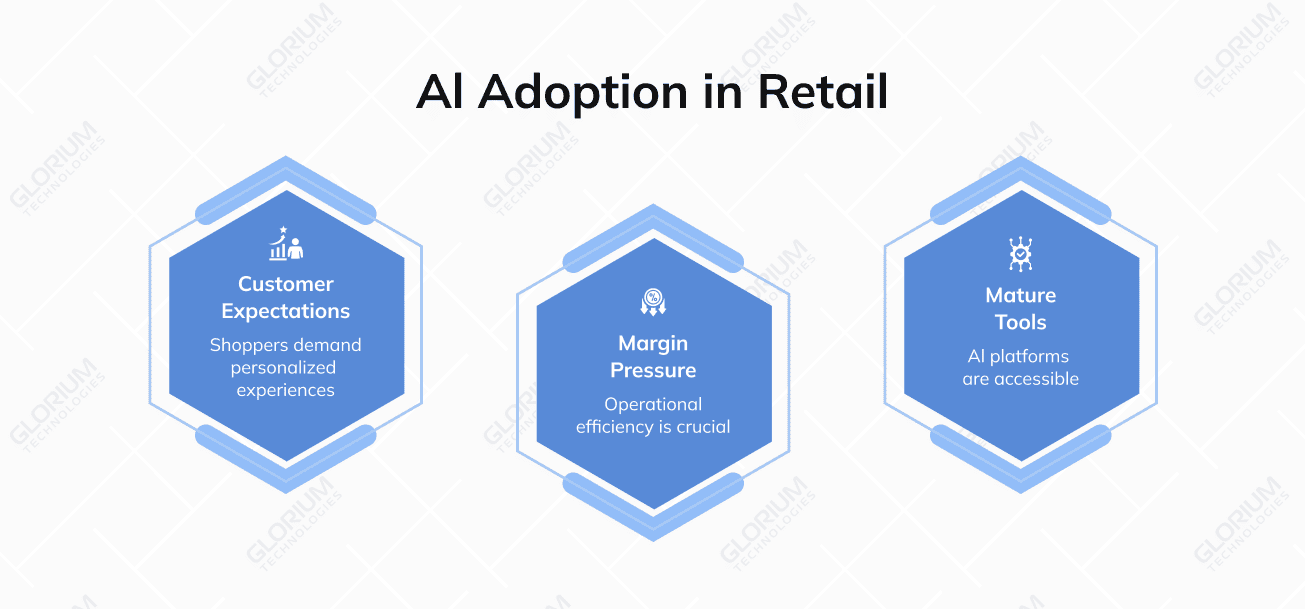
Three forces are driving that shift. First, customer expectations have changed. Shoppers who get personalized recommendations from streaming and social platforms expect the same from the retailers they buy from, whether they are browsing online or walking store aisles. Second, margin pressure has made operational efficiency non-negotiable, and AI-powered solutions for inventory management, pricing, and supply chain optimization consistently show measurable cost reductions. Third, the tools themselves have matured. Machine learning models, computer vision systems, and generative AI applications that once required large in-house data science teams are now available as configurable platforms, which has opened AI adoption to mid-market and regional retailers, not just the largest chains.
The global AI in retail market was valued at approximately $11.6 billion in 2024 and is growing at roughly 23% annually, making retail one of the fastest-moving AI deployment sectors in commerce today. The stakes are sizable: the National Retail Federation forecasts U.S. retail sales will grow 4.4% in 2026 to $5.6 trillion, and the retailers capturing a disproportionate share of that growth are consistently the ones already treating AI in retail as core infrastructure rather than a side experiment.
Retail AI is not one technology. It is a collection of applications, each solving a distinct operational problem, that together reshape how a retail business runs. Here is where adoption is furthest along.
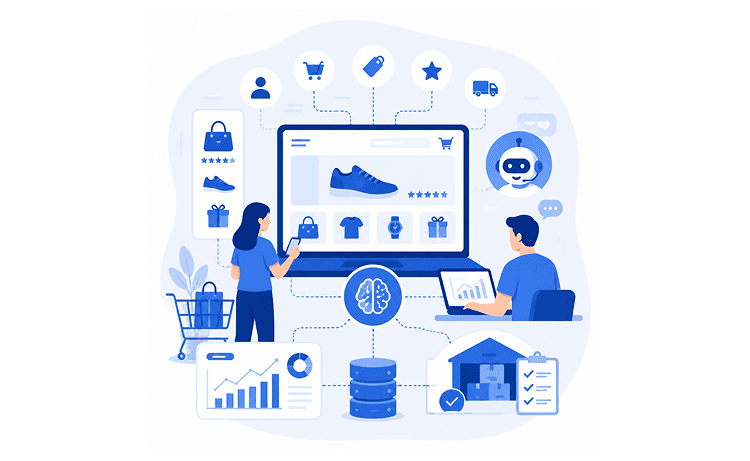
Recommendation engines analyze customer data, including purchase history, browsing behavior, and real-time interactions, to surface products a specific shopper is likely to want. This is the most mature and widely adopted use case in retail AI, and it extends beyond the “customers also bought” widget. Leading retailers now personalize email content, on-site search results, and even in-app promotions based on the same behavioral signals, connecting online browsing with in-store recommendations to create one continuous shopping experience regardless of channel.
A joint IBM and National Retail Federation study found that 45% of consumers now turn to AI at some point during their buying journey, most often to research products, interpret reviews, or hunt for deals. Yet McKinsey research has found that only about 15% of retailers have fully implemented personalization strategies, even though the vast majority say their customers expect it, which is precisely the gap that a well-built AI recommendation system is designed to close.
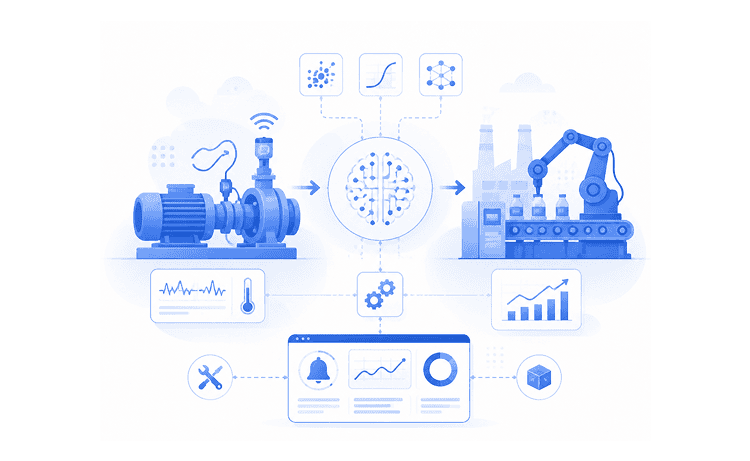
Traditional inventory planning relied on historical sales data and manual judgment. AI-driven demand forecasting adds machine learning models that factor in seasonality, local events, weather, and even social media posts referencing a product, to predict future customer demand with far greater precision. The practical effect is fewer out-of-stock items during demand spikes and less capital tied up in overstock. Automated inventory management systems built on these forecasts can also trigger reordering automatically, reducing the manual workload on planning teams.
AI-powered pricing engines continuously analyze sales data, inventory levels, and competitor pricing to recommend or automatically apply price adjustments. This lets retailers optimize pricing strategies in real time rather than relying on periodic manual reviews, protecting margin during low-demand periods and capturing more revenue when demand is high. Dynamic pricing has historically been associated with e-commerce, but electronic shelf labels are bringing the same capability into physical stores.
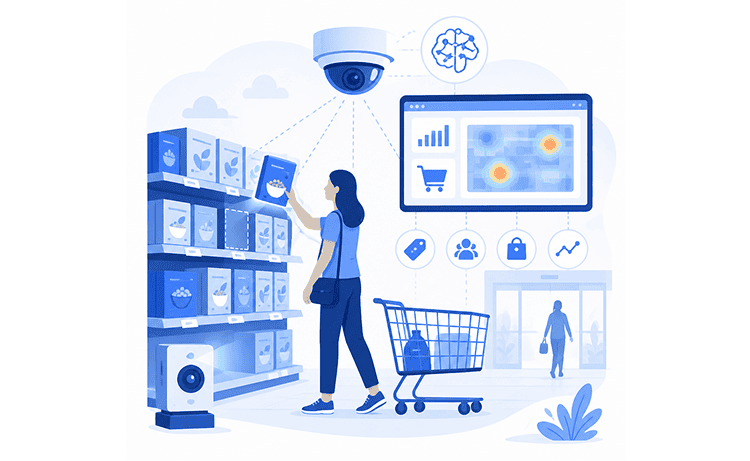
Computer vision systems monitor store aisles and shelves to flag when products are out of stock, misplaced, or improperly priced, often before a customer or store associate notices. Paired with smart shelves and sensor networks, this technology also supports checkout-free store formats and gives retailers a continuous, real-time view of what is actually happening on the floor, not just what point-of-sale data suggests after the fact.
The same camera networks that track shelf availability are now turned toward loss prevention. Computer vision trained to spot shoplifting patterns, flag self-checkout scan anomalies, and catch process deviations at the register gives loss prevention teams real-time oversight that manual floor coverage cannot match at scale. The problem it addresses has grown sharply: in the NRF’s Impact of Retail Theft & Violence 2024 report, retailers reported a 93% jump in average annual shoplifting incidents in 2023 compared with 2019, and a 90% rise in dollar losses over the same stretch. That trajectory has pushed AI-powered loss prevention into one of the fastest-growing investment areas in physical retail, since the cameras are, in many cases, already on the ceiling.
Beyond forecasting demand, AI supports supply chain management more broadly by identifying bottlenecks, predicting supply chain disruptions before they cause stockouts, and recommending route or supplier adjustments. Supply chain automation extends this further, using AI to handle routine logistics decisions that once required manual coordination between planning, procurement, and logistics teams.
Two use cases are opening up product discovery in ways text search cannot. Visual search lets a shopper upload a photo and find matching or similar products, turning a phone camera into a query. Virtual try-on uses augmented reality to place apparel, eyewear, or cosmetics on the shopper before purchase, giving online buyers a sense of fit and look that a flat product image cannot. Both lift engagement, but the operational payoff shows up in return, and the stakes there are large.
The NRF and Happy Returns estimated that U.S. shoppers sent back $890 billion in merchandise in 2024, about 16.9% of sales, with online return rates running near 20% and clothing and shoes topping the list of what comes back. When a shopper can see how something suits them before checkout, the size- and expectation-driven returns that dominate apparel start to fall, which protects margin in exactly the categories where returns hurt most. For e-commerce retailers, that makes this pairing one of the clearer near-term wins in AI-driven merchandising.
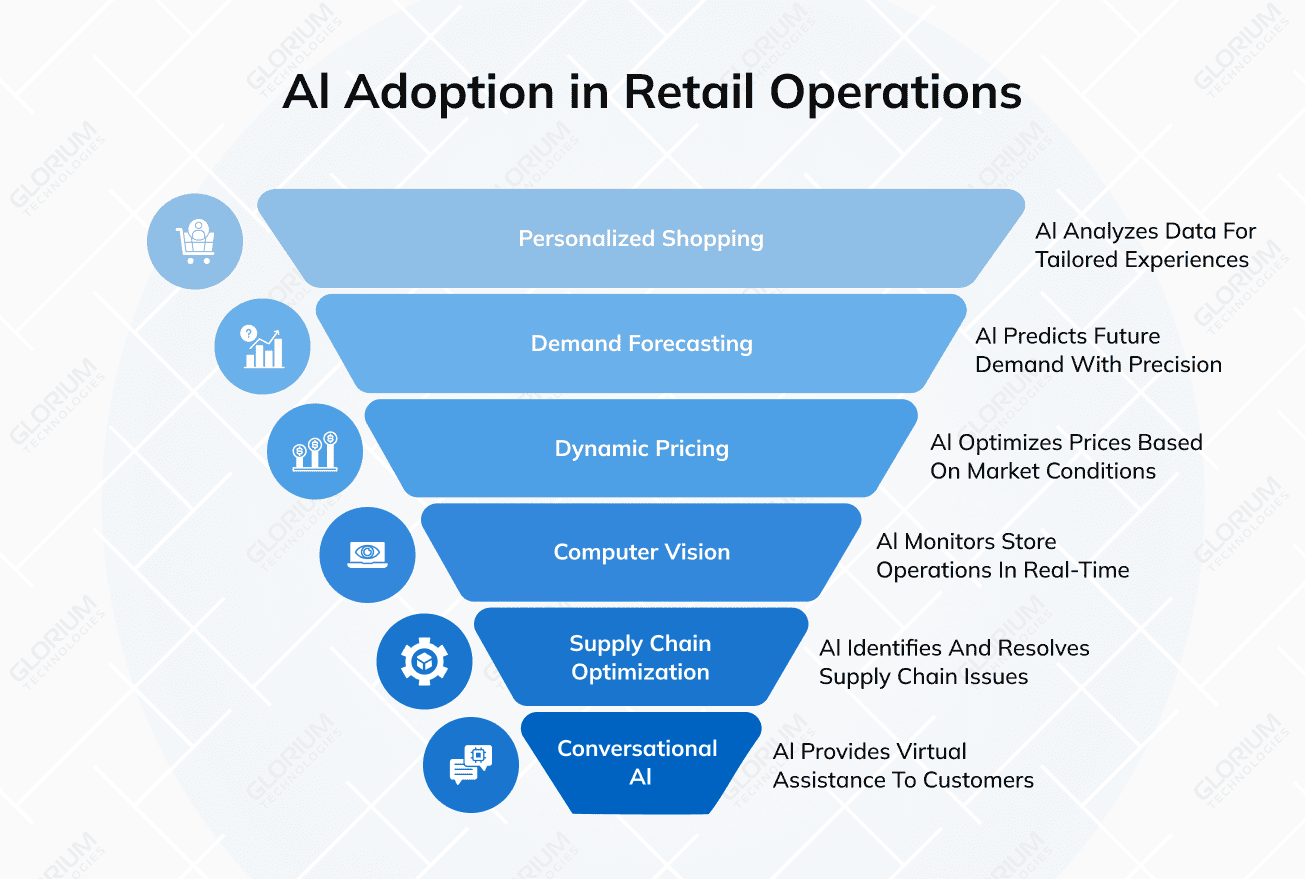
Natural language processing powers virtual assistants and chatbots that handle customer queries, from order status to product recommendations, across web, mobile, and in-store kiosks. These systems increasingly go beyond scripted responses, using generative AI to interpret nuanced customer questions and respond in a way that mirrors how an experienced store associate would. Implementation has also gotten faster: purpose-built AI chatbots for e-commerce can now go live in as little as two weeks, well under the eight-to-twelve-week timeline that was standard just a couple of years ago.
| Use case | Primary business function | Common technology |
| Product recommendations | Marketing, e-commerce | Machine learning, collaborative filtering |
| Demand forecasting | Inventory, planning | Predictive analytics, time-series models |
| Dynamic pricing | Revenue management | Machine learning, real-time data pipelines |
| Smart store monitoring | Store operations | Computer vision, IoT sensors |
| Supply chain optimization | Logistics, procurement | Predictive analytics, optimization algorithms |
| Conversational assistants | Customer service | Natural language processing, generative AI |
The specific gains vary by use case, but retailers that have moved past pilot projects consistently report improvement across a similar set of metrics. McKinsey research puts a number on the headline benefit: getting personalization right across physical and digital channels can lift revenue by 5–15% across a retailer’s full customer base.
Retailers that treat these gains as compounding, better inventory data improves forecasting, which improves pricing, which improves customer experience, tend to see the strongest results because each use case reinforces the next rather than operating in isolation. Glorium Technologies’ e-commerce and retail software development practice is built around exactly that compounding logic, rather than treating each AI use case as a standalone tool.
None of the benefits above arrive automatically. Retailers pursuing AI adoption consistently run into the same set of obstacles, and understanding them ahead of time is what separates a smooth rollout from a stalled one.
AI personalization depends on customer data, often including purchase history and behavioral signals drawn from both first-party and third-party data sources. Retailers have to balance the value of that data against growing consumer expectations around privacy and against tightening regulatory requirements in the markets where they operate. Being transparent about what data is collected and why is now a competitive differentiator, not just a compliance checkbox.
Building or licensing AI models, integrating them with existing systems, and maintaining them over time requires real budget, and the return is not always immediate. Retailers that succeed tend to start with a single, well-scoped use case that can demonstrate value within months, rather than attempting an enterprise-wide AI transformation in one phase.
Many retailers still run on point-of-sale, inventory, and ERP systems that were never designed to feed real-time data into machine learning models. Integrating modern AI tools with this infrastructure is often the single biggest source of delay in a retail AI project, more so than the AI model itself.
AI models are only as reliable as the data behind them. Incomplete, outdated, or unrepresentative sales data or customer data can produce biased or inaccurate recommendations, whether that means consistently under-forecasting demand for a specific region or over-targeting certain customer segments with promotions. Ongoing data quality management is not optional; it is what keeps AI algorithms accurate as conditions change.
Store associates and planning teams need to trust and know how to work alongside AI tools, not feel replaced or bypassed by them. Retailers that invest in training and clearly communicate how AI supports (rather than eliminates) existing roles see higher adoption rates on the floor.
The question retailers most often raise when weighing AI adoption is rarely about ROI. It is about people. The honest answer is that AI in retail automates tasks, not whole jobs: routine inventory scanning, repetitive service queries, self-checkout monitoring. It tends to reshape roles more than erase them. Cashiers move toward customer experience work. Store associates make the judgment calls and handle the face-to-face moments that AI handles poorly. Supply chain planners shift from manual data entry to reviewing AI-generated recommendations.
McKinsey estimates that today’s technology could theoretically automate around 57% of current work hours in the US. The roles genuinely at risk are the ones built entirely from tasks AI performs faster. Retailers that invest in retraining alongside AI rollout tend to see higher adoption rates and lower implementation friction than those who treat the workforce question as something to address after the rollout is already underway.
Retail AI is moving quickly, so let’s explore the trends we think are worth watching as 2026 continues to unfold.
AI shopping assistants are becoming more conversational and more capable, moving from simple product lookup to acting as a genuine research and comparison tool for online shoppers throughout their entire purchase journey.
Autonomous retail stores, from checkout-free formats to fully automated fulfillment corners inside larger stores, are expanding beyond early pilots into standard formats for select store types.
Hyper-personalized customer experiences are extending past product recommendations into personalized store layouts, tailored loyalty offers, and individualized marketing campaigns generated for micro-segments rather than broad customer categories.
Generative AI for retail marketing is accelerating the production of product descriptions, social media posts, and ad creatives, letting marketing teams test more variations without proportionally increasing headcount.
Predictive inventory management continues to advance from reactive forecasting toward inventory systems that model future customer demand across multiple scenarios and automatically adjust replenishment plans as conditions shift.
AI-powered omnichannel retail is closing the remaining gaps between physical stores and digital channels, using shared customer data models so that a shopper’s experience, and the retailer’s understanding of that shopper, stays consistent no matter where the interaction happens.
Agentic AI in retail marks the move from AI that advises to AI that acts. Most retail systems today support a human decision: a pricing engine flags a margin opportunity, and a manager signs off. Autonomous retail agents close that loop themselves, repricing thousands of SKUs overnight and placing replenishment orders when inventory models hit a threshold. McKinsey frames this as the next real shift in merchandising. It estimates that merchants could reclaim up to 40% of their time by handing repetitive work to agents and spending it on strategy, product discovery, and vendor negotiation instead.
The technology is early, though: in a December 2025 McKinsey survey, 71% of merchants said that AI merchandising tools had shown limited to no effect on their business so far. That gap between promise and payoff is exactly why the working question for retailers is not whether to build agentic systems, but which decisions to hand over first, and where to keep a person in the loop. Our Agentic AI Enterprise Guide goes deeper on how these systems are built and governed.
Retailers that want to remain competitive over the next few years are generally not choosing one of these trends in isolation. They are treating them as a connected roadmap, since a strong data foundation built for one trend, such as unified customer data for omnichannel retail, tends to accelerate the next.
Retailers that adopt AI successfully tend to follow a similar pattern: they pick one high-impact, well-defined use case, confirm it can integrate with their existing point-of-sale or ERP systems without a full replatform, and set clear, measurable goals before writing a single line of code. That staged approach is exactly where an experienced technology partner earns its value.
Glorium Technologies builds custom AI solutions for retail businesses, including product recommendation engines, conversational shopping assistants, computer vision for store operations, and predictive demand forecasting, designed to integrate with the platforms retailers already run rather than force a full replatform. With more than 15 years of experience and 80+ industry awards, including four consecutive years on the Inc. 5000 list of fastest-growing private companies and a spot on Clutch’s Top 1000 Global Service Providers, Glorium Technologies has the track record to support a retail AI project from first use case to full rollout. The team has delivered AI-driven personalization and automation systems across e-commerce and omnichannel retail environments, working from each retailer’s actual data and infrastructure rather than a one-size-fits-all package.
If you are weighing which AI use case makes sense for your retail business first, schedule a free intro call with Glorium Technologies to talk through your specific operations and data readiness.
Timelines vary by use case and by how much integration work is required with existing systems. A narrowly scoped project, such as a product recommendation engine layered onto an existing e-commerce platform, can often launch in a few months. A broader initiative involving legacy system integration, such as connecting in-store computer vision to a decades-old point-of-sale system, typically takes longer and benefits from a phased rollout.
At a minimum, a retailer needs clean, accessible historical sales data and enough customer interaction data, such as purchase history or browsing behavior, to train the model on real patterns rather than assumptions. Data quality matters more than data volume at the start; a smaller, well-organized dataset produces more reliable results than a large but inconsistent one.
Yes. Glorium Technologies develops custom AI systems, including recommendation engines, conversational agents, and computer vision applications, that integrate with a retailer’s existing e-commerce platform, POS system, or ERP rather than requiring a full replatform. The approach is scoped around the retailer’s actual infrastructure and data maturity rather than a generic template.
Glorium Technologies works across both ends of that spectrum, from early-stage retail brands validating a first AI-powered feature to established retail chains scaling AI across multiple stores and channels. The engagement model adjusts to the retailer’s data maturity and budget rather than assuming enterprise-scale resources from the outset.
The most common failure mode is deploying AI in an isolated pocket, such as a single chatbot or pricing tool, without connecting it to the retailer’s broader data and systems. This produces underwhelming results and makes it harder to justify the next investment, even when the underlying technology works as intended. Starting with a clear, measurable use case and a realistic integration plan avoids this outcome.