







Autonomous AI Agents Have Moved from Hype to the Office
Updated July 31, 2026

 Summarize in ChatGPT
 Summarize in ChatGPT
Two years ago, an AI agent was mostly a demo on a conference stage. Something impressive and out-of-this-world that never quite made it to your workflow. Now it signs into enterprise systems and completes jobs that used to land on your to-do list.
McKinsey’s 2025 State of AI survey found that 88% of organizations used AI in at least one business function, up from 78% the year before. If they repeat that survey in 2026, the numbers can be much higher.
So, what exactly is an autonomous AI agent? Think of it as software that can plan, use other tools, and carry out multi-step work toward a goal with limited guidelines from you. Want to know how it differs from the AI chatbots you already use or where you can put it into operation? We’ll talk about those things in the sections below.
Content
You’ve got the basic definition down. Now, let’s see how autonomous AI agents operate because the way they work is what sets them apart from everything else you’ve used.
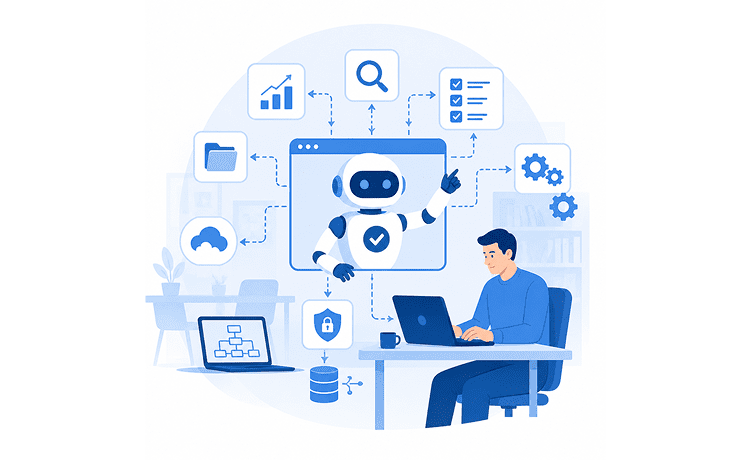
An agent runs a loop, meaning it perceives a request, plans an approach in a reasoning phase, acts through external tools, observes what came back, then adjusts and continues. Say you’re dealing with an IT service ticket. A chatbot answers a single question and waits. An agent, on the other hand, reads the ticket, checks the user’s access in internal systems, resets permission, confirms the fix worked, and closes the case.
That ability to chain multi-step tasks toward an outcome is one of the key characteristics that moves agents past rule-based agents and simple bots. The reasoning that powers this comes from large language models, which interpret instructions and make context-dependent choices instead of following a fixed flowchart. Here’s how AI agents differ from the tools you already run.
| Capability | Traditional automation/ RPA | Chatbots/copilots | Autonomous AI agents |
| Trigger | Fixed rule or schedule | Single-user prompt | Goal, then self-directed steps |
| Scope of work | One repetitive task | One query at a time | Connected, multi-step tasks |
| Decision-making | None follows the script | Suggests, you decide | Plans and acts within set limits |
| Tool access | Narrow, pre-wired | Usually none | Calls APIs, databases, and external tools |
| Human role | Builds the rule | Reviews each answer | Sets goals and human oversight points |
Since both AI-empowered software and chatbots communicate in plain language, people often confuse the two. To understand the difference, you should look beyond the conversation aspect, as one type of software only responds while the other actively performs tasks. This distinction matters most when you plan budgets and staffing around either tool.
Unlike generative AI tools that produce a response and stop, an agent is goal-directed and can operate independently across a task, calling on data and services as it goes. For example, a generative AI model writes an email; meanwhile, an agent decides what type of email is needed, then drafts it, and sends it. McKinsey notes that agents decompose complex tasks and run workflows end to end, while copilots only respond to individual queries. Traditional AI chat tools we all use daily can help deal with one task at hand; agents perform tasks from start to finish.
“Despite their autonomy, these agents must be built on the core principles of fairness, safety, and trust. This means incorporating safety measures like manual overrides, maintaining a log of actions for transparency, and ensuring human approval is required for highly important actions.”
Deployment may look quite different: some run one agent against one job, and others coordinate several specialists who hand work off between them. Knowing which type you need affects cost, complexity, and how much human intervention you should design in.
A single agent handles a contained job well, such as triaging support tickets. Using multi-agent systems means splitting a larger goal across multiple agents, each tuned for a slice of the work, and then passing results along a shared path. This is where agent orchestration matters: a controller routes tasks, resolves conflicts, pulls from external databases, and keeps the agent’s workflow coherent with minimal human intervention. Remember that a single well-scoped agent can often solve many problems more quickly than a crowd of agents.
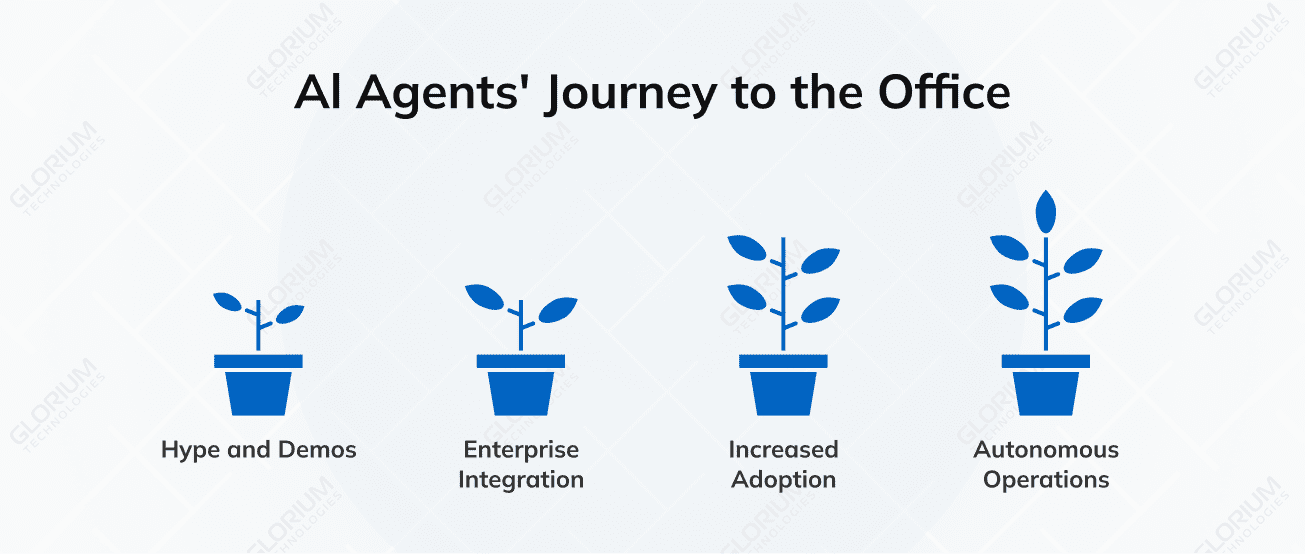
Let’s be honest: adoption, investment, and product readiness all bent upward at once between 2024 and 2025. That convergence is why agentic AI stopped being a research topic and started showing up in quarterly plans. Last year, Gartner predicted that 40% of enterprise applications would include task-specific AI agents by the end of 2026, up from under 5% in 2025. Moreover, by 2028, at least 15% of day-to-day work decisions are expected to be made autonomously through agentic AI, a jump from 0% in 2024.
The reasoning gains let agents handle structured and unstructured data in the same task, from a tidy database row to a free-text email. Better agent frameworks gave teams a faster route to agent building without wiring everything from scratch. As practical AI-powered copilots showed up inside everyday software, leaders grew comfortable enough to trust the next step. Cheaper access to machine learning algorithms, broader training data, and steady gains in AI systems then shortened the path from pilot to production.
A few sectors have become early AI agent adopters just because their work maps cleanly onto what agents do well: structured processes, heavy documentation, and repeatable decisions, to name a few. McKinsey’s research shows the technology industry leads, with software engineering and IT reporting the highest levels of scaled agent use. Healthcare shows strong uptake in knowledge management and IT. The common thread is that early supporters had clean data infrastructure and well-mapped processes, so agents had relevant data to act on. If your processes are documented and your enterprise data is reachable, you are closer to readiness than you might think.
Across functions, agents now handle work that once required a queue of people and a stack of handoffs. The examples below show what the agent does, where a human stays in the loop, and the outcome where hard numbers exist.
Deutsche Telekom built a “RAN Guardian” agent that monitors mobile network performance and assists with troubleshooting. McKinsey reports that reducing manual effort in investigation and execution delivered savings of 20% to 40% in initial deployments. Glorium Technologies sees the same pattern in client work across healthcare, finance, and engineering: the wins come when an agent owns a full process.
The technology delivers, yet a lot of projects fail anyway, and it’s hardly ever about the model. That’s something most vendors won’t tell you. So, if you’re getting ready to back one, know what usually goes wrong before you commit.
Gartner predicts that more than 40% of agentic AI projects won’t survive to the end of 2027, all because of rising costs, unclear business value, and weak risk controls. Add here the fact that the market is crowded with “agent washing.” Only some agentic vendors offer genuine capability, with the rest rebranding assistants and RPA tools.
McKinsey finds that high performers are 2.8 times more likely to report fundamental workflow redesign, at 55% versus 20% of others. Buying a tool changes little if the work around it stays the same. Redesigning the work, then giving an agent room to run it, is what separates the winners.
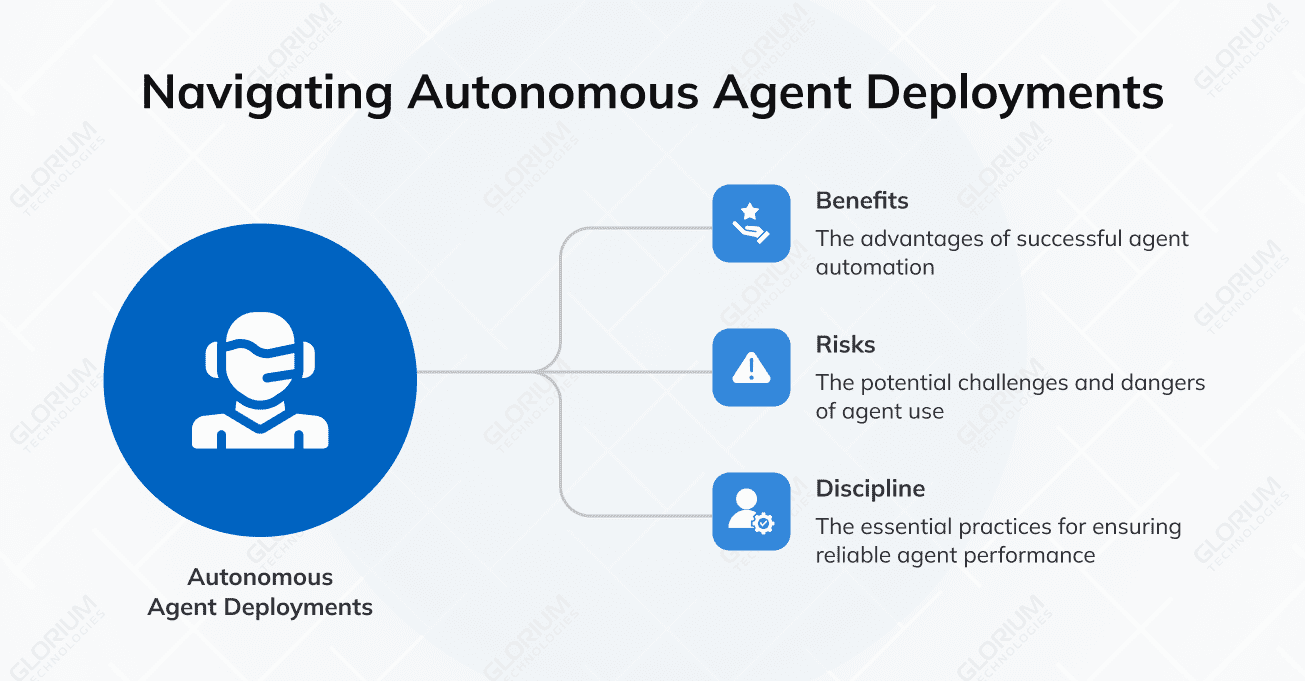
Like anything genuinely useful, agents bring tradeoffs along for the ride. Weighing benefits against risks in a vacuum won’t get you far. What matters is knowing which controls turn that eye-catching demo into a system you can trust in production. Both lists stay short on purpose.
The upside, when autonomous agents work as designed:
The risks you have to plan for:
What separates a production-grade deployment from a flashy pilot comes down to discipline. When deploying AI agents, set firm task boundaries so the agent’s scope is unambiguous. Build audit trails and continuous monitoring so you can trace every action. Keep human oversight checkpoints where stakes are high and design a clean human agent handoff. Most of all, tie the work to a redesigned process. Scaling agents requires policy frameworks, retrieval systems, and audit infrastructure that most organizations have not yet built, which is exactly the foundation that protects data protection regulations compliance as you grow.
Predicting AI timelines is a fast way to look foolish, so treat this as direction instead of a fixed date. Still, the trajectory is readable from where investment and product design are heading. The next phase is less about smarter single agents and more about how they coordinate and where humans sit in the loop.
As of now, you can expect three shifts. Multi-agent networks will coordinate specialists to tackle complex tasks across functions. One reasoning engine will plan, while others will execute. This structure mirrors how autonomous systems and autonomous robots already split sensing from action.
Agents will embed into the software you use daily instead of living in a separate app, extending the enterprise-app trajectory. And autonomous AI capabilities will pair with people in hybrid workflows, where autonomous AI handles volume and humans handle nuance. On governance, the direction is toward audit trails, bias testing, and compliance logging as agents take on more decisions. Glorium Technologies works with teams designing this scaffolding, building autonomous agents and the controls around them, so a workflow scales without losing oversight.
Agents have reached the office, and the technology works. The deciding factor now is whether you redesign the work and govern it well. The organizations pulling ahead are the ones that rebuilt a process around an agent and measured the result.
Are you weighing where autonomous AI agents belong in your roadmap? Talk to the team that has shipped AI and automation in real, regulated settings. Glorium Technologies builds and integrates agent workflows with the governance to match. Book a short intro call to map where an agent could own a full process in your business.
You should measure it against the redesigned workflow. Track how much time each task takes now, the cost per task, error rates, and how much manual effort the agent took off your team’s plate. Real numbers beat impressive demos, so tie every gain back to a process you can see improving.
There’s no single answer, but the timeline depends on how much your data and processes are ready. A clean, well-documented workflow can move from pilot to live use in weeks. Messy systems and scattered data stretch that out considerably. The slow part is the groundwork around the agent.
This is the question of keeping legal and compliance teams up at night. The agent acted, but you set its goals and granted its access, so responsibility lands on your side. That’s exactly why audit trails and human checkpoints matter. They let you trace a decision back to its source instead of shrugging at a black box after the damage is done.
It depends on how core the work is for your business. Off-the-shelf agents get you moving fast on common tasks like support triage or scheduling. But when an agent touches your differentiating processes or sensitive data, building gives you control over the logic, the guardrails, and where everything runs. Most teams end up blending both.