









The Practical Role of AI in Real Estate
Updated May 29, 2026

 Summarize in ChatGPT
 Summarize in ChatGPT
Real estate is inherently a traditional industry that likes to follow the rules that worked well. But what happens when manual data entry, reliance on intuition, and traditional approaches hit the wall? In 2026, the real estate market is undergoing significant changes. And it’s all due to AI.
The change is not instantaneous, though. Three years ago, most real estate firms considered AI an experimental tool, with only about 5% of companies actually testing it. Today, that number jumped to 90%, with more companies implementing AI to help real estate agents remain productive in an environment where manual processes can no longer keep up.
At Glorium Technologies, we’ve spent years working with teams to bridge the gap between legacy operations and modern tech. We’ve seen where the hype meets the reality, and where AI in real estate makes a difference in the day-to-day operations. In this article, we’re looking at what’s working on the ground right now, the specific ways to use AI, how it helps your bottom line, and how to get it running without the usual headaches.
Content
Artificial Intelligence has become a force for transforming industries, and the real estate market is no exception. Real estate agents are dealing with the sheer volume of data the industry produces every day. The efficacy of property market analysis depends on many inputs: listing prices, demographic changes, infrastructure developments, etc. However, the fluid nature of this information usually leaves it scattered across incompatible systems.
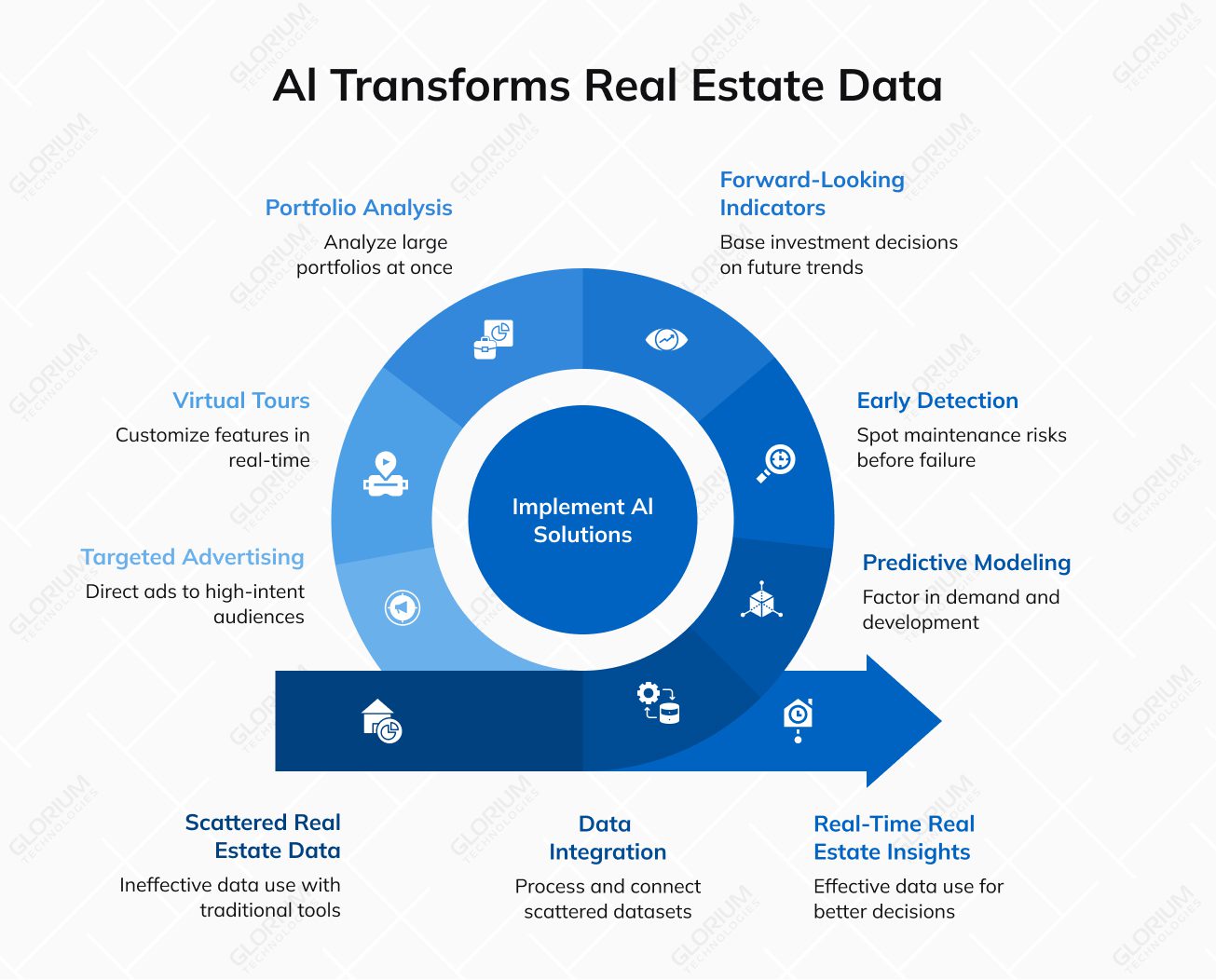
What’s driving this shift in practice:
Overall, investors can spot areas that are likely to grow before prices peak, property managers can avoid costly repairs, and agents can price listings more accurately from the start.
AI tools take the guesswork out of everything from buying apartments to maintaining them. However, there is a gap in the market: roughly 80% of real estate companies have launched AI pilots, but only about 20% are currently seeing meaningful results. This discrepancy usually comes down to implementation; having the tech is one thing, but integrating it into daily operations is where most companies, unfortunately, struggle. Below, we analyze the core use cases for AI in real estate.
Relying on slow, manual property checks is becoming a thing of the past. Today, real estate artificial intelligence is turning valuation into something much closer to an exact science. We’ve seen a shift from basic price-per-square-foot metrics to complex Automated Valuation Models (AVMs) that pull from hundreds of data points at once.
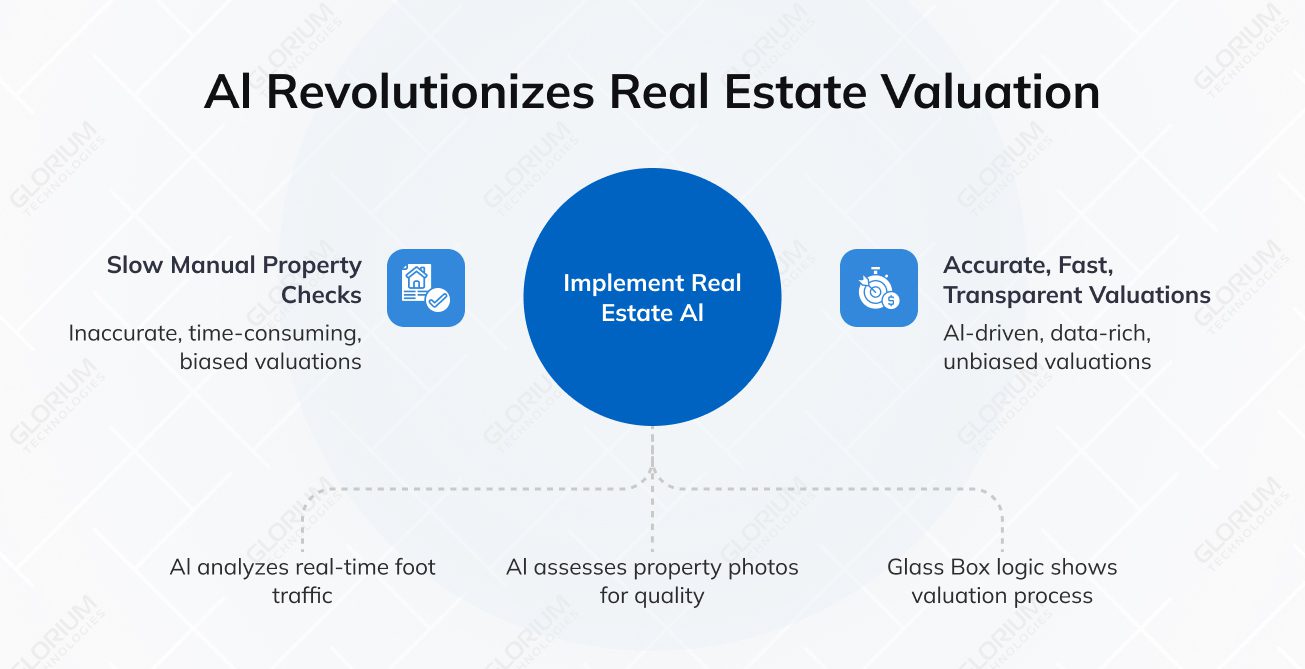
For real estate companies, this change shows up in a few ways:
Commercial real estate teams now use “look-alike” algorithms to find undervalued areas by spotting patterns, such as new transit plans or business permits, that mirror historically successful neighborhoods before prices climb.
In 2026, real estate companies rely on these tools for the following tasks:
The real estate market has always been competitive. Success in this area depends on finding the right buyer at the exact moment they are ready to commit. For real estate professionals, this means changing the approach they work every day. Simply put, they need to move away from manual follow-ups and broad digital ads toward a more automated process.
Automating these routine tasks reduces administrative pressure on sales teams. When manual sorting of leads is handled by machine learning, agents can spend more time on actual negotiations. Implementing these systems requires a deep understanding of both PropTech and data security, areas where Glorium Technologies has spent years helping real estate businesses gain a competitive edge through custom AI development.
AI adoption by property managers increased from 21% in 2024 to 34% in 2025. Moreover, 94% of property management companies expect their annual revenue to increase in the upcoming two years. Artificial Intelligence is starting to take over the operational side of property management, especially the repetitive work that used to slow teams down. For example, building systems like HVAC, elevators, and smart meters generate continuous performance data, such as energy use or operating cycles. AI analyzes this data and helps detect unusual patterns (when equipment starts consuming more energy than normal), which can signal an early-stage fault.
This approach, known as predictive maintenance, allows managers to fix issues before equipment fails. In facility management, it has been shown to reduce unplanned downtime by up to 30–50% and lower maintenance costs by around 10–20%. For property teams, this means fewer emergency repairs; for tenants, fewer disruptions.
Communication is changing as well. Many property managers now use AI-driven chatbots and messaging tools to handle routine interactions, such as maintenance requests, rent reminders, and booking shared spaces, via email, apps, or tenant portals. These systems can respond instantly, 24/7, and in multiple languages.
‘AI is not going to replace an agent, but an agent who’s scaled and operationalized with it is going to just absolutely leave everybody in the dust. The bullet train’s moving and it’s like get on the bullet train or be left at the station.’
Jimmy Burgess, AI Tools & Strategies Every Real Estate Agent Needs in 2025
The same applies to documentation. Lease agreements and financial records no longer need to be reviewed line by line. AI tools can pull out key details, rent terms, dates, or clauses, with a level of consistency that’s hard to maintain manually.
Risk control is another area worth mentioning. Fraud in tenant applications has become more sophisticated, especially with digitally altered pay stubs and bank statements that can look legitimate at first glance. Many property managers report encountering fraudulent applications regularly, especially in high-demand markets.
AI tools can detect inconsistencies in formatting, metadata, and financial data, for example, when income figures don’t align across documents or when files show signs of editing. Some systems also verify applicant information against external data sources in real time. Property managers can quickly see all possible issues and reduce the risk of false approvals.
AI is becoming a core layer in modern buildings, especially in how energy, maintenance, and security are handled day to day. One of the clearest AI applications is energy optimization. Fixed schedules are gradually being replaced. HVAC and lighting systems now react to real occupancy, using data from sensors and connected devices to adjust on the fly. This often leads to energy savings of 20–30% in commercial spaces where demand fluctuates during the day.
The same setup supports predictive maintenance. Sensors in equipment (e.g., elevators, heating systems, water pumps) monitor vibration, temperature, or pressure. When something starts drifting from normal patterns, the system flags it early. As a result, property owners have fewer unexpected failures, which are usually more expensive to repair. This is where more advanced data analysis comes into play, helping teams spot issues that wouldn’t be obvious during routine inspections.
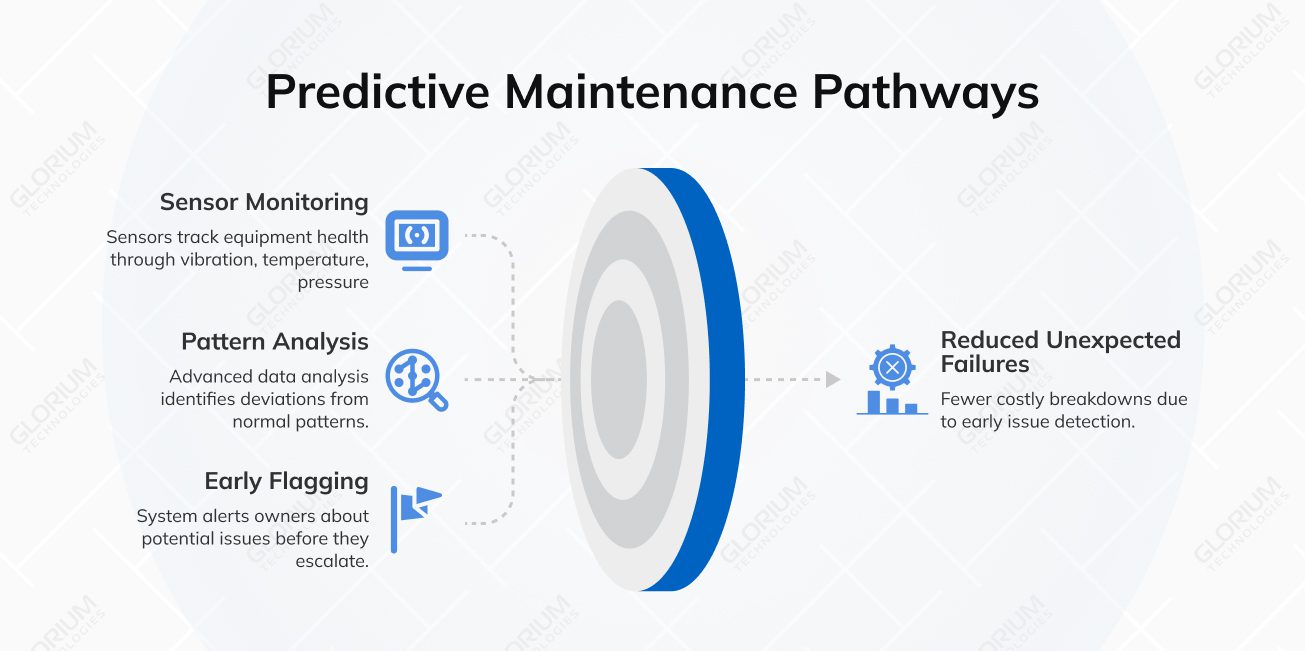
Property owners are under more pressure to keep a close eye on energy use and carbon emissions, especially as ESG requirements become stricter. AI tools can pull this data straight from building systems and turn it into ready-to-use reports, saving time and reducing the chance of errors.
AI-based video systems can distinguish between normal activity and behavior that actually needs attention (unauthorized access or unusual movement patterns). That helps reduce false alarms and improve response times when something is off. Overall, the real estate sector is gradually moving to more responsive and data-driven operations that can predict potential issues and respond quickly.
Not every real estate business needs an expensive, custom-built network on day one. In most cases, the most effective solution is to invest in building a single AI agent that can solve specific problems: answering common tenant questions or sorting through new listings. Gradually, as your business scales, these can evolve into a multi-agent environment where different tools “talk” to each other and manage more complex workflows. However, you need to know if your business is ready to implement AI.
To determine your AI technology readiness, you should evaluate three main areas:
| Criteria | Low Readiness (Manual Focus) | High Readiness (AI Ready) |
| Data Quality | Records are mostly paper-based or in unstructured PDFs | Data is digitized, centralized, and updated in real-time |
| Task Volume | Staff spends <10% of their time on repetitive data entry | Teams are overwhelmed by high-volume, predictable tasks |
| Growth Goals | Maintaining the current size with the existing staff is the priority | You need to scale operations without a linear increase in headcount |
The real estate sector is unique, and generic bots often fail to understand the nuances of property law or local market variables. So, working with professional partners guarantees that the real estate operations you automate actually deliver a return on investment.
Glorium Technologies has many successful projects. One recent case that may be of interest is the work done for Liberkeys. It’s a PropTech startup focused on the residential market. The project involved building a custom front-end with Vue.js and overhauling the back-end to support an all-in-one sales platform. The platform was upgraded with advanced investment modeling, custom mapping, and real-time market updates. These features made this a high-performance tool that manages everything from initial property estimates to the final sale. Overall, this project shows how a solid technical foundation allows a business to scale in a competitive market.
Once you understand your AI readiness, the next step is choosing how to move forward. Real estate companies usually have three practical options: integrate existing tools, buy a ready-made platform, or build a custom AI solution.
Fine-tuning foundation models, such as Claude or GPT, can also work for real estate-specific use cases. Companies can train these models on lease documents, market reports, listing data, client communication, or internal procedures. This gives the AI more domain context without creating a full AI R&D function from scratch.
AI only brings value when it works with the systems your team already uses every day. In real estate, this usually means MLS feeds, CRM platforms, property management software, accounting tools, marketing systems, email, and calendars.
For custom real estate AI platforms, the architecture usually includes mobile apps, backend services, structured databases, cloud hosting, and API or middleware layers for legacy systems. The exact stack may vary, but the planning question stays the same: what should the AI connect to, how fast should data move, and which workflows need human review?
There’s a lot of excitement around generative AI, technology that can create new content, such as floor plans, design projects, or property descriptions, but it is still difficult to move from a small pilot to a full-scale rollout. Most real estate companies understand that it is not enough just to have the tech. Commercial real estate research from JLL points to a major disconnect: even though adoption is high, 60% of companies aren’t ready to scale their AI models because of technical, organizational gaps, or other challenges.
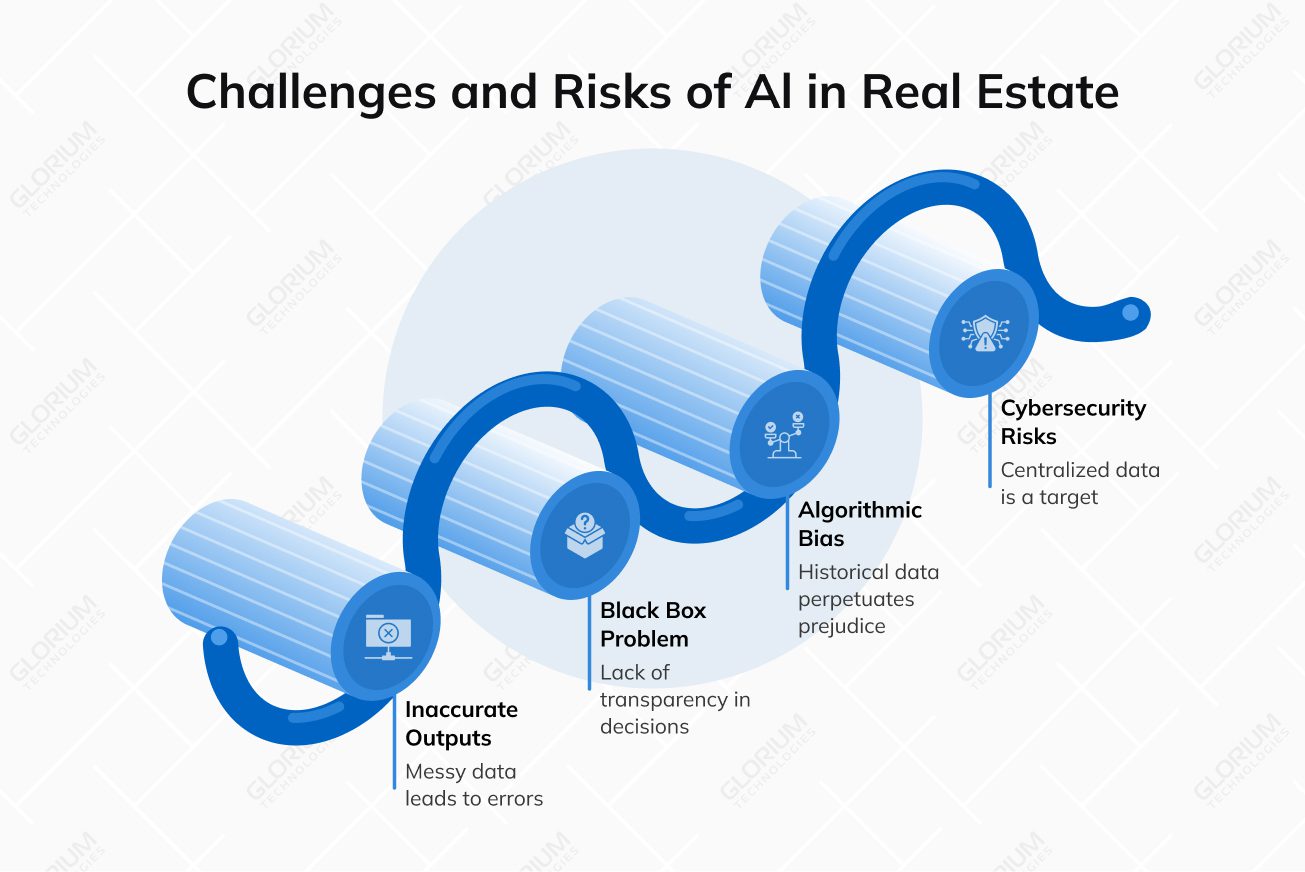
Let’s take a closer look at the risks of AI for the real estate market:
The AI in the real estate market will grow to $1303.09 billion in 2030 at a compound annual growth rate (CAGR) of 33.9%. AI is settling into everyday operations, and as PropTech continues to mature, attention is moving toward practical outcomes, such as better performance, smarter investments, and more predictable operations. Let’s review the main trends that shape the industry.
The adoption of IoT devices is the main driver of AI in real estate. These are physical objects that have software, sensors, and connectivity capabilities integrated. They collect and exchange data over the internet. Simply put, they help turn buildings into living organisms. For example, sensors collect massive amounts of property data and optimize energy use and air quality in real time. This is a financial strategy that can protect property values by significantly reducing operational overhead and carbon footprints.
The integration of AI and IoT is changing the focus toward smarter leasing, proactive maintenance, and a better overall tenant experience. According to the UK Department for Science, Innovation and Technology (DSIT), the number of connected devices in the UK reached over 720 million by the end of 2024. This explosion of smart city and enterprise tech is the real engine behind AI’s growth in the real estate sector.
Property management is evolving into a concierge service through specialized machine learning models. AI agents can now analyze lease documents and find upcoming vacancies or renewal opportunities before they even hit the manager’s desk. For example, these systems can understand the tenant behavior and offer personalized offers, flexible lease terms, or other perks. All this guarantees higher retention rates. So, real estate agents spend less time managing administrative paperwork and can focus on high-level strategic decision-making.
Generative AI tools are changing how properties are presented, especially at the listing stage. For example, agents don’t need to spend time on writing descriptions manually; they can easily generate drafts and change them depending on the audience or platform.
Virtual tours are also changing. Instead of showing a single fixed version of a space, it’s now possible to switch layouts or interior styles on the fly, which can be a game-changer for targeting different buyer preferences. It also reduces much of the cost and effort tied to physical staging. Tools like ChatGPT, Matterport, and Virtual Staging AI are already being used to support these workflows in day-to-day marketing.
Investing in a skyscraper was for billionaires only because the legal fees and administrative overhead were too expensive. But AI can turn physical buildings into small digital tokens. Just imagine, instead of only one person who owns a $100M property, 10,000 people can own a $10,000 “share.” It’s as easy as buying a stock. AI algorithms can handle the administrative work that previously required a professional team of analysts. They can monitor rent payments, distribute income automatically, flag issues, etc. On top of that, AI creates the transparency needed for people to buy and sell their shares on an open exchange.
If you need a trusted partner to design and build AI products, Glorium Technologies can support you end-to-end, from a pilot to a full-scale roll-out. Expert teams work with you to find the right approach for your case. It can be integrating third-party AI software, implementing an AI agent, or building custom AI solutions.
Our work with (Re)Meter highlights how we modernize aging systems and meet the market demand. The client had an old software built 6 years ago that didn’t meet their current business needs. Glorium Technologies overhauled the platform and developed a customizable deal approval flow and a risk-assessment tool that evaluates tenant financials in real time. We integrated business analytics and market data from sources like Equifax and JDE. Property owners received a crystal-clear view of their portfolios from negotiation to maturity. This modernization provided (Re)Meter with a strong competitive edge and allowed its users to model deals with total confidence.
Ready to bring AI to your real estate company? Let’s talk. Book an intro call to discuss your goals and build a plan for moving forward.
Pay attention to the quality of your information. Most firms have a mountain of unstructured data, such as PDFs, scanned lease documents, and email threads, which are invisible to basic software. The first thing you need to do is to audit and centralize this into a clean, digital format. Before you can use an AI powered platform to identify investment opportunities, your internal records must be organized so the algorithms aren’t learning from “garbage” data.
On average, it takes 3 to 4 months to build an AI pilot. However, moving to a full-scale AI integration across an entire organization may take from 9 to 18 months. It depends on how quickly you can connect the AI to your existing property management systems and train your team to trust the outputs.
Yes, but it requires a “bridge” via APIs or custom middleware. Modern AI is good at extracting value from older databases to improve property searches and property research. Legacy systems weren’t built for the cloud, but a professional development team can build layers that pull data from these old silos, allowing real estate investors to benefit from modern insights without having to scrap the software they’ve used for a decade.
A modern real estate professional should be a high-level strategic advisor. We can see that AI automates property searches, so agents will move into a “supervisory” role. They will be able to focus on more complex, human-centric tasks. Success in this area will depend on emotional intelligence, hyper-local community intuition, and other skills that AI can’t replicate.