








ERP Software for Logistics Industry: Why Finance and Operations Must Share a Brain
Updated September 7, 2026

 Summarize in ChatGPT
 Summarize in ChatGPT
A container sits at the Port of Long Beach for five extra days, quietly accruing $1,000 in demurrage. The operations department sees the cargo stuck on the terminal. Finance knows a customs payment is waiting on a reconciliation. Each team assumes the other is moving, and neither connects the dots until the invoice surfaces a month later. By that point, the customer has already heard the excuse, and the margin on that shipment is gone.
Operations and finance still run as separate entities in most companies throughout the logistics industry, even as the cost of that split becomes painfully high. Swiss Re puts the annual price tag of disruption across global supply chains at $184 billion. The lion’s share of that figure reflects two teams looking at different screens and coming to different conclusions about the same shipment.
To explore hidden costs and the patterns that keep resurfacing across international carriers, we spoke with Guido Gries, Senior Supply Chain Executive and Advisor. Below, you’ll discover a director-level perspective on the recurring blind spots shippers continue to overlook.
Content
Disconnected systems don’t usually announce themselves on a balance sheet. They show up as a customs broker emailing a spreadsheet to a warehouse team or a planner re-entering shipment data into three platforms before noon. Each handoff looks minor on its own. Multiply it across thousands of shipments per month, and the cost becomes substantial in labor hours, in delayed decisions, and in errors that ripple downstream. For most international shippers, the real expense of fragmented technology isn’t the software licenses or the integration projects. It’s the operational drag that builds up quietly, day after day, shipment after shipment.
Guido Gries, Senior Supply Chain Executive and Advisor, sees this play out consistently across the industry:
“The biggest challenge we consistently see in the industry is data fragmentation and latency. Teams are pulling data and information from siloed systems—warehouse, sales, and finance—that don’t talk to each other in real time. The result is forecasts built on stale data, which in highly volatile markets leads to costly overstocking or understocking.”
According to McKinsey’s 2025 supply chain risk pulse survey, the majority of companies still understand their supply chain risks only up to tier one, and the share of firms reporting deeper visibility actually slipped after pandemic-era memory faded. An average company can lose 45% of one year’s profits over a decade because of supply chain disruption, with disruptions lasting more than a month now occurring every 3.7 years.
Nowhere is this more expensive to ignore than in freight forwarding, where, as Gries points out, institutional knowledge rarely makes it into any system:
“Today, experienced planners hold knowledge that never makes it into a system. In freight forwarding, this leads to no-shows on long-placed bookings or substituting high-cost airfreight for replacement bookings. Most in our industry work with transportation management systems that have started to offer crowd intelligence and machine learning. However, as an industry average, we still operate with separate infrastructure for finance and operations.”
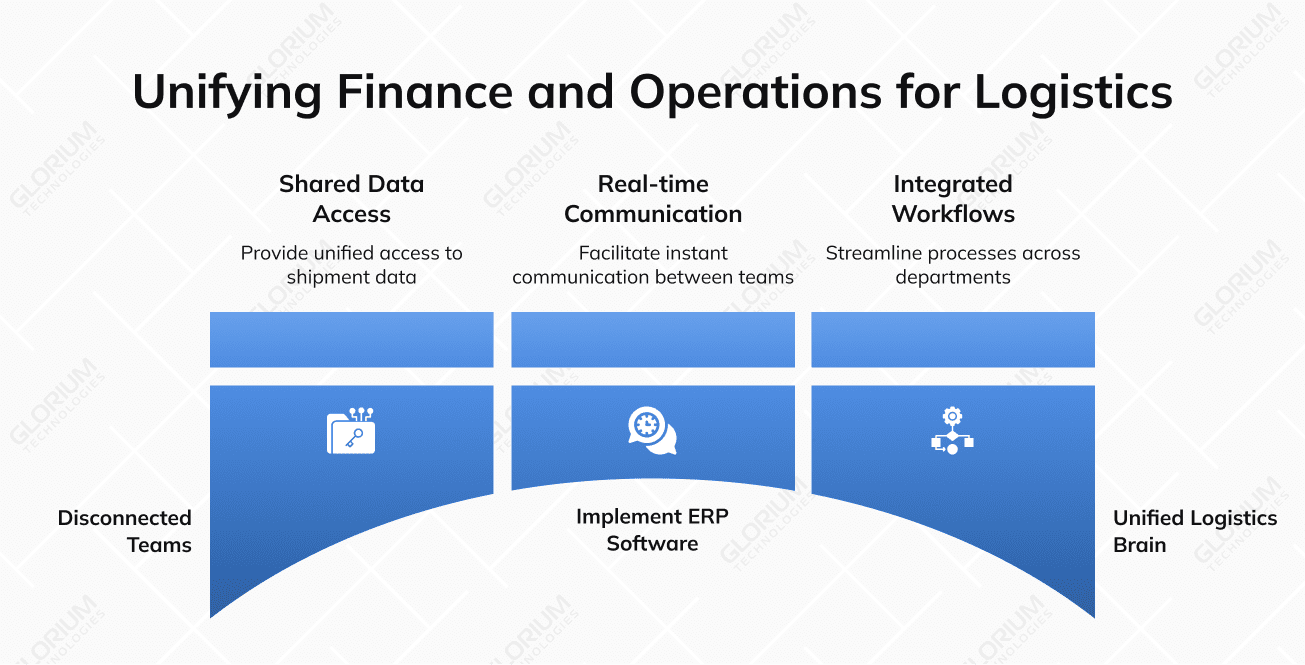
That last point matters. A transportation management system that learns from historical lanes is still blind if it cannot see the credit hold on a customer, the open AP balance with a carrier, or the working capital position behind a booking decision. Logistics ERP systems that integrate data from both sides effectively break the latency cycle. Your teams stop maintaining three separate spreadsheets just to reconcile what should already be a single source of truth.
You probably think of an ERP system as accounting plus a few modules. In a freight environment, that framing undersells it badly. ERP software for logistics industry users sits at the intersection of three concerns: operational execution, financial management, and the data discipline that makes both AI-ready.
Most automation initiatives stall because the underlying data sits in three disconnected databases. ERP for logistics centralizes master records (carriers, customers, lanes, rates, GL accounts) so that automated workflows have something coherent to act on.
A well-implemented logistics ERP ties order management, order processing, inventory tracking, warehouse management, inventory management, customs documentation, customer billing, and the GL to a single transactional spine. When a container clears customs, the GL accrual updates. When a customer’s credit deteriorates, operations sees it before they confirm the next booking. Embedded customer relationship management capability lets account managers see the financial state of every relationship without leaving the ERP platform. That is what business automation actually requires, and it is also why implementing ERP before agentic AI matters more than the marketing decks suggest.
Gartner’s 2025 trends report points to agentic AI, intelligent simulation, and decision intelligence as the technologies reshaping supply chain operations. None of them produces value on top of fragmented data. The pattern is consistent: AI thrives when software integrates operational events with financial data in real time, and it stumbles when those two halves live in separate systems.
Once the foundation is in place, AI handles the work humans should not be doing. Predictive analytics flags demurrage risk before the container even arrives. Machine learning models recommend lane substitutions based on cost-to-serve (not just transit time). Business intelligence dashboards stop being weekly PDFs and start being live decision tools. Routine tasks like invoice matching, rate auditing, and freight cost allocation move out of the inbox and into the ERP, freeing planners to do the judgment work no algorithm can yet replicate.
The expense most often missed when you defend a fragmented stack is the cost you never see itemized. Gries points to one charge that captures this dynamic better than any other:
“The classic hidden cost is demurrage and detention charges. A container sits at the port because the finance team hasn’t released payment for customs or freight due to manual reconciliation or DPO optimization. Depending on the trade lane, you can rack up thousands of dollars in charges from the delayed release of a single container.”
The numbers back this up. According to FreightAmigo’s 2025 analysis, demurrage and detention can add 10 to 25% to total shipping costs, with daily rates typically running from $100 to $300 per container. WSI’s 2025 figures sit in the same range, and note that for large shipments, recurring fees easily climb into the thousands per container before anyone in finance sees the line item. Over the course of a year, the costs associated with inbound containers quietly become one of the largest hidden categories of operational expenses on the profit and loss statement (P&L).
The deeper issue, Guido Gries noted, is what happens between each handoff:
“A single shipment can pass through 10 to 15 manual touchpoints. Each one is a potential source of delay, and delays are cash flow killers. Invoices go out late, partner systems don’t talk to each other, and disputes freeze receivables for weeks. Without automation and machine learning, visibility stays fragmented—so when disruption hits, whether it’s a port issue, fuel spike, or offload, the cash impact is reactive, not managed. That turns an operational problem into a financial one.”
You will recognize the pattern. A late invoice triggers a dispute, and the dispute, in turn, freezes receivables. The frozen receivable means you cannot release payment to a carrier. The unpaid carrier holds the next booking. The next booking moves to spot freight at a premium. None of this shows up as a single failure, which is why it persists across complex logistics networks and erodes margin year after year.
| Hidden Cost Category | Typical Driver | Where It Hits the P&L |
| Demurrage and detention | Manual customs reconciliation, DPO games | Freight costs, COGS |
| Spot freight premiums | Bypassed procurement guides during crises | Gross margin |
| Disputed invoices | Mismatched data between operations and finance | Working capital, DSO |
| Forecast errors | Stale planning data | Inventory write-downs, stockouts |
| Compliance fines | Incomplete audit trail across systems | Operating expense |
| Excess fuel and idle time | Poor coordination between fleet management and dispatch | Transportation costs |
In a stable market, fragmented systems are inefficient. In a volatile one, they become structurally dangerous. Guido Gries framed the crisis dynamic precisely:
“In a crisis—port strikes, fuel spikes, or off-loads due to war or unrest—control becomes fiction. Operational teams bypass procurement guidelines and preferred carriers, booking spots at premium rates, and nobody flags the cost until the quarter closes. Without predictive measures, the window to pass costs onto clients closes, too. That’s when opportunity cost becomes very real: the margin that could have been preserved is gone, and it rarely shows up early on any report. Legacy firms are structurally cash inefficient. Automation closes that gap by shortening the cash conversion cycle and enabling proactive decisions before disruption turns into losses.”
According to the World Economic Forum’s January 2025 analysis, only about a quarter of supply chain professionals believe their companies have completed the digital transformation of their supply chain processes. Over 40% still report limited or no visibility into tier-one supplier performance.
If you accept that operations and finance need to share a brain, the question is: what does that brain look like? Implementing logistics ERP software is the foundation, but architecture matters more than the brand name. Here is what the most coherent setups have in common.
One cloud ERP system houses every record (carrier, customer, lane, rate, GL account, container), and all other systems reference it. Microsoft Dynamics 365 Supply Chain Management and Business Central approach this differently than Oracle Fusion or Infor Nexus, for example, but the principle is the same.
Logistics ERP software that maintains a single record means your warehouse management, fleet management, and transportation management layers all read the same truth, real-time tracking included. The right cloud-based ERP system also gives you asset management as a native capability, not a bolt-on, which matters when multiple warehouses and rolling stock sit on different books.
Events in operations (gate-in, gate-out, customs clearance, POD signing) automatically trigger downstream financial actions. An ERP system handles this without batch jobs or overnight reconciliation. Gartner’s 2025 CEO survey found that 38% of companies plan to integrate intelligent automation into their logistics, distribution, or production workflows within three years. Plus, 33% are targeting contract management and payments as well. That second figure is the one most supply chain managers underestimate. Payments and contracts sit at the seam between transportation operations and finance, and the firms automating that seam are pulling ahead on logistics efficiency metrics that competitors cannot match.
Predictive analytics and machine learning function as an integrated layer atop a unified data foundation. According to Gartner’s September 2025 forecast, 70% of large organizations will adopt AI-based supply chain forecasting by 2030. Companies that derive value from predictive analytics are those whose forecasts rely on clean transactional data sourced from a single ERP platform. This is the practical path to transforming supply chain efficiency without the multi-year ERP implementation horror stories that frighten boards out of the right investment.
Every transaction (operational and financial) carries a complete audit trail across the entire supply chain. This matters more every quarter as regulations like the EU’s Supply Chain Due Diligence Act, the Uyghur Forced Labor Prevention Act, and forthcoming Scope 3 emissions reporting tighten. U.S. Customs has stopped over 10,000 shipments at the border under UFLPA enforcement since 2022 (with a combined value above $3.5 billion). Regulatory compliance is a dual challenge for finance and operations, and requires a holistic approach that delivers a defensible record that will stand up to an audit.
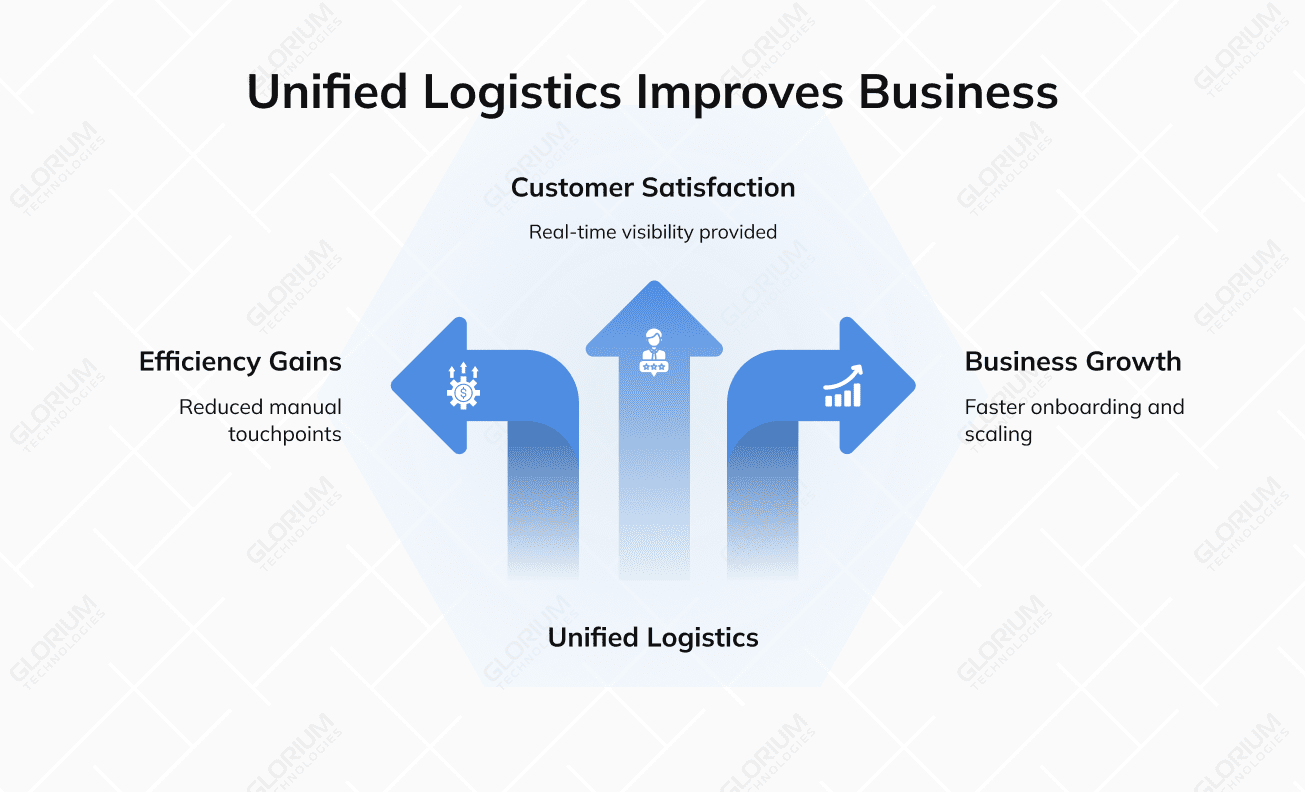
When you unify logistics operations and finance on a common spine, three things shift in ways that show up on the P&L. First, operational efficiency improves because the manual touchpoints collapse. Invoices are generated from POD events instead of waiting for a clerk. Customs payments are released on schedule because the trigger is automated, not reliant on someone watching an inbox. The cash conversion cycle shortens.
Second, customer satisfaction rises because you can answer questions you previously could not. A shipper inquiring about an exception anticipates that you will provide the operational status, billing status, and resolution path all at once. Real-time visibility across business functions makes that possible. Gartner found that just 7% of supply chain leaders have the infrastructure to respond instantly to disruptions, so the bar for differentiation is genuinely low. Meeting elevated customer expectations at scale starts here, not in the call center.
Third, business growth becomes defensible. Onboarding a new lane, a new customer, or a new geography stops requiring a six-month integration project because the cloud ERP absorbs new entities into the existing schema. Freight forwarders, logistics providers, and transportation and logistics companies running on robust ERP systems scale faster because the marginal cost of adding complexity falls. The path to improve operational efficiency runs through architecture decisions, not headcount.
Most ERP buyers learn what they should have asked about six months after signing. Run through the questions below before any vendor conversation, and you’ll walk into demos asking sharper questions, spotting weaker pitches, and protecting your timeline from costly surprises.
A short market note while you evaluate. Conversations about the best ERP software for freight often come down to a handful of platforms. The right answer depends on your size, your lane mix, and your customization ideas.
Two decades of patterns, one consistent finding: the firms losing margin are not the ones moving slowly. They’re the ones whose finance and operations don’t share a common view of the business. Guido Gries put it plainly at the end of our conversation:
“Legacy firms aren’t simply slower — they’re structurally cash inefficient. Automation closes that gap by shortening the cash conversion cycle and enabling proactive decisions before disruption turns into losses.”
That’s the gap worth closing. If your finance and ops teams are still reconciling reality after the fact, the cost is paid in cash you’ll never see in a report. Ready to see what your operation looks like with one system behind it? Let’s map it out together.
Your TMS and WMS execute, but neither sees the finance side of a shipment. Enterprise resource planning ties booking decisions to credit holds, AP balances, and working capital in real time. Your logistics teams stop guessing what finance will approve, and your finance team stops reconciling what operations have already moved.
You can start with solving an issue that costs you the most cash, usually the gap between booking and billing. Connecting your TMS to your finance stack first will reshape your logistics processes more than any new automation layer would. From there, you can expand connections outward.
Ignore the “top ERP software” rankings that lump every industry together. What matters for you is whether the platform handles freight forwarding workflows natively, for example, customs, demurrage tracking, and multi-leg shipments. You should also check whether it connects to the carriers you actually use. Anything else is a generic system you’ll pay to customize for years.
Most operators see meaningful gains within nine to twelve months. You can expect to see reduced operational costs concentrated in three areas: fewer detention charges, lower manual reconciliation hours, and faster invoice-to-cash cycles. The savings accumulate across hundreds of shipments, where small delays are used to compound into real expenses.
You should look for open APIs, native integration with finance and fleet management software, and a vendor that publishes its product roadmap. Scalability is about whether the platform can absorb new carriers, trade lanes, and regulatory changes without forcing you back into a year-long implementation cycle.