







9 Signs Your Business Is Ready for an ERP System (or Not)
Updated June 5, 2026

 Summarize in ChatGPT
 Summarize in ChatGPT
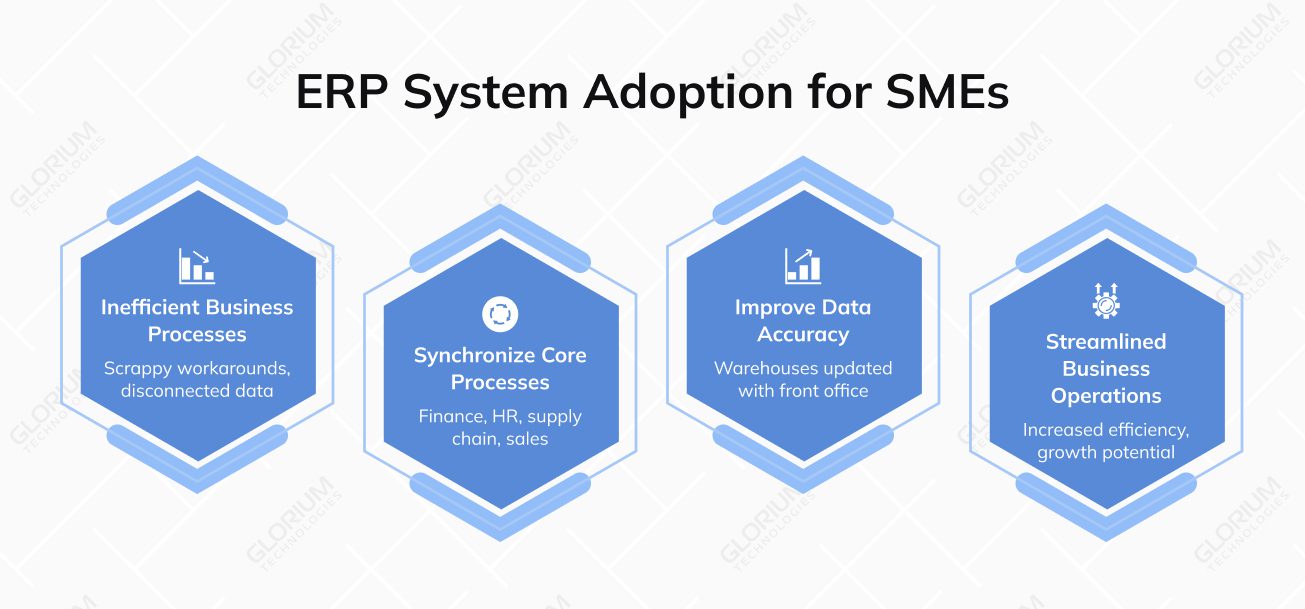
Did scrappy workarounds and basic accounting tools (like QuickBooks) start to feel like lead boots? Chances are that your team is caught in the busy-ness trap. They are working ten-hour days, moving data between disconnected spreadsheets and hunting down missing invoices. Although everyone is busy, your business remains capped, unable to push past its growth ceiling.
That’s when many SMEs consider adopting an enterprise resource planning system. The latter synchronizes the core business processes, from finance to human resources to supply chain management to sales. For example, if you run a retail company, ERP software keeps your warehouses up to date on exactly what the front office promises.
A projected return of $1.52 for every dollar invested may sound like a win, but that 52% ROI can be a massive trap for smaller businesses that aren’t prepared for adoption. ERP implementation success comes from organizational maturity in handling the transition.
Content
You’ve likely spent years perfecting the art of making it work with spreadsheets and manual workarounds. A few extra tools, one more report seemed to fill the operational gap until you reach a stage where “good enough” processes start costing more than the software meant to replace them.
These days, around 61% of companies are prioritizing ERP implementations to stabilize core business processes. This shift proves that sustainable business growth depends on a reliable system that handles the heavy lifting of daily cycles.
Are your departments reporting different figures for the same KPIs? Inconsistency triggers a defensive loop: you end up wasting hours in meetings debating whose manual export is correct rather than making strategic decisions. This situation occurs because of the reliance on individual Excel files, which are prone to human error, outdated entries, and fragmented logic.
By implementing an ERP system, you establish a “Single Source of Truth.” These enterprise resource planning systems pull live, synchronized data into a unified dashboard, ensuring every stakeholder views the same data and real-time metrics. Transitioning from fragmented spreadsheets to a centralized ERP platform shifts the focus of executive meetings from tedious data verification to business intelligence and actionable insights.
Rather than arguing over which numbers are “true,” ERP software allows teams to automate core business processes and finally align on what the data means for the company’s future.
Many organizations struggle to meet industry-specific regulations — GDPR, HIPAA, and SOC2 — often due to fragmented data and inconsistent privacy controls across legacy enterprise systems. Without a centralized ERP platform, ensuring data residency and fulfilling data subject access requests becomes an administrative nightmare.
Furthermore, a critical vulnerability is the lack of audit trails for financial transactions, which leaves businesses exposed to fraud and unable to satisfy auditors who require a tamper-proof history of every ledger entry.
Implementing a new ERP system transforms financial management and security by unifying all business functions. Modern ERP systems provide the following protections:
When you rely on a constant stream of manual calls between sales, the warehouse, and carriers to track a single purchase request, your order management devolves into a game of phone tag. This fragmented communication creates data silos where sales teams are left in the dark, unable to confirm inventory management levels or provide shipping updates, directly causing the customer experience to suffer.
Transitioning to a comprehensive ERP system provides real-time, end-to-end visibility across all business units. Instead of chasing updates, a cloud-based ERP provides a single software system to track the entire lifecycle of an order (from the initial purchase to the final delivery). By using ERP solutions to automate business processes, you can avoid the shipping errors and missed deadlines caused by manual hand-offs. You can improve operational efficiency, spending less time on the phone and more time focusing on integrated management and growth.
Fragmented architecture – usage of 10+ disconnected apps and APIs – forces employees to jump between platforms, deal with data duplication, and fix manual-data-entry errors nonstop. When your customer relationship management system doesn’t talk to your inventory manager, and your billing software is a stranger to both, scaling business operations is little more than wishful thinking.
Compounding this is the financial drain of legacy on-premises servers. Maintaining aging hardware requires significant capital for physical security and cooling. You also need to cover high software licensing fees and expenses for ongoing maintenance performed by specialized IT staff.
An Enterprise Resource Planning (ERP) system consolidates your disconnected tools into a single platform, acting as a hub for data management. You save yourself the hassle of messy API “band-aids.” If you go for a cloud-based ERP, you can replace heavy capital expenditures with predictable ongoing subscription fees while ensuring data flows seamlessly across every department.
Expanding into new territories or launching diverse products is never easy. You need to find customers and manage multiple currencies, tax laws, and legal entities, not to mention other local requirements. Your finance teams may end up being buried in manual reconciliations and heightened compliance risks.
Scaling requires a centralized hub to maintain brand and process consistency. You cannot afford fragmented workflows that vary by office or region, especially when managing sensitive financial data. This is why cloud-based ERP system adoption becomes a strategic necessity.
Implementing a robust cloud ERP can become the digital backbone for your global operations by:
If your front office operates in a data vacuum, you remain unaware of actual production output until the end-of-shift reports are filed. Conversely, without real-time insights, the shop floor operates blindly, oblivious to shifting order priorities or urgent customer demands. This shop-floor-office gap, often caused by a paper-based manufacturing system, results in missed deadlines and poor resource allocation.
Modern ERP solutions bridge this divide by creating a unified data environment. Replacement of manual processes with seamless ERP integration means:
eCommerce companies often face two expensive extremes: rippling carrying costs or frequent stockouts. Overstocking ties up capital in dusty warehouse corners, while underestimating demand leads to missed sales and fractured customer trust.
The root cause of this volatility is usually a lack of visibility. If you don’t have real-time analytics on supply chain lead times, you are unable to account for shipping delays.
Implementing enterprise resource planning software transforms guessing into precision. ERP systems facilitate seamless inventory tracking by unifying your core business functions and provide:
You can finally stop reacting and devote more time to planning. Transitioning from spreadsheets to an enterprise ERP turns your supply chain into a strategic asset.
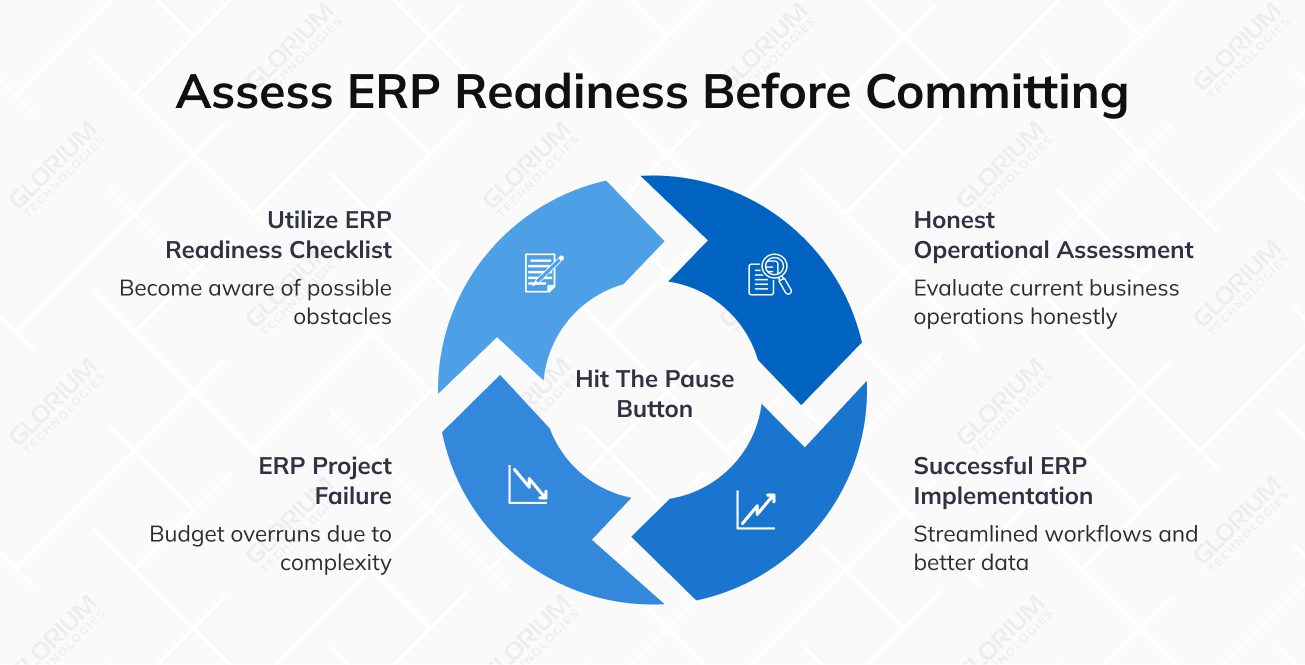
Let’s be honest: the promise of streamlined workflows and better data is tempting. You might even have ticked off all the signs your business is ready for an ERP system. But is it 100% so?
Roughly 64% of ERP projects end up blowing past their original budgets, often due to unforeseen complexities or lack of initial prep. Before you commit to a timeline or a vendor, you need to be brutally honest about your business’s operational health. If you recognize either of these two red flags in your current operations, it’s a sign to hit the pause button. You can also avail yourself of our ERP readiness checklist to become clearly aware of possible obstacles.
The most immediate red flag is the state of your data. When records are unstructured, duplicated, or cluttered with test entries from three years ago, you have a foundational crisis.
The risk here is the classic technical trap: “Garbage in, garbage out.” Migrating “dirty” data into a sophisticated ERP can only accelerate the rate at which errors propagate through your department.
The golden rule of digital transformation is simple – implementing an ERP on top of broken processes just automates your mess. Whether you are looking at cloud-based systems or a hybrid ERP, the software is designed to streamline efficiency, not invent logic where none exists. Before digitization, you must establish standard operating procedures (SOPs) to ensure your risk management strategy is sound. Fix the flow first; the software comes second.
An ERP implementation is a massive financial and cultural undertaking. If you are running on a tight budget, you risk a “failed go-live” before the first line of data is ever migrated.
It is a mistake to view the software license as the total price tag. The total ERP system cost for a midsize business includes system implementation, data migration, and intensive staff training (if there is a steep learning curve). Without a dedicated contingency for expense management, the productivity dip during the transition can derail the project mid-stream.
Success calls for more than just an IT admin. You need a team of experts who know their way around the ERP software, as well as a leader dedicated to project management who can bridge the gap between technical teams and executives. Otherwise, the transition will lack direction.
Even the best ERP system for business will fail if the staff is “stuck in their ways.” Forcing a six-month rollout onto a team used to manual processes will result in low adoption and resentment. A top-down mandate rarely works without bottom-up buy-in; if the people using the software every day don’t see its value, they will revert to spreadsheets the moment leadership looks away.
Think of ERP implementation as a continuous journey of growth. It is a living ecosystem that must evolve alongside your business. Yes, the transition can be daunting, but the cost of stagnation is eventually fatal.
Small and large enterprises that cling to rigid, aging infrastructure eventually face a quiet crisis: missed opportunities, staff burnout, and a fog of unreliable data, to name a few. Whether you are managing financial reporting or complex product lifecycle management, your tools should empower your team.
What does an expert-led ERP transition look like? For a metal manufacturer, it meant a massive 10x reduction in downtime and a 15% leaner inventory. Meanwhile, a health-focused restaurant saw revenue climb by 18%. Plus, ERP adoption translated into 50% faster reports and a 22% reduction in food waste.
Don’t let legacy friction paralyze your growth. Turn to Glorium Technologies for a bespoke business process audit.
Selecting ERP software is about refining how your organization functions day-to-day. The goal is to replace fragmented workflows with a cohesive environment that supports higher productivity. To ensure you pick a system that fits your specific needs, consider these three pillars: system interoperability, operational scalability, and deployment strategy.
Remember that focusing on modularity allows you to activate specific features as they become necessary.
Pricing usually depends on your team size and specific requirements. Most small businesses opt for a monthly subscription per user, which keeps upfront investment manageable. However, remember to factor in one-time implementation fees, data migration, and staff training. Balancing these initial setup costs against long-term efficiency gains is the best way to ensure a solid return on investment.
To switch successfully, begin by auditing data across various business functions to ensure only clean records migrate. Many small business ERP solutions offer migration tools, but you should still test the new platform in a sandbox environment before going live. Finally, prioritize ERP system support and team training to ensure everyone can navigate the new workflows, especially on mobile devices.