








Microsoft Dynamics 365 Business Central Insights for 2026
Updated February 20, 2026

 Summarize in ChatGPT
 Summarize in ChatGPT
In 2026, companies continue to grow, and so does their operational efficiency. Constantly changing markets, remote teams, an expanding list of products, and rising customer expectations make spreadsheets and old ERP systems less useful year by year. So, you don’t ask whether you need a modern ERP system; you ask which one to choose, and Microsoft Dynamics 365 Business Central is one of the top game changers among the existing systems for automated workflows.
The global ERP market is forecasted to grow by $128.3 billion by 2033, according to ERP Today. And Microsoft Dynamics 365 Business Central, an AI-powered, user-friendly ERP system for small to medium-sized businesses, is among the leaders in the list. But how did Microsoft Dynamics 365 Business Central become so widespread worldwide, and is it really useful for companies in 2026? Let’s see what the numbers say!
Content
Your understanding of how many businesses actually use Business Central in 2026 is far more helpful than just reading the list of the product’s stated features, like the Microsoft Power BI insights connector and others. Adoption rates, deployment trends, and regional usage patterns show where companies find the greatest value and whether the platform scales in real-world scenarios.
Microsoft continues to expand its user base for all its products, including Business Central. According to Business Central reporting, Dynamics 365 already supports more than 50,000 firms worldwide as of 2025. Such a central dataset will give you one consolidated view of your business – a single source of informed data-driven insights. You will get in-depth insight into your business’s sales, finance, and operations.
However, such growth is important not only because of the number of customers but also because of how quickly adoption has increased.
The real-time data shows that from 2023 to 2025, Microsoft Dynamics has expanded its number of online users:
As you see, small and mid-sized businesses have been adopting cloud ERP faster in the last 2 years, migrating from older Microsoft NAV systems more frequently, and integrating Microsoft 365 services more tightly.
Instead of focusing on discrete process fixes, businesses that invest in Microsoft Dynamics 365 usually aim for quantifiable, organization-wide improvements, reducing manual work.
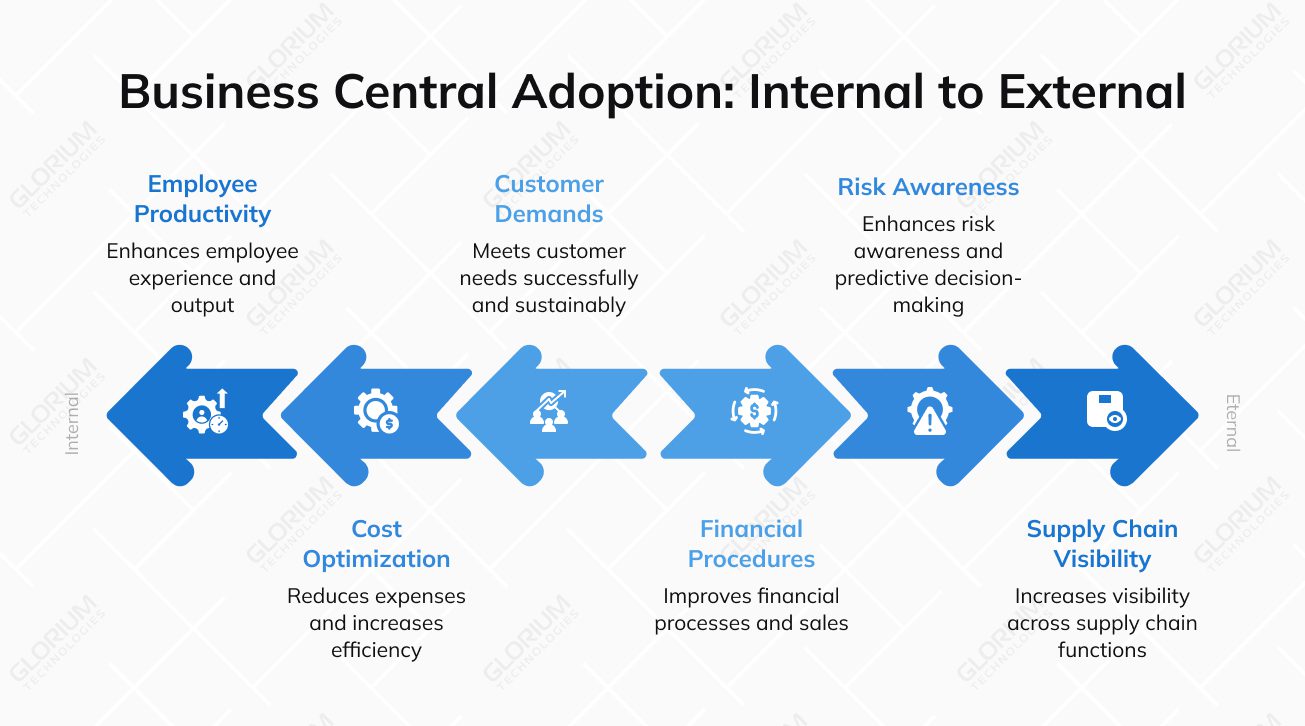
Based on historical data from 160 decision-makers using Dynamics 365 Business Central, Forrester Consulting’s commissioned Total Economic Impact (TEI) study from June 2024 reveals a distinct pattern in adoption objectives. Here’s a clear overview of the data:
The Business Central market is on a rapid growth trajectory in 2026, holding the leading position. Now, Microsoft Dynamics dominates the global ERP market, and its share accounts for 76.44%, as of January 2026, according to Statista.
As for the worldwide launch, Microsoft Dynamics 365 is most widespread in the following regions:
| Region | Market Share |
| North America | Expected 42% in 2026 |
| Europe | 12.0% |
| Middle East & Africa | Fastest-growing, CAGR 13.48% through 2030 |
North America is expected to lead the Microsoft Dynamics market in 2026, with a 42% revenue share, owing to increased R&D spending and broad adoption of AI-powered ERP and CRM solutions that improve customer satisfaction. Europe accounts for 12%, propelled by manufacturing powerhouses such as Germany and GDPR-driven demand for sovereign-cloud solutions, while the United Kingdom grapples with Brexit-related data-residency concerns. The Middle East and Africa are the fastest-growing regions, with a CAGR of 13.48% through 2030, as Saudi Arabia and the UAE include ERP modernization into Vision 2030 projects, and South Africa acts as a regional services hub.
In 2026, you need to evaluate business operation success by key performance indicators like revenue growth, employee productivity, supply chain efficiency, customer retention rate, and digital engagement metrics. Modern ERPs, especially Business Central insights apps, transform your KPIs into dynamic, predictive data flows that allow teams to correct inefficiencies before they reduce their profit margins.
ERP implementation is no longer a “set it and forget it”. The trend has shifted from heavy, rigid customizations to agile, AI-integrated deployments that put long-term flexibility ahead of day-one perfection as market contexts become more dynamic. Firms now focus on “Composable ERP” systems adoption, in which Business Central functions as a key player with a network of great apps, according to Gartner.
When you evaluate Business Central ERP deployment, the question isn’t “Can we run it on our servers?” but “Do we get the most business value from a cloud-based solution?” For Microsoft Dynamics 365 Business Central, the data clearly shows that the cloud has become the dominant trend in 2026. The demand for ERP solutions is growing globally.
This shift from conventional on-premise systems to adaptable cloud-based solutions offers better scalability and allows for the adoption of remote workforces, which is beneficial for small and medium-sized companies.
Microsoft Dynamics 365 stands out in 2026 for its quick timescales. The majority of small and mid-sized businesses finish implementation, which covers key operational workflows, their own custom reports, and basic financials, in 4 months.
One of the most statistically significant trends in Business Central implementations is the quick growth of Microsoft AppSource. AppSource is currently one of the biggest ERP extension ecosystems in the Microsoft market, with ongoing additions.
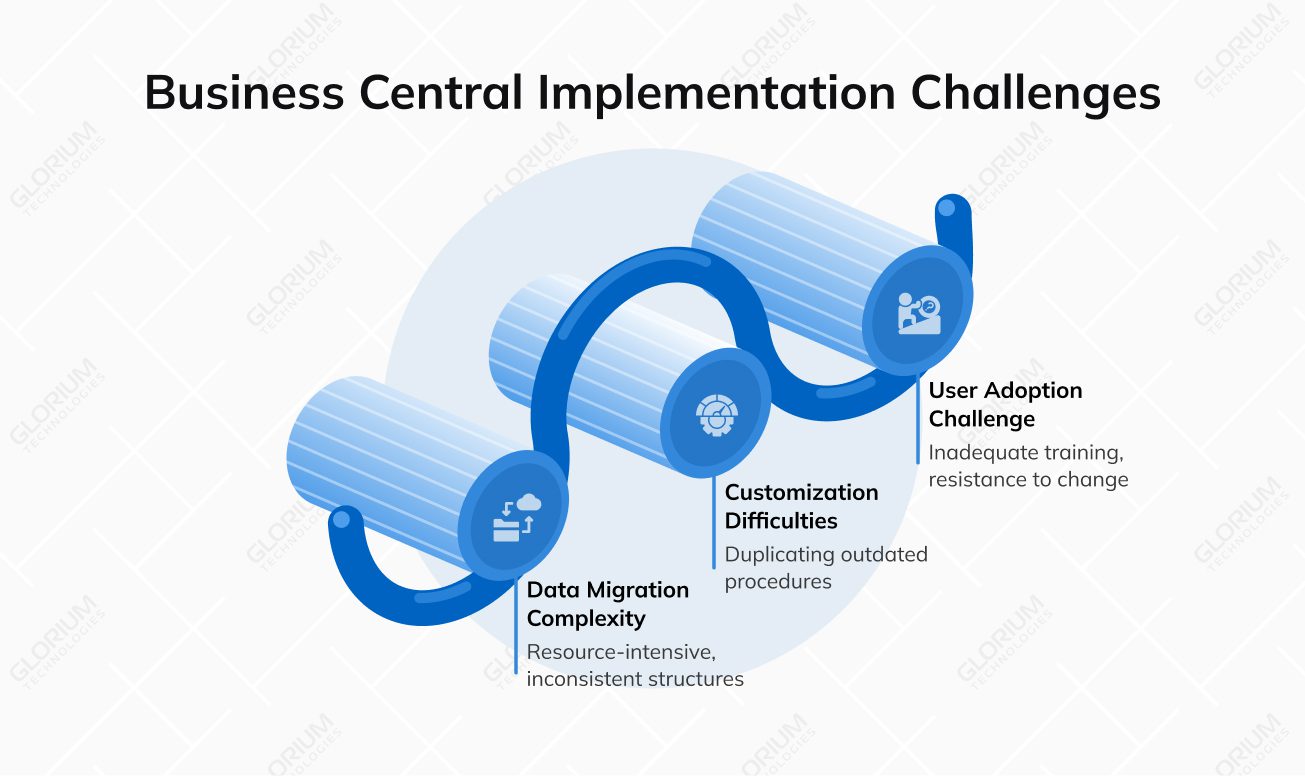
Even in 2026, when cloud ERP adoption is growing and Business Central is well-established, real-world implementations still show recurring problems that can impede your long-term value delivery, slow projects, and raise costs. When you don’t give enough priority to planning, execution, or change management, these issues arise in all implementations and are not specific to any one sector or geographical area.
One of the most resource-intensive aspects of a Business Central project is still data migration.
Data migration is one of the biggest obstacles in almost every Business Central implementation, according to a Microsoft report, particularly when transferring from legacy systems with inconsistent structures. Technical complexity is increased when Business Central reporting is integrated with current CRM, BI, e-commerce, and banking tools, particularly for businesses that operate across several systems and geographical areas.
One of the main causes of Business Central installation challenges is customization overload. Why does it occur, you may ask? Rather than implementing Business Central’s best-practice workflows, organizations frequently attempt to duplicate outdated procedures. Also, implementation, customization, ongoing management, and staff training around Business Central can cost about $118,000, because organizations rely on internal teams for a four-month deployment and continued maintenance. That’s why you can hire an experienced implementation partner of Microsoft to help you with customization.
At Glorium Technologies, we provide complete support by creating stable integrations that maintain reporting accuracy and business continuity from the start, validating data integrity, and designing controlled migration frameworks.
Inadequate user training causes even well-configured systems to malfunction. Adoption and management by users is a significant problem, particularly when your staff members are used to older systems. It happens because ERP systems necessitate planned training and continuous support since they introduce new workflows, vocabulary, and interfaces. That’s why, according to industry research, more than 60% of teams using Microsoft Dynamics 365 hire professional service providers to administer and deploy the program.
Although Microsoft Dynamics 365 Business Central’s adaptability makes it useful for you in a variety of industries, actual adoption trends show where ERP offers the most benefits.
The world’s biggest user of ERP systems is still a manufacturing industry firm. In 2025, ERP adoption rates in manufacturing reached 78% in industrial businesses. According to Forrester, the manufacturing organization’s interviewee showed that with Business Central insights, their sales representatives can record customer interactions, reduce production time, predict cash flow, track performance, and provide customer proposals. For example, a Belgian industrial company cut production downtime by 10× after integrating accounting, warehouse, and production systems into Microsoft Dynamics 365 Business Central.
ERP usage in retail and e-commerce continues to grow, with retail industries accounting for 14% of ERP installations in 2025. These firms are looking to increase their business intelligence, point-of-sale integration, and unified inventory control. Namely, about 14% of Forrester Research’s respondents, who use Microsoft Dynamics 365 Business Central insights, indicated that their company belongs to the retail industry. So, cloud ERP maximises profits, improves your service management, data-driven decisions, inventory forecasting, and real-time stock visibility.
ERP usage in healthcare is increasing because providers seek unified platforms for financial, procurement, and compliance reporting. In 2026, approximately 65% of ERP demand originates from the healthcare industry, driven by resource allocation, patient data management, and legal reporting requirements. ERP systems, such as Microsoft Dynamics 365 Business Central, facilitate the alignment of clinical operations with financial performance and reduce administrative duplication.
Additionally, such industries as professional services, telecommunications, chemicals and metals, financial services and insurance, transportation and logistics, and consumer services all use Microsoft Dynamics 365 Business Central.
When you compare ERP platforms, you need to determine which one fits your company’s size, growth trajectory, and operational complexity to stay ahead in a competitive market. Here’s a comparison of Business Central with other popular ERP systems as external tools to improve your business decisions.
Workday is a cloud-native “Enterprise Management Cloud” created especially for big, international businesses and mid-market businesses with intricate operations. Its industry-leading Financial Management and Human Capital Management (HCM) suites, which offer a single “source of truth” for data focused on people, are its main assets. Let’s see how Workday is compared with Business Central!
| Metric | Business Central | Workday |
| Market Share (by revenue) | 4.0% | 2.50% |
| User Recommendation Rate | 75% of ERP user engagement | 85% of ERP user engagement |
| Integration Score | 4.5 | 4.1 |
| Customization | 4.2 | 4.3 |
| Ideal For | Mid-market and enterprises integrated with MS 365 | Large/Global enterprises focused on HCM and finance |
SAP Business One is a powerhouse for international finance, excelling at multi-currency transactions and global operations through an intuitive interface with quick-search tools. Its cloud architecture makes it particularly easy for expanding businesses to scale their access quickly. See how SAP Business One wins or loses in certain metrics compared to Microsoft Dynamics 365.
| Metric | Business Central | SAP Business One |
| Market Share (by revenue) | 4.0% | 6.57% |
| ERP Category Mindshare | 4.4% of ERP user engagement | 2.7% of ERP user engagement |
| Average Rating (ERP category) | ~8.2 (PeerSpot) | ~8.2 (PeerSpot) |
| General Ledger Feature Support | 93.3% weighted support | 91.8% weighted support |
| Payroll Processing Support | ~95.4% weighted support | ~84.9% weighted support |
| Manufacturing Feature Coverage | ~95.9% weighted support | ~81.0% weighted support |
Oracle NetSuite is an ERP for organizations with complex international operations or multi-entity consolidation needs.NetSuite provides revenue recognition, billing models, and multi-subsidiary financial consolidation without third-party tools. Let’s see the comparison of Oracle NetSuite with Business Central!
| Metric | Business Central | Oracle NetSuite |
| Market Share (by revenue) | 4.0% | 6.63% |
| PeerSpot Mindshare | 7.4% (user engagement) | 7.4% mindshare in the same category |
| ERP Rating | 8.2/10 average rating (ERP category) | 7.8/10 average rating (ERP category) |
| Customer Base (approx.) | ~50,000 organizations | ~100,000+ customers |
| Financials Feature Support | ~96.07% weighted feature coverage | ~99.9% weighted feature coverage |
| Manufacturing Support Coverage | ~94.54% feature coverage | ~96.95% feature coverage |
| Inventory Management Coverage | ~97.55% | ~98.29% |
| Purchasing Service Management Coverage | ~99.77% | ~97.87% |
If you’re planning to implement Microsoft Dynamics 365 Business Central, one thing is more important than the software itself: how well your business objectives are established before rollout. According to the Forrester Total Economic Impact study, Business Central adoption can result in a 265% return on investment over three years. These results are due to fewer manual processes, more powerful reports, and improved cross-departmental visibility; however, those outcomes are not inevitable.
Instead of viewing Business Central as merely an IT upgrade, you should approach it as a business transformation project. When you underestimate process alignment, user adoption, or change management, your ERP adoption initiatives fall short of expected business value.
To improve your chances of success, you need to:
At Glorium Technologies, a trusted Microsoft partner, we help organizations implement and optimize Business Central solutions customized to their industry needs.

According to data from 2025 and 2026, Microsoft Dynamics 365 Business Central has become a dominant force in the SME sector, marked by a swift transition from on-premise legacy systems to cloud-based environments.
The data shows that if you’re looking at a platform with accelerating adoption, strong cloud-based, and demonstrated effect across finance, operations, supply chain, and customer-facing procedures, Business Central data is a smart pick.|
If you’re contemplating your next ERP move, the conclusion is simple: Business Central, with its products like Power BI and others, is a robust, future-ready platform. However, the real value is realized when it’s deployed with a clear strategy, reasonable expectations, and skilled direction.
If you need any help, Glorium Technologies is here to help. Just secure your spot for an intro call!
Yes, it’s a must have in 2026. Business Central is designed for small and mid-sized companies that are scaling operations, expanding product lines, or entering new markets.
Business Central centralizes financial, operational, and supply chain data into a single system and connects natively with tools like Power BI and Excel for better decisions.
The most significant risks you should consider before implementing any ERP platform are poor data migration, excessive customization, and low user adoption. To mitigate these risks, we recommend working with an official partner, like Glorium Technologies.