







What Is Cloud Manufacturing ERP Software? Features, Benefits, and Pricing in 2026
Updated April 13, 2026

 Summarize in ChatGPT
 Summarize in ChatGPT
Manufacturers face increasing demands to automate processes, streamline production, improve visibility, and eliminate blind spots in their operations. Spreadsheets and disconnected tools no longer provide enough control for production, inventory, and supply chain teams. The global ERP market is expected to grow from $106.22 billion in 2026 to $281.58 billion by 2034, with cloud-based manufacturing ERP accounting for more than half of all deployments. This trend points to a move toward AI-driven planning, IoT-connected operations, and real-time decision-making.
This article will explore manufacturing ERP software: what it is, how it can streamline your operations, potential costs, and how to choose the best fit for your business.
Content
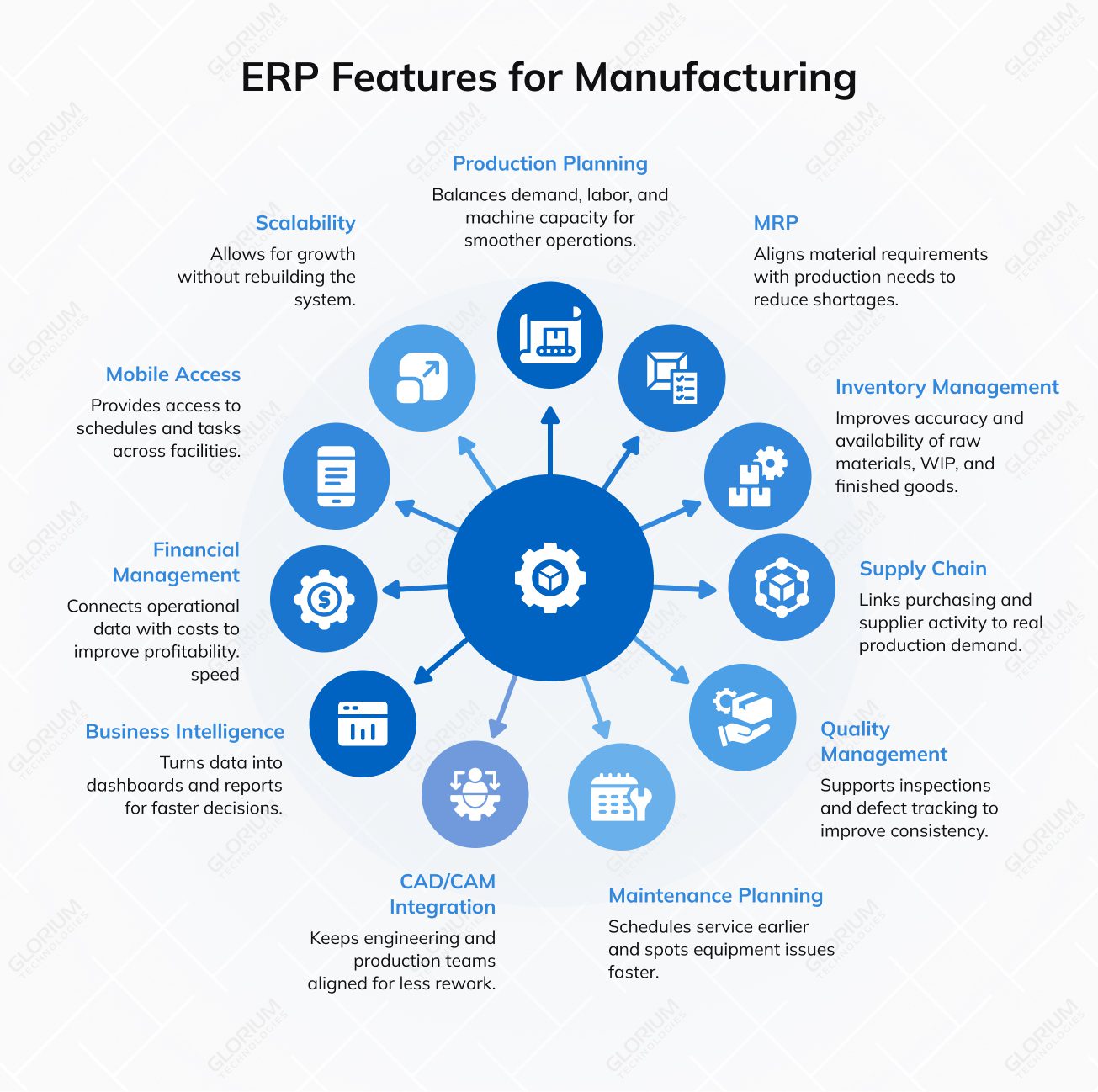
Manufacturing ERP offers tools for planning production, managing inventory, controlling quality, and organizing shop-floor activities. In contrast, larger generic ERP platforms usually focus more on finance, human resources, and supply chain management.
A manufacturing ERP system combines the core components of a business on a single platform. It streamlines a manufacturer’s operations, encompassing production planning and scheduling, inventory management, supplier and order oversight, and up-to-date financial record-keeping. Upon receiving a new order, the system immediately adjusts inventory levels, initiates production, monitors expenses, and disseminates pertinent information to various departments. Cloud ERP solutions simplify the process; the vendor manages the system, and users simply log in via a web browser, which facilitates setup, updates, and expansion into new geographical areas.
Generic cloud ERP systems normally manage back-office operations such as finance, accounting, human resources, and basic supply chain activities. Manufacturing ERP often comes with extra features such as bill of materials, routing, capacity planning, shop floor scheduling, quality management, and maintenance tools.
| Area | Manufacturing ERP | Generic ERP |
| Primary focus | Supports manufacturing industry operations | Supports broad business administration across industries |
| Deployment model | Delivered as a cloud-based ERP system with remote access, updates, and scalability | May be cloud-based or on-premise, often without strong manufacturing depth |
| Core purpose | Connects production, inventory, procurement, quality, warehouse, and financial workflows | Handles finance, HR, sales, and other general business functions |
| Production planning | Built for production planning and scheduling, routing, and capacity balancing | Usually limited or handled through add-ons |
| Shop floor visibility | Tracks orders, labor, machine activity, and shop floor performance | Often lacks deep shop floor functionality |
| Inventory management | Handles raw materials, finished goods, traceability, and inventory control | Usually focuses on standard inventory records |
| Supply chain management | Better aligned with supplier coordination, material flow, and production-linked purchasing | Covers general supply chain needs, but may not reflect production realities well |
| Quality control | Often includes inspections, traceability, and quality management workflows | Usually offers lighter quality functionality |
| Product structure | Supports BOMs, routings, revisions, and product configuration | May not support complex manufacturing structures well |
| Real-time visibility | Provides real-time insights across production, warehouse, and supply chain | Often stronger in finance reporting than in real-time manufacturing visibility |
| Mobile access | Supports cloud-based access from different locations and devices | May be more limited depending on the system |
| Best fit | Manufacturing companies that seek to streamline manufacturing and run operations on one flexible cloud software platform | Companies with uncomplicated business operations and little production complexity |
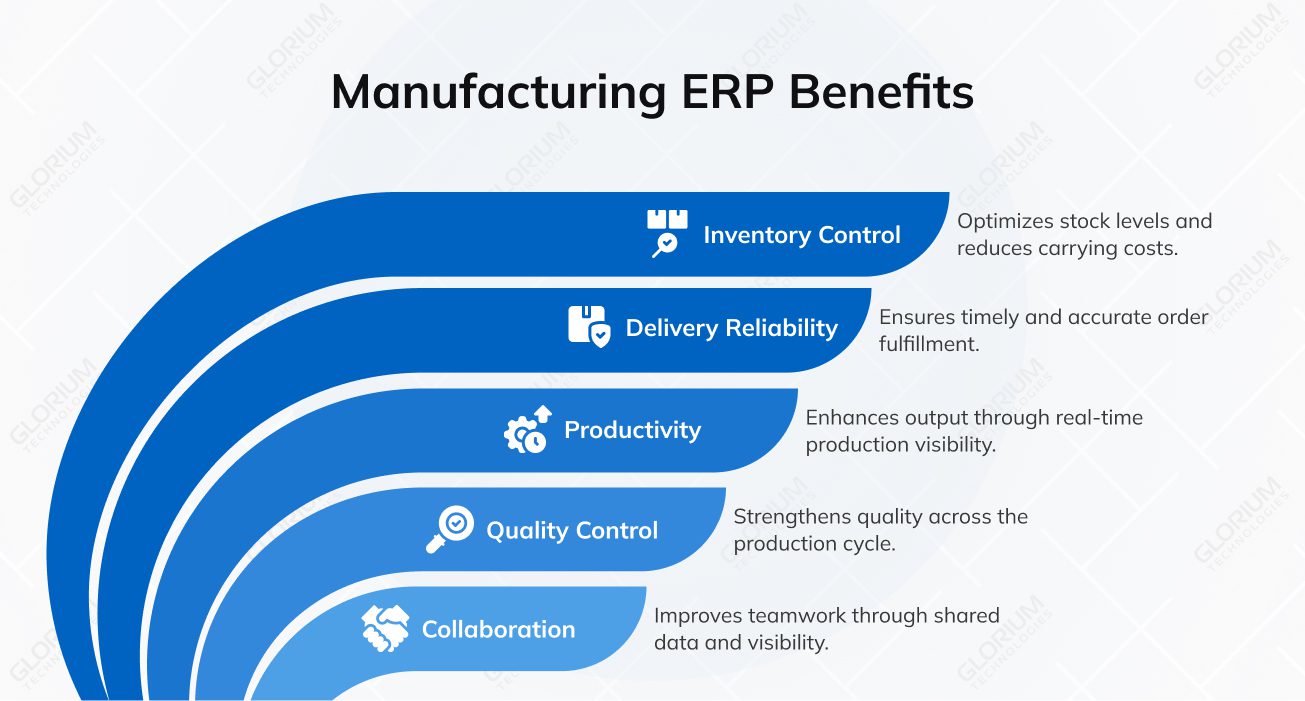
An ERP system is useful because it supports daily work in areas like production, inventory, purchasing, quality, and finance. With the right system, manufacturers can work faster, avoid errors, and make better decisions based on clear and reliable data.
The cost of manufacturing ERP software varies widely since it is just one part of your total investment. Your overall budget will depend on which processes you want the system to handle, the modules you choose, the level of customization you need, and how well it fits with your other manufacturing operations.
Most ERP platforms offer three main pricing models: subscription plans for cloud setups, perpetual licenses with yearly support for on-premise systems, or a combination of both. Cloud-based manufacturing ERP systems often charge a monthly fee per user, but some vendors base their prices on the number of modules, features, or how much you use the system.
In 2026, small businesses usually spend between $3,000 and $25,000 on ERP during their first year. For mid-sized companies, costs range from $20,000 to $125,000. Large businesses often pay more, depending on how complex the setup is and what extra services they need. Cloud ERP subscriptions generally cost between $40 and $200 per user each month.
The main factors that affect cost are the deployment model, how many users you have, which modules you need, how much integration is required, and how complex the setup is. ERP system costs usually increase when they need to manage complex manufacturing, production planning, financial tasks, inventory, or advanced production processes.
ERP costs can increase due to data migration, training, changes to processes, integrations, and technical support after launch. Integration work is often costly, and software prices rarely reflect the total investment or the long-term savings the system could offer.
ERP helps growing manufacturing businesses run more smoothly by making planning, execution, and coordination more consistent.
There is no single best ERP for every business. The right choice depends on your production model, company size, the complexity of your processes, the reports you need, and the level of flexibility you want during setup.
Microsoft Dynamics 365 Business Central works well for manufacturers who want better control over production, inventory, warehouse operations, quality, and finance. It is especially helpful for companies already using Microsoft products. Business Central is a good choice for manufacturers with complex operations who need more structure than basic ERP systems, but still want an easy way to move to the cloud and customize their setup.
Recently, we helped a food manufacturer set up Dynamics 365 Business Central to solve problems with disconnected systems, limited batch tracking, and compliance challenges. Our solution included batch and recipe management, FEFO warehouse automation, expiration tracking, and digital quality logs. We focused on building strong processes first to make future growth easier.
Odoo is a great choice for manufacturers who want a modular system, quick setup, and more flexibility in how they manage workflows. It works especially well for small and mid-sized manufacturers, project-based producers, and companies looking to bring together manufacturing, inventory, purchasing, sales, and finance without switching to a more complex enterprise system.
Recently, we helped a U.S. healthy restaurant chain bring POS, inventory, recipe management, purchasing, HR, accounting, and loyalty into one Odoo 18 system hosted on Odoo.sh. With real-time stock tracking, expiry alerts, automated procurement, digital shift planning, and live recipe costing, the business improved control across three locations. As a result, the client achieved 18% revenue growth, reduced food waste by 22%, cut reporting time by 50%, increased returning customers by 5%, and made workforce management 28% faster.
SAP S/4HANA Manufacturing works best for large companies with complex operations, detailed planning needs, and a focus on coordinating manufacturing across the whole business. SAP works well for organizations that need advanced production scheduling, handle many constraints, have complex engineering processes, or want strong analytics. Manufacturers with several plants or locations often find SAP a better fit than basic ERP systems.
Oracle NetSuite Manufacturing works well for mid-sized manufacturers who want a cloud-based system that brings together procurement, production, inventory, shipping, and finance. It appeals to companies looking for a single, connected platform and a straightforward cloud ERP, without the complications of large enterprise solutions. Many manufacturers who want better visibility and an easier move to the cloud often consider NetSuite.
Manufacturing ERP projects can face operational challenges. Unclear processes, a rushed launch, poor integration, inadequate data preparation, and low user adoption are all significant risks. You can mitigate these issues by implementing the system in stages, clearly defining roles, and beginning training before the official launch.
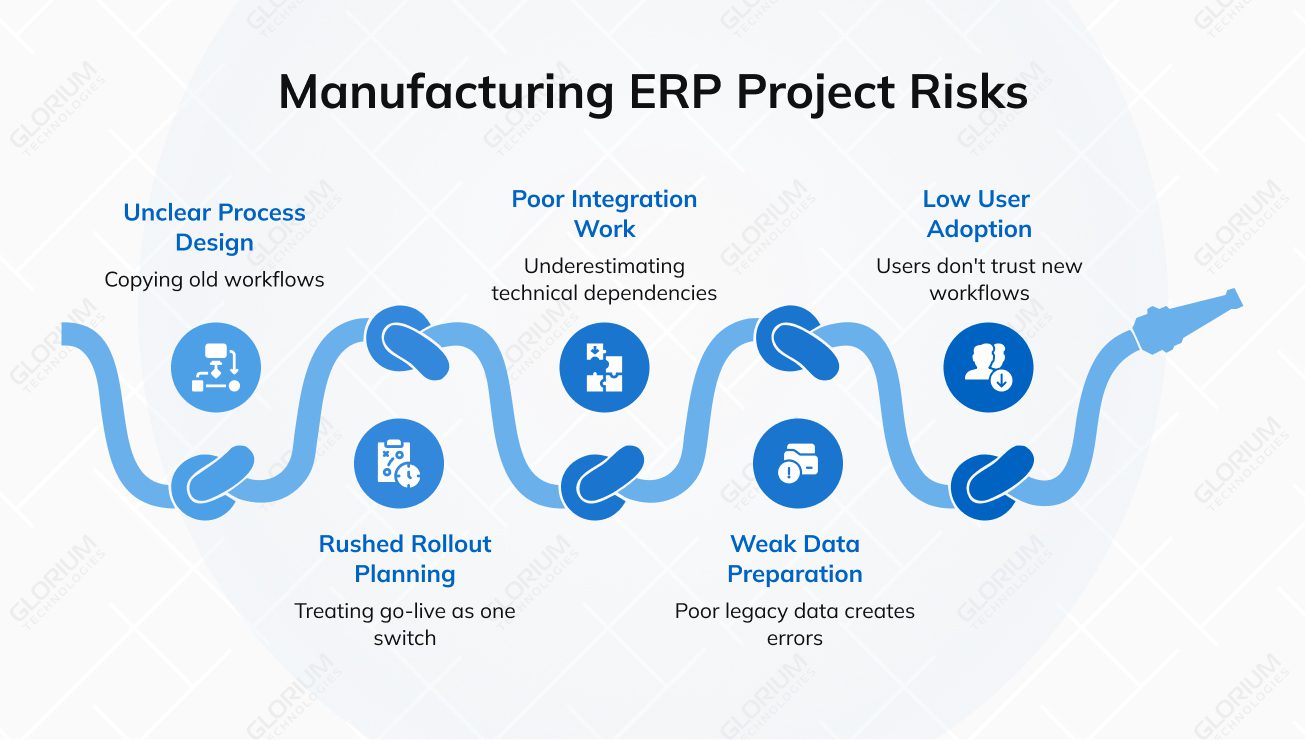
Many teams move their old workflows into a new ERP system without first deciding which processes could be simplified, standardized, or redesigned. This often results in extra customization, slower rollout, and added complexity down the road. Glorium Technologies helps reduce this risk through early discovery, process mapping, and a clearer separation between what should be configured in the system and what should be improved operationally.
Even a well-configured ERP can underperform when users do not trust the new workflows or do not understand how to use them in daily work. This risk is easier to control with role-based training, user acceptance testing, and post-go-live support.
A good example is Glorium Technologies’ high-growth custom lighting manufacturer case, where the rollout was phased, starting with operational automation before expanding into CRM, sales, project costing, and finance. The company had Excel-based planning, disconnected tools, slow shipping, and inconsistent warehouse processes. After implementation, the business achieved 90%+ inventory accuracy, reduced defects by 35%, and saved 20+ hours per month, demonstrating that phased delivery and stronger training can simultaneously improve adoption and operational stability.
Many manufacturers are concerned that rolling out an ERP system could disrupt their manufacturing, shipping, or purchasing processes. The risk is much higher if go-live is treated as a single big event rather than a gradual change. Glorium Technologies addresses this by using a staggered approach, where discovery, configuration, migration, testing, training, and cutover happen in separate steps. This makes any interruptions easier to handle.
ERP becomes less useful when it cannot exchange data with MES, warehouse tools, barcode systems, finance platforms, or other business-critical software. These gaps often appear when technical dependencies are underestimated early in the project. Our team eliminates this risk by identifying integration points during planning, prioritizing them by business impact, and testing them before broader rollout.
When historical data is unreliable, it can lead to planning problems, inaccurate inventory records, and reporting issues right from the beginning. Security risks can also arise if access controls, approvals, and audit procedures are not established promptly. Glorium Technologies addresses these challenges before launch by performing data audits, cleanup, validation, staged migration, and setting up controlled permissions.
Thorough vendor research is key for businesses aiming to select an ERP platform that aligns with their present requirements, facilitates future expansion, and provides clearer insights into production, inventory, and planning processes:
In 2026, ERP is becoming more predictive, more connected to industrial data, and more widely implemented across production, supply chain, and maintenance.
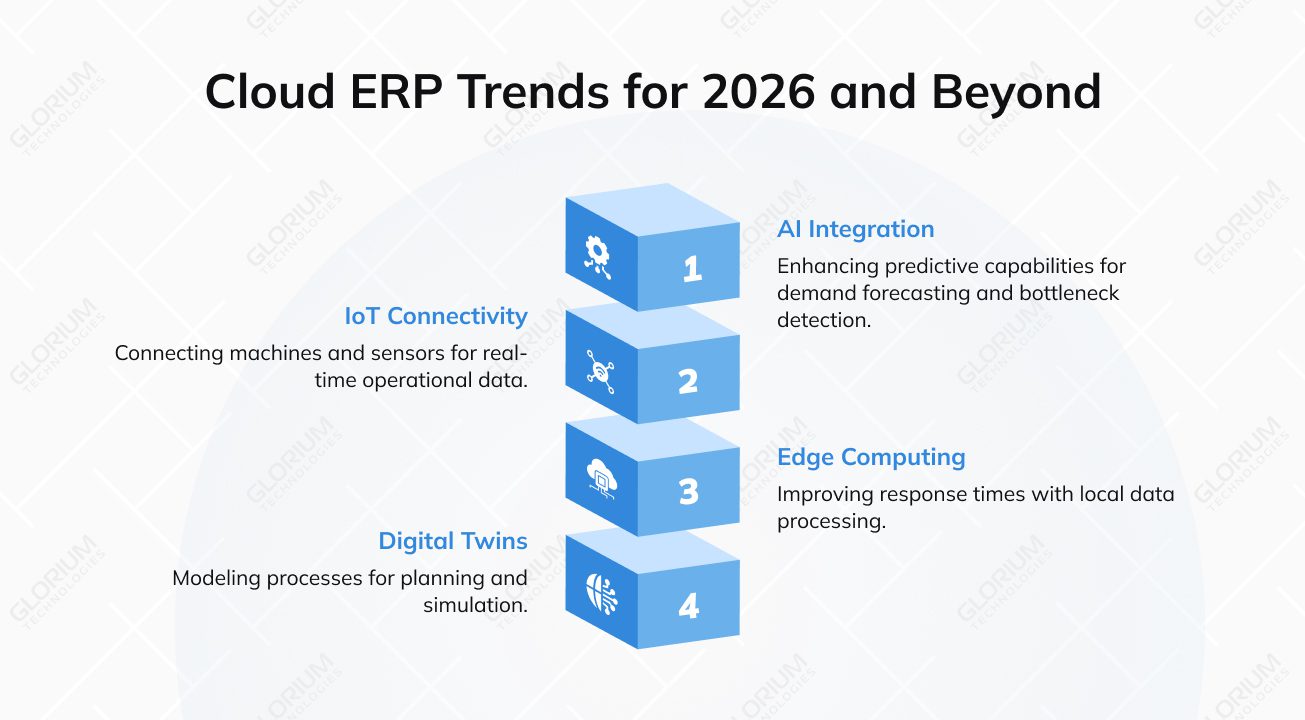
Artificial intelligence is taking ERP beyond simple workflow automation, making it a more active part of daily operations. In manufacturing, this means better demand forecasting, earlier detection of bottlenecks, smarter scheduling, and quicker maintenance decisions. Microsoft calls this a move toward more intelligent coordination across the value chain, while SAP sees AI as key to improving planning, execution, and organizational readiness for change.
As ERP systems integrate with machines, sensors, and other production assets, their utility grows. This connectivity enables real-time data to refine production planning, inventory management, maintenance schedules, and quality control. Microsoft identifies IoT as a cornerstone of Industry 4.0 in contemporary manufacturing. NetSuite, on the other hand, characterizes ERP as a unified platform that consolidates procurement, production, inventory, shipping, and financial functions.
Edge computing lets teams process time-sensitive machine and operational data right where it is generated. Microsoft names edge computing as a key technology for Industry 4.0, especially in connected manufacturing, where speed and quick reactions are essential.
Digital twins become more relevant as they help manufacturers model processes, test changes, and evaluate scenarios before applying them in live production. That makes digital twins useful for capacity planning, process improvement, and sustainable growth. Microsoft’s Azure Digital Twins documentation describes them as a way to create digital models of entire environments and use those models to gain data-driven insights, streamline operations, and reduce costs.
Glorium Technologies is a Certified Odoo Partner and Microsoft Dynamics 365 Business Central Partner with an expert team that works with manufacturers across the United States, Europe, and the UK, supporting cloud ERP selection, implementation, third-party integrations, legacy migration, user training, and post-launch support. That end-to-end approach helps businesses move from disconnected systems to a cloud ERP environment with a more practical rollout plan and stronger long-term fit.
Explore our case studies or book an intro call with our experts to map the right cloud ERP journey for your business.
Glorium Technologies works with mid-sized and small manufacturing companies to find the right ERP system for their needs. We look at their manufacturing processes, reporting and integration needs, and long-term growth plans. Our aim is to recommend ERP solutions that help with production planning, financial management, and smoother business operations, all in one platform.
Yes. Glorium Technologies works with Odoo for manufacturing environments and can help with implementation, customization, integration, migration, and support. Odoo can be a strong fit for industrial manufacturers that want a flexible, modular ERP with lower entry costs and room to expand over time.
Yes. Glorium Technologies can support Microsoft Dynamics 365 projects for manufacturing, including implementation, customization, integration, and process alignment. Dynamics 365 is often a good fit for manufacturers that need stronger operational control and want close integration with the Microsoft ecosystem.
Yes. Every manufacturing business is different, so ERP systems should match your real production needs. Glorium Technologies can adjust workflows, approvals, product setup, reporting, and production management to fit your processes. We also support discrete manufacturing, mixed-mode production, and other industry-specific requirements.
An ERP system works best when it is fully integrated. At Glorium Technologies, we connect ERPs with MES, WMS, CRM, accounting software, and other tools. This helps real-time data flow smoothly between production, finance, and customer teams, cuts down on manual entry, and makes sales processes easier.
The process usually starts with a review of current workflows to see how things are done. Next, the team identifies what is needed, selects the right cloud ERP solution, prepares the data, sets up the system, tests it, and supports the rollout. The main goal is to make the implementation practical so manufacturers can automate tasks, speed up production, and manage operations more efficiently in a connected environment.
How long an ERP project takes depends on your business size, the number of users, the level of customization you need, and the number of systems you want to connect. Most small cloud-based ERP projects finish in a few months. Larger projects, especially for manufacturers with several locations or more complex needs, can take much longer. Once the discovery phase is done and the rollout plan is clear, you’ll get a more accurate timeline.
Glorium Technologies is equipped to manage data migration from spreadsheets and outdated ERP systems, among other sources. We meticulously examine, cleanse, and map your data to ensure its integrity. This process results in a new ERP system that boasts cleaner records, fewer reporting errors, and enhanced support for data-driven decision-making.
Risk is often managed through careful planning, sequencing, and execution. At Glorium Technologies, we reduce rollout risks by working in stages. We check that processes are correct, move data safely, train users, and focus on key integration points. This approach helps teams work more efficiently and supports long-term growth by improving quality control, data security, and the reliability of go-live events.
Yes, Glorium Technologies can support manufacturers who need to follow strict regulations, especially in the medical device field. We set up ERP systems to make it easier to track information, manage approvals, handle documentation, and control processes. This helps with audits, quality management, and everyday decisions.
Yes. A dependable cloud ERP allows growing manufacturers to monitor their operations in real time. It also offers mobile accessibility and the ability to streamline workflows without a complete overhaul. Consequently, managing orders, maintaining customer satisfaction, and adapting to market fluctuations become more manageable.