







MVP Development for Enterprises: How to Go from Idea to Validation in Weeks
Updated March 25, 2026

 Summarize in ChatGPT
 Summarize in ChatGPT
Enterprise MVP development. Three words that make even the most seasoned product leaders pause. And it is completely understandable — the stakes are high, and the fear of failure is natural. According to a Gartner CIO and Technology Executive Survey, only 48% of enterprise digital initiatives meet or exceed their business outcome targets. The global MVP development market was valued at $288 million in 2024 and is projected to reach $541 million by 2031, exhibiting a CAGR of 9.5 percent — a clear signal that enterprises are seeking structured ways to validate products before committing full-scale budgets.
With an undertaking this complex and daunting, it is imperative to break the process into smaller pieces. This guide outlines a step-by-step process to help enterprise product leaders navigate MVP development from discovery to scale — reducing risk, accelerating time-to-market, and validating ideas with real users before budgets balloon.
Content
A minimum viable product (MVP) is a product that integrates core user needs into a single feature set and feedback loop. It includes only the essential features. For some apps, these features may be user authentication, a primary value workflow, analytics tracking, notification systems, administrative controls, and so on. The choice of the core features dictates how well you can validate market demand with real users before committing to full-scale development.
The main goal is to consolidate separate assumptions into a single testable product.
When discussing MVP development, it’s natural to immediately connect it to startups. Small companies often develop MVPs to test the core features of their idea and attract investors. For enterprises, this is a different process. Where startups can afford to move fast and deliver a scrappy proof of concept, enterprises must navigate procurement processes, compliance requirements, and multiple stakeholder groups.
The development strategy itself depends on the company size, market complexity, industry requirements, and internal technical expertise. The best approach combines company resources with development partner or dedicated team support. In-house development efforts rely on internal engineering departments or stakeholders, sometimes with external consultants.
Partner-driven development is especially useful when companies have skill gaps in their departments and want to collaborate with an expert team that has experience developing MVPs.
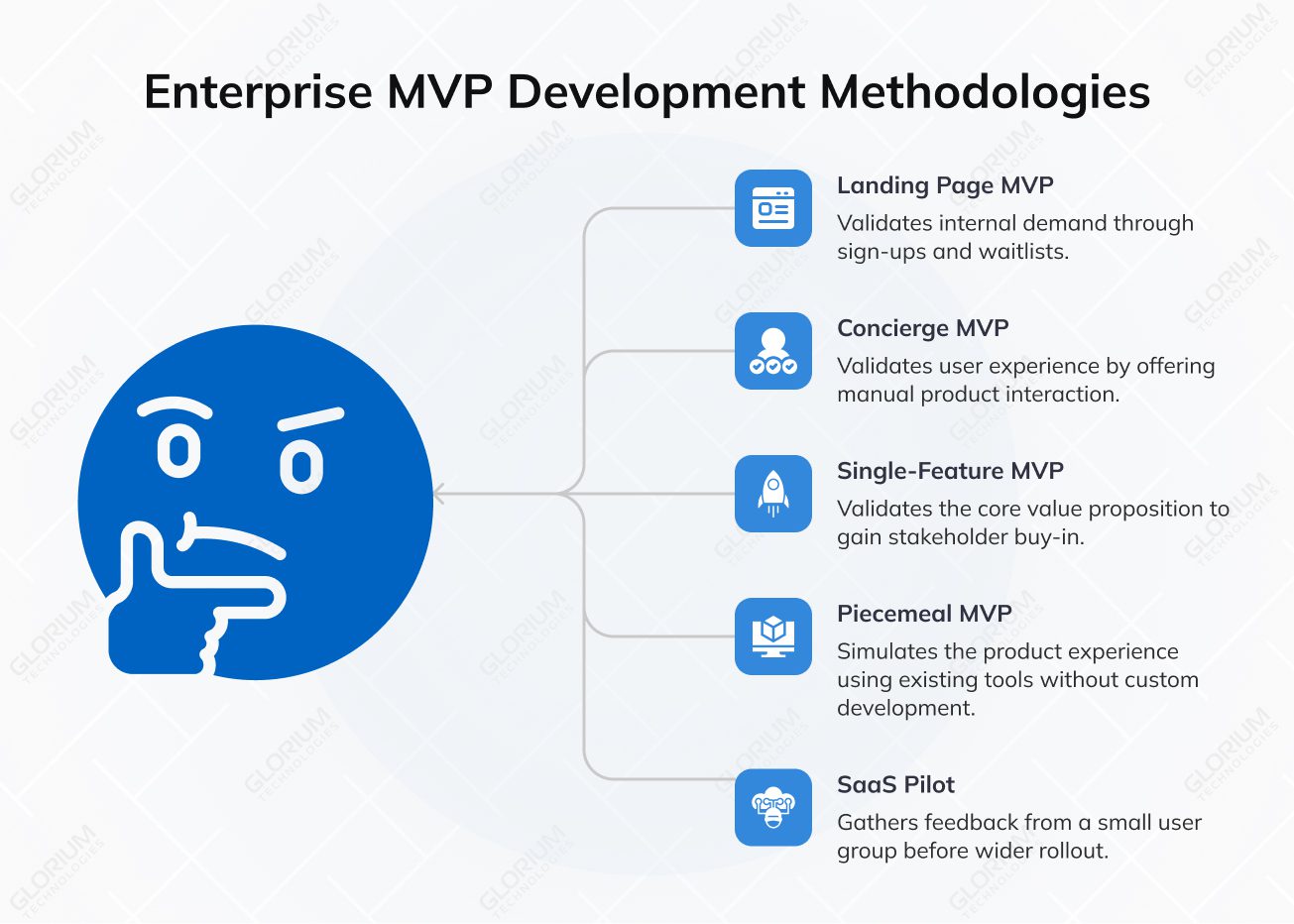
And since we’re discussing MVP development strategies, let’s touch on methodologies: landing page, concierge, single-feature, piecemeal, and SaaS pilot. Each of these methdologies serve a different validation need:
Do you know why 72% of startups build an MVP before rolling out a full-scale product? Because minimum viable product development delivers exceptional benefits across budget, risk, and organizational alignment. Successful MVP development processes typically finish on time and within budget, then deliver documented product-market fit validation and ROI. This observation matters even more at the enterprise level, where the cost of a missed launch is high. According to a Tempo report, nearly 1 in 3 enterprise projects fail to deliver meaningful ROI — high-performing organizations achieve measurable ROI on 81% of projects versus just 45% among traditional planning organizations, a gap representing up to $260 million in lost annual value.
Risk reduction is one of the benefits that accompany MVP development. Product launches without structured validation routinely miss timelines and budgets — and the larger the organization, the wider the miss. Teams using scenario planning report a 17-percentage-point higher rate of projects delivering measurable ROI compared to teams that do not.
MVP development also accelerates stakeholder alignment by replacing internal assumptions with real user data. Organizations that adopt the Minimum Lovable Product (MLP) concept — where the bar is not just viability but creating enough value that internal champions actively advocate for continued funding — report significant reductions in development and operational waste during the validation phase.
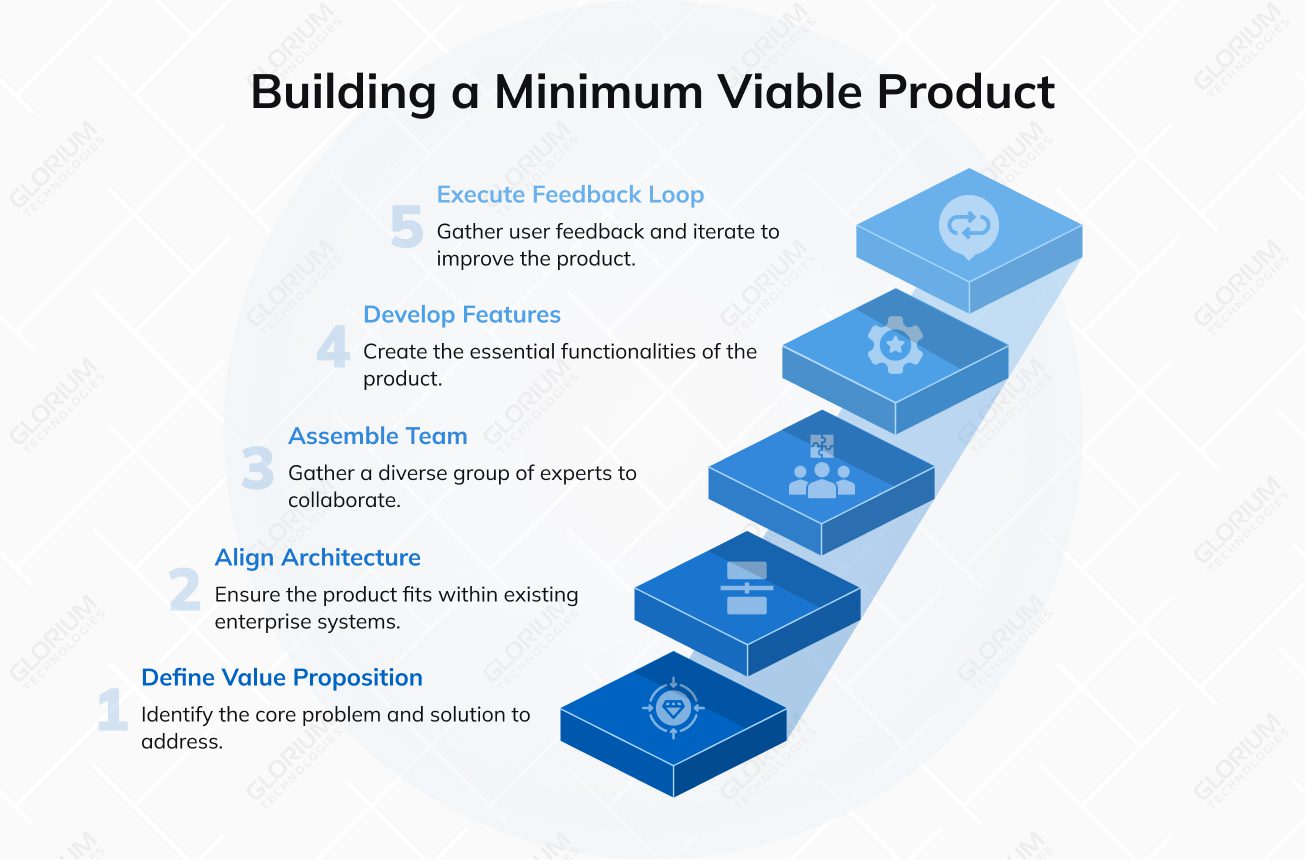
Unlike early-stage startups that can afford to improvise, enterprises need a solid plan that accounts for existing systems, stakeholder expectations, and regulatory requirements at every phase. The enterprise MVP development process should follow a structured sequence. Let’s explore a repeatable framework of five steps that will help you move from an initial concept to a validated product.
Every successful enterprise MVP has one thing in common: a properly conducted discovery phase, where the company answers one important question: “What is the one problem this product must solve?” Not the five problems, not the advanced new features we want to add, not what stakeholders have requested—the one core pain point that, if addressed well, will justify the product’s existence. This is especially difficult for enterprises, due to internal politics, competitor priorities, and vocal stakeholders. And often, when the discovery phase is skipped, what could’ve been a successful MVP turns into an overengineered product that tries to do everything and validates nothing.
Adopting appropriate discovery processes reduces organizational resistance while maximizing product benefits. The process ensures standardized methods for efficient change handling, minimizing impact on user experience quality. Companies that recognize that MVP adoption is a product validation initiative more than an engineering department undertaking are the best prepared.
Planning begins with leadership, establishing clear business objectives:
In our experience, the discovery stage is where most enterprise MVPs are won or lost — teams that skip rigorous problem-solution fit analysis end up building feature-rich products that solve the wrong problem. When a U.S.-based pediatric healthcare provider came to us ahead of their app launch, this was exactly the risk on the table. The client needed to validate planned features against real user needs and confirm technical feasibility, while maintaining HIPAA compliance. The discovery phase, conducted by Glorium Technologies specialists, delivered a clickable prototype, architecture documentation, and a detailed Vision-Blueprint-Scope roadmap to help the client move forward with clarity and reduced investment risk.
Before development, assess the current IT infrastructure. Ensure stable API connectivity and adequate system capacity while maintaining the legacy system. Implement disaster recovery plans with full data backups.
Data governance is critical. Remove duplicates, archive outdated information, and merge external sources, such as spreadsheets. Handle personally identifiable information according to SOC 2 and data privacy regulations. Create compliance reporting, KPIs, and security audit reports aligned with enterprise standards.
Building on a modular architecture from the outset ensures that the MVP can scale without requiring a complete rebuild — each module should function independently, enabling future development teams to extend functionality without disrupting the core system.
You can have the discovery phase and all the tech stack in place, but no MVP succeeds without the right people behind it. Often, development teams include a product owner, a lead architect specializing in specific MVP systems, a UX/UI Designer, and a QA team.
You can choose to develop your MVP in-house or partner with an experienced development team. Each approach has its advantages and disadvantages. Independent development partners may be more proficient at aligning product requirements to technical architecture due to focused expertise. In-house teams have intimate product knowledge but might lack broader resources.
At Glorium Technologies, we typically deploy a dedicated squad that acts as an extension of your in-house R&D team to ensure knowledge transfer. Whether you need staff augmentation, a dedicated development team, or a project-based engagement, the key sourcing models should align with your MVP’s scope and timeline.
When possible, talk to development partners before engagement, especially for vendor-provided teams. Discuss industry experience and obtain client references to verify performance in your field. Look for independent assessments, such as Clutch-verified reviews of development partners, explore the case studies, and most importantly, talk to your chosen vendor directly.
MVP is a minimum viable product, but we often see companies think of it as a “smaller version of the full product.” This isn’t accurate, and such an outlook could lead to the failure of your development process. The single most important thing when creating an MVP is defining the feature set. You can add new features and build a full-scale product once you validate your idea and gather early user feedback.
If you’re unsure how to prioritize features for your MVP, explore our guide to feature prioritization with frameworks and examples.
Let’s explore a case of a large retail enterprise looking to validate a B2B wholesale ordering portal for their network of independent retailers. A full platform with ERP integration and a dynamic pricing engine sounds nice, but with the MVP approach, the company can validate the idea and justify the next phase of investment.
This is what their prioritized feature set could look like:
| Feature | Rationale |
| Product catalog with basic search | Core to validating whether users can find and browse products digitally |
| Basic order form | The primary action the MVP needs to validate |
| Email order confirmation | Minimum required to close the transaction loop |
| User authentication and login | Required for secure, attributable order tracking |
You followed every necessary step, developed an MVP with the proper features, and already rolled it out. However, that’s not the finish line. You still need to gather feedback that tells you whether your core assumptions were right, partially right, or wrong.
This is why the feedback loop and iteration step are important. Once testing is complete and the system is ready to go live, you may deploy a soft launch with a small group of users tasked with catching any last-minute issues. Implement ongoing assessments to identify deviations from the plan.
Conduct regular audits to gather feedback and track project progress against objectives. Ideally, you will learn that your assumptions were right and your product works. But even if the feedback doesn’t validate your concept, now you have information and direction on how to improve and roll out a second iteration.
Structured market validation separates enterprise MVPs that reach production from those that stall in pilot. Mapping your validation journey from start to finish is crucial, including dates for key milestones. Regular communication between stakeholders, development leads, and end users reduces organizational alignment problems.
Strong validation plans prevent scope creep by focusing on agreed-upon features supporting product hypotheses. Validation should emphasize core functionalities mapped to user needs, achieving objectives, and avoiding unnecessary features. Effective market research at this stage combines quantitative user feedback with qualitative user research — surveys and analytics tell you what users do, while interviews and focus groups tell you why. A CB Insights analysis of 431 VC-backed company post-mortems found that 43% of product failures are attributed to poor product-market fit — building products nobody wants.
According to MIT and KPMG, 95% of enterprise generative AI pilots fail to deliver measurable P&L impact, and the average organization scrapes 46% of AI proofs of concept before production. ROI compares product development costs against cost savings and increased revenue generated.
Track these metrics throughout the MVP development project to gauge whether the product validates your core assumptions:
Pilot rollout, department-wide deployment, and enterprise-wide rollout are the three options available for scaling MVP solutions.
Figma launched as a browser-only design tool in late 2015, focused solely on real-time collaboration — deliberately not competing with desktop-based tools on feature depth. Once that need was confirmed, adoption accelerated from MVP to enterprise platform, leading to a $20 billion Adobe acquisition attempt in 2022. Similarly, Spotify started as an invite-only beta with a single feature — streaming music — to validate user willingness to adopt a legal alternative to piracy before building a full platform.
According to McKinsey, companies deploying AI across the product development lifecycle see 40-50% faster timelines and 40% cost reduction in modernization efforts. Hybrid solutions blend on-premise and cloud benefits, enabling quick data and functionality migration between deployments.
Technical debt management becomes critical during the transition from MVP to full product. The shortcuts that made the MVP fast — hardcoded configurations, manual processes, limited error handling — become liabilities at scale. Many teams aim to allocate 20-30% of each sprint to addressing technical debt accumulated during the validation phase, preventing the kind of architectural decay that derails future growth.
According to BCG, roughly 70% of implementation challenges stem from people and process issues, 20% from technology, and 10% from algorithms. Even a well-executed MVP can fail if organizational alignment and stakeholder buy-in are not addressed up front.
Common obstacles to successful MVP development include:
Managing stakeholder expectations is often the most underestimated challenge. Enterprise stakeholders may argue that an MVP approach is too risky for brand reputation — releasing anything less than fully polished could damage trust and credibility. The “fail fast” mentality also clashes with enterprise procurement and compliance cycles, where each version requires security review, legal approval, and stakeholder sign-off.
Often, the solution is partnering with a professional development team that understands both speed and enterprise-grade rigor. An experienced partner, like Glorium Technologies, can help navigate internal operations, keeping them running smoothly while the innovation team validates new product ideas. The right partner brings both the technical feasibility assessment and the organizational experience to manage enterprise-scale complexity from day one.
It’s easy to get overwhelmed by a project as large and complex as an enterprise MVP initiative, but with a thoughtful planning process and steadfast follow-through, you can make yours a success.
And remember, you don’t have to go it alone. Building a scalable digital product requires a balance of speed and enterprise-grade rigor — the most successful MVPs are built on learning, not just launching. Glorium Technologies combines deep technical expertise in custom software development, AI/ML, and digital transformation with flexible delivery models designed to fit your enterprise’s needs. Contact our team today for an intro call or if you’re curious about budget planning, use our form to estimate the cost of your project.
Enterprise MVP development typically takes 3 to 6 months from discovery to initial launch, though timelines vary based on technical complexity and compliance requirements. The entire MVP development process includes several phases: obtaining development support from leadership, defining business objectives and IT requirements, outlining expected business benefits, ensuring compatibility with existing systems, training staff, and launching with a small group of early adopters before full deployment. Organizations should focus on their unique objectives and how the development process supports product goals — rushing to compress timelines often backfires, adding development costs and reducing product quality.
Development costs vary significantly based on company size, methodology, and customization needs. Most startups and small teams (under 100 employees) budget between $50,000 and $250,000. Large enterprises (10,000+ employees) budget above $500,000. Cost variables include: product customization or business process reengineering, cloud or on-premise deployment, rollout approach (phased, pilot, parallel, or SaaS), data cleaning and import from legacy systems, business productivity disruption costs, staff and development specialist hiring, and end-user and stakeholder training.
No single template works universally because MVP development varies by product type and the team composition involved. A prototype is a visual or interactive model used to demonstrate a concept and gather early feedback, while an MVP is a functional product with the minimum features needed to test a core hypothesis with real users in a real market.
Failure rates have dropped dramatically. Previous studies showed up to 50 percent failure, but recent surveys indicate more than two in three product launches succeed. Despite increased success rates, consultants note significant unrealized benefits remain. Stakeholders often report only one or two benefits — typically reduced development costs and faster time-to-market — rather than targeting broader gains, including production capacity increases, revenue growth, cycle time reduction, and decreased manual data entry. Beyond complete failure, success remains subjective. Some consider any benefit a success, while others view modest benefits as disappointing given potential returns.
Define clear success metrics and a decision framework before launch — if the MVP fails to validate market demand after two to three iteration cycles, it may be time to pivot direction or reallocate resources. The goal of a successful MVP is validated learning: even a killed project delivers value if it prevents the organization from spending millions on a product vision that the market does not support.