








AI Statistics and Trends That Define Business Profitability in 2026
Updated February 26, 2026

 Summarize in ChatGPT
 Summarize in ChatGPT
In 2026, the global AI market reached $390.91 billion, forcing companies to move from small-scale testing to full integration. Success now depends on technical readiness and the speed of deployment. As businesses audit their infrastructure to handle heavier workloads, the focus has shifted toward building scalable systems that deliver measurable financial results.
Current adoption rates reflect this market shift: 16.3% of the global population now uses generative AI tools regularly. Many business leaders ask: When did generative AI become popular? The technology existed for years, but the real turning point was late 2022 and early 2023, when ChatGPT reached 100 million users in record time. Since the initial surge, these AI systems have moved from simple text generation to managing complex operations. Financial forecasting, workflow automation, and software development – all of these are now impossible without AI.
We’ve put this data together to show the real picture: the artificial intelligence growth statistics and the numbers that support the push for expansion. If you’re still hesitant about implementing AI in your workflow and looking for the data to justify your next move in AI technology, these are the trends and figures defining 2026. We hope this will help you make the right choice.
Content
Investing in artificial intelligence is not a leap of faith; it’s a massive reallocation of global capital. This shift is defined by several key financial and infrastructure trends:
There is a massive disconnect between owning technology and actually profiting from it. Current market data highlights a growing disparity between general adoption and real financial returns. Check out the statistics:
The success of these companies often depends on which AI models they use in their workflows. Choosing the right infrastructure is a strategic decision that determines how fast a business can scale.
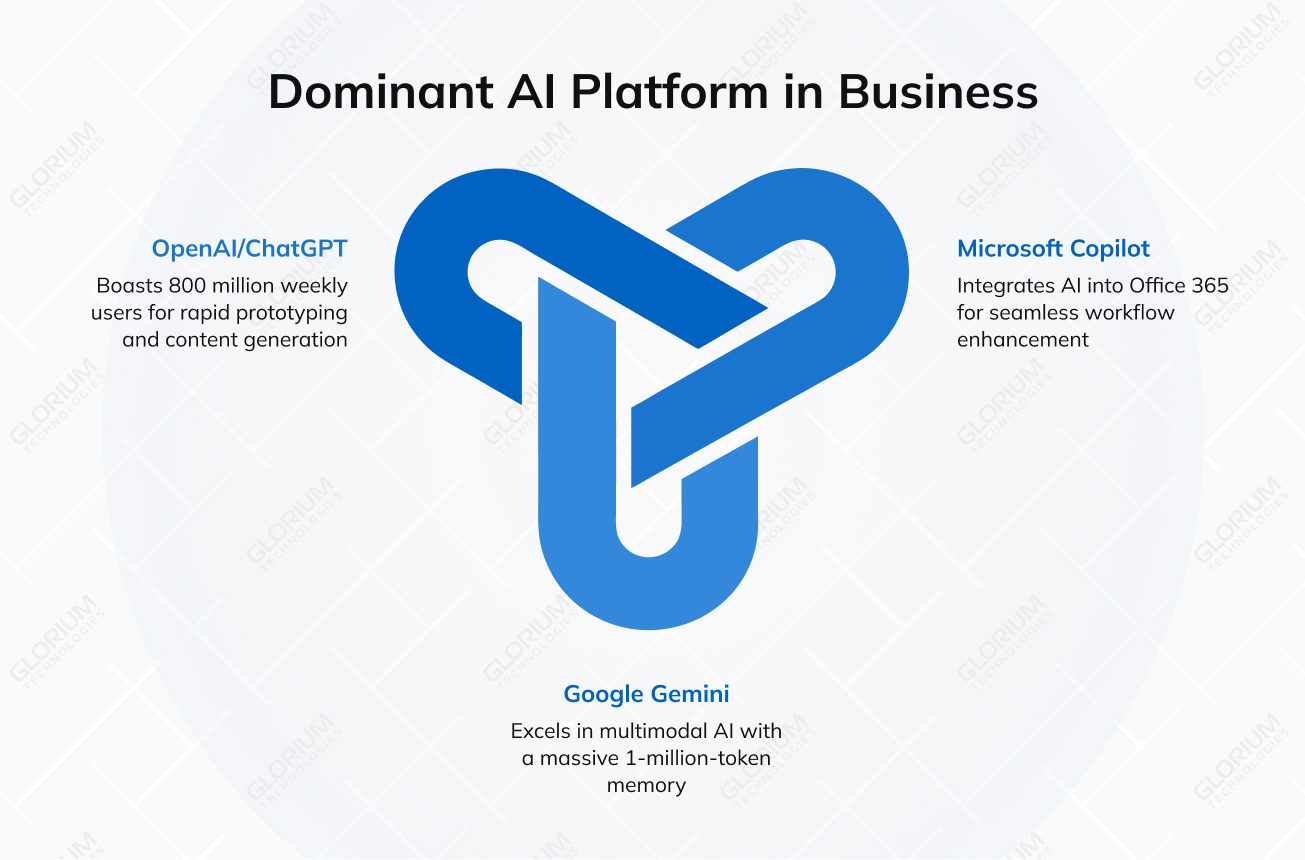
Here are three platforms that dominate:
Recent AI advancements are moving us from simple chatbots to AI agents. A chatbot only talks, but an agent acts. How does this look in a real-world case? You ask a chatbot to “organize a business trip,” and it can give you a list of hotels. An AI agent, on the other hand, can go into your company’s booking system, compare prices, reserve the room, and then add the flight details to your calendar.
This move toward autonomous workflows is made possible by Transformer Models. This is the underlying technology that allows the AI to understand the intent behind a command. It’s what turns the AI from a search engine into a digital employee that can execute multi-step tasks across different software.
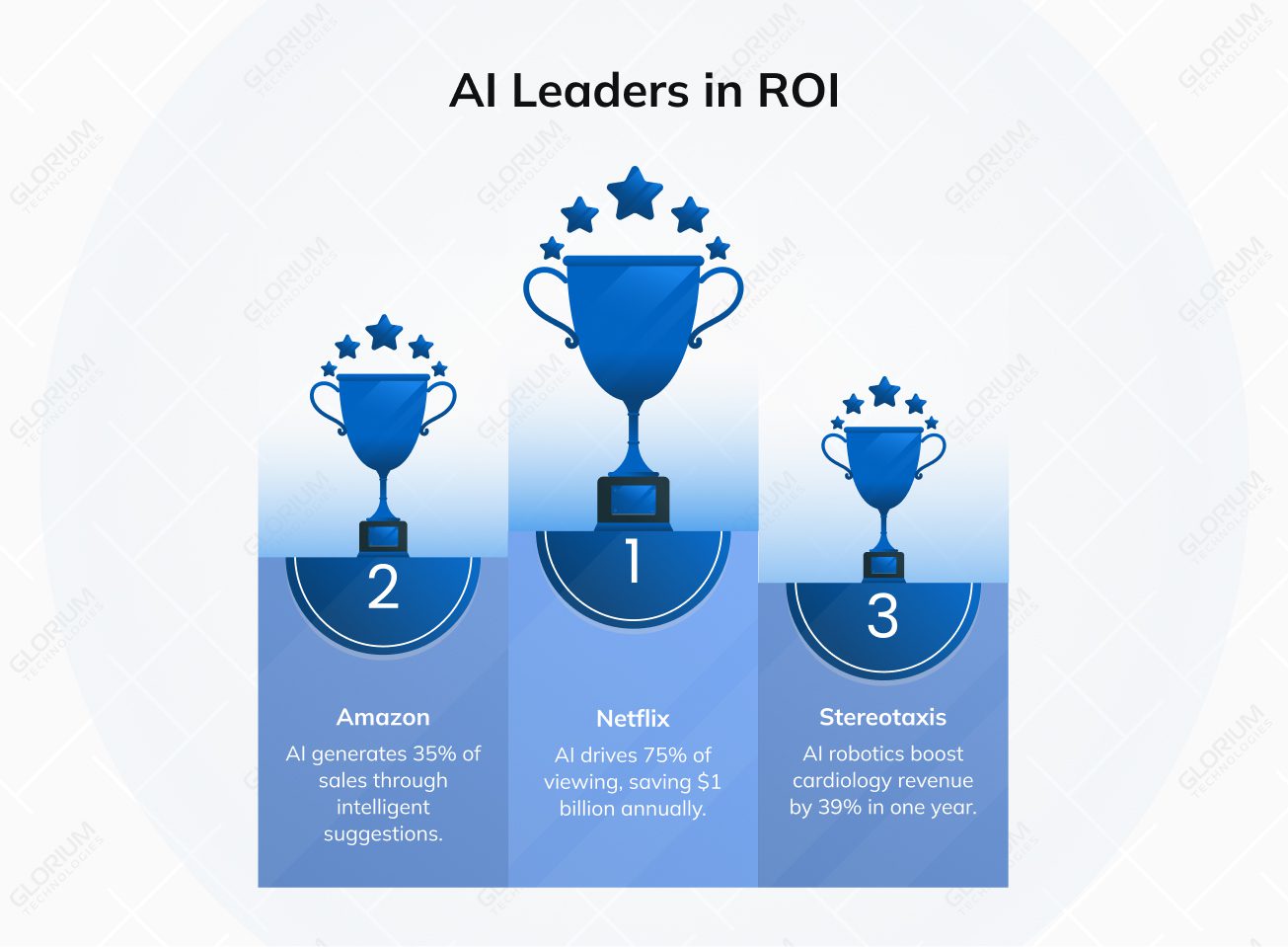
Recent studies demonstrate that AI tools increase productivity by 14% on average, but the real impact is among novice workers: they experience a 34% boost when using AI. Business leaders are now more than just interested in AI. They are seeking more information on real AI performance. Simply put, they understand that having a tool is not enough; they want to know if AI projects can move the needle on profitability. Here is how the market leaders are winning:
They’ve turned AI into a billion-dollar retention tool. About 80% of everything people watch is driven by their recommendation AI models. AI helps predict what users want to watch, and allows Netflix to save $1 billion every year by keeping subscribers from leaving.
Amazon has expanded its AI-powered shopping tools. The new “Help Me Decide” feature analyzes browsing behavior and past purchases to suggest a single personalized product, helping customers make faster decisions.
AI is now helping surgeons perform complex heart procedures with much higher precision. This shift to AI-powered robotics in cardiology helped the company grow its revenue by 39% in just one year. These figures show that high-tech surgery is becoming a major business driver.
Their automotive revenue jumped 21% to $1.1 billion, fueled by AI “cockpit” platforms. This is one of the most visible AI trends of 2026. AI is moving from simple chatbots to controlling machines. Platforms like NVIDIA DRIVE now act as a ‘brain’ for self-driving cars and robotics. So, we can see that AI is turning into a functional tool that operates directly in the real world.
AI performance by the numbers
AI has become the core infrastructure for industries that handle massive data. Leading companies are using these tools to reshape business models, from scientific research to logistics. Check out relevant statistics to see the real value:
The integration of AI in medicine focuses on high-precision robotics and accelerated research cycles:
Banking institutions rely on AI to automate complex decision-making and modernize legacy infrastructure. Check out the statistics that prove this:
Supply chain success depends on demand forecasting and high-precision movement. Instead of reacting to orders, modern firms are integrating AI into their core infrastructure to slash waste. Take a look at the stats below:
The line between human work and technology is blurring now. The labor market is undergoing a structural shift where automation is simultaneously displacing traditional roles and creating demand for new specialized skill sets. The following figures break down the impact:
AI has moved past the stage of simply answering questions. The focus now is on systems that can execute tasks and work with accurate, real-world data. Here are some of the trends shaping what comes next.
“In 2026, that software is going to appear even more in the physical world as physical agents who can move on their own. The numbers show this is already happening. For example, Waymo. Their autonomous taxi service has now logged over 100 million fully autonomous miles and is involved in 96% fewer crashes than human drivers.”
Jeff Su, Top 6 AI Trends That Will Define 2026 (backed by data)
AI is definitely here to stay, but the reality of AI integration is a bit of a wake-up call. Right now, 70–85% of AI projects fail. It happens not because the tech is broken, but because the strategy is. Unfortunately, many companies fall into the fail-fast trap. Simply put, they rush to launch AI products and don’t have a clear plan to follow. As a result, they realize they’ve spent a fortune on something nobody can use.
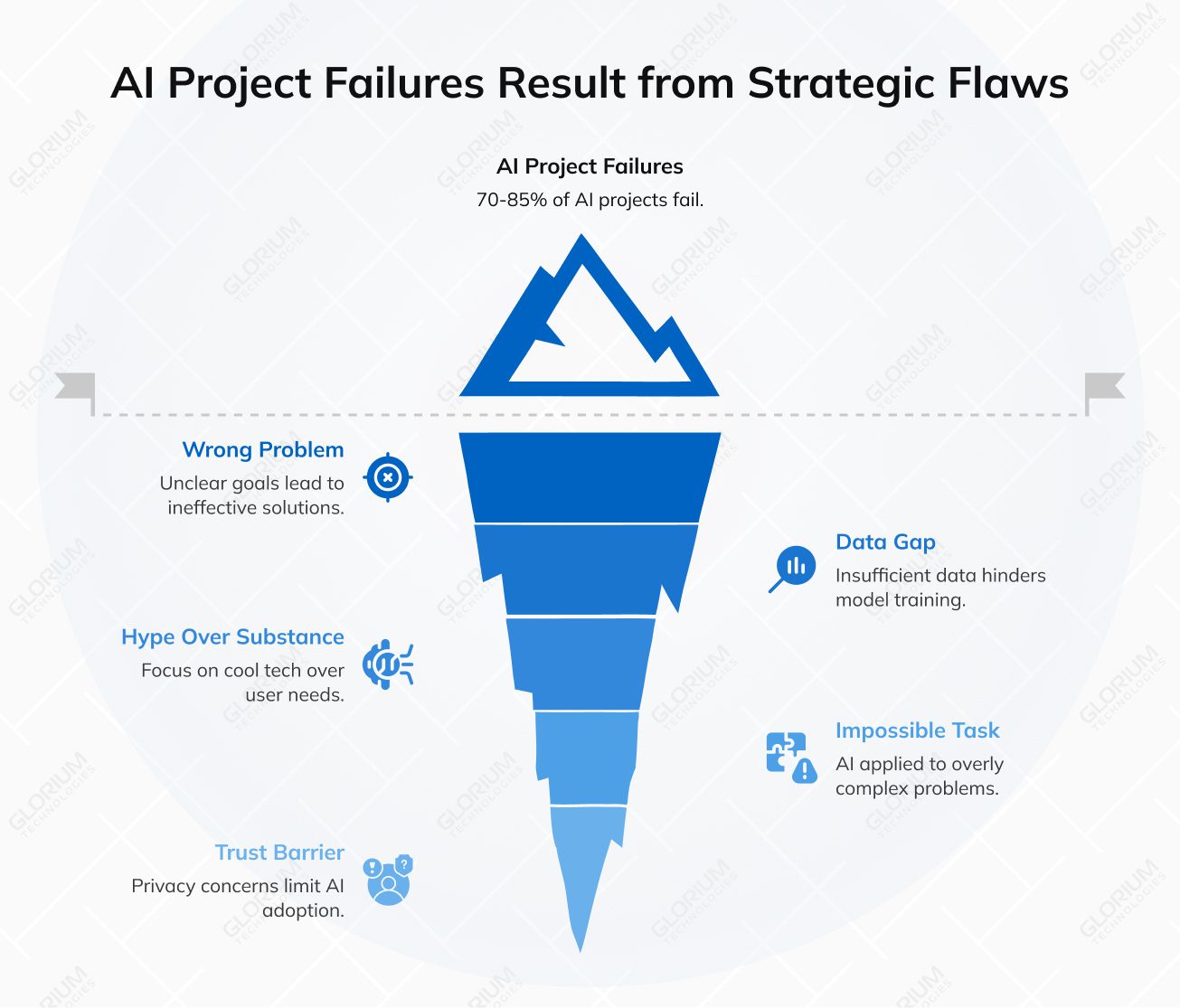
Let’s explore the main reasons why these projects hit a wall:
We’ve reached the point where simply “having AI” isn’t a competitive advantage anymore. In 2026, the real divide is between companies stuck in endless testing and those actually hitting their ROI targets. Moving out of “pilot hell” requires more than just better AI development; it takes a shift toward autonomous agents that can handle real-world operations without constant supervision.
The main goal for AI research now is to build systems that people can actually trust. The main formula for success is not just chasing the latest artificial intelligence trends in business. You should focus on solving specific problems using AI. Today, AI is the engine that drives a new era of business; it is not a laboratory experiment anymore. Want to bridge the gap between AI potential and real-world profit? As experts in building high-impact AI solutions, Glorium Technologies is here to help you navigate the complexities of integration. Book an intro call with our experts to take the first step toward integrating AI into your workflows.
In 2025, the global artificial intelligence market size was valued at USD 390.91 billion. By 2033, there is a chance it can reach USD 3,497.26 billion. To reach these trillion-dollar scales, the industry will likely rely on the rise of quantum computing, which will allow us to process data far beyond what today’s chips can handle. To help businesses navigate these shifts, Glorium Technologies provides AI consulting and software engineering services to turn these tools into real growth.
Some are getting it right, but most are still struggling. Only 39% of businesses see a real impact on their bottom line. The difference is how they treat AI. The businesses that actually see a return on investment have moved past using it for small daily tasks or simple email drafts. They use AI to process information when humans struggle to do so. For example, they use AI to analyze thousands of supply chain variables or automate complex financial audits. In doing so, they cut deep operational costs that actually appear on the balance sheet.
We can’t be 100% sure now. We’re losing 85 million existing positions but gaining 97 million new ones. In this market, the top priority is knowing how to direct it. That’s why Prompt Engineering demand is up 135%; companies need people who can turn a vague idea into high-quality AI-generated content.
Agentic AI is a system that executes actions across different software. A basic chatbot summarizes a meeting for you, an agent can take the action items from that meeting, update the project in Jira, and send follow-up emails to the team. Businesses are choosing Agentic AI because it handles the repetitive everyday tasks that usually slow people down. As a result, these agents manage the background “grunt work,”and human employees focus on the customer experience and the parts of the job that need a human touch.
This is where a lot depends on your purposes and tasks that you are going to handle with these tools. ChatGPT is a perfect tool for general office help. Gemini has a massive memory and is a great helper in processing information from huge archives. And Anthropic’s Claude has already become a must-have tool for AI development. Many software developers are using it for writing cleaner and more reliable code.
The Stanford Institute and recent online surveys point to bad foundations. Companies try to build fancy tools on top of messy historical data. If the base is broken, the AI will fail. Most of these projects are just “hype” without the proper infrastructure that backs them up. Among other challenges, we can mention that teams often throw AI at problems it just can’t handle yet. For example, high-precision climate modeling or other tasks where the data is too complex to solve.
The EU AI Act now requires companies to demonstrate their tech is safe before it hits the market, especially for hiring or healthcare “high-risk” tools. €5.88B in GDPR fines have already been issued, so this means that cutting corners on transparency is a massive financial risk. For businesses, the “deploy and pray” era is over. You now need ironclad documentation and a human in the loop to stay legal. If you want to stay legal, you need to keep clear records and make sure a human is always reviewing the AI’s work.