







The 8 Major AI Conferences the US Has on the Calendar in 2026
Updated March 6, 2026

 Summarize in ChatGPT
 Summarize in ChatGPT
By 2033, the AI industry is expected to reach $3.49 trillion, with growth rates that force companies to move fast just to stay relevant. With over $109 billion in private investment, roughly 12 times more than China and 24 times more than the UK, the infrastructure for 2026 is already being built. Moreover, US institutions are churning out dozens of world-leading models and agentic workflows that drive revenue.
For tech leaders, 2026 is the year of the “AI agent.” But the real challenge is making it work inside existing systems. This is why being on the ground at US events is of utmost importance for business owners. Visiting AI conferences means talking to peers who are dealing with the same integration headaches and security risks.
Networking at these summits is often the fastest way to validate a roadmap. Informal conversations between sessions usually provide the kind of raw, honest feedback you won’t find in a marketing brochure. In this article, we review the best AI conferences scheduled for 2026 in the USA. So, check it out and see which event will help you turn the AI hype into a functional part of your business strategy.
Below, you will find a detailed overview of the most popular AI conferences planned for 2026 in the United States. The real value of these events is getting early access to hands-on demos and vetting vendors before you commit your budget.
NVIDIA GTC is called the “Woodstock of AI.” It is organized by NVIDIA, the company that builds the powerful chips (GPUs) and software that most of the world’s AI runs on. The company’s main goal for this event is to announce its biggest hardware and software releases for the year. The conference focuses on “AI factories,” robotics, and the infrastructure required to run massive AI models.
Who should attend: This is a must for developers, data scientists, and IT infrastructure leads. It’s also very useful for CTOs who need to know what hardware they’ll need to buy in the next 18 months.
This AI Summit is probably one of the best enterprise AI conferences, created by the teams behind Money20/20 and Shoptalk. HumanX is built specifically for business executives and policymakers. It’s held at the Moscone Center and aims to bridge the “implementation gap”. Simply put, it is supposed to help leaders move from vague AI interest to clear business results. The event is famous for its “SolutionBridge” program, which directly matches corporate buyers with vetted AI vendors. Plus, Peer change sessions are also planned. They allow executives to talk privately with others in the same role.
Who should attend: C-suite leaders (CEOs, CFOs, CMOs), founders, and board members who need to set the strategy should definitely visit HumanX. You’ll learn to figure out the ROI of your AI spend and understand new regulations.
This event focuses on shifts from experimental pilots to building a rock-solid data foundation. As a premier global AI conference, the summit provides CDOs and CIOs with the frameworks needed to validate budgets to the board and turn raw data into actual profit. The sessions will be about managing agentic systems and controlling the hidden costs of scaling.
Who should attend: CDOs, CIOs, and data leaders who need to balance aggressive deployment with strict security and corporate governance.
IBM Think Boston is the hub for industries like banking, healthcare, and energy. The event is about the “agentic leap”, moving past simple chatbots to autonomous AI agents that actually handle complex workflows within your hybrid cloud. You will attend sessions on governance, transparency, and building models that don’t hallucinate during an audit.
Who should attend: CTOs, Chief Risk Officers, and Enterprise Architects.
Forget high-level slide decks; this is a practitioner’s event hosted by Databricks. The theme is Data Intelligence, essentially the shift toward making your data pipelines smart enough to feed autonomous agents without manual work. When you visit this event, you will learn more about Lakehouse architecture, open-source tools such as Spark and Delta Lake, and the messy reality of MLOps. Over 800 powerful sessions are planned.
Who should attend: Data engineers, machine learning scientists, and architects.
Ai4 is a giant 360-degree view of the market. It has become North America’s largest meeting point for the AI community, where you’ll find sessions for healthcare, finance, retail, and more. It’s the top event where business and tech leaders meet to shape the industry’s near future. You’ll join thousands of people to see how tech works in the real world, share what’s working, and explore the latest in AI systems. Simply put, it covers every corner of the market through hands-on workshops and live demos.
Who should attend: Business executives, product leads, procurement officers, and everyone looking for specific, industry-aligned solutions and building a network within the broader tech ecosystem.
It is widely considered a premier event for those focused on applied research and the foundation model ecosystem. The summit gathers 5,500+ engineers and researchers who are interested in neural architectures. The 2026 agenda is split across tracks such as “The AI Stack” and “AI Frontiers,” with a heavy focus on the intersection of data engineering and model training. You’ll find technical sessions on distributed inference and edge computing, focusing on how to run massive models on local hardware. It’s a high-energy environment designed for shaping the future of AI.
Who should attend: AI engineers, tech leads, and researchers.
Other AI business events offer high-level talks about cloud software; this summit is all about Edge AI. It focuses on the practical challenge of making vision systems work on local hardware.
It is a good idea to arrive early for the technical workshops that cover how to optimize models so they don’t overheat or drain batteries. You’ll see many real-world applications on the demo floor that show how vision tech is being used in automotive safety and retail automation. It’s a very grounded, engineering-first environment where people talk more about hardware constraints than marketing hype.
Who should attend: Engineers and product managers building “embodied AI”.
Content
Many useful events are planned for 2026, but choosing the best AI conferences in America may be challenging. A lot depends on your requirements: finding new vendors, networking, training the team, etc. However, you should keep in mind that all these conferences offer a fantastic opportunity to gain insights directly from industry experts. You should focus on summits that match your business goals. Let’s review a few tips that might help you make the right choice:
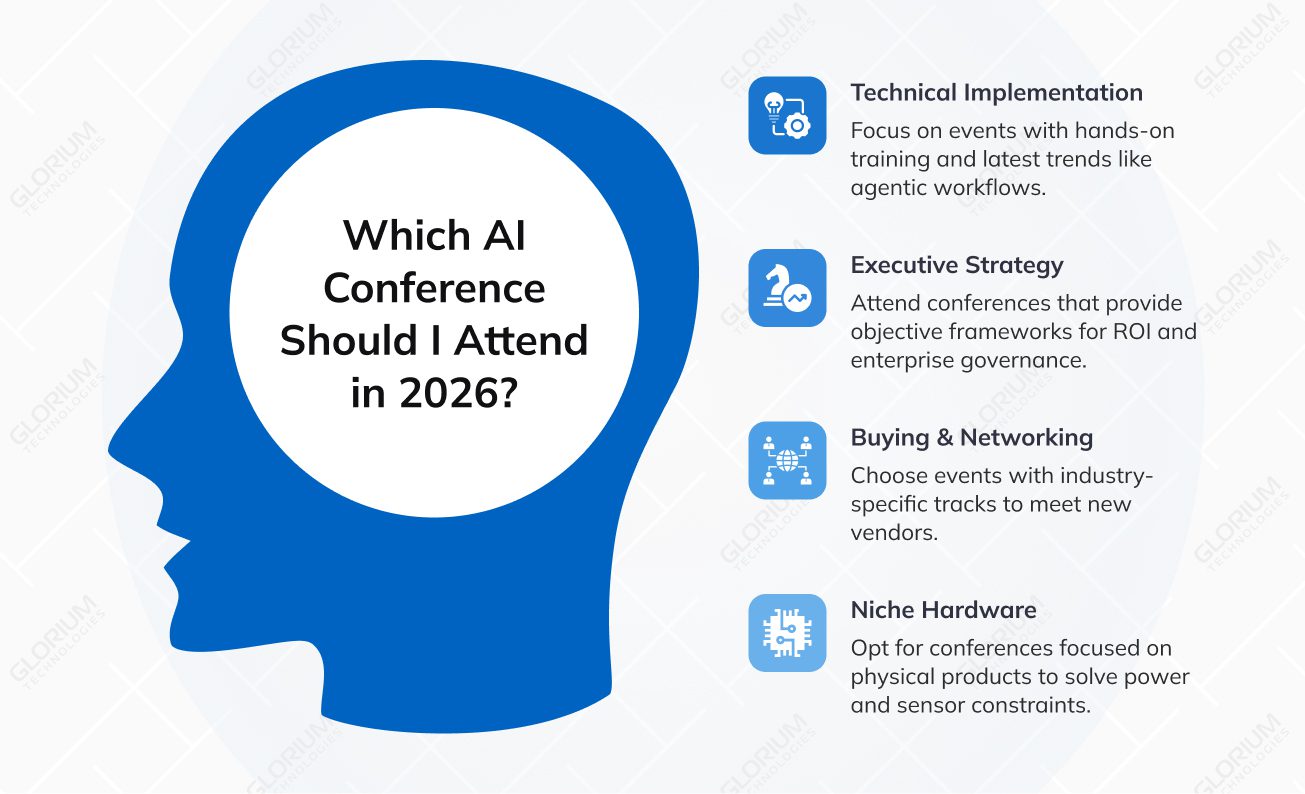
All in all, the best approach is to look at the roadmap for the next year, plan your travel and registration 3-6 months in advance, and prioritize summits that align with your team’s level.
In 2026, investors and boards are looking for a clear line on the balance sheet showing how much money AI tools can make and save. Meeting with thought leaders and peers at these summits is the best way to see how the most successful firms are hitting their targets. These networking opportunities allow you to compare your progress against the high bar set by the current market leaders.
Looking at the latest statistics and scientific research, we can see that some companies are only testing AI, while others have already integrated it into their operations. Check out the stats below:
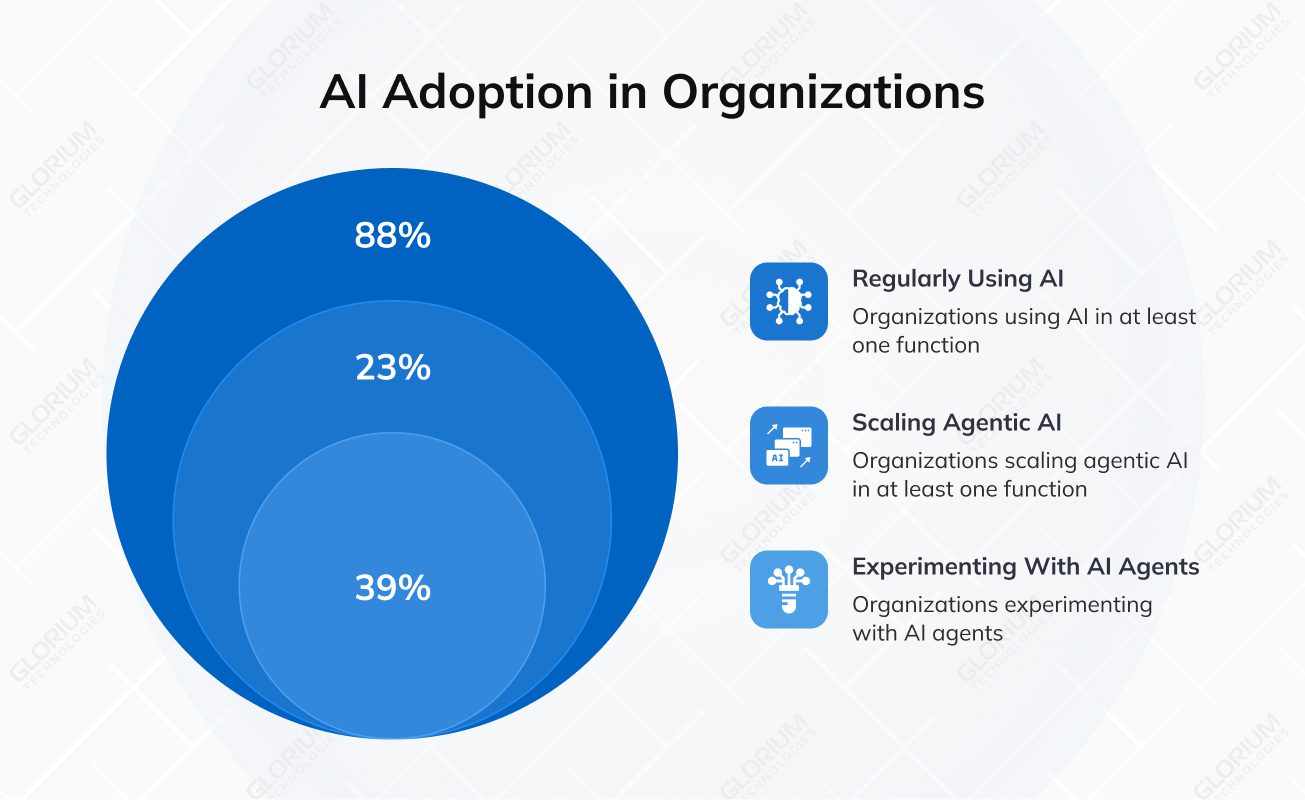
The main reason why these conferences are so popular is the search for talent. The thing is that building an effective AI strategy requires decent experience and, of course, understanding the current pressure on the US labor market:
The volume and depth of AI conferences in the US in 2026 show that the industry has moved past mere experimentation into a sophisticated era of agentic systems and industrial-scale integration. Whether you are aiming for the hardware-heavy sessions of NVIDIA GTC or the executive strategy rooms of HumanX, these events offer the essential high-level networking and technical validation required to thrive in a $3 trillion market.
Success this year won’t just come from attending the right summits, but from effectively translating those insights into a resilient, production-ready roadmap. If you need a partner to help navigate this complexity, the experts at Glorium Technologies are ready to help you refine your AI strategy and implement custom solutions that turn emerging tech into a tangible competitive advantage.
The largest summits that gather AI leaders from around the world include NVIDIA GTC in San Jose, HumanX in San Francisco, and Ai4 in Las Vegas. They are the best hubs for data strategy and governance.
This event marshals hardware architects, data science researchers, investors, and other professionals under one roof. Plus, its major announcements often set the tone for the year ahead. NVIDIA reveals the next generation of chips and software libraries that make training world models possible. If you want to see the physical limits of emerging technologies, you should definitely visit the summit.
HumanX and the Gartner Data & Analytics Summit are the top choices in this case. These conferences focus on the ROI of deploying AI and managing the transition to agentic AI.
It is the largest bridge between technical builders and business leaders. Ai4 organizes tracks by industry (Healthcare, Finance, Retail, etc.). If you need to see how deep learning is being applied in a specific commercial context, this event is for you. On top of that, it’s a massive networking hub for anyone looking to vet vendors or hire talent.
The major “boots on the ground” summits have high ticket prices, but NVIDIA GTC and the Data + AI Summit provide free digital access to their keynote speeches and certain sessions. So, it’s a good opportunity to experience AI breakthroughs and see what’s new without attending these events in person.
The AI Conference in San Francisco is the most concentrated gathering for LLM development. In 2026, the focus is on agentic AI, systems that execute tasks. IBM Think is also a primary spot for seeing how these models are audited for enterprise use.
This summit is specifically structured to close the gap between emerging technologies and their implementation in the corporate world. Their “SolutionBridge” program acts like a matchmaking service, connecting government organizations and enterprises with the right tech partners.
Data + AI Summit and The AI Conference offer the most technical depth. They usually offer many sessions on the mechanics of deep learning, model pruning, and the complexities of deploying AI. Plus, they attract professionals from leading research labs and tech companies, so you can meet interesting people who have solid experience in building AI tools.
If we are talking about private investments or the commercialization of agentic AI, the US leads in 2026. American summits are for those who want to see the biggest hardware launches.
European events like VivaTech are worth attending, but the conversations there lean heavily toward policy, ethics, and the EU AI Act. So, the cultural difference is noticeable. The US ecosystem moves fast and prioritizes shipping, but Europe prioritizes governance. Both matter, but they are playing very different games right now.
Start with your 2026 goal:
When you’re ready to move past the ‘demo’ phase, Glorium Technologies can help you turn AI concepts into functional software.