








Odoo vs. Salesforce: Which Platform Is Better for Your Business in 2026?
Updated April 9, 2026

 Summarize in ChatGPT
 Summarize in ChatGPT
Most companies begin their software journey with a CRM to organize leads, track deals, and manage customer relationships. While CRMs may work perfectly well for sales teams, as the business grows, simple sales tools alone won’t cover everything needed to keep the company running smoothly.
You will notice your finance team requesting accounting tools, your operations teams needing inventory control, and your HR teams needing employee management tools. Before long, departments find themselves juggling several disconnected platforms just to keep everyday processes running.
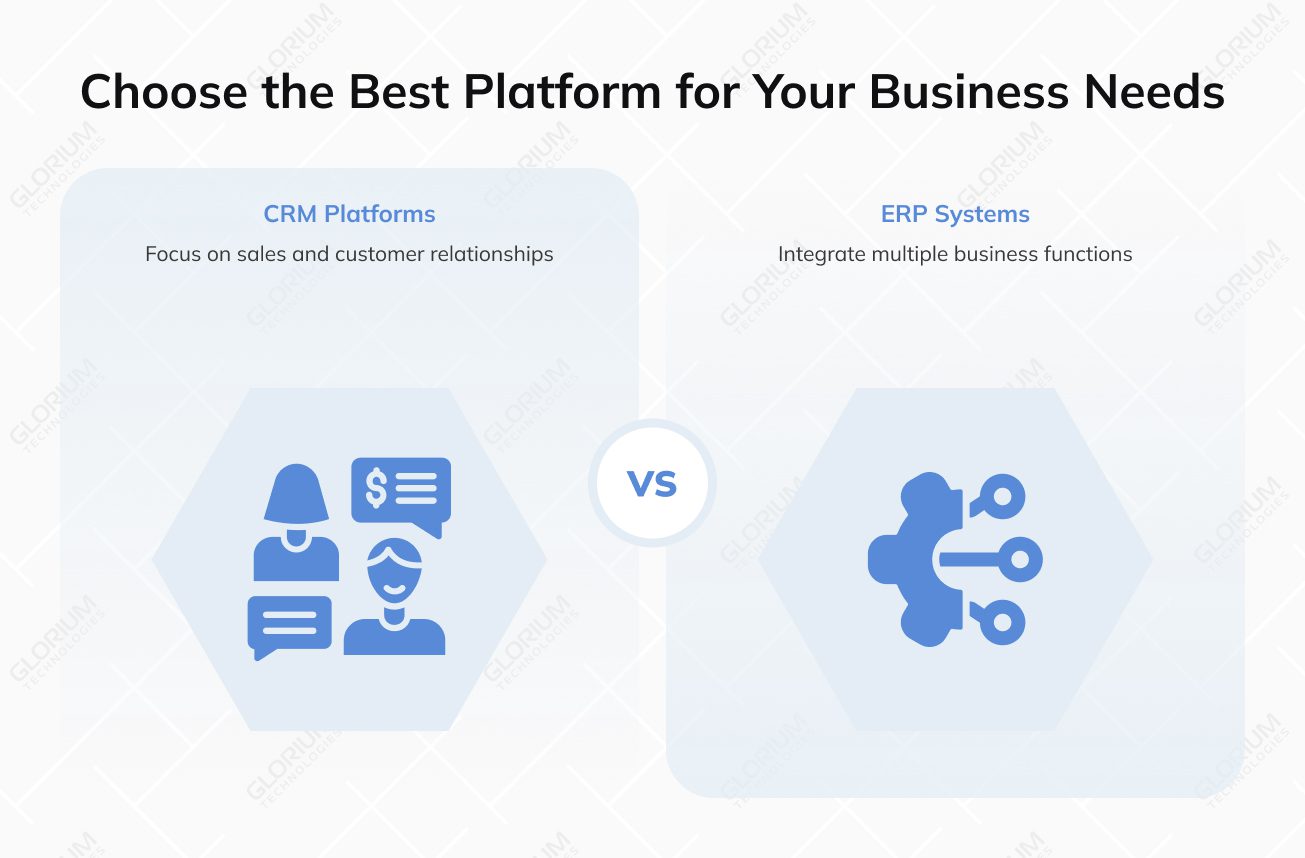
This is where the difference between Customer Relationship Management (CRM) platforms and Enterprise Resource Planning (ERP) systems becomes clear.
CRM platforms primarily focus on managing customer relationships and sales pipelines. ERP systems, on the other hand, go much further by connecting internal processes such as accounting, inventory, procurement, and project management. When these processes are spread across separate systems, teams face scattered data and limited visibility between departments.
Because of this, more businesses are now evaluating platforms that combine CRM tools with ERP capabilities in a single system. Platforms like Odoo take an integrated approach, allowing teams to manage multiple departments within a single user-friendly system.
For companies comparing Odoo vs. Salesforce, the question is not limited to CRM features. It is about which system better supports the business and its needs as it grows.
In this article, we compare Odoo and Salesforce across pricing, features, implementation complexity, and long-term ROI to help business leaders choose the platform that best fits their organization and business needs.
Content
Before comparing pricing or features, it helps to understand how Odoo and Salesforce are designed and what role each platform plays inside a company’s software environment. This makes it easier to make an informed decision reflecting your business priorities. Although both Odoo and Salesforce support CRM software capabilities, they approach business management in very different ways.
Odoo is an open-source ERP platform built around a modular system, offering a wide range of integrated business apps. Rather than focusing only on sales management, it brings together CRM tools and ERP modules that support day-to-day business operations.
Since Odoo is modular and allows companies to connect the tools that run their business, it creates a single source of truth, greater comfort, and improved communication between departments.
Odoo is one of the most popular choices among SMBs due to its open-source nature. This flexibility allows businesses to add customized features, expand the system, and grow without needing to add more software in the future.
To support different teams, Odoo offers a set of built-in modules that cover the main areas of day-to-day operations. These include:
Because these modules share the same database, information can move easily between teams. For example, a sales order can automatically connect to inventory availability, invoicing, or project delivery, helping departments stay aligned and work from the same data.
Many small and medium-sized companies adopt Odoo when they want to reduce complexity in their software stack and manage operations without relying on multiple disconnected systems. For instance, a U.S.-based health-focused restaurant chain faced challenges managing inventory, recipes, staffing, and POS across multiple locations using fragmented systems. We implemented a unified Odoo 18 platform connecting POS, inventory, manufacturing, HR, accounting, and loyalty programs. The result was a 22% reduction in food waste, 18% revenue growth, faster reporting, and improved customer retention, all while streamlining operations and creating a single source of truth.
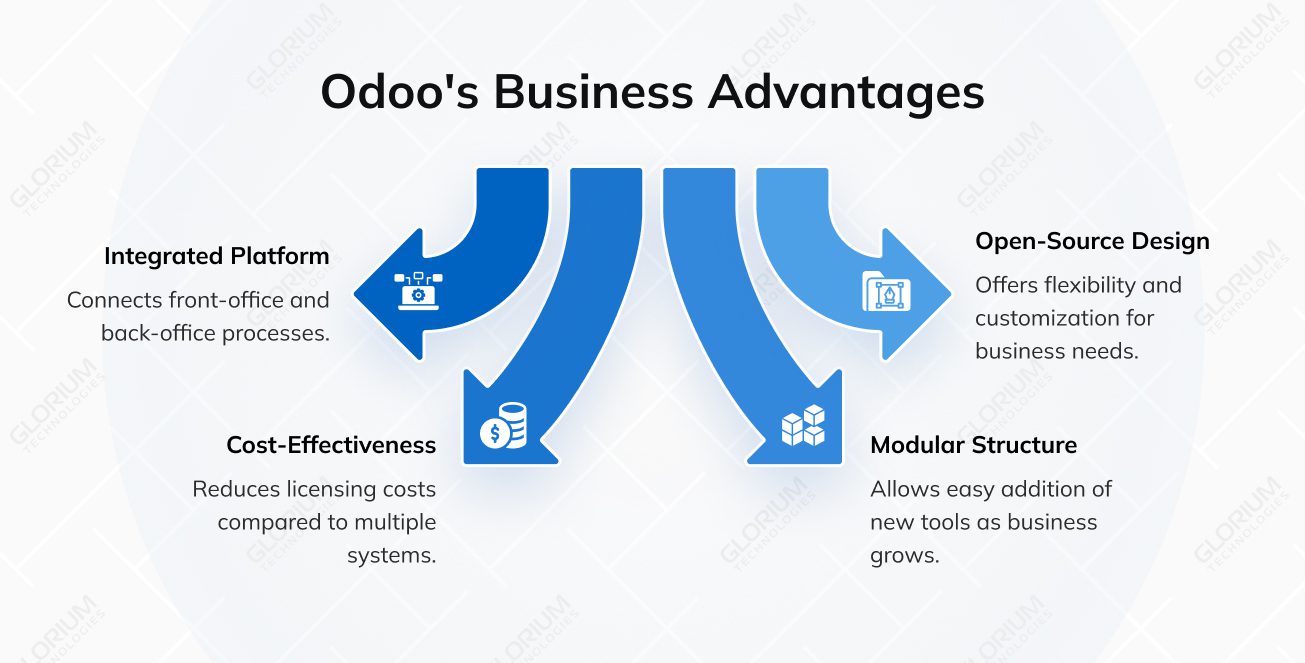
Overall, Odoo offers advantages for businesses looking to manage operations in one place, including:
Salesforce is a cloud-based CRM software platform built to help companies support customer relationship management and sales marketing activities. Instead of covering the full scope of business operations, Salesforce focuses on tools that support sales teams, marketing campaigns, and customer service workflows:
These products allow teams to track customer interactions, manage sales pipelines, and analyze performance data. Because Salesforce is mainly a CRM platform, businesses often find the need to connect it to other systems, including ERP (such as Odoo), to manage the financial processes, track inventory, and improve internal operations.
The software offers a range of capabilities that help sales and service teams work more efficiently and stay connected with customers, including:
Because Salesforce focuses mainly on customer-facing processes, companies commonly use additional platforms to manage finance, inventory, or other operational areas. As more integrations and cloud products are added, the system environment can become more complex. Over time, these third-party tool additions can increase the overall cost of the platform.
Both Odoo and Salesforce can help companies manage customer relationships, but they play very different roles inside a company’s software environment. The differences become clearer when businesses examine how each platform supports everyday operations, integrations, and team collaboration.
Instead of evaluating CRM features alone, many companies look at how well a platform can support multiple business processes in one place. This shift is becoming more common. According to Eurostat data from 2024, 43.3% of EU enterprises reported using ERP software, while 25.8% used CRM software, reflecting a growing move toward unified platforms that connect different parts of the business.
One of the most noticeable differences between the platforms is the range of processes they cover. Odoo provides native modules for many operational areas, allowing companies to manage sales, finance, inventory, and projects within the same environment. Salesforce primarily focuses on front-office activities, such as sales management, marketing automation, and customer service workflows.
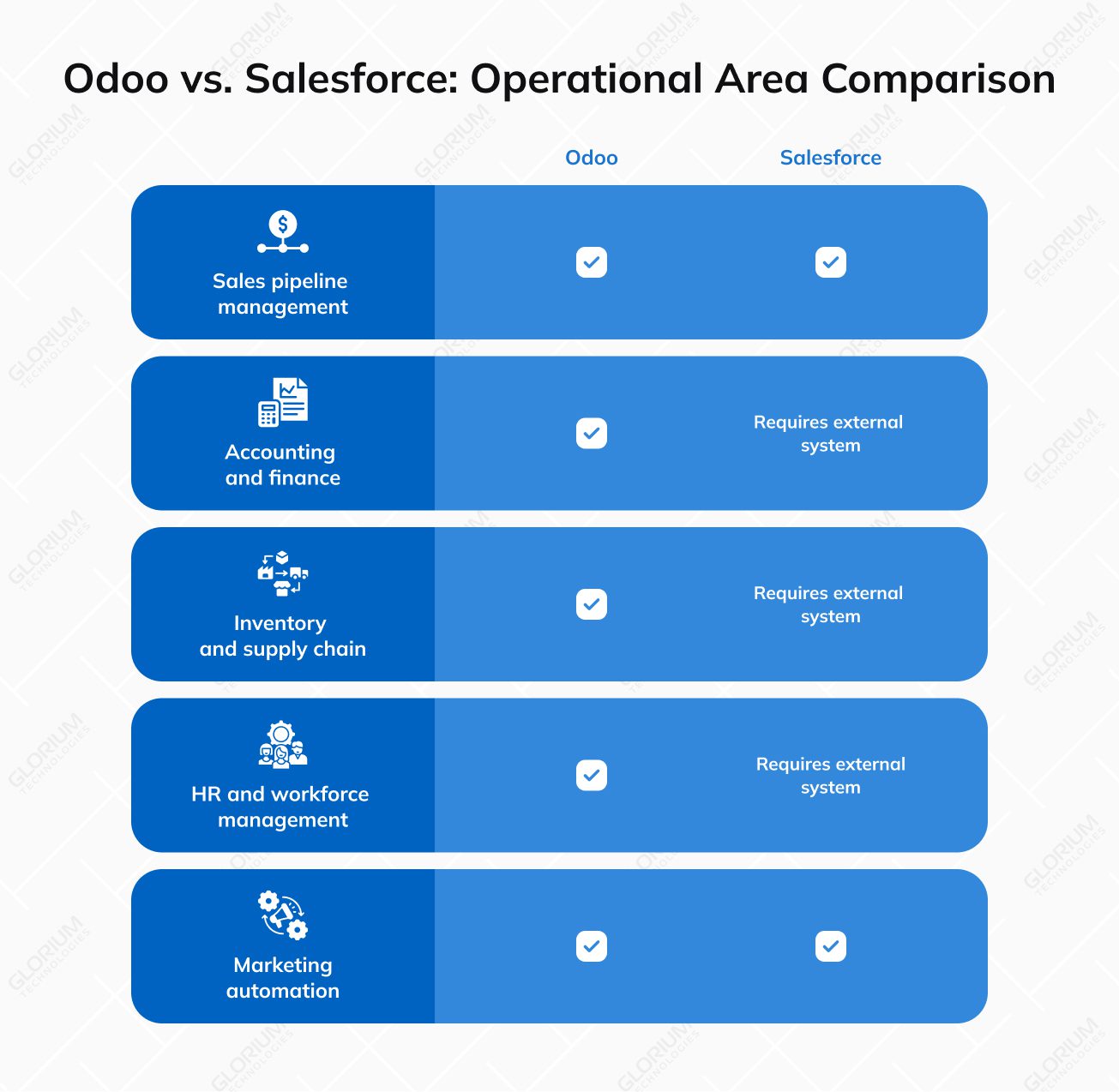
To handle accounting, operations, or supply chain management, companies often connect Salesforce with separate ERP platforms.
Another factor you’ll quickly notice when using Salesforce is the number of software applications you need to maintain. Standalone tools are more difficult to maintain as the numbers grow, and challenges pile up:
This is one of the reasons why businesses compare Salesforce to Odoo. While the CRM system on its own provides significant help to sales teams, companies often find they need more apps. Odoo, on the other hand, includes various operational modules within a single platform, eliminating the need for disparate tools.
Pricing is often the factor that determines whether the business will switch from a CRM system to a comprehensive solution or stay and patch things up with disconnected tools. Because the initial cost of implementing Odoo may seem higher than getting only Salesforce, businesses hesitate to take the next step. While both Odoo and Salesforce use subscription models, their pricing structures differ significantly in how features, modules, and additional services are packaged. To get the full picture, you need to look beyond licensing costs and consider the total cost of ownership (TCO).
Odoo uses a modular pricing model that allows businesses to adopt only the tools they need. Companies can choose the free Community version or move to the Enterprise edition for additional features, hosting options, and support. This flexibility makes it easier to adapt the system to different business objectives without committing to a large upfront investment.
Salesforce, on the other hand, uses a tiered pricing model based on user roles and product levels. Companies typically select from different plans and may add more cloud products over time, depending on their requirements. This structure works well for teams focused on CRM software, but costs can increase as more features, users, or integrations are added.
| Cost Component | Odoo | Salesforce |
| Base platform | Free (Community edition) | Not available |
| Pricing model | Modular, per user (Enterprise) | Tiered subscription per user |
| Entry price | Lower entry point | ~$25/user/month (Starter) |
| Advanced plans | Based on modules and users | Up to ~$330/user/month (Unlimited) |
| Core features | Included or added as modules | Varies by plan |
| Hosting | Optional (cloud or on-premise) | Cloud-based |
While this table provides a helpful overview, the final cost of an Odoo implementation often depends on additional services. Many companies choose to customize modules, integrate Odoo with existing tools, or configure workflows across multiple departments. This can involve data migration, system setup, and ongoing optimization.
For Odoo, costs can vary depending on how a company chooses to scale. Some of the most important considerations include implementation, module customization, cloud or on-premise hosting options, and ongoing support and optimization. Because it is an open-source platform, businesses have more flexibility to prioritize investments based on their workflows and goals, adding new features or apps as needed.
For Salesforce, expenses often grow as more cloud products, AI features, and third-party integrations are added. As more tools are added to expand functionality, the system can become more complex and more expensive to maintain over time.
Looking at these cost drivers together gives a clearer understanding of the long-term financial impact, rather than focusing only on the starting price.
Feature comparisons can be useful, but they rarely give the full picture. What really matters is how a platform helps your team get work done every day, streamlining workflows, automating repetitive tasks, and providing insights that actually guide decisions.
Both Odoo and Salesforce offer CRM tools, but they take different approaches when it comes to automation, integrations, and supporting day-to-day operations.
| Capability | Odoo | Salesforce |
| Lead management | ✓ | ✓ |
| Opportunity tracking | ✓ | ✓ |
| Pipeline automation | ✓ | ✓ |
| Sales forecasting | ✓ | ✓ |
| Workflow automation | Built-in automation across modules | Advanced automation within CRM workflows |
One advantage of Odoo is the way it connects sales activities directly with daily operations. Sales workflows can link to inventory availability, invoicing, or project delivery, giving teams access to real-time operational data without relying on additional systems.
Salesforce focuses mainly on customer-facing activities. Its automation tools are designed to help sales teams manage pipelines, track opportunities, and interact with customers more efficiently.
Artificial intelligence is becoming an important part of modern business platforms, helping companies analyze data, predict trends or customer insights, and automate routine tasks. When comparing Odoo and Salesforce, the key difference lies in how broadly these capabilities are applied across the business.
| Capability | Odoo | Salesforce |
| AI-powered insights | Available through integrated modules and extensions | Advanced predictive analytics and insights |
| Automation scope | Across CRM, accounting, inventory, and operations | Primarily focused on sales, marketing, and service workflows |
| Data usage | Unified data across departments | Customer and sales-focused data |
| Flexibility | Open-source ERP allows customization and extension | AI features available through platform add-ons |
Because Odoo operates as a unified ERP platform, its AI and automation capabilities can cover more than customer management and support financial processes, inventory tracking, and project management, helping companies boost processes between departments.
Another factor companies consider is how well each platform fits into their broader technology environment. Odoo’s open architecture allows companies to customize workflows and extend functionality in different departments. This flexibility works well for companies that want to consolidate several operational systems within one platform.
Salesforce environments are typically extended through additional cloud products or third-party applications. This allows companies to add new capabilities as needed within their CRM environment.
The return on investment from a business platform usually depends on three things: how much it simplifies operations, how many tools it replaces, and how well it scales as the company grows. While both Odoo and Salesforce can deliver measurable value, the sources of ROI often differ depending on how the platform is used within the organization. Platforms that combine CRM tools with ERP capabilities can help businesses reduce system complexity and manage more processes within one platform. This level of integration not only improves internal performance but also contributes to better customer satisfaction and long-term business performance.
Odoo delivers return on investment by replacing multiple disconnected tools with a single platform. By combining ERP and CRM capabilities, it helps businesses manage customer relationships, operations, and financial workflows all in one place.
Common ROI drivers include:
Companies implementing Odoo often achieve measurable benefits by streamlining operations and reducing the number of software systems used across the business. This consolidation can lower IT overhead, simplify reporting across departments, and help teams collaborate more effectively.
For instance, one of our clients, a U.S.-based lighting manufacturer, replaced disconnected tools like spreadsheets, email, and accounting software with a unified Odoo environment. As a result, the company reached over 90% inventory accuracy, reduced stock losses and shipping errors by 16%, and cut defect rates by 35%. By connecting operations within one system, the team also improved visibility and reduced manual workload across departments.
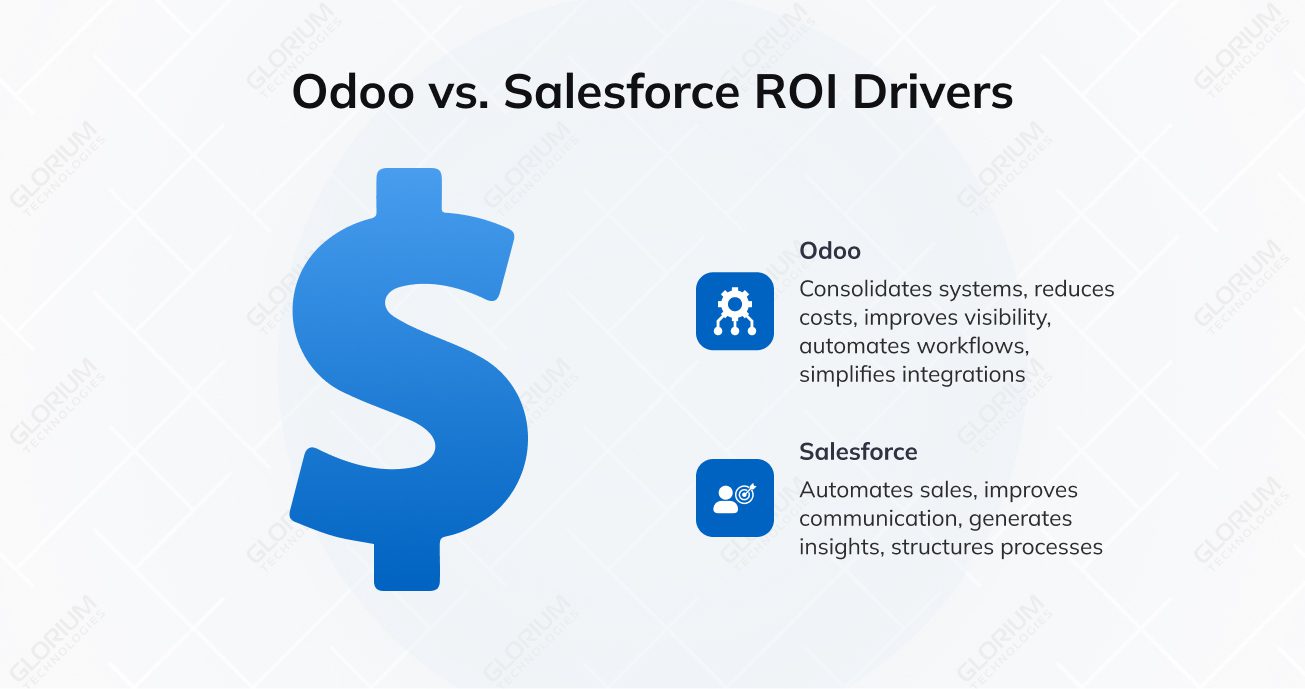
Salesforce ROI is typically tied to improvements in customer-facing processes, particularly within sales and service teams.
Common ROI drivers include:
Organizations may realize benefits from more structured sales processes and improved visibility into customer data, particularly when CRM tools play a central role in sales and marketing.
Choosing between Odoo and Salesforce usually comes down to how your business operates today and how you plan to grow in the future.
If you’re looking for a system that connects multiple departments and supports day-to-day operations across the business, Odoo offers a more unified approach. As an open-source ERP platform, it brings together sales, finance, inventory, HR, and project management in one environment, making it easier to handle workflows and keep data consistent.
Salesforce, on the other hand, is built as a CRM-first platform. It’s designed to help sales, marketing, and service teams manage customer interactions, automate pipelines, and improve visibility into customer data. For companies that lean on customer relationship management CRM processes, this focus can be a strong advantage.
As businesses grow, this difference becomes more noticeable. Some organizations continue expanding Salesforce by adding more cloud products and integrations. Others choose to move toward platforms like Odoo to reduce system complexity and bring operations into one place.
To make the decision clearer, here’s how the two platforms compare over main areas:
| Factor | Odoo | Salesforce |
| Main focus | All-in-one open-source ERP + CRM platform | CRM-first platform |
| User experience | Unified interface across departments; less switching between tools | Highly polished CRM interface, but often spread across multiple products |
| Pricing approach | Modular, flexible, lower entry cost | Tiered pricing, can increase with add-ons |
| Implementation | Faster when used as a unified system | Often requires multiple integrations |
| Customization | Highly flexible (open-source, custom modules) | Configuration-based, extensions via ecosystem |
| Operations & manufacturing | Strong support for inventory, manufacturing, and supply chain workflows | Typically requires external ERP systems |
| User onboarding | Easier to onboard teams into one system | May require onboarding across multiple tools |
| Growth strategy | Scale by adding modules within one platform | Scale by adding products and integrations |
| AI capabilities | Growing AI features across modules | Advanced AI tools focused on CRM and analytics |
| Automation scope | Cross-department automation (sales → finance → operations) | Primarily focused on CRM workflows |
| Best fit | Businesses looking to centralize operations and reduce system complexity | Companies prioritizing advanced CRM and client interaction tools |
In practice, the right choice depends on your business needs. Companies that want to simplify their systems, minimize the need for multiple tools, and gain full visibility across operations often lean toward Odoo. Meanwhile, some organizations use Salesforce as a standalone CRM, typically alongside additional platforms to support operational processes.

At the end of the day, one of the most important factors to consider when choosing a business platform is how well the system fits your company’s way of working and growing.
At Glorium Technologies, we help medium-sized and growing businesses plan, implement, and customize Odoo solutions that connect sales, finance, inventory, and internal operations in one platform.
Our Odoo specialists support the entire process, including:
If you’re evaluating Odoo as a replacement for conventional CRM platforms, we can help you define the best approach designed for your specific requirements. Schedule an introductory call to see how the platform could support your business or request a free custom demo to test out Odoo in practice.
Consider switching to Odoo when Salesforce isn’t enough, teams struggle with disconnected tools and scattered data, and the cost of maintaining several platforms is too much. If you want to manage all your business operations in one single tool, Odoo outperforms Salesforce. And if you’re comfortable with Salesforce and its features, you can always connect it to Odoo.
It often makes sense to switch when a company starts outgrowing Salesforce as a standalone CRM and needs a more unified system to support day-to-day operations.
In many cases, Odoo has a lower entry cost because companies can deploy multiple business modules within a single platform. Salesforce environments usually need additional integrations or products to cover the same operational areas.
For many SMBs and mid-market businesses, Odoo can replace Salesforce by combining CRM tools with ERP functionality. However, the best option depends on the company’s processes, team size, and system requirements.
Yes. Odoo’s modular structure allows companies to start with a few modules and gradually expand the platform as the business grows.
Odoo can be installed independently, but many companies work with implementation partners to configure modules, migrate data, and align the platform with their workflows. A professional team can also help avoid common setup issues and ensure the system supports long-term growth.
Yes. Odoo can integrate with Salesforce using APIs or middleware connectors, allowing data such as leads, customers, and orders to sync between systems. Many companies use this approach during a transition period before consolidating more processes inside Odoo.
Implementation timelines depend on the number of modules, system complexity, and customization requirements. Smaller deployments can typically be completed within a few weeks, while larger ERP implementations may take several months to fully configure and deploy.
Before implementation, companies should evaluate their business processes, required modules, and integration needs. Planning the system architecture early helps ensure the platform supports both current operations and future growth.