










Startup Software Development

Your Budget, Simplified - Discover Your Project's Cost
What is your primary goal for building an MVP?
Choose the primary funding for this project:
Choose your industry:
What MVP elements have you completed so far?
What matters most in a development partner?
How do you plan to promote your MVP?
What’s your estimated budget for this project?
What is your timeframe for launching an MVP?
How would you describe your core business idea?
What’s your biggest challenge right now?


 Back
Back
Cut Risk with the Right Team

Smart Builds for Early-Stage Growth


Benefits of Collaboration with Glorium Technologies


Where Startups Succeed—Our Software Building Process


- Market fit
- Tech strategy
- Feature scope
- Milestone planning
- User journey
- Interface clarity
- Visual prototypes
- Usability focus

- MVP build
- Agile sprints
- Clean code
- Real feedback

- Bug detection
- Performance checks
- Usability testing
- QA coverage

- App launch
- Store compliance
- Feature tuning
- User feedback

- Continuous updates
- Bug fixes
- SLA support
- Scaling strategy

Join Forces with a Tech Team for the First 100K Users
- Tap into 200+ vetted specialists
- Experts across 15+ tech stacks and roles
- Reduce time-to-market by up to 47%

Reasons You Can Grow Faster with Us
- Concept validation
- Cost
- Development lifecycle
- Methods & best practices
- Performance optimization
- We guide your vision from the start
- Startup-friendly
- Full-cycle
- Processes defined
- Scale up or down anytime
- Hiring a separate consultant is required
- Low
- Limited
- Verification is required
- Re-onboarding is required
- They often lack the needed experience
- High
- Limited
- Verification is required
- Scaling isn’t always smooth
Move from Legacy to Modern

Our engineers analyze your code to uncover business logic. They review dependencies and work with your team to handle integration for a smooth update.

We assess technical and business risks before any changes. Modularizing your legacy system helps us modernize it in smaller, trackable, low-risk steps.

Our experts track system behavior after modernization. We vouch for smooth performance and zero interruptions to your business processes.


Startup Software That Fits Your Market




Collaboration That Fits Your Strategy

- Hourly pricing
- Flexible timelines
- You manage priorities

- Custom pricing
- Flexible timelines
- You track progress

- Monthly rates
- 6–24 months
- Hands-on collaboration
Next-Gen Tech Driving Startup Success


Don’t Guess—Learn Your Idea’s Potential in Under 2 Weeks
- ESTIMATE COSTS1. DISCOVERY We get your requirements

- 2. SHORTLIST We send you a shortlist
- 3. INTERVIEW We set the cooperation details
- 4. CHOOSE You interview the candidates
- 5. HIRE Your developer starts working

What our clients say about us







Our clients journeys










Who we are
About usGlorium Technologies is a full-cycle app & software development company which covers specific client business needs and manage them with the help of the best possible technology solutions.
Since 2010, we have been inventing digital breakthroughs, helping startups and businesses come out on top in their markets.

Why choose us




Certifications








Let's Connect!



Startup Software Development for Founders Who Want Results
Coming up with a great idea is a big milestone, but transforming it into a polished software product is never straightforward. Founders are often caught between building fast and building right, and in this tension, many startup companies run out of steam. As stated by Exploding Topics, 34% of startup failures are due to a poor product-market fit while 18% of startups fail due to team problems and other human-resource-related issues. A missing business model and a lack of market need are also major contributors. These statistics highlight a recurring pattern: founders pour time and cash into overengineered projects that users don’t need.
What makes a difference? Founders who balance smart planning with speed and flexibility tend to beat the odds. Building a minimum viable product once thorough market research is completed can sidestep the typical startup traps. Agile development – with short iterations and early user testing – makes for another cornerstone.
Take Airbnb’s early days, for example. Before coding a full platform, its founders launched a simple MVP—an online listing and payment form—and validated demand with early users. That lean launch guided essential product decisions, ultimately fueling their global success.
What Founders Must Know About Software Development Today
Unlike enterprise software engineering, startup software development is shaped by lean budgets, urgent timelines, and rising user needs. The pressure to launch quickly without compromising the user experience means you must be deeply involved in every phase of the software development process. And the latter should focus on testing assumptions, incorporating customer feedback, and iterating fast. Short development life cycles and agile principles become your best allies.
Why strategic planning defines product outcomes
Many founders rush into startup software development without verifying whether the product solves a real problem, only to become part of the failure rate later on. No matter how well it’s built, a product lacking early validation often fails to resonate with users. A solid foundation begins with research—understanding the target audience, analyzing competitors, and defining a clear problem-solution fit.
Early user validation allows teams to avoid assumptions and build around actual needs. This is where minimum viable product thinking becomes essential. Rather than building a full solution, startups focus on core features that deliver immediate value. This approach can help you minimize wasted development cycles.
Software development for startup-specific needs
Unlike large enterprises, software startups usually don’t have the luxury of unlimited time or resources. They need to build working prototypes quickly, without putting the future of their product at risk. Requirements also shift frequently as new insights emerge, making fast feedback loops and adaptability essential.
Why the right team is a critical success factor
Even the top-of-the-line tech stack won’t carry your product without the right people behind it. You need a software development team with startup experience that’s product-focused, adaptable, and proactive in making better decisions.
The best teams offer more than execution—they contribute to your strategy, bring business analysis into every phase, and care deeply about the end user. In early-stage ventures, that mindset is just as important as code quality.
How to Choose the Right Startup Software Development Company
The best software development partner brings more than technical skill; they bring a product mindset. That means thinking beyond features and focusing on user value, business goals, and long-term growth. They ask the right questions, challenge unclear assumptions, and help define what success looks like before moving into development.
Startups operate in unpredictable environments, where customer feedback can change the roadmap overnight. A flexible team, comfortable with shifting priorities and short development cycles, can keep your project on track without compromising quality.
Finally, early stage experience makes a noticeable difference. Teams that have worked with other startups understand the importance of lean development, MVP delivery, and speed-to-market. They know how to balance velocity with stability and help you avoid common missteps.
Warning signs that you may be opting for the wrong partner
Not all software companies are built for startup work. Lack of MVP experience is a major red flag. If they only know how to deliver full-scale enterprise systems, they may overbuild and miss the core problem you’re solving.
Poor communication is another sign, as your company needs frequent check-ins, fast decisions, and clarity across roles. If the development team is slow to respond or vague about timelines, that’s a risk.
You must beware of overly rigid processes – your startup needs room to iterate. If the team can’t adapt to their approach, your product may stall before it even launches.
How to vet a software development company for startup readiness
Evaluating the right partner goes beyond code samples or case studies. You need to assess whether they truly understand the pace, priorities, and unpredictability of startup life.
Start by asking targeted questions:
- Have you built minimum viable products before?
- How do you handle shifting requirements mid-sprint?
- What’s your approach to fast feedback and iteration?
- Can you walk us through a startup project you’ve scaled successfully?
You need to look for indicators of alignment with startup culture. Are they comfortable working with expanding roadmaps? Do they prioritize user value over feature volume? Are they transparent, responsive, and solution-oriented in early conversations?
A startup-ready team like Glorium Technologies will lean into collaboration, flag risks early, and show flexibility without compromising delivery speed. We are not just a contractor; we act like strategic partners who treat your product as our own.
Software Development for Startup Projects: The MVP Approach
As speed and precision often determine survival for early-stage companies, MVP startup software development is the smartest way to move forward. Instead of pouring resources into a fully featured product, you can launch with the essential features needed to solve a specific problem for a clearly defined user base.
The MVP approach allows teams to validate assumptions early and avoid overbuilding based on internal opinions alone. It reduces time to market while helping prioritize future development based on data. In short, it’s about learning fast and investing wisely.
Custom startup software development vs. off-the-shelf tools
Choosing between custom-built software and off-the-shelf tools comes down to what you’re aiming to achieve and how you plan to grow. Pre-made solutions are fast and affordable, but often lack flexibility. While more resource-intensive, custom startup software development offers scalability, better integration, and long-term alignment with your business model.
A custom software development company is worth your attention if your software is central to your value proposition or you’re building something innovative. For non-core functions, leveraging existing tools can keep costs low and timelines short while maintaining focus on your core product.
Startup Outsource Software Development: Is It Worth It?
Outsourcing software development can be a smart, strategic choice for early-stage companies operating on limited budgets and tight timelines. But it’s not a one-size-fits-all decision. Understanding when and why to outsource is key to avoiding wasted resources and missed opportunities.
Outsourcing vs. hiring in-house: what startups need to consider
Speed of execution is often the most compelling reason to outsource. Building an in-house team takes time—recruiting, onboarding, and team alignment can delay development. An experienced external partner can start immediately and deliver results faster.
Cost control is another advantage as outsourcing gives startups predictable pricing models and flexibility to scale resources up or down based on the development phase. You can save yourself from the trouble of full-time salaries and benefits.
Key Phases of Startup Software Product Development
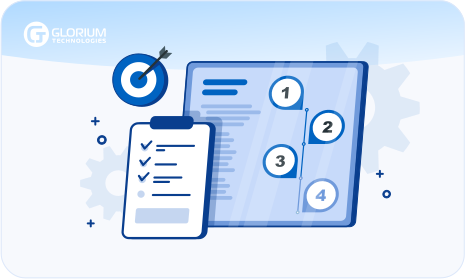
The startup software development process for early-stage companies follows a clear, iterative path. Each phase is vital in reducing risk, improving clarity, and ensuring your final product aligns with customer needs and your business plan. Here’s how smart software product development unfolds:
- Discovery & planning: Define the core problem your product will solve for your target audience. Once it is validated, align the project scope with your available resources, timeline, and broader business objectives to avoid overextension. Prioritize key features that deliver early value and support an MVP strategy
- Design & prototyping: Develop UX/UI for early users, focusing on simplicity. Create interactive prototypes to simulate user flows before development. When ready, test for usability, navigation issues, and messaging clarity
- Development & iteration: Execute development in agile sprints to enable fast adaptation. Conduct ongoing QA and usability testing throughout each software development phase. Plus, incorporate structured feedback loops from users and stakeholders
- Launch & post-launch growth: Track key metrics such as retention, churn, activation, and conversion. It’s essential to optimize infrastructure and code for scalability and performance. Once everything is all set, prepare supporting materials for fundraising or entry into new markets
Top Startup Software Development Services That Add Real Value
The most effective software development teams offer services that support product success from day one, helping founders make informed decisions at every stage. These services often include product strategy and defining the right direction based on user needs and business goals.
User research keeps your product decisions rooted in how people actually think and behave, helping you focus on features your audience will truly use. At the same time, tackling compliance and security early on means your software will meet industry standards and earn users’ trust. Together, these steps set the stage for a product that’s not only user-friendly but also scalable and reliable from the start.
Glorium Technologies – Your #1 Choice for MVP Startup Software Development
Want to team up with a partner who brings strategy, adaptability, and results to every engagement, guiding you through focused MVP development and market alignment? Look no further than Glorium Technologies. We understand that software development is not only a technical task but a critical business decision. That’s why we build solutions that solve real problems and support sustainable growth.
Partner with a team that brings structure, insight, and focus to your launch. Schedule a discovery call to discuss the first steps.

More From Glorium Technologies
FAQ
What are the best practices for a software development startup?
The best practices are focused on lean development, early validation, and adaptability throughout the process. Start with a clearly defined problem and use MVP development to test assumptions with real users. Invest in user research, UX design, and short development cycles to stay aligned with customer needs.
What matters most when planning software development services for startup companies?
You should hone in on clear problem definition, early user validation, and a focused MVP. Choose a flexible tech stack, outline a realistic timeline, and align the scope with your budget and goals. Agile workflows, short feedback loops, and scalable architecture are also important for building a product that meets real market needs.
How does a strong MVP strategy affect startup software development projects?
A strong MVP strategy helps focus startup software development on solving a real problem with minimal features. It enables early testing with users, reduces development time and costs, and provides critical feedback for future improvements.
What are the key challenges in startup software development?
The list of challenges in startup software development includes limited budgets, tight timelines, shifting requirements, choosing the right tech stack, prioritizing features, and managing scope. Balancing speed with product quality, validating ideas early, and assembling a skilled, adaptable team are all critical to overcoming these obstacles.