







Everything You Need to Know about Mobile Banking App Development
Updated September 7, 2026

 Summarize in ChatGPT
 Summarize in ChatGPT
Speed and security create a solid foundation for modern finance: the faster you deliver your services, the more profit you make. A robust mobile banking app delivers both and puts essential services directly into your customers’ hands. However, the path to a successful launch is full of regulatory complexity, such as GDPR in the EU, AML/CFT in the UAE, and EFTA in the US. A single misstep in the development process can result in costly mistakes, making expert guidance necessary.
The good news is that you don’t have to do the development process alone or with an inexperienced team. We created this article to guide you through the mobile banking app development process, its benefits, pricing factors, integrations, and more.
Content
Banks are organizations with the largest and most diverse audiences: almost every adult has a bank account or uses financial services. Rising customer expectations and a significant shift to mobile-first banking highlight the need for financial institutions to become digital.
New Forrester research highlights how strong this trend has become. In 2024, 73% of Australian adults, 68% of UK adults, and 65% of US adults said they want to perform all financial activities using a mobile app. People no longer want to log in on a desktop or wait in line. They now look to banking providers to let them literally carry their budget in a pocket.
Financial institutions that embrace this trend see a significant payoff. Neobanks generated $33.5 billion in revenue in 2023, with nearly a quarter of that coming from NuBank alone. These digital-first players prove that mobile-centric services can drive adoption and profitability, showing traditional banks what happens if you give your customers the digitized experience they expect.
The digital trend hype isn’t enough to convince financial institutions to invest in banking app development services. And it makes sense! However, this isn’t just a trend that’ll fizzle out in a few years; banking software development is a long-term investment with unmatched benefits, cost-efficiency through automation and personalization, security, and business continuity.
So, let’s explore the factors that drive companies to approach banking app development services:
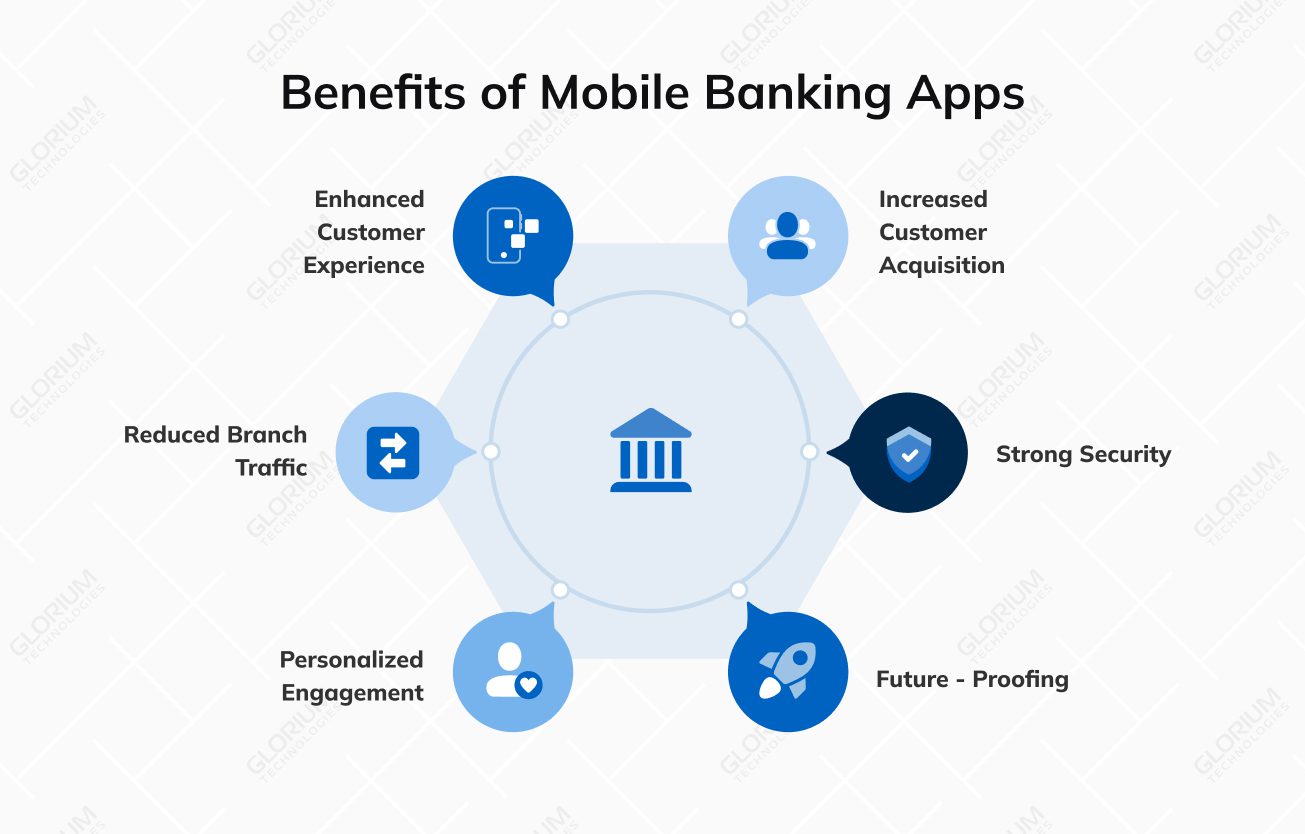
These benefits just scratch the surface. Depending on your app’s idea, basic features, advanced features, and other components, you may see unmatched advantages not listed here.
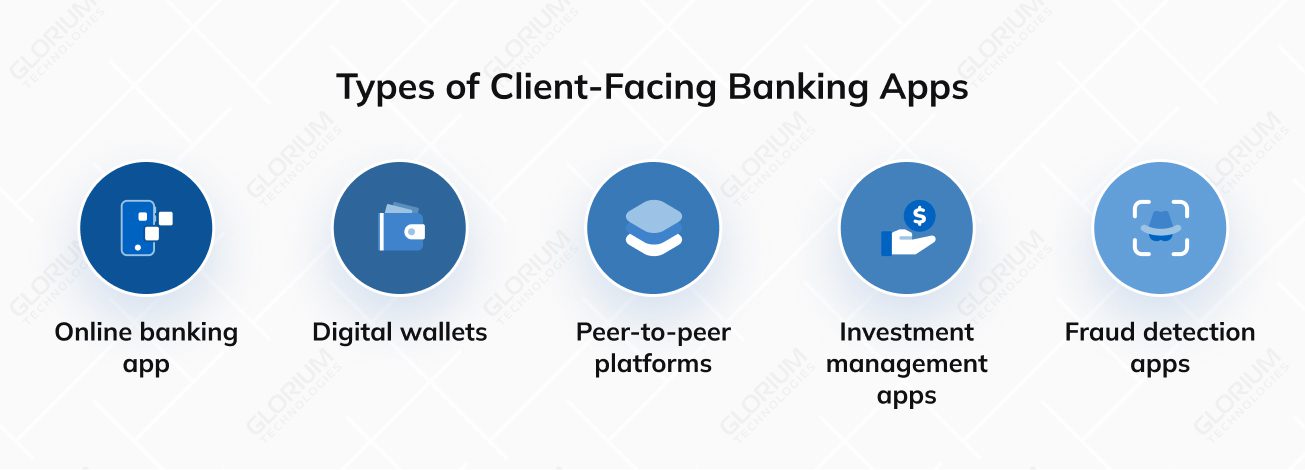
You can develop two types of banking apps: client-facing and in-house. The first category helps you attain more customer loyalty, offer diverse digitalized services, and the second category allows you to automate processes, reduce manual work, and grow efficiency. Need a better guide? Below, you’ll find the most commonly developed mobile banking apps:
Client-facing apps are designed to improve the way customers interact with your bank. These solutions focus on speed, convenience, and security, giving end users the tools they need to manage money on the go. They also help banks build stronger relationships, increase digital adoption, and open new revenue channels.
Let’s explore some of the most in-demand apps:
Online banking apps offer retail and SME customers a fast, secure way to bank from anywhere. You can add numerous user-friendly features, including easy onboarding, account dashboards, payment solutions, transfers, bill pay, card controls, and alerts. By building this app type, you reduce branch dependence for account holders and lift digital engagement with clear flows and an accessible design.
With a digital wallet, customers can use your app for everyday purchases. They can store cards, pay with NFC or QR codes, collect loyalty rewards, view receipts, and request refunds. The wallet can also connect with core banking, KYC/AML, and fraud prevention services. It makes transactions fast and secure, driving repeat use and giving you better first-party data.
Peer-to-peer platforms make sending and receiving money simple for your customers. You can add features like address book lookup, payment links, request-to-pay, and group payments. Your users will be able to apply limits, velocity rules, and clear dispute flows. P2P features increase daily app usage and improve retention.
Investment management apps provide a modern wealth experience in an app. They display portfolios, positions, performance, and analytics for end customers, support rebalancing requests, and secure advisor messaging. You can also connect your investment management app to custodians and market data to keep information current and compliant with review and audit needs.
Fraud detection tools are designed to build trustful relationships with your users. They let your customers freeze cards, set spending limits, file travel notices, and confirm high-risk actions with strong authentication. Paired with visible controls and background risk checks, fraud detection tools can lower friction and financial losses for your financial institution.
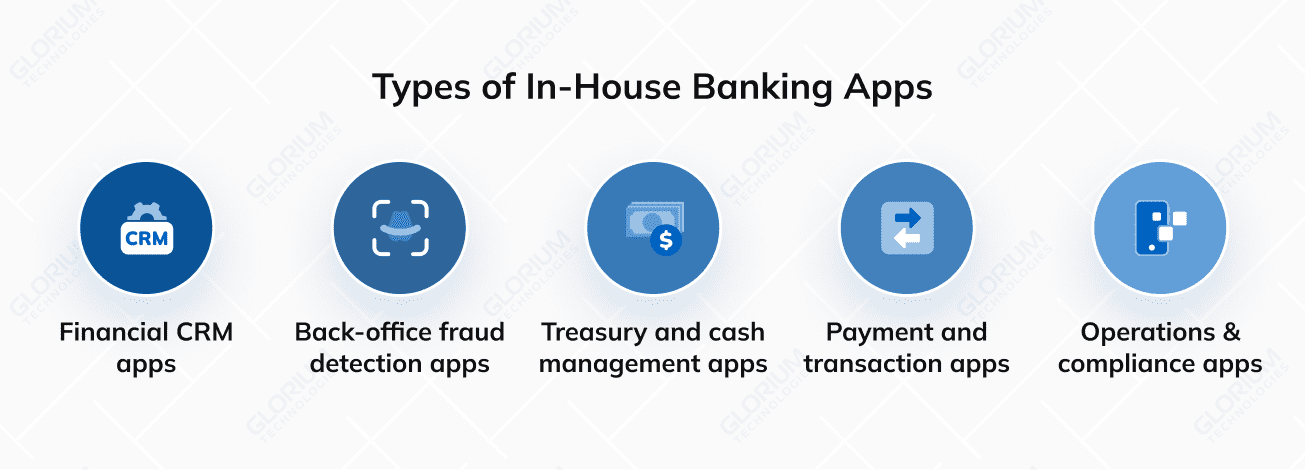
In-house apps are built to support the bank’s own operations. They give staff better tools to manage data, reduce risks, automate tasks, and improve compliance. By streamlining processes and providing real-time insights, these applications help your financial teams cut costs and work more effectively.
Let’s explore the most popular in-house banking solutions that automate processes and workflows:
Financial CRM apps let managers and support teams access all customer information in one place. Profiles, risk alerts, communication history, and recommended next steps are easy to track in a single system. We can also connect your financial CRM with core systems, ticketing, marketing tools, and telephony to help you resolve issues faster and personalize outreach.
Back-office fraud detection tools use ML models and rules to spot anomalies early. They equip your financial analysts with case management, investigator workbenches, and audit trails. Tied into device fingerprinting, behavioral biometrics, consortium data, and sanction lists, these tools reduce false positives (cases flagged as fraud when they are actually legitimate) and speed investigations.
Treasury and cash management apps support corporate clients with centralized liquidity views, sweeps, entitlements, and multi-signature approvals. They provide real-time balances, forecasting, and payment initiation across rails. By investing in a treasury and cash management app, you can cut manual reconciliation and lower operational risk with controlled, auditable workflows.
Payment and transaction apps are designed to help the bank itself (and the staff) manage and process large volumes of payments efficiently. You can enhance these applications with features like PoS integrations, invoicing, payouts, chargeback management, and automated reconciliation. These tools streamline back-office operations, reduce errors, and ensure smoother financial workflows across the institution.
Operations and compliance apps strengthen oversight with case management, role-based access, audit logs, reporting packs, and evidence capture. With the help of this application, you can automate regulatory reporting and reduce audit preparation time. As a result, your sensitive data will always stay safe and traceable across teams.
A recent client—a global investment firm—faced challenges with slow and inefficient data processing. They approached Glorium Technologies with the request to develop a solution to help them manage the vast amounts of financial information critical to their clients’ success. Using a scalable Python and Django REST framework, our developers created a custom trading platform.
Our solution:
Impact:
No roadmap works for every company; each business is unique and requires a custom development plan. But we prepared a 5-step development process based on our banking app development services and expertise to guide you:
Every mobile banking application development project starts with an idea. At this stage, we define the app’s purpose, the problems it will solve, and the key features it needs. A clear vision helps keep the project focused.
Adding the right features can turn a simple project idea into a successful mobile banking app. After all, your app’s functionality can increase adoption, user retention, and engagement. On the flip side, the wrong choice of features will lead to unnecessary project expenses and wasted development time.
So, before you dive into the development process, explore these must-have features for mobile banking apps:
| Feature | Core Function | Key User Benefits |
| Account Management | View balances, transactions, and account history. | Full financial visibility without visiting a branch. |
| Fund Transfers | Send and receive money instantly. | Convenience, especially for international transactions. |
| Bill Payments | Pay and manage bills with reminders. | Never miss a payment; automate finances. |
| Mobile Check Deposit | Deposit checks using the phone’s camera. | Streamlines payments and reduces branch visits. |
| Security & Compliance | Adheres to standards like PCI DSS and GDPR. | Builds trust and protects user data and money. |
| Alerts & Notifications | Push notifications for transactions and low balances. | Keeps users informed and automates management. |
| Personalized Analytics | Insights into spending habits with visual reports. | Helps set budgets, control spending, and plan. |
| Budget Tracking | Categorize spending and track savings goals. | Provides interactive control over financial discipline. |
| Customer Support | In-app live chat, call center, or AI chatbot. | Quick issue resolution and human-like responsiveness. |
| Third-Party Integrations | Links to tax, investment, and payment apps. | Creates an all-in-one finance management hub. |
In a crowded marketplace, a standard mobile banking app blends in. To truly stand out and win customer loyalty, your app needs to offer a superior experience. The following advanced features are designed to give you that critical competitive edge.
| Feature | Core Function | Key User Benefits |
| QR Code Payments | Pay merchants by scanning a code. | Fast, secure, and hassle-free transactions. |
| Bill-Splitting | Divide group costs and send payment requests. | Simplifies and adds transparency to shared expenses. |
| Voice-Based Banking | Perform banking tasks using voice commands. | Hands-free convenience and accessibility. |
| Gamification | Earn rewards, badges, and points for financial activities. | Increases engagement and motivates better money habits. |
| Credit Score Tools | Monitor and understand credit health. | Helps users make smarter borrowing decisions. |
| Cardless Cash Withdrawal | Withdraw money from ATMs without a physical card. | Enhanced convenience and security. |
| Personal Financial Management (PFM) | Unified tools for budgets, expenses, and savings goals. | Simplifies money management with clear insights. |
| AR for Banking Services | Find nearby ATMs/branches using augmented reality. | Interactive and fast way to locate services. |
| P2P Lending Integration | Lend and borrow money directly within the app. | Quick access to funds and potential returns. |
| Crypto Exchange & Payments | Buy, sell, and transfer cryptocurrencies. | Positions the app as a modern, all-in-one finance hub. |
UI/UX design is an essential part of the mobile banking app development process that guides the rest of the path into creating a user-friendly and successful mobile banking app.
At Glorium Technologies, we create wireframes that show how users will move through the app. Then, our designers craft a clean and intuitive interface that makes banking simple and enjoyable.
This is the most critical step, which requires commitment from a professional development team, project managers, and other specialists.
This is the core phase where we engineer your secure and high-performing mobile banking software. We build with a modern, scalable tech stack and integrate it with your critical systems, ensuring a seamless banking app development process.
Our technical foundation:
For in-house business banking apps, we integrate with CRMs and ERPs. For client-facing apps, we connect to payment gateways and other third-party solutions. This phase is critical in the banking app development process, as we ensure all data exchanges are secure and efficient, creating a solid foundation for adding advanced features later.
Once the product is ready, it should undergo a multi-layered testing process to ensure a flawless and secure launch. This is an essential step of Glorium Technologies’ mobile banking app development process. It includes:
This is a comprehensive approach that our experts use with every software development and banking app development service.
Once the testing is complete and you’re sure the app performance is solid, you can launch and start gathering feedback from your customers. This feedback will help you improve your services, interface, and overall app experience. For continuous maintenance and support, you can always employ an in-house team or an experienced group of developers from Glorium Technologies.
Bonus: Don’t forget about third-party and open banking API integrations
We didn’t forget to mention APIs in the tech stack section of the guide. It deserves a separate chapter to explore how these connectors empower your app’s features and transform basic applications into a comprehensive digital banking platform.
Our banking development services include seamless integration to enhance security and user experience. We specialize in connecting your apps to critical third-party services that power modern banking operations:
Regulations vary by region, and each one imposes specific technical and procedural requirements that influence your architecture, data handling, and go-to-market timeline. Understanding these obligations early prevents costly rework and potential legal exposure down the line.
In the European Union, the General Data Protection Regulation (GDPR) governs how you collect, store, and process personal data. For a banking app, this means implementing explicit user consent flows, providing data portability and deletion capabilities, and maintaining detailed processing records. The revised Payment Services Directive (PSD2) is equally important: it mandates Strong Customer Authentication (SCA) for electronic payments, requiring at least two independent verification factors. PSD2 also compels banks to open account data to licensed third parties through secure APIs, which directly shapes your integration layer.
In the United States, there is no single federal privacy law equivalent to GDPR. Instead, your app must comply with a patchwork of regulations. The Gramm-Leach-Bliley Act (GLBA) requires financial institutions to explain data-sharing practices and safeguard sensitive information. The Bank Secrecy Act (BSA) and its associated Anti-Money Laundering (AML) rules obligate you to implement transaction monitoring, suspicious activity reporting, and customer identification programs. If your app handles card payments, PCI DSS compliance is non-negotiable: you need network segmentation, encryption of cardholder data at rest and in transit, and quarterly vulnerability scans.
In the United Arab Emirates, the Central Bank’s Consumer Protection Regulations and the AML/CFT framework set strict requirements for digital financial services. Apps serving customers in the Dubai International Financial Centre (DIFC) must also comply with the DIFC Data Protection Law, which closely mirrors GDPR but has its own registration and breach notification rules. Obtaining an e-money or stored value facility license from the Central Bank is a prerequisite before your app can process transactions.
Regulatory requirements dictate concrete development choices. GDPR’s “right to erasure,” for instance, requires your database architecture to support granular deletion of individual user records without corrupting relational data. BSA transaction monitoring demands a real-time event processing pipeline capable of flagging anomalies against configurable rule sets. PCI DSS influences your entire hosting environment, from firewall configurations to access logging and key management procedures.
Licensing timelines also affect your project plan. A banking license application in the EU can take 6 to 12 months. In the UAE, Central Bank approval for a digital payment service typically requires 3 to 9 months of regulatory engagement. Many mobile banking application development companies choose to launch under a licensed partner (Banking-as-a-Service provider) while pursuing their own license, which adds a BaaS integration layer to the development scope.
Start by engaging a regulatory advisor familiar with your target markets before writing a single line of code. Map every data flow in your application to the specific regulation it falls under. When scoping mobile banking app development services, build consent management, audit logging, and data classification into your architecture from day one rather than retrofitting them later. Automate regulatory reporting wherever possible: manual report generation does not scale and introduces human error.
Finally, schedule independent compliance audits at key milestones (after the design phase, before UAT, and before launch) so issues surface when they are still affordable to fix. Treating compliance as a continuous process rather than a one-time gate is essential for any team pursuing custom mobile banking app development, keeping your product secure, trustworthy, and ready for market entry.
The banking app development cost is probably one of the most interesting subjects in this guide. The simple answer is: there’s no such thing as a one-size-fits-all figure. The price varies significantly depending on the project scope and complexity. As you’ve seen, essential and advanced features differ from each other, and their presence may increase the price of the final product.
Before we give you approximate price ranges, let’s explore the factors that affect the cost of developing a mobile banking application:
| App Tier | Key Features | Approximate Cost Range | Timeline |
| MVP / Basic Banking App | – User Authentication & Profile
– Account Balances & History – Basic Funds Transfer (P2P) – Bill Payments – Simple Dashboard – Basic Security & Compliance |
$80,000 – $150,000 | 4 – 6 months |
| Mid-Market / Full-Featured App | – All MVP features
– + Biometric Authentication – + Mobile Check Deposit – + Card Management – + Personalized Budgeting & Analytics – + Recurring Payments – Advanced Security Suite |
$150,000 – $350,000 | 6 – 9 months |
| Enterprise / Advanced Banking App | – All Mid-Market features
– + Investment & Trading Integration – + Advanced PFM & Predictive Analytics – + Multi-Currency & Forex – + Open Banking API Integrations – + AI-Powered Chatbots & Support – + Custom Business Banking Features |
$350,000 – $700,000+ | 9 – 18+ months |
The future of banking is already in your customers’ pockets. What matters now is how seamless, secure, and engaging you make that experience. With the right app, banking firms turn everyday interactions into lasting trust and long-term growth. And you can be one of them.
At Glorium Technologies, we build mobile banking apps that comply with cybersecurity standards, integrate with other systems, and deliver the features customers actually use.
For example, one of our recent projects included developing a financial data management platform for a leading investment firm. Their old system was too slow to process large volumes of data from multiple sources, making it difficult to provide timely insights to end users.
To address this, we built a platform with a microservices architecture and AI-driven algorithms that sped up data collection, analysis, and reporting. Now the client enjoys faster, more accurate results and can deliver better insights to investors.
Another critical case involved creating a mobile app for a trading and risk management platform. The client wanted to provide traders with quick access to portfolio and risk data anytime and anywhere.
We delivered an Android app with real-time updates, customizable views, seamless integration with the Imagine platform, and an easy-to-use interface. With this solution, traders can track risk and position numbers instantly, adjust views to their strategies, and manage portfolios directly from their phones.
Beyond immediate results, all of our clients benefit from long-term partnerships and ongoing knowledge transfer. If your goal is to grow your audience, improve efficiency, and scale with confidence, Glorium Technologies is here to help you achieve the same success.
Ready to launch a secure, customer-focused mobile banking solution?
We’re here to make it happen. Get in touch with us for the introductory consultation.
With seamless integrations, advanced analytics, and ease of use, mobile banking apps make mundane financial tasks easier and faster. Customers get a chance to conduct banking operations, review transaction history, and pay bills in just a few taps. In the long run, this convenience generates loyalty. Customers tend to trust banking services that save them time, reduce stress, and are fully customized to their needs.
Check the portfolio and customer reviews of your potential partner. The perfect choice is a company with proven expertise in fintech, strong security expertise, and a deep understanding of compliance requirements. Opt for a partner that aligns with your business goals, not just the technical skills you look for.
Apart from programming skills, you should pay careful attention to the ability of your partner to explain complex things in simple words. They should demonstrate how flexible they are in adapting to your requirements. Also, consider cross-functional skills necessary for banking mobile app development, such as UI/UX, backend, QA, and security practices. A company that combines technical strength with financial sector knowledge will deliver more stable, performant, and user-friendly mobile apps. For projects involving internal tools, verify their experience with integrations, such as connecting to your existing accounting software, to ensure a smooth workflow.
We develop every solution with regulatory compliance and its key challenges in mind, implementing encryption, multi-factor authentication, data protection, secure data storage, and other enhanced security measures. Our engineers follow regulations such as PCI DSS and GDPR. Regular security audits, testing, and monitoring make the apps secure, transparent, and compliant with the evolving requirements of financial institutions.
The actual tech stack for mobile banking software development will differ depending on the purpose. Typically, secure mobile banking apps use languages like Java, Kotlin, or Swift for native performance. Backend choices include Node.js or Python with frameworks ensuring scalability. It’s no less important to add reliable databases, secure APIs, and cloud services to maintain speed and flexibility.