A product roadmap slips by a quarter because two backend engineers left. A compliance audit is three months away, and nobody on staff has run one before. Situations like these push most companies to the same question: should this work stay with the in house team, or go to an external provider?
IT outsourcing is how a growing share of businesses answers it. According to Statista’s IT outsourcing outlook, revenue in the IT outsourcing market is projected to reach US$634.18 billion in 2026. Broader spending on IT services keeps rising too: Gartner’s April 2026 forecast expects IT services spending to pass $1.87 trillion this year, up 9% from 2025.
The reasons companies outsource have also changed. In Deloitte’s 2024 Global Outsourcing Survey, skilled talent and agility joined cost reduction as the key drivers, and 80% of executives said they plan to maintain or increase their investment in third-party outsourcing.
If you are facing a stalled roadmap or a skills gap like the ones above, this guide helps you decide what to hand over and how. You will see how IT outsourcing differs from offshoring, which outsourcing models and pricing models fit each situation, where hidden costs tend to appear, and how to vet an outsourcing provider before you sign a contract.
What Is IT Outsourcing in Plain Words?
IT outsourcing is the practice of hiring an external provider to deliver IT services that a company would otherwise handle with its own in house staff. The scope can be as narrow as help desk support for employees or as wide as an entire software product, from discovery to release and maintenance. IT outsourcing services range from software development and cloud operations to technical support and security monitoring.
Companies turn to IT outsourcing for very different reasons. A startup may need a full development team to build its first product. A mid-sized company may hand over infrastructure management so its internal resources can concentrate on product work. An enterprise may sign a managed services contract for cloud operations across several regions.
How IT outsourcing works in practice
Most engagements follow a similar path. The client defines the service scope, the expected business outcomes, and the constraints. The outsourcing partner proposes a team, a delivery approach, and a pricing model. Both sides then sign a contract with service level agreements (SLAs) that describe response times, quality targets, reporting, and responsibilities.
After onboarding, the provider manages the agreed work and reports progress on a fixed schedule. The client keeps ownership of the IT strategy and product direction, while the vendor handles execution. This split lets the client maintain accountability for key decisions without carrying the full operational load.
IT Outsourcing vs. Offshoring: What’s the Difference?
People often use “outsourcing” and “offshoring” as synonyms, although the terms describe two separate decisions. Outsourcing answers the question “Who does the work?” You hand a function to an external provider. Offshoring answers the question “Where is the work done?” You move work to another country, either to your own subsidiary or to a third party.
The two decisions can overlap. Offshore outsourcing means you contract an external provider located in a distant country, usually in a different time zone. A US company that hires a development firm in Poland or India is outsourcing and offshoring at the same time. A US company that opens its own engineering center in Romania is offshoring without outsourcing, a setup known as a captive center or global in-house center.
Location choices usually fall into three groups:
|
Model |
Provider location |
Main advantage |
Main trade-off |
|
Onshore outsourcing |
Same country as the client |
Same time zone, language, and legal framework |
Highest labor costs |
|
Nearshore outsourcing |
Neighboring or nearby country |
Partial time zone overlap and lower rates than onshore |
Smaller talent pools in some regions |
|
Offshore outsourcing |
Distant country, often on another continent |
Lowest labor costs and the largest talent pools |
Wider time zone gaps and more coordination |
Many companies mix these options. A business might keep IT strategy and strategic planning onshore, place user support with a nearshore team, and run software development with offshore providers.
Types of IT Outsourcing Models
Geography is only one dimension. The IT outsourcing models below differ in how responsibility is split between you and the vendor: who manages the team, who carries delivery risk, and how you pay. Five models cover most engagements.
Project-based outsourcing
In project based outsourcing, the provider delivers a defined result, such as a web platform, a mobile app, or a data migration, within an agreed timeline and budget. The vendor manages the team and the process. You approve requirements, review milestones, and accept the final deliverable.
This model fits projects with a clear and stable scope. Changes after signing usually go through a change request with extra budget.
Dedicated team
A dedicated team is a group of specialists who work only on your product for an extended period. The provider handles hiring, payroll, equipment, and HR, while you set priorities and direct the work, often with a project manager on the vendor side.
Companies choose a dedicated development team when they need long-term capacity for a product that keeps evolving, without building an internal department from scratch.
This model works well for long-running products with several workstreams. For Plume, the largest US provider of gender-affirming care for the trans and nonbinary community, Glorium Technologies supplies dedicated product management, QA, and data teams. They automate clinical and billing workflows across platforms such as Healthie and Elation and turn raw data into business dashboards.
Staff augmentation
Staff augmentation adds individual specialists to your existing team to close a skill gap or speed up delivery. In this case, the client company, while leveraging external resources, retains direct management of the internal IT infrastructure and full control over all services. The outsourcer guarantees that the partner staff meets its requirements and will provide a replacement if necessary.
Augmented engineers follow your processes, tools, and sprint rhythm. Tech outstaffing is a close variant: the specialists are employed by the vendor but work as full members of your team.
Managed services
With managed services, an external provider takes ongoing responsibility for a function and its results, usually under a monthly contract with strict service level agreements. Typical examples include managed IT services for networks, endpoints, and servers, cloud services operations, cybersecurity services such as 24/7 monitoring, and help desk support for employees.
The provider manages tools, staffing, and processes. You pay a predictable monthly cost, often calculated per user or per device, and judge the vendor by uptime, response times, and ticket resolution. This form of IT services outsourcing suits functions that need constant attention.
Co-managed services
Co managed services sit between full outsourcing and doing everything internally. Your in house team keeps control over selected areas, such as IT strategy or business applications, while the vendor covers others, such as after-hours monitoring, patching, or user support. A co managed setup suits companies that already have a capable IT department and need extra depth and coverage.
|
Model |
Who manages daily work |
Typical pricing |
Best for |
|
Project-based delivery |
Provider |
Fixed price or milestones |
A defined scope with clear deliverables |
|
Dedicated team |
Client, with vendor support |
Monthly fee per specialist |
Long-term product development |
|
Staff augmentation |
Client |
Hourly or monthly rate per specialist |
Short-term skill gaps |
|
Managed services |
Provider |
Monthly fee per user, device, or tier |
Ongoing operations and support |
|
Co-managed services |
Shared |
Monthly fee for the agreed scope |
IT teams that need extra coverage |
What IT Services Can You Outsource?
Almost any function of an IT department can go to an outsourcing provider. Most requests for outsourcing IT services fall into two groups: building software and running technology operations. Many IT service providers cover both, so you can start with one area and add others later.
Software development and engineering
IT outsourcing companies can provide every type of technical specialist you need: developers, UI/UX designers, QA engineers, and DevOps engineers. Architecture and infrastructure decisions are guided by Solution Architects, who also offer assistance with programming methods and tools.
- Custom software development: Web platforms, enterprise software, SaaS products, and internal tools built to your requirements
- Mobile app development: Native and cross-platform apps for iOS and Android, from technical specification to store release
- UI/UX design: User research, prototypes, and interface design tested with real users
- Quality assurance: Manual and automated testing, performance testing, and release checks
QA is often outsourced as a separate service. When outsourcing QA services you don’t need to maintain a whole department of QA engineers. A qualified dedicated testing team will conduct full-scale testing of your product.
IT operations and support
Operational IT services keep systems running after launch and are usually delivered under SLAs, from 24/7 technical support to security monitoring. DevOps outsourcing covers CI/CD pipelines, monitoring, alerting, and configuration management. This approach allows new products to be created, tested and deployed in a shorter time than the traditional software development lifecycle.
Security is another frequent request. The requirements for cybersecurity are constantly changing. Security services help businesses prevent, detect, and mitigate threats to their IT infrastructure. Providers offer cybersecurity services ranging from risk assessments to compliance support for HIPAA, PCI DSS, and SOC 2.
- Infrastructure management: Servers, networks, storage, and data centers
- Cloud services: Migration, cost optimization, and daily operations on AWS, Azure, or Google Cloud
- Help desk support: First-line user support, ticket handling, and basic support for common requests
- Technical support: Second- and third-line technical assistance for complex incidents
- Backup and disaster recovery: Tested recovery plans that protect business continuity
Business process outsourcing (BPO) is a related category that covers non-IT functions such as payroll, accounting, and customer service. Many vendors of outsourcing services offer both.
Benefits of Outsourcing IT Services
The outsourcing benefits companies report reach well beyond a lower invoice. Outsourcing IT services offers significant advantages when the scope and the partner are right. These are the advantages that matter most when you compare an outsourcing partner with hiring internally.
Cost savings and predictable budgets
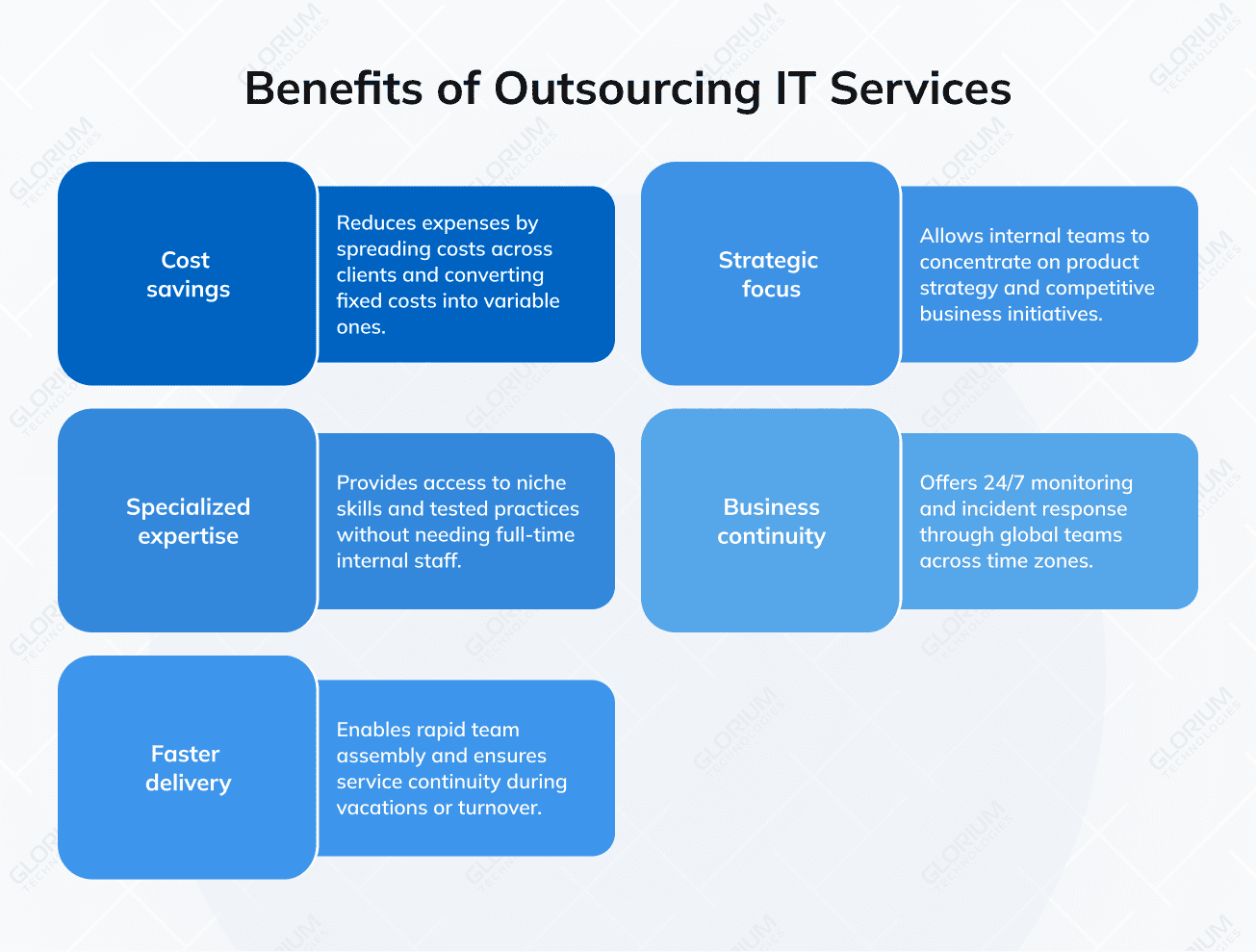
Outsourcing helps reduce costs in two ways. First, an in-house hire comes with salary, taxes, benefits, recruitment fees, training, equipment, and office space. An outsourcing vendor spreads these expenses across many clients, which can bring significant cost savings, especially in regions with lower labor costs.
Second, outsourcing turns part of your fixed costs into variable ones. You can increase spending during a major release and reduce it after launch. A fixed price or a stable monthly fee makes the services cost easier to forecast, and operational costs become easier to tie to specific business priorities.
Access to specialized expertise
Few companies can keep every skill on payroll: cloud architects, security engineers, data specialists, and developers for niche frameworks. Outsourcing lets you access specialized expertise when a project needs it and release it when the work is done. Providers that serve many clients also bring tested practices, tools, and lessons from similar projects.
Specialized services such as penetration testing, HIPAA compliance audits, or machine learning engineering are hard to staff internally for occasional needs. An outsourcing model lets smaller teams access expertise that once only large enterprises could afford.
Faster delivery and flexible scaling
An established vendor can assemble a team in a few weeks, compared with the months an internal hiring cycle often takes. The process of changing the team is sometimes difficult and expensive. With an outsourcing provider, replacements during vacations, sick leave, or turnover are part of the contract, so service continuity does not depend on a single person.
More focus on strategic initiatives
When routine maintenance, patching, and user support move to a vendor, your internal resources can concentrate on strategic initiatives that build competitive advantage: product strategy, customer experience, and new revenue streams.
Business continuity and round-the-clock coverage
Providers with teams in several time zones can offer 24/7 monitoring and incident response. For companies with global users, this comprehensive coverage protects business continuity without the cost of internal night shifts.
IT Outsourcing Pricing Models and Costs
Outsourcing costs depend on the engagement model, the scope, the team location, and the seniority you need. Before you compare quotes, learn how each pricing model splits budget risk between you and the vendor. Companies that outsource to save costs should compare the total services cost, including their own management time, instead of hourly rates alone.
Fixed pricing
You pay an agreed amount for a defined scope. Most of the budget risk sits with the vendor, so quotes usually include a buffer. Fixed pricing fits small, well-specified projects.
Time and materials
You pay for the hours actually spent at agreed rates. This model handles changing requirements well, but you need regular reporting to manage costs.
Monthly team fee
Dedicated teams and augmented specialists are usually billed as a monthly cost per person. The fee covers salary, overhead, and administration, which keeps spending predictable.
Per user, per device, or tiered pricing
Managed IT services are often priced per user or per device, or as service tiers that range from basic support during business hours to full 24/7 coverage. Check exactly what each tier includes before you compare offers.
Outcome-based pricing
Some contracts link part of the fee to business outcomes such as uptime, resolution times, or delivered features. Deloitte’s 2024 survey lists a stronger focus on value among the forces reshaping outsourcing decisions, and outcome-linked fees are one way buyers apply that focus.
|
Pricing model |
How you pay |
Budget predictability |
Best fit |
|
Fixed pricing |
One agreed price for a defined scope |
High |
Small projects with stable requirements |
|
Time and materials |
Hourly or daily rates for actual work |
Medium |
Evolving products and discovery phases |
|
Monthly team fee |
Fixed monthly cost per specialist |
High |
Dedicated teams and staff augmentation |
|
Per user or per device |
Monthly fee tied to users or endpoints |
High |
Managed services and help desk support |
|
Outcome-based |
Fee partly tied to agreed results |
Medium |
Mature partnerships with clear KPIs |
Hidden Costs of IT Outsourcing
The decision to outsource the process should be balanced and weighed. A low hourly rate can hide expenses that appear only after the contract for outsourcing services starts.
There are two types of hidden costs when outsourcing. The first is the cost of finding and contracting a vendor: research, negotiations, legal review, and due diligence. The second is the ongoing management of the relationship, meaning the time your managers spend on meetings, reviews, and coordination.
Several other expenses deserve a line in your budget:
- Knowledge transfer: Onboarding, documentation, and parallel running while the vendor learns your systems
- Scope creep: Change requests that fall outside the original service scope
- Rework: Fixing deliverables that did not meet quality expectations
- Communication overhead: Overlapping working hours, travel, and collaboration tools
- Exit costs: Transferring code, data, and knowledge if you switch providers or bring the work back in-house
A detailed scope, clear acceptance criteria, and a budget that includes your own management time keep these costs under control. Ask each outsourcing provider for a written list of exclusions together with the quote.
IT Outsourcing Risks and How to Manage Them
Most lists of outsourcing risks start with the same four concerns: data, control, quality, and dependency. Each one can be managed when the contract and governance model for your IT outsourcing services address it from day one.
Data security and confidentiality
When outsourcing IT services, you give an external provider access to your systems, and your attack surface grows. The IBM Cost of a Data Breach Report 2025 puts the global average cost of a breach at USD 4.44 million, while breaches that start with a third-party vendor or supply chain compromise average USD 4.91 million. The Verizon 2025 Data Breach Investigations Report found that third-party involvement in breaches doubled to 30%.
To protect data security, sign an NDA and a data processing agreement, limit access to what each role needs, and check certifications such as ISO 27001 or SOC 2. For healthcare data, confirm HIPAA compliance and a signed business associate agreement.
Loss of control over service delivery
Handing work to a vendor can make daily progress harder to see. Systematic monitoring and interaction with the outsourcer will minimize this risk. Agree on reporting formats, demo cadence, and escalation paths before work starts, and keep a product owner or IT lead on your side who reviews results against your criteria.
Inconsistent service quality
Quality problems usually come from unclear requirements or a vendor without the right competencies for the task. Define acceptance criteria, coding standards, and test coverage targets in the contract. Track service quality with measurable KPIs such as defect rates, SLA compliance, and ticket resolution times.
Vendor lock-in and unplanned price increases
Over time, a provider may hold most of the knowledge about your systems. If the IT provider raises prices or underperforms, switching becomes expensive. Clear IP ownership clauses, current documentation, direct access to repositories, and a defined exit plan protect you from this scenario.
A change of vendor is still possible with the right preparation. When TurtleHealth, a startup with an at-home fertility testing device, could not move forward with its previous outsourcing vendor, Glorium Technologies took over the project. The team delivered the patient web portal, a learning platform, and an admin portal for the client’s managers.
Communication, time zone, and cultural gaps
Language barriers, different work cultures, and time differences can lead to misunderstandings. Look for at least three to four hours of overlap with your working day, a shared toolset, and a vendor with experience in your market. Discuss these points openly before signing the contract.
|
Risk |
What can go wrong |
How to reduce it |
|
Data security |
Leaks, breaches, compliance violations |
NDA, access control, ISO 27001 or SOC 2, HIPAA where relevant |
|
Loss of control |
Low visibility into progress |
Regular demos, reports, and an internal owner |
|
Quality issues |
Defects and rework |
Acceptance criteria, QA metrics, and SLAs |
|
Vendor lock-in |
High switching costs |
IP clauses, documentation, and an exit plan |
|
Communication gaps |
Delays and misunderstandings |
Time zone overlap, shared tools, and clear escalation |
How to Choose an IT Outsourcing Provider
The lowest quote rarely leads to the lowest total cost. Before you sign up for IT outsourcing services, run a structured vendor evaluation that compares IT service providers on the criteria that predict long-term results.
Define your needs and the right model first
Start with the problem you want to solve by outsourcing IT services, the expected business outcomes, and a budget range. Then pick the engagement model: a fixed-scope project, dedicated developers, staff augmentation, or managed services. A clear brief makes proposals from different vendors comparable.
Check expertise and track record
Review case studies from your industry, the vendor’s tech stack, and the seniority of the people who will actually work on your project. Independent platforms such as Clutch and GoodFirms publish verified client reviews and rankings. Certificates, awards, and recognitions show the high quality of the company.
Assess security posture and compliance
Ask how the provider manages access, secures devices, handles incidents, and trains staff. Request evidence of certifications and recent audits instead of relying on claims in a sales deck.
Evaluate communication practices and cultural fit
Hold calls with the team lead and several engineers in addition to the sales manager. Notice how they ask questions, report problems, and handle disagreement. Cultural fit shapes daily collaboration as much as technical skill does.
Review contracts, SLAs, and IP terms
Check service level agreements, penalties, change request procedures, IP ownership, confidentiality terms, and exit conditions. Make sure the NDA covers trade secrets, trademarks, copyrights, and patents.
Start with a pilot
A paid pilot or discovery phase of two to six weeks shows how the vendor works under real conditions before you commit to a long contract.
|
Criterion |
Questions to ask the vendor |
|
Relevant experience |
Have you delivered similar projects in our industry? |
|
Team quality |
Who exactly will work on our project, and at what seniority? |
|
Security |
Which certifications do you hold, and how do you control access? |
|
Communication |
How often will we get reports, and who is our main contact? |
|
Contract terms |
Who owns the code, and what happens if we end the contract? |
|
Scalability |
How fast can you add or replace specialists? |
Top IT Outsourcing Destinations and Provider Types
The IT outsourcing market is global, and each region has its own profile. Statista’s market outlook highlights growth in India, China, Latin America, and Eastern Europe, driven by skilled talent pools and lower labor costs.
- India: The largest talent pool and a mature ecosystem of service providers, strong in large application maintenance and support services
- Eastern Europe: Poland, Ukraine, Romania, and nearby countries combine strong engineering education with cultural closeness to Western Europe and the US
- Latin America: Mexico, Brazil, Colombia, and Argentina offer working hours that overlap with North America
- Southeast Asia: The Philippines and Vietnam are popular for support outsourcing and user support, with growing development capacity
When people search for the biggest outsourcing companies, they usually find global integrators such as Accenture, TCS, Infosys, and Capgemini. These firms run large enterprise programs. Mid-sized engineering companies offer closer collaboration and senior teams for product development. Managed service providers (MSPs) concentrate on infrastructure, security, and help desk operations. Freelance marketplaces suit small, isolated tasks and rarely include ongoing management. Software development outsourcing services and support services outsourcing are often split across hubs, with engineering in one region and user support in another.
Most companies outsource to the vendor type that matches their project size, the level of control they need, and how much coordination they can handle internally.
Best Practices for a Successful IT Outsourcing Partnership
Outsourcing delivers the best results as a managed relationship with shared goals. The practices below come from quality management principles such as TQM and ISO standards and from Glorium Technologies’ work with long-term clients. Treat vendor management as a standard business practice with clear owners and routines.
The first principle is active involvement from your side in planning, demos, and reviews. This principle implies moving beyond formal contractual arrangements and establishing a trustful and open dialogue. The second is deliberate risk management. Incorporating management risk into the life cycle of outsourcing makes it possible to take advantage of positive opportunities and minimize the likelihood of undesirable events.
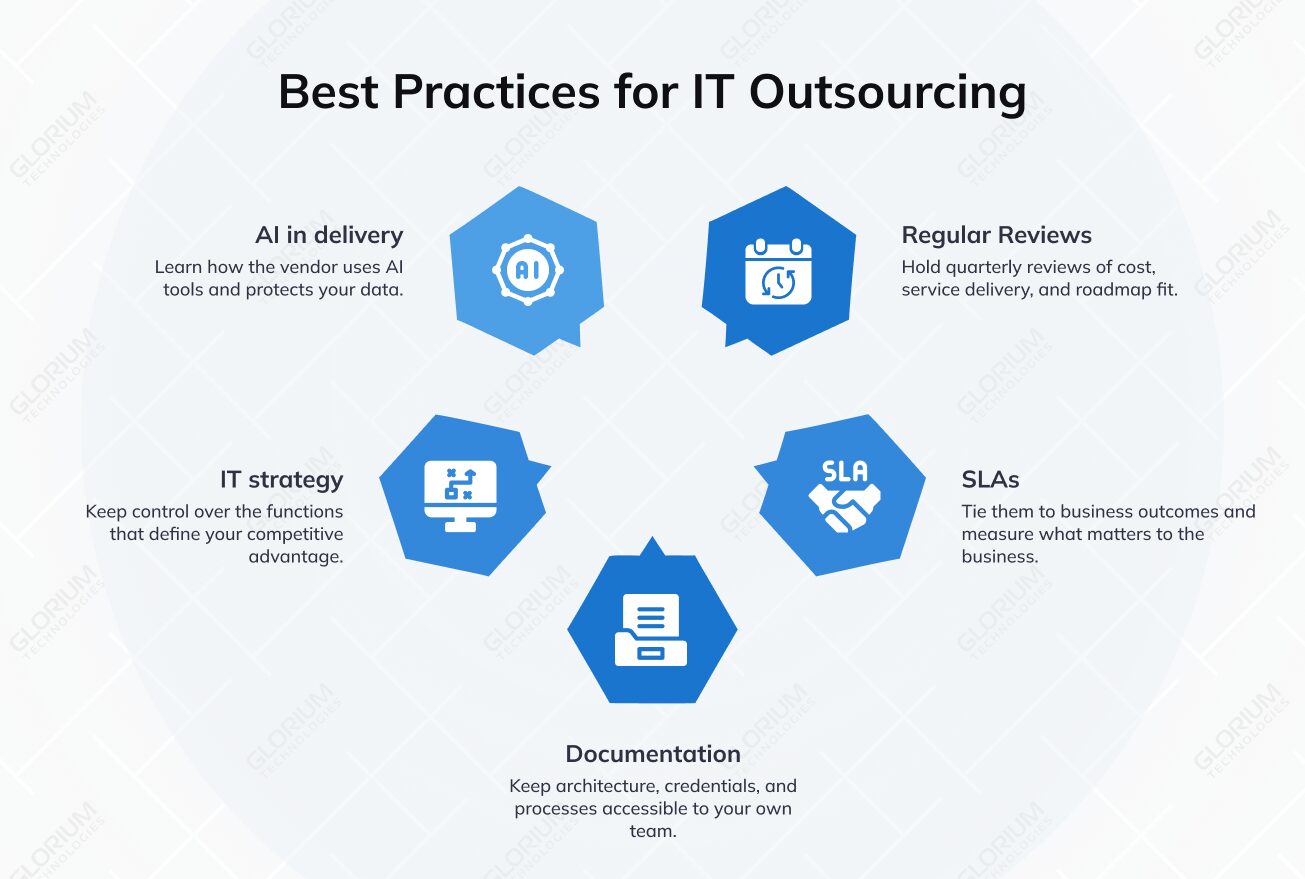
- IT strategy: Keep control over the functions that define your competitive advantage
- SLAs: Tie them to business outcomes and measure what matters to the business, such as release frequency or system availability
- Regular reviews: Hold quarterly reviews of cost, service delivery, and roadmap fit
- Documentation: Keep architecture, credentials, and processes accessible to your own team
- AI in delivery: Learn how the vendor uses AI tools in coding, testing, and support, and how it protects your data in those tools
Sourcing strategies keep moving. Deloitte’s 2024 survey found that 83% of executives already use AI as part of their outsourced services, and 70% have brought some previously outsourced scope back in-house over the past five years. Both numbers point to one habit worth adopting: review your sourcing mix regularly and keep enough internal knowledge to change it.
Outsource IT Services with Glorium Technologies
IT outsourcing pays off when the model, the pricing, and the governance match your goals. With clear SLAs, a realistic budget, and a partner who communicates openly, an external team becomes a steady extension of your own. The last step is choosing a provider that has already solved problems like yours.
Since 2010, Glorium Technologies has provided IT outsourcing services that help startups and established companies build and scale software through project-based development, dedicated teams, and outstaffing. Our engineers have deep experience in healthcare and real estate, where security, compliance, and integrations matter from the first sprint.
If you are outsourcing IT services for the first time, tell us what you plan to delegate, and we will suggest the right model, team composition, and timeline. Contact us for a free consultation.
FAQ
What should an IT outsourcing contract include?
A solid contract covers the scope, deliverables, SLAs with penalties, the pricing model and payment terms, a change request procedure, IP ownership, confidentiality and data protection clauses, liability limits, termination conditions, and an exit or transition plan. Glorium Technologies reviews these terms with every client during the proposal stage, so both sides agree on responsibilities before work begins.
How long does a transition to an outsourcing provider take?
Augmented specialists or a small project team can start within one to three weeks. Moving an ongoing function, such as infrastructure management or the service desk, usually takes one to three months, including knowledge transfer and a period of parallel operation. Glorium Technologies sends a shortlist of candidates right after the brief and helps plan the onboarding schedule.
Can a small business afford IT outsourcing?
Yes. Small companies often gain the most because they cannot justify full-time specialists for every area. Start with a narrow scope, such as employee onboarding support, technical support for one application, or one development project, and expand once the partnership proves its value. Glorium Technologies works with startups and SMEs on flexible team sizes, from one specialist to a full product team.
What is the difference between IT outsourcing and managed IT services?
IT outsourcing is the broad term for any IT work handled by an external provider. Managed IT services are one form of IT services outsourcing in which the provider takes ongoing responsibility for operations under a monthly contract and SLAs. Fixed-scope projects and staff augmentation are other forms. Glorium Technologies focuses on software development models: project-based development, dedicated teams, and outstaffing.
Who owns the code when you outsource software development?
In most contracts, the client owns the code and related IP once invoices are paid. Confirm this in writing, along with access to repositories, documentation, and third-party licenses. Glorium Technologies fixes IP ownership terms in the contract before development starts.
Can we move outsourced work back in-house later?
Yes, if you plan for it from the start. Keep documentation current, require knowledge transfer sessions, and include transition support in the contract. Many companies combine models, keeping core development internal and outsourcing support services. Glorium Technologies can build knowledge transfer and documentation into the engagement, so a later handover stays smooth.
Which IT functions should stay in-house?
Functions tied to your core product vision, sensitive decisions, and long-term IT strategy usually stay internal. Routine operations, short-term specialized tasks, and capacity peaks are the typical candidates for outsourcing. If you are unsure where to draw the line, Glorium Technologies can review your setup and suggest which functions to delegate.
About Oleg Kumko