


30% Faster Order Processing with Odoo for
the Steel Manufacturing Industry

30% Faster Steel Order Processing 
with Odoo
client

Client:

Manufacturer
Steel

Industry:

Steel Manufacturing
core technologies

Core technologies:

Odoo / Python / Odoo.sh
country

Country:

USA
Client Background

Client Overview

Processes Built on Quality and Held Back by Legacy Systems

This American steel manufacturer has 20 years of experience supplying high-strength steel rods for the country’s largest infrastructure projects. Their reputation has been supported by the quality of their work, but behind the scenes, their internal tech was struggling.
As the business grew, the company’s old back-office systems struggled to keep up with the increasing complexity of operations. Every day, different friction points resurfaced due to disconnected tools and processes usually handled manually. The client observed delays in order processing and unreliable production data. That’s when the company started looking into Odoo for the steel manufacturing industry as a way to bring all of its operations together and build a digital foundation that could grow with the company.
Challenge

Challenge

Clear Signs It Was Time to Implement Odoo for the Steel Industry

Even before Glorium Technologies stepped in, the signs of struggle were clear: inefficiencies across every department, manual errors, lack of standardization, and more. The company was facing challenges that could only be solved by a unified system—Odoo ERP for the steel industry.
Key challenges included:
  • Fragmented systems: The company relied on disjointed systems, such as BSI for sales, separate tools for manufacturing, and standalone accounting software. The disjointed systems caused data duplication, reporting inconsistencies, improper data formatting, and other issues
  • Repetitive, manual quotation process: A prominent challenge was handling more than 700 parameters and calculations (dimensions, grades, volumes, material specifications). Manual quotation usually takes longer than automated quotation and is prone to mistakes
  • Low standardization and control: There was no single way for all departments to approve quotes, manage purchases, or track changes. As a result, inventory planning was often incorrect, and production schedules were pushed back
  • No year-end closing procedures: Without the formal year-end closing procedures, retained earnings and other balances weren’t properly carried over, making things confusing between fiscal years
  • Financial and data silos: Executives couldn’t see combined performance data because the systems weren’t connected, making it harder to make financial and procurement decisions
steel client

Why They Chose Glorium Technologies

The Expertise and Approach That Won This Steel Industry Odoo Implementation

The client partnered with Glorium Technologies for our:
  • Deep experience in manufacturing and project-driven businesses
  • Phased implementation plan that focused on quick wins
  • Expertise in integrating Odoo with existing tools
  • Commitment to long-term growth and scalability
Solution

Customizing Odoo to Fit the Steel Industry Requirements

Glorium Technologies set up an Odoo ERP for the steel industry, with custom modules that brought all departments onto a single platform. This particular project required three phases, with the first six months spent on digitizing the most important processes—sales and manufacturing.

The project was executed in three structured phases, with the first focusing on digitizing the sales and manufacturing cycle within six to seven months.

1. Process Centralization

During the discovery stage, we mapped end-to-end operational processes to customize the Odoo system to cover all major business functions, including sales, production, inventory, logistics, and accounting.

2. Streamlined Quotation Management

To address the challenge of the 700-field quotation process, we created Odoo templates that automate calculations using formulas. This approach got rid of unnecessary manual entry and increased accuracy.

3. Industry-Specific Customization

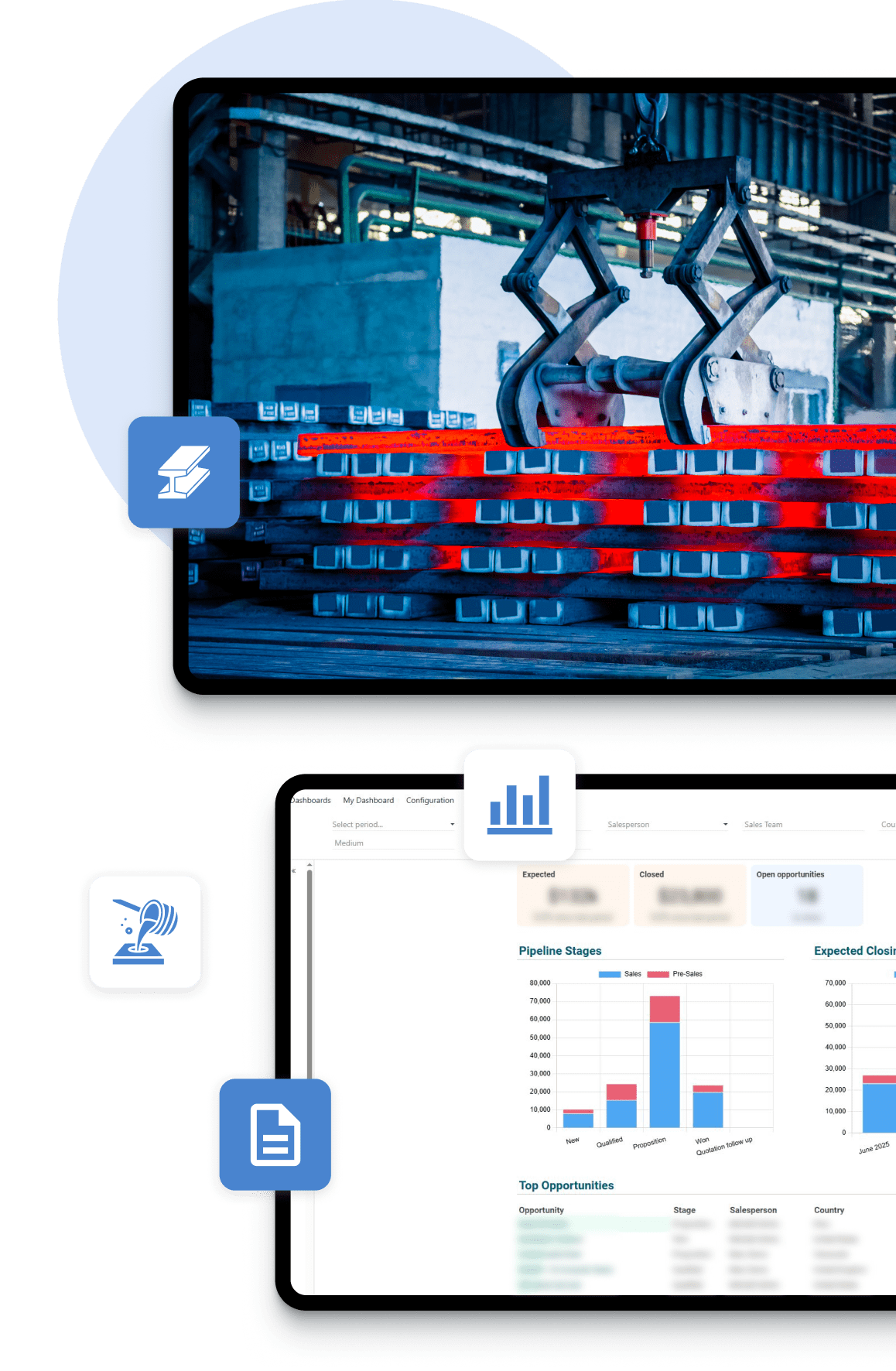
The steel manufacturing industry required unique customizations, such as high-precision fields for material types, casting types, and quality groups. Glorium Technologies built these unique customizations in Odoo for the steel manufacturing industry, helping decision-makers analyze performance data by steel grade, order source, or location in seconds.

4. Revision Tracking System

Customizations included enhancing Odoo to track multiple quotation versions, store every parameter change, and automatically pass updated data to manufacturing orders. By doing so, we’ve ensured production planning would be precise and traceable.

5. Procurement Workflow Automation

With the procurement workflow automation, departments and subcontractors can now create purchase requisitions directly in Odoo. The managers can later review the requisition forms and turn them into official orders with only a few clicks, again, helping the team replace old manual workarounds with a clearer, automated approval process.

6. Integration and Data Synchronization

  • Master data integration: To keep data consistent across channels, the company now has real-time synchronization with Azure Data Lake via REST API
  • Document management: Document management was made easier with auto-convertion of CAD files to PDF, linking them directly to their respective sales orders in Odoo
  • Legacy sync: During transition, the system maintained synchronization with the old BSI system to ensure continuity

7. Logistics and Compliance

Customized Odoo ERP handles all import, export, and interstate logistics operations. The client doesn’t have to manually track freight, charges, port fees, or compliance documentation—it’s now all handled in Odoo. And the audit trails are digitalized as well, with Odoo’s eSign and Document module.

8. User Access and Mobile Enablement

Before, the client struggled to scale their systems and allow their users to access permissions smoothly; now, the platform supports over 800 users across U.S. branches. Managers can approve workflows, monitor KPIs, and review reports directly through the Odoo mobile app.

Results

What 50% Faster Quotations Look Like: Results of Odoo for the Steel Industry

Implementing Odoo transformed the client’s processes, improving speed, visibility, and accuracy. Below, you can explore the results of this three-phased implementation based on order conversion speed, quotation preparation time, revision visibility, and other success metrics.

MetricImprovementOutcome
Order Conversion Speed+30% FasterStreamlined cross-departmental workflow improved order fulfillment time.
Quotation Preparation Time–50% ReductionAutomation replaced manual 700-field Excel entries.
Revision Visibility100% TransparencyEach change in product specification is fully traceable in Odoo.
Production QualitySignificantly Fewer RejectionsManufacturing errors reduced through accurate data flow.
Operational ControlCentralized & Real-TimeLeadership now has one unified view of operations and financials.
Business Value

What the Leadership Team Gained from Odoo for the Steel Manufacturing Industry

  • Faster time-to-quote: Implementing Odoo reduced the time the sales team spent on generating accurate quotes. Now, instead of hours, they can do it in minutes
  • Unified financial insight: The essential financial data has been gathered within one platform, giving the decision-makers an opportunity to view consolidated P&L, procurement costs, and production data in real time
  • Full compliance: The client has complete traceability thanks to Odoo’s approval workflows and digital documentation
  • A platform that scales alongside the company: The system supports over 800 active users, ready to expand as the company grows nationwide
Need 30% Faster Order Processing? Request a Demo
Get a unified view of your operations with a customized Demo from our experts.
Anna Vozna
Account Executive

Awards & recognitions

More achievements
Frame 1000001760
Frame 1000001740
Clutch
award
excellence award

Inc. 5000

2020
2021
2022
2023

Named among the Inc.5000 (2020, 2021, 2022, 2023) & Regionals (2021, 2022, 2024) fastest-growing private companies in America

Certifications

ISO 9001
ISO 13485
ISO 27001
aws
aws
microsoft

Questions You May Have

How long does it take to adapt to using Odoo for steel manufacturing companies?

Odoo is a fairly user-friendly platform, which means you can expect your teams to get comfortable with the basics within the first few weeks. However, a full adoption requires change management, user training, and proper support from an official partner. The timelines of adoption depend on your team’s size and readiness to adopt a new tech. If you’re planning to implement Odoo for the steel manufacturing industry, we recommend taking an ERP readiness checklist to test both the leadership and team readiness.

Can Odoo ERP handle specific steel industry requirements, such as heat numbers or chemical compositions?

Of course. Odoo ERP can be customized to fit not only the steel manufacturing industry, but other industries as well. Glorium Technologies offers customization services to ensure your Odoo setup is accurate, you’ve migrated all your data properly, and your modules solve all your industry-specific problems.

Why implement Odoo in stages instead of switching everything at once?

A well-executed Odoo implementation is typically divided into several phases to minimize downtime and workflow disruptions. If you switch everything all at once, you’re risking hitting critical areas like sales and manufacturing, you’re risking losing data, and increasing manual errors. A phased approach allows you to implement small changes, keep your data safe, and gradually prepare your team to move the system into daily production.

How does Odoo manage document security when sharing CAD files and technical drawings?

Odoo ERP for the steel industry can be implemented with strict, role-based access to sensitive files. Only authorized users can access or download technical drawings and CAD files. Everything’s centralized, linked to specific sales orders, and there’s no risk of intellectual property leaking out.

What happens to the historical data from the legacy BSI system after the migration?

Moving historical data from the legacy system to a new ERP is a critical step—one that shouldn’t be taken lightly. When moving data, we recommend the client do a sweep—cleaning their data, removing junk, and categorizing what needs to be migrated. We also format the data properly, create a standardized documentation rule, and start migration. You don’t have to lose twenty years of history just because you’re switching to a new and improved ERP system.