









Computerized Maintenance Management System
Give technicians work orders, PM schedules, spare parts, and asset records that load in offline mode. They tag equipment by NFC and close each job with a photo, straight from their phone.

Every Facility Task in One Place
Bring maintenance, contractors, inspections, and occupancy under one roof, then watch reactive spend fall as asset life stretches. Prove how your space is really used and keep audit evidence ready all year round.

Launch products up to 60% faster

Add up to 60% more features

Same budget and no extra hires

80-100% Al-Generated Code

Copyright Compliance

Cost-per-Feature Tracked Every Sprint

SAST + Security Review on Every Commit

Multi-Layer Al + Human Review

SOC 2 / HIPAA-Ready
The industry matters far less than operating conditions. Where two or three of these describe your portfolio, a purpose-built system usually pays for itself inside the first full budget cycle.
Your asset hierarchy, approval chains, and inspection routines drive the build. Bring us the workflow you have outgrown, and we will map the system meant to run it well.
Give technicians work orders, PM schedules, spare parts, and asset records that load in offline mode. They tag equipment by NFC and close each job with a photo, straight from their phone.
Hybrid work left most offices paying for space nobody counts. Floor plans, occupancy tracking, chargeback reporting, desk and room booking show how much of it earns its rent each month.
Property decisions carry more weight when they come from history instead of instinct. Lease terms, capital plans, sustainability data, and maintenance records all live in a single data layer.
Facility service companies live or die by response time, not by good intentions. Multi-client scheduling, subcontractor management, SLA tracking, and white-labeled portals run in one system.
Hotels, resorts, and short-stay operators get direct booking, room inventory, and guest check-in and check-out, along with room access, cancellation flows, and a POS that collects all deposits.

Every operation wants something slightly different, yet the underlying parts stay the same. The capabilities below cover most of what facility teams ask for.
Know what you own, its worth, and when it needs replacing, so capital requests reach the board with real evidence instead of a hunch about aging equipment.
Every request lands in one queue, routes to the right person, and leaves a record behind, so nothing dies in an inbox and no job closes without proof it was done.
Small faults get caught on a schedule before they turn into failures, moving your team off emergency callouts and onto the work they can plan around in advance.
The right part is on the shelf when the technician reaches for it, cutting the delays and rush orders that turn a one-hour fix into a three-day wait for the site.
Contractor spend usually beats internal labor, yet goes unchecked; this ties every invoice to the SLA behind it, so you pay for performance you can prove.
Audit evidence stays logged and searchable all year round, so a regulator's visit takes a few hours to prepare for instead of a frantic week of reconstruction.
The questions finance keeps asking (cost per asset and square meter, backlog age) get answered from live data instead of another month-end scramble.
Every building produces a flood of readings that mostly ends up ignored. Route it into your facility software, and it becomes work orders and repairs scheduled before equipment fails.
Your HVAC, lighting, fire safety, and access systems each speak their own protocol and rarely talk to anything else. Connect them over BACnet, Modbus, and KNX so one platform reads them all.
Learn MoreA bearing runs hot for days before it seizes, and nobody sees it. Temperature, vibration, humidity, leak, and occupancy sensors feed a record that catches the drift while a fix is still affordable.
Learn MoreA work order that says 'pump on level 3' still sends a technician hunting. Link assets to the building's 3D model and the job opens on the right floor, beside the exact unit that failed.
Learn MoreWaiting for a fixed service date wastes good parts and misses early failures. Sensor thresholds raise work orders the moment readings drift, with a human in the loop where the stakes are high.
Learn MoreBasements and remote sites drop signals where the equipment is located. Local processing keeps data flowing through the outage and reconciles everything the moment the connection returns.
Learn MoreLink facility data to finance, HR, procurement, and property teams so it gets used. We treat integrations as core architecture, built on documented APIs, event streams, and middleware.
Four stages, each ending in something concrete, so the project stays visible from the first workflow map to the day it goes live.
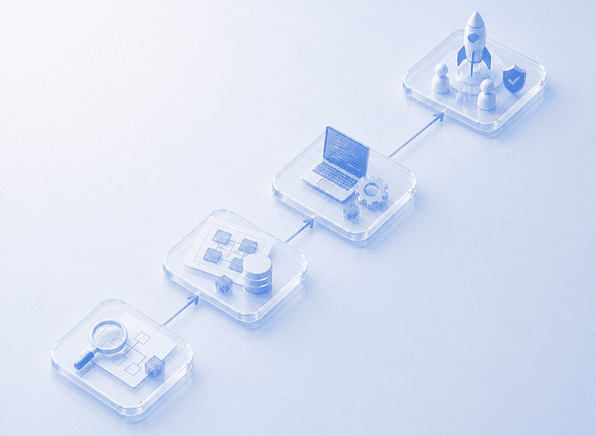
Your assets, workflows, sites, and integrations get mapped in full, and every gap becomes a pricing plan ready for the board.
The stack, the data model, and the interface take shape around your operation, built for the crew who open the app on day one.
Development runs in short cycles, your existing systems get wired in, and real users see working software before full rollout.
Data is migrated, teams are trained, and the system is live with SLA-backed support and a roadmap that grows with your sites.
Show us how your sites run today, and get back an architecture direction plus a realistic budget range

Somewhere in your portfolio right now, a pump is drawing a little more current than it did last month. Nobody has noticed, because the reading lives in a controller that talks to nothing. In six weeks, it might fail on a Sunday, and the repair will cost five times what it would this week. Facility management software exists to close that gap. It helps organizations manage the daily work of keeping buildings running, from maintenance tasks and inspections to space management and reporting. Done well, it turns scattered, reactive effort into steady operational reliability, and gives you the up-to-date information every decision depends on.
Let’s be honest: not every organization needs a custom facility platform. The fit depends far less on your industry than on how your operation is shaped, how many sites you run, and how much your equipment costs you when it stops.
You are a strong candidate when several of the following describe you:
Facility managers sit at the center of this shift. Deloitte’s 2026 Commercial Real Estate Outlook describes a market recovering unevenly. Industrial and digital assets are performing well, while older offices struggle, and that gap is pushing organizations toward selective, data-driven decisions about which buildings to keep. Facility teams increasingly hold the operational and cost data those decisions depend on. That raises the bar for your facilities management strategy, and it means facility performance now shapes broader business processes.
In-house FM and corporate real estate services teams can use facility management software to control their own costs. FM service providers rely on it to deliver contracted work, with multi-client asset tracking built in. And software companies build FM software of their own on top of it. Strong facility maintenance management is the common thread across all three.
A good build feels less like a software project and more like a series of decisions you get to make with better information each time. You are never handed a black box. Each phase ends in something you can see, use, or approve before the next one starts, which keeps the risk visible and the budget under your control.
The work moves through four stages, and the sequence is what keeps maintenance processes from turning into guesswork:
| Stage | Timeline | What you get |
| Discovery | 2 to 4 weeks | Your assets, workflows, sites, and integrations mapped, with every gap turned into a priced plan for leadership |
| Architecture and design | 2 to 4 weeks | The stack, the data model, and an interface your field crew will open, since adoption is won or lost there |
| Build and integration | Iterative | Short development cycles, your existing enterprise systems wired in, working software in front of real users before rollout |
| Launch and support | Ongoing | Data migration, training resources, and SLA-backed maintenance with a roadmap that grows with your portfolio |
Along the way, the platform learns to track maintenance activities automatically, hold your maintenance schedules in one place, and generate preventive maintenance tasks before a person has to remember them.
Proactive maintenance delivers unplanned downtime reductions of 30 to 50 percent against reactive strategies. That is how the software works to prevent equipment failures rather than log them into after the fact. Deloitte puts the annual cost of unplanned downtime to industrial manufacturers at roughly 50 billion dollars, and notes that poor maintenance strategies can cut a plant’s productive capacity by 5 to 20 percent. Proactive repairs on the same asset run four to five times cheaper than emergency ones, which is the clearest way the system helps you reduce costs.
Price is the question everyone wants to get answered first, and nobody can give the precise number. A custom platform is not a product with a sticker on it. What you pay reflects the scope you choose, and the useful way to think about it is by what the engagement consists of rather than a figure pulled from the air.
A custom facility management software engagement usually breaks into these components, and its key features map directly to what you pay for:
A serious discovery phase tells you which parts to build and which to buy, so you control costs and reduce overhead costs before the larger spend is committed. It also keeps your operational costs predictable once the system is live.
The tools your facilities run on are changing faster than at any point in the category’s history. Why? Your facilities now generate more data than any person can read, so the software has to do the reading. Four shifts are worth watching as you plan.
Artificial intelligence is arriving in facility operations, though more cautiously than the headlines suggest. Gartner forecasts that worldwide AI spending will reach $ 2.52 trillion this year, a 44 percent year-over-year jump. The caution is warranted: a Gartner survey of infrastructure and operations leaders found only 28 percent of AI use cases fully meet ROI expectations, with success tied to integrating AI into existing workflows rather than bolting it on.
The other three shifts are steadier. Integrated platforms are consolidating maintenance, space management, and capital planning into a single data layer, since siloed systems produce siloed decisions and undermine operational efficiency.
IoT and predictive maintenance are moving from pilot to standard practice as sensor costs fall, while live monitoring of energy consumption turns utility data into something you can act on.
Mobile solutions now handle tracking tasks in the field and keep compliance requirements documented on the spot, which is often the fastest way to improve operational efficiency across scattered crews. And facility data is being pulled into portfolio strategy, with 81 percent of real estate leaders in Deloitte’s survey naming data and technology as their top spending focus. The through-line for your own roadmap: prioritize integration capabilities and clean asset data first, because every trend above depends on them.
You know that a failing pump never announces itself. It leaves a trail of small signals first, and the gap between a routine fix and a weekend emergency comes down to whether anyone reads them in time. The latter is a software problem, and building software is what we do.
With 16 years of development experience and an in-house team of specialists across product, engineering, and QA, we build custom facility platforms and the wider systems they connect to. Want to find where data goes to waste? Our experts can audit your setup and show you what a system built around your operation would cover. Schedule a free call to get started.
Excellent experience from both professional expertise and customer experience perspectives.

They’re truly exceptional.

Their punctuality and delivery capabilities were exactly as advertised.