









How to Approach Microservices Architecture Development without Overengineering
Updated July 31, 2026

 Summarize in ChatGPT
 Summarize in ChatGPT
Somewhere between the seed round and Series A, most growing engineering teams end up having the same conversation. Should this monolith get broken into services before it becomes unmanageable? The pressure to answer yes is real, and it rarely comes from your own data. Investors ask about scalability, new hires expect a modern stack, and most software development blogs treat microservices as the default answer for any product with real users.
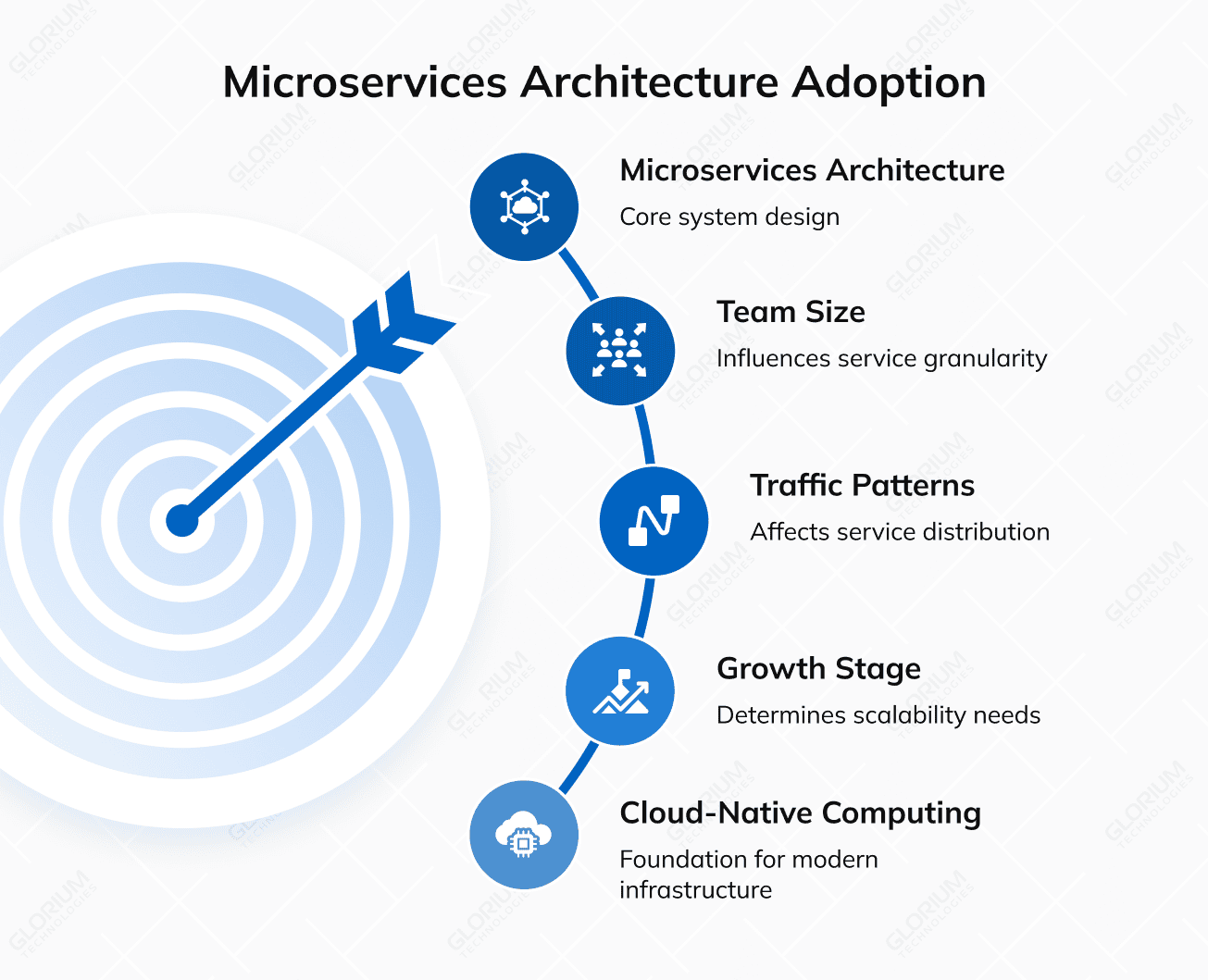
Cloud-native computing has, in practice, become nearly universal. According to the Cloud Native Computing Foundation’s 2026 Annual Survey, 98% of organizations now use cloud native techniques in some form. What’s shifted isn’t whether teams adopt these techniques, but how deliberately they apply them. The organizations getting the most value out of microservices architecture development aren’t the ones running the most services. They’re the ones who match the architecture to the actual team size, traffic patterns, and growth stage.
Content
You’ve probably seen the diagrams: one big application box on one side, a cluster of small, connected boxes on the other. Before picking a side, you should know exactly what changes underneath. That difference matters more for your engineering team than it does for the people using your product.
In a monolithic architecture, every part of your application, from user accounts to billing to notifications, lives in one codebase and deploys as a single unit. Running that is a no-brainer when your product is small, but a tiny change to checkout can mean rebuilding and redeploying the entire application. As AWS describes it, monolithic systems tightly couple every process together. A spike in demand on one feature forces the whole system to scale.
A microservices setup splits those same functions into independent services that talk to each other over well-defined APIs. Each service owns its own logic, and often its own database. That lets your team update the payment flow without touching notifications. You can also scale checkout on a high-traffic day without paying to scale everything else alongside it.
Breaking an application into services adds real coordination costs: network calls where there used to be function calls, more moving pieces to monitor, and more infrastructure to secure. The temptation to keep splitting further, chasing an ever-smaller unit of deployment, is exactly where overengineering starts.
A modular monolith is a single deployable application with strict internal boundaries between its modules. It often delivers most of the organizational clarity teams want, without the network tax that comes with microservices. Overly granular services, ones split far smaller than any real team or workload needs, tend to create more operational overhead than value. That shows up as more deployments to coordinate, more service dependencies to track, and more places for a network latency issue to hide. The right call depends on your team’s size and your product’s actual scaling needs, not on what looks impressive in a job posting.
“You can even develop each service with a different programming language, and you can have dedicated teams for each service that can choose their own technology stack.”
Nana Janashia, Microservices Explained: The What, Why and How?
Before any code gets written, the most important decision in microservices architecture development is where one service ends and another begins. Get this wrong, and you end up with distributed systems that behave like a monolith anyway. You add extra network calls in between, with none of the independence you were hoping for.
Once you know you’re building services instead of one shared codebase, the next question is where each one stops, and the next begins. You should skip the org chart and the tech stack and anchor each boundary to your business capabilities instead: what the product does (not who happens to maintain the code).
A specific business capability, like checkout, inventory, or notifications, becomes one service. Please note that it neither becomes one service per team nor one service per developer.
Each of these individual services should do one job well. In other words, one dedicated order processing service shouldn’t also have user service responsibilities, even if the same engineer builds both today. Keeping to a single business capability per service, with clear service boundaries enforced from day one, lets you change one part of the system without breaking another.
Business capabilities are easy to name but harder to draw precise lines around without a method. This is where a more formal design approach earns its place, instead of leaving boundaries to whoever wrote the first version of the code.
Domain-driven design gives you a formal way to draw those boundaries. Instead of starting from database tables or existing code, you start by mapping your business domain. That means the real-world concepts your product deals with, like orders, payments, and shipments, plus the language your team already uses to talk about them.
Each bounded context in that domain map becomes a natural option for its own service. This is of great importance because a business logic change in one bounded context shouldn’t ripple into another. For example, updating how discounts get calculated shouldn’t affect how shipments get tracked. When the domain model and the service map line up, your architectural style stops being an abstract diagram and starts reflecting how the business works.
Once your service boundaries are set, a handful of technical patterns determine whether your system holds together under real traffic or falls apart the first time something goes wrong. These patterns cover how services talk, how you deploy them, and how you know what’s happening inside a system with dozens of moving parts.
Services that can’t reach each other reliably aren’t independent; they’re just separated. Two mechanics decide most of this: how one service calls another, and what sits in front of all of them to manage that traffic.
When microservices communicate, they typically use one of two patterns. Direct API calls over HTTP are synchronous and simple to reason about. Asynchronous communication through messaging systems, like a message broker, works differently: a service publishes an event and moves on without waiting for a response. Different services often mix both, using direct calls for anything the user is waiting on and messaging for anything that can happen a moment later.
Most systems put an API gateway in front of all of this as a single-entry point for client requests. The gateway handles request routing to the right service, along with cross-cutting concerns like role-based access control, so individual services don’t each have to reimplement authentication from scratch. Getting this inter-service communication layer right matters more than any single technology choice. How well services communicate determines how resilient the whole system is when one part slows down.
Splitting the code is the easy part. Splitting the data behind it, without losing the ability to trust that two services agree on the same facts, is where most microservices projects hit their first real technical challenge.
Data management gets harder the moment you split a shared database into several smaller ones. Each service typically owns its own data store, which gives you real independence. It also means that maintaining data consistency across services takes deliberate design, instead of a single database transaction.
The common failure mode is data duplication without a plan: two services quietly caching the same data, drifting out of sync the moment one of them updates it. Multiple services that need the same information usually do better publishing events when something changes. That way, every interested service can update its own copy, instead of querying other services directly on every request. Treating data consistency as a design decision up front, not an afterthought, is what keeps an order and its payment record from disagreeing with each other in production.
Automated pipelines matter more once you have several services instead of one. A manual release process that worked for a single codebase quickly becomes the slowest part of the entire system.
With continuous integration, every change to a service is built and tested before it is merged, catching problems early when they are small. Continuous delivery takes it a step further, but leaves all services in a state where they are ready to ship all the time, even if a human still signs off on the final release. Continuous integration and continuous delivery are two different habits when written out in full. They must be processed separately in each service’s pipeline, because a shared, monolithic pipeline defeats the purpose of splitting the application in the first place.
Automation only pays off if it’s set up per service instead of being bolted on as an afterthought to a system that was never designed for it. That’s what separates a pipeline saving time from one that just adds another thing to maintain.
Well-built CI CD pipelines are what make it realistic to run dozens of services without dozens of manual release checklists. Each pipeline builds, tests, and pushes exactly one service, so a change to the payment flow never waits on an unrelated feature elsewhere in the system.
Continuous deployment goes one step further than delivery: instead of a person approving each release, a service that passes its automated checks ships straight to production. That level of automation only makes sense once you trust your test coverage and your monitoring, which is exactly why observability tends to mature alongside the pipeline.
More services mean more places for a problem to hide. The debugging habits that worked for a single application stop being enough the moment a request has to pass through five or six of them to complete.
Once a request touches several services on its way to a response, working out what went wrong stops being obvious from a single log file. Distributed tracing tools follow a single request across every service it touches, showing exactly where the time went and which service caused a delay.
Centralized logging does the same job for events instead of individual requests. It pulls logs from every service into one place, so nobody has to log into a dozen machines to find one error. Together, these two habits are usually what separates a team that can diagnose a failing service in minutes from one that spends a full afternoon guessing.
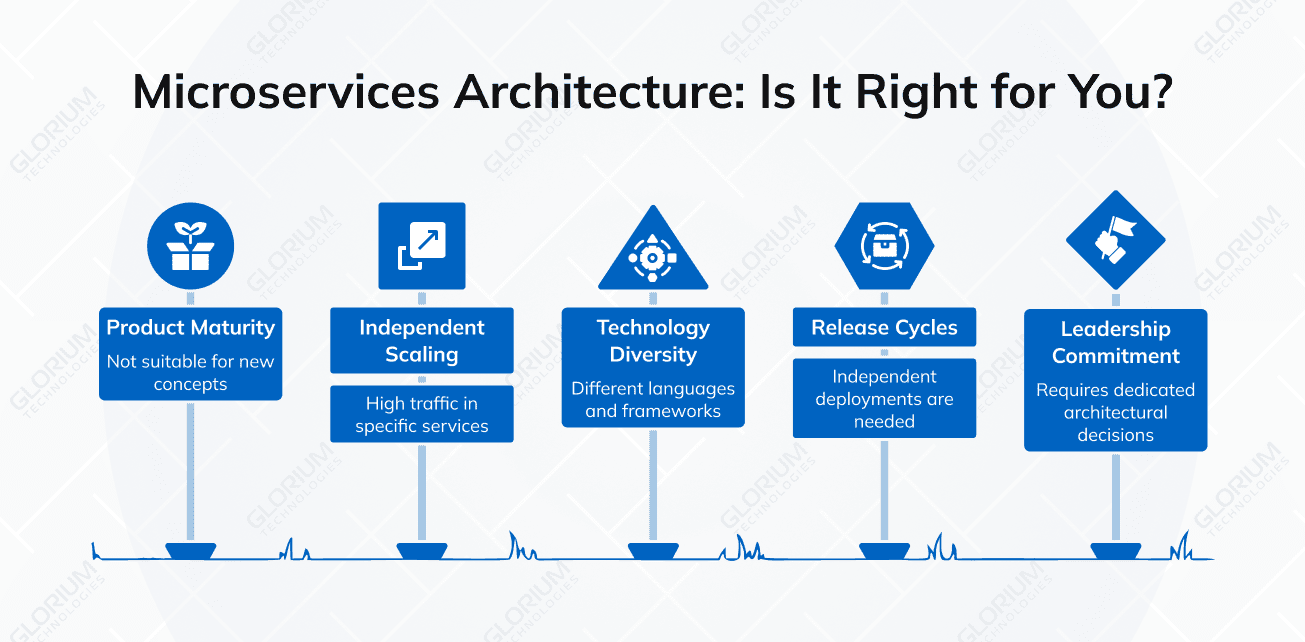
Not every product can benefit from splitting into services on day one, and that’s a reasonable place to be. The right fit depends less on your industry and more on whether your team, traffic, and technology stack are ready for the coordination that comes with running many independent parts.
Microservices architecture development is your go-to option if several of these points are true for you:
Are you still validating your core idea or working from wireframes instead of a working codebase? Are you running on a budget better spent proving the product works at all? If that’s where you are, an MVP-first approach that gets a lean, working version in front of real users will teach you more than an early architecture debate ever could.
The same logic applies at a smaller scale. If one service could realistically handle your current traffic, or a single service already meets your reliability needs, splitting further mostly adds overhead without a matching benefit. That’s especially true if you’re not yet running several service instances behind load balancing. A system that needs a full rewrite because it’s broken calls for a different kind of engagement entirely.
Monolith, modular monolith, or microservices: a quick comparison
| Factor | Monolith | Modular monolith | Microservices |
| Best team size | 1 to 10 engineers | 5 to 25 engineers | 25+ engineers, multiple teams |
| Deployment | One unit, one pipeline | One unit, enforced internal boundaries | Each service is independently deployable |
| Best for | Loosely coupled services aren’t needed yet | Internal clarity without network overhead | Components that need to scale on their own |
| Where it breaks down | Team coordination as code grows | Very high-scale, independently scaling components | Small teams without dedicated platform support |
Overengineering rarely looks like a bad decision at the time. It usually looks like copying a pattern that worked for a company at a completely different scale. Maybe that means splitting separate services faster than your team can operate them or reaching for a service mesh before you have enough services to justify one.
These are the patterns that tend to cause the most regret later:
A properly scoped engagement isn’t one giant rebuild delivered all at once. It typically moves through distinct phases, each with its own working checkpoint. That holds whether the goal is to extract the first service from an existing system or to plan multiple microservices for a build still on the drawing board.
Typical phases and timelines
| Phase | Typical timeline | What you get |
| Discovery and technical assessment | 1 to 4 weeks | Codebase review, service boundary recommendations, architecture diagram, tactical estimate within a 30% range |
| Infrastructure and communication setup | Included in early implementation | Service discovery and a service registry, so services can find and call each other without hardcoded addresses |
| Phased implementation | 3 to 8 months, depending on scope | Services built or extracted incrementally, with working software at each milestone |
| Validation and hardening | Ongoing through delivery | CI/CD pipelines, monitoring, and load testing against real traffic patterns |
By the end, you should have a system where the highest-priority services are independently deployable. You’ll also have documented architecture your team can extend without you, plus working monitoring and error tracking already in production.
You should also come away with infrastructure that can be deployed and scaled without a manual checklist. You’ll get a clearer picture of system reliability too: which services are load-bearing, and which ones can fail gracefully without taking down the entire system. Just as important, you get a record of what was deliberately left out of scope for now. Knowing what you’re not building yet is as valuable as knowing what you are.
This kind of work is typically billed on a time-and-materials basis tied to the actual scope agreed on. That’s instead of a flat package price, since the right amount of decomposition varies so much by product. A short, fixed-cost discovery and planning phase, usually 2 to 4 weeks, comes first. It gives you a documented architecture plan and an estimate within a 30% range before any implementation work begins.
A few factors move the estimate more than anything else. How many services are in scope for the first phase matters, along with whether the team already knows the programming languages and frameworks involved. A specific domain, like inventory management or payments, can also add its own compliance requirements. Extracting one well-defined service from a healthy codebase costs meaningfully less than a full-scale decomposition of a large, tangled application.

The conversation around microservices is maturing quickly. A few shifts are worth watching if you’re planning an architecture that needs to hold up for the next few years.
The operational weight of running distributed services doesn’t disappear on its own. That’s why organizations are building internal platform teams to absorb it, instead of leaving every product team to solve infrastructure problems from scratch.
Gartner projects that by the end of 2026, 80% of large software engineering organizations will have a dedicated platform engineering team. The latter provides reusable services and tooling, up from 45% in 2022. For smaller teams, this shows up as a growing set of managed tools that handle service discovery, deployment, and monitoring. Fewer engineers need deep infrastructure expertise to run a service-based system well.
As more products add AI-driven features, the same architectural discipline that prevents overengineering today is what makes it realistic to add those capabilities later without a rebuild.
Deloitte’s Tech Trends 2026 report describes future-ready systems as modular, API-first, and observable by design, built on platform engineering and cloud-native foundations. That framing matters as more teams look to draw sharp service boundaries early. A poorly scoped microservices setup makes it hard to bolt on a new capability later, without touching the same service twice for two unrelated reasons.
The teams that benefit most from microservices architecture development are the ones that scope work to where their product stands. That’s not the same as where the industry says it should be.
Glorium Technologies has spent 15+ years helping early- and growth-stage engineering teams size their architecture to their real constraints, from a single extracted service to a full production infrastructure buildout. Engagements start with a scoped technical assessment, so you know what you’re building and why before any implementation work begins.
If you’re weighing whether now is the right time to move toward microservices, talk to the Glorium Technologies team about a technical assessment for your product.
No, Kubernetes is not a must-have. It’s a common choice for orchestrating many containerized services, but plenty of teams manage a handful of services on simpler, managed container platforms instead. Adopting Kubernetes before you have enough services to justify it usually adds overhead without a matching benefit.
The best first candidates are usually well-understood, high-value parts of the system with a clear boundary already visible in the code, like a checkout or notifications flow. Extracting a piece the team already understands well lets you validate the approach and the tooling before touching anything riskier.
Yes, this is possible without a full rewrite. Glorium Technologies approaches it as a phased extraction, starting with the highest value, best-understood segments of the existing system. Then the team builds or extracts those as services, testing each in production before moving to the next. Most of the original application keeps running throughout, so you avoid the risk of a single, high-stakes rewrite.
A phased structure is built to absorb this. Because each service is a discrete milestone, priorities can shift between phases without unwinding work already delivered, and the roadmap gets reassessed against the current business need at each checkpoint.