








Generative AI for Enterprises in 2026: Trends, Tools, and Risks
Updated July 31, 2026

 Summarize in ChatGPT
 Summarize in ChatGPT
2025 was a roller-coaster year for artificial intelligence. Model races, everyday releases, disappointing generative AI pilots’ success statistics, talks about artificial general intelligence (AGI), and even superintelligence (ASI) – all of these raised questions about the abilities and limits of AI that businesses wanted the answers to.
According to the 2025 survey report by Cloudera, 96% of enterprise IT leaders stated that AI is at least somehow integrated into their processes, with generative AI being the primary model in 60% of cases. Such a level of AI adoption leaves no doubt that companies want to implement AI. But many of them are still lost in the opportunities it can provide.
In this article, we’d like to provide an overview of what generative AI has to offer for enterprises in 2026 and which of the trends you can confidently follow. So, if you want to learn whether agentic AI is as powerful as they say, what new AI regulations we can expect, and how government investment in sovereign models may affect multinational enterprises, just keep reading.
Content
Apart from generative AI being the main part of enterprise AI adoption strategies, we could also see a few other important trends.
A survey of the state of AI in 2025 conducted by McKinsey revealed that those who work in technology, media, and healthcare use AI agents more often and in more cases compared to other industries. Respondents in the same survey identified the main value of artificial intelligence as innovation, employee and customer satisfaction, and a competitive edge.
Marketing and sales, corporate finance, and development company units experienced the highest revenue increase in 2025, caused by AI implementation.
According to the ISG State of Enterprise AI Adoption from September 2025, the majority of AI use cases are still focused on classification and recognition (33%), and optimization (26%), which is explained by the fact that those AI applications have less risk and higher accuracy. However, content generation and data summarizing appeared to be growing categories, constituting 17% of all mentioned cases.
The average spent per use case was $1.3M, but despite large investments and overall positivity around AI implementation, the majority of enterprise AI initiatives in 2025 were still at the pilot stage, with around 31% of them reaching full production.
These numbers convey a pretty clear message: generative AI adoption in enterprises was scaling. But how exactly was that? Let’s talk more practically.
The last year widened the range of use cases for generative AI and paved the way to the full-scale automation of enterprises. So, here’s how businesses leveraged the power of AI models across their departments.
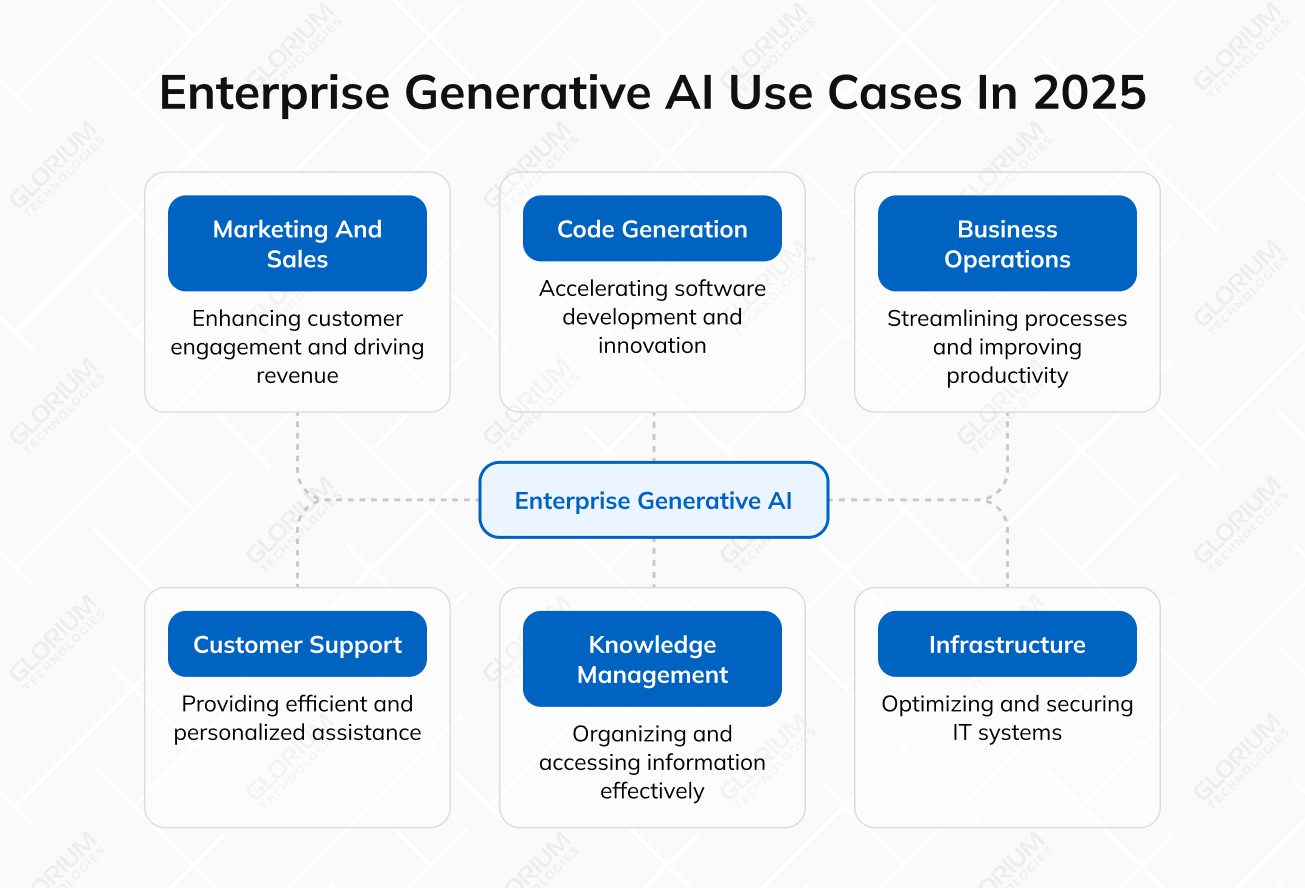
There are many generative AI tools that can help with the creation of content, and that was one of the first, the most obvious uses gen AI got famous with. It gained particular popularity among marketing and sales teams. However, 2025 was more creative about how to use AI technology for brand promotion and lead generation:
Thanks to the natural language processing powers of generative AI, companies have already been using it to resolve customer support tickets for a few years. The trend didn’t change, but the scale and the quality did. In 2025, that’s what worked for customer care in enterprises:
Software development teams experienced perhaps one of the most dramatic transformations with the adoption of generative AI in 2025. What started as simple code autocomplete evolved into sophisticated AI agents that could understand entire codebases and participate in the development lifecycle:
One of the most transformative use cases of generative AI in 2025 was how enterprises approached knowledge management. Large language models finally broke the code on making institutional knowledge accessible and actionable:
Beyond specific departments, 2025 saw generative AI technologies embed themselves into core business processes across enterprises:
What made all this possible was the maturing of enterprise generative AI tools and platforms. Companies moved beyond experimenting with consumer-facing generative AI tools and started building robust AI solutions designed for enterprise needs:
The future of generative AI in enterprises became clearer in 2025: it wasn’t about replacing humans but about augmenting human capabilities. By leveraging generative AI to execute repetitive tasks and analyzing data, employees gained time to focus on creative problem-solving and strategic thinking. This practical foundation set the stage for what we’re seeing in 2026.
2026 is predicted to be the year when AI reshapes enterprises. More investments, more revenue, and more innovations are predicted according to reports from Deloitte, IBM, McKinsey, and Gartner, as well as from independent AI researchers and analysts.
We’ve read them all, so here’s an overall picture of what to expect from AI in 2026:
These are the main predictions about generative AI in enterprises. Each of them will, one way or another, affect enterprises in 2026. But to understand how exactly they fit into your AI strategy, we need to go beyond the numbers and dive into each case individually.
For the longest time, agentic AI was on everyone’s lips in Silicon Valley. From OpenAI and Anthropic, to NVIDIA and Microsoft leaders – everyone believes that one day our lives will be partially or fully automated. And it seems like this day is so much closer in 2026.
Today, most enterprises use AI to automate their processes. And while it’s proven to increase productivity, save costs, and promote faster decision-making, it’s limited to predefined scenarios.
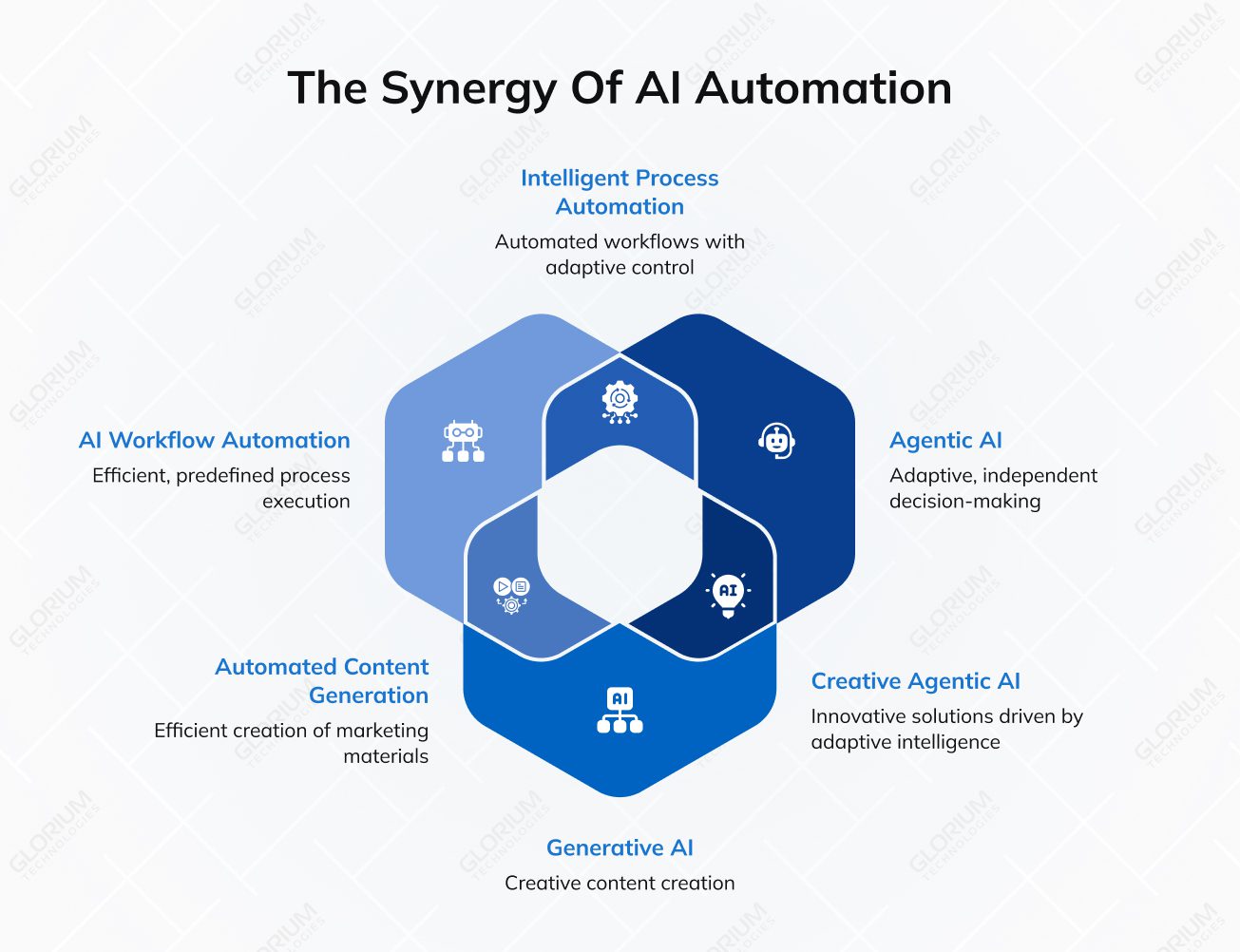
Agentic AI, in turn, represents a more proactive and agile form of automation, where the agent doesn’t just follow a simple instruction but can adapt and take actions based on real-time data through deep reasoning. This makes it more independent, requiring less human interaction.
And what is generative AI’s role here? Well, generative AI, with all of its popularity, is a reactive technology that alone cannot automate anything. It reacts to your request and generates the answer, whether it’s text, image, video, audio, or code.
They’ve learnt the statistical relationships between words and between pixels and between waves. And they’ve learned that from massive data sets. So when you provide a prompt, GenAI predicts what should come next based on its training, but its work does end at generation. It doesn’t take further steps without your input.
Martin Keen, Generative vs Agentic AI: Shaping the Future of AI Collaboration
Thus, generative AI and agentic AI are two different ways AI approaches systems. However, both generative and agentic AI share a common foundation: Large Language Models (LLMs). LLMs are responsible for reasoning in agentic AI: the ability of a system to make decisions on its own.
So, how will generative AI, workflow automation, and agentic AI co-exist? Enterprises will move towards big automation systems, where:
Such systems can be custom-created and integrated into enterprise networks or developed with the use of agent builders.
Here’s the comparison of the most popular options for building AI automation agents and systems:
| Tool | Capabilities | Best for | Price |
| Microsoft Copilot | 1,200+ enterprise connectors | Enterprises within the Microsoft ecosystem | Microsoft licensing |
| n8n | Advanced AI workflow orchestration | Enterprises that want average complexity automation and easy implementation | Free self-hosted;
Cloud from $20/mo |
| ChatGPT AgentKit | Simple drag-and-drop automation | Enterprises that don’t need complex workflow automation | Included in
Plus ($20/mo) |
| Agentforce | AI agents orchestration with deep SFDC integration | Enterprises within the Salesforce ecosystem | Flex credits
from $500 |
| LangGraph | Fully custom NLP workflow orchestration | Enterprises that want maximum customization | Free/Self-hosted |
In 2025, most organizations treated AI as a series of isolated experiments, but in 2026, a shift toward complex orchestration and high-stakes production began. Moving past simple chat interfaces requires a move toward multi-model systems, autonomous agents, and “sovereign” infrastructures that prioritize data security over convenience.
To successfully scale these technologies, leadership must address the friction between rapid technical adoption and the practical realities of regulation, job restructuring, and data quality. Let’s break down the essential questions your team must answer to transition from fragmented pilots to a unified, production-ready AI strategy.
According to IBM, companies won’t stick to a single model, but will instead integrate the capabilities of different models into systems.
Relying on one single model isn’t the strategy anymore. 2026 will become a year when enterprises invest in the orchestration of more complex and capable AI workflows, where a few smaller models, each responsible for automating specific tasks, cooperate.
What’s more, combining the capabilities of different generative AI models can benefit the effectiveness of enterprise AI systems, since each model excels in different types of work.
To make it easier for you to choose the models for your priority assignments, here is a brief comparison of the main generative AI model providers:
| Provider | The newest model | Best for | Price (USD/1M tokens) |
| Anthropic | Claude Opus 4.5 | Writing, coding | $10.00 |
| OpenAI | GPT‑5.2 | Reasoning, deep research | $4.81 |
| Gemini 3 Flash | Reasoning, multimodal capabilities | $1.13 | |
| Meta | Llama 4 Maverick | Multimodal capabilities | $0.46 |
You can find more tech specifics of these and other models here.
If you need more information to understand what models can help your specific cases, Glorium Technologies also offers AI consulting services.
The idea of AI going beyond chat interface to more immersive and personalized experiences is expected to take shape in 2026. Google has already introduced the gen UI concept for its products in November 2025, and more and more companies will implement generative interface capabilities into their systems.
For enterprises, this shift will bring:
A McKinsey survey from the last quarter of 2025 discovered that only 7% of organizations had fully deployed and integrated AI technology, while 62% are still at the experimenting or piloting stages. But this is something that will change for enterprises in 2026.
The main driver for the shift will be more structured, high-quality data. So far, 80%–90% of enterprise data was unstructured, and is believed to be the main reason why AI initiatives couldn’t go past the pilot stage, according to the latest Salesforce State of Data and Analytics report. But this year, with more investments into data preparation, companies will finally be able to deploy and scale their AI systems.
Aaron Baughman, IBM Fellow and Master Inventor, believes that multimodal AI will drastically improve in 2026 and reach a nearly human level of data understanding and perception.
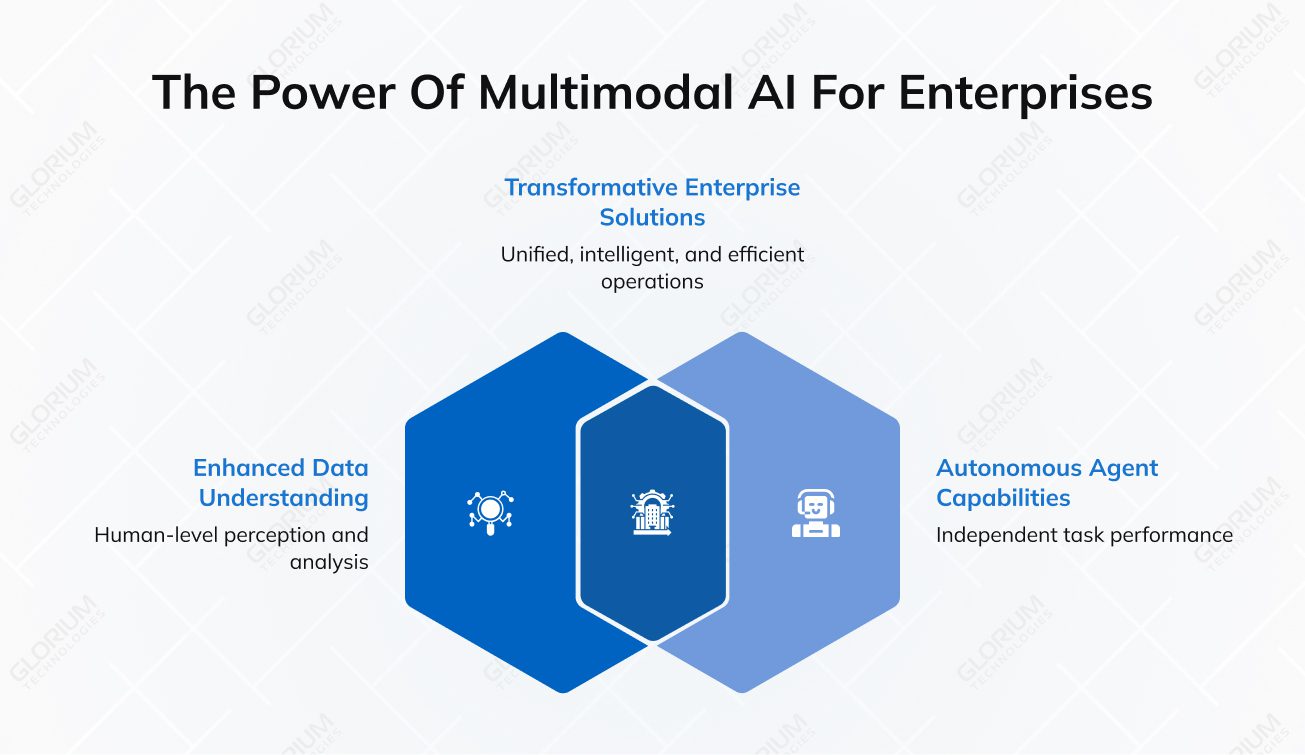
This will allow for more independent multimodal AI agents that can autonomously perform various tasks due to their abilities to receive not only textual and numeric, but also visual and audio information.
For enterprises, this can mean:
According to Deloitte, global edge AI, or, in other words, physical AI adoption, is projected to grow from 58% to 80% within two years, with manufacturing, logistics, and defense industries leading the way.
The main applications are expected to be:
The EU AI Act, presented in 2025, was just the beginning of a more regulated AI use. In 2026, many countries, including member states of the EU, are expected to establish AI governance and provide specific guidelines regarding AI that they expect from companies operating within their digital borders. In this manner, Italy, for example, has implemented special additions to the EU AI Act.
The government of the U.S. is yet to debate about whether and how AI regulations will be established, but separate states, like Colorado and California, have already listed expectations from companies using AI in such industries that work with “consequential decisions” like healthcare, employment, or legal.
Even though AI laws provide some level of security, relying on technology that stores and processes data in another state might leave space for regulatory loopholes, and thus may raise ethical concerns, endanger citizens’ privacy, or even national security.
According to Gartner, in order to enhance independence and guard against extraterritorial regulatory intrusion, 65% of governments globally will implement some sort of technical sovereignty standards by 2028.
Deloitte’s State of AI report has already shown that reliance on foreign-owned AI infrastructure and technologies is a concern for at least 66% of businesses. And for enterprises, where compliance and data security are a must, sovereign AI may become a big trend in 2026.
McKinsey’s AI in the Workplace report from 2025 revealed that 48% of employees place a significant role in AI adoption on internal AI education. Yet, half of them felt like the support they got was moderate or less.
This is also backed by Deloitte. They found that 53% of companies simply raise overall awareness of AI, and 83% haven’t made any changes to jobs around AI capabilities.
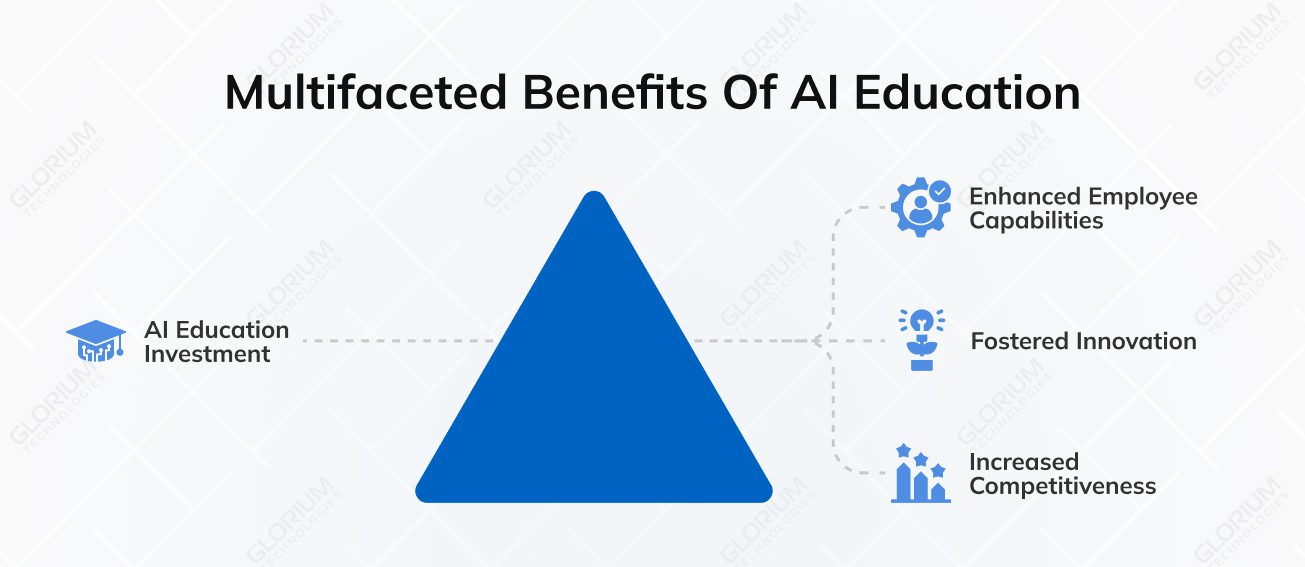
To enable full AI adoption and finally move from experiments and pilots, enterprises will need to significantly invest in generative AI education to fit the new reality.
Each department requires practical training on integrating generative AI tools into its workflows:
But education alone won’t be enough. Beyond teaching employees how to use AI tools, enterprises will need to restructure jobs to align with what AI capabilities can actually handle. According to Deloitte, 83% of companies haven’t done this yet. Here’s what the process looks like:
Companies that restructure jobs around AI capabilities will enable employees to focus on more meaningful work while AI assistants manage repetitive tasks. This is when AI adoption fulfills its promise of operational efficiency and employee satisfaction.
The future of generative AI in enterprises looks bright. With the right strategies, businesses will be able to embrace automation, improve processes, and increase ROI. However, there are no wins without a battle. And to fully adopt AI, enterprises will need to have a few.
According to Statista, three main barriers to AI adoption in 2025 were the lack of skills to support adoption, the lack of vision among managers and leaders, and the high costs of available AI products and services.
The no-skill gap seems to be easy to address: you just need to hire the right talent. But what is the right talent, and where to find them? To simplify this for you, we’ve prepared a guide on how to hire development teams, which will help you understand which experts you need and what hiring approach to take.
The lack of vision is something more complicated. It’s not enough to just want AI in your enterprise. You need to have a problem AI can resolve, or a process AI can improve. What might give your company a clearer picture of where gen AI might be the most beneficial is looking at AI use cases and seeing which of them can be applied to your enterprise.
Finally, AI development costs can be adjusted based on your priorities. You don’t have to invest billions right away or use the most expensive model or services to succeed. What matters is the right strategy and using AI where it fits.
Having reviewed these nine trends, you can now consider their implications for enterprise generative AI tools and solutions you may develop or adopt.
These trends are shaping a new landscape for generative AI applications that extend well beyond basic chatbots and content generators. By 2026, enterprises will invest in several key categories of AI solutions, each targeting specific business processes and operational challenges.
They will integrate traditional workflow automation with generative AI and AI agents. These platforms will adapt to changing conditions and make real-time decisions by analyzing data, rather than relying solely on predefined rules. For example, such systems could process customer support tickets or manage supply chain logistics, using natural language understanding to interpret requests and machine learning to optimize outcomes.
Such technology will change how companies access and utilize proprietary data. These generative AI solutions will search across documents, emails, databases, and video recordings to provide relevant information as needed. Unlike traditional search engines, these AI-powered tools will understand context, synthesize information from multiple sources, and generate summaries or reports based on their findings.
This will become standard. Marketing teams will use AI assistants to analyze customer data and create personalized content across channels. Sales teams will leverage AI to draft proposals, prepare for meetings, and identify high-potential leads. Software development teams will collaborate with AI agents for code generation, testing, and documentation, allowing developers to focus on architecture and complex problem-solving.
Multimodal will process and generate content across text, images, audio, and video. These technologies will enable use cases such as visual quality control in manufacturing, sentiment analysis that considers both content and tone in customer interactions, and automated content creation for marketing campaigns across multiple formats.
Solutions that are tailored to industries like healthcare, finance, and retail will become more prevalent. These solutions will understand industry terminology, comply with sector regulations, and integrate with specialized software. For example, a healthcare AI solution would be trained on medical literature and clinical workflows, while a financial services AI platform would address regulatory requirements and accounting principles.
They combine cloud-based and edge processing and will become more common. Enterprises will deploy AI systems that run locally on devices for sensitive data or real-time decisions, while using cloud resources for complex analysis. This approach addresses privacy concerns and operational efficiency.
These platforms will enable enterprises to build custom solutions by combining different AI capabilities as building blocks. Rather than purchasing monolithic AI applications, companies will assemble generative AI systems using components for natural language processing, data analysis, content creation, and decision-making, all coordinated through a central platform.
The convergence of agentic AI, multimodal systems, generative interfaces, and other trends is creating opportunities that were not possible even a year ago. The priority now is to identify which enterprise generative AI tools align with your specific challenges and to translate these trends into actionable strategies for your organization.
All of these trends for generative AI adoption in enterprises, as well as potential obstacles, show us one important thing: it doesn’t matter what AI you use; it matters how and where. The models won’t matter anymore; systems will. And to build a system that can automate your enterprise efficiently and securely, you will need the right partner near you.
At Glorium Technologies, we can help you address your unique generative AI adoption challenges and turn them into secure and scalable solutions. Reach out to us to get professional assistance from an experienced AI development team.
Agentic AI is an AI-based system that, due to its deep reasoning and learning capabilities, can autonomously perform tasks. It requires minimal human interaction, and, unlike reactive generative AI and simple workflow automation, acts proactively. The rise of agentic AI in 2026 is driven by the need of big companies to automate more complex tasks, which wouldn’t be possible with other types of artificial intelligence systems.
Enterprise AI tools cost varies depending on the nature of the tool, the scale of its implementation, and the tasks expected to be handled. The initially named price of the subscription is rarely the overall expense companies end up with. To correctly calculate costs, you would need to consider the number of employees or customers that will be using the tool, whether there are usage limits and how they match your needs, if you require extra tools for a seamless integration with your internal systems, and whether your team needs additional training or talents.
The top five generative AI trends for enterprises in 2026 are the rise of agentic AI, a switch from a one-model to a multi-model approach, passing pilot and experimenting stages and entering production, more advanced multimodal systems, and investing in physical AI.
Whether using a single AI platform or multiple models depends on your specific needs. If you seek to automate two or three simple workflows, you won’t necessarily need to use a few different models. However, if your automation requires handling tasks that are more complex, with workflows that require different approaches and capabilities, you might benefit from a more sophisticated orchestration with multiple models.
All three are enterprise-level AI solutions that can help companies with knowledge management and simple automations. ChatGPT Enterprise and Claude Enterprise offer integrations with different knowledge bases and data sources, while Microsoft Copilot operates within its own ecosystem. ChatGPT Enterprise is SOC-2 compliant, Claude has a HIPAA-ready offering available, and Microsoft follows GDPR and ISO. The cost for Microsoft Copilot for new customers is $33.50 per user/month; ChatGPT Enterprise and Claude Enterprise do not disclose their pricing. If you plan to use the Microsoft ecosystem and want to know the full implementation cost, check out this article on Microsoft ERP budgeting.
The short answer: from as little as 12 months to 5 years. The time it takes to get from AI implementation to significant, measurable ROI depends on the industry and the type of AI system in use. Generative AI initiatives can start returning before the first year from the initial investment, while companies adopting agentic AI systems, due to their complexity and higher costs, will typically see ROI in one to five years.