







Your Must-Read Guide to AI Personalization in eCommerce
Updated July 31, 2026

 Summarize in ChatGPT
 Summarize in ChatGPT
Now that shoppers are pickier than ever, eCommerce businesses have to continually roll out new solutions to drive customer engagement and cement their competitive advantage. Like in most other industries, AI can help here, too.
AI personalization is the missing link between people willing to do some mindful shopping and tailored, frictionless shopping experiences. Personalized interactions are expected by 71% of consumers, a figure that’s too high for any eCommerce business to disregard. That’s why it’s now a matter of how you can personalize your offerings, not whether you should go for it in the first place.
This article can serve as both your intro to AI personalization in eCommerce and a data-backed guide to delivering personalized shopping experiences that drive revenue.
Content
AI-driven personalization is a way to tailor an online shopping experience based on customer behavior and other data consumed and analyzed by AI tools in real time. It fundamentally differs from traditional personalization, which relies on predefined user segments and deterministic reasoning. With AI, eCommerce platforms can shift to probabilistic decision-making as customers shop, train models to infer trends and patterns, predict what a specific shopper is most likely to do next, and act upon that without further ado.
Personalizing customer experiences at the individual level sets the stage for hyper-personalization, the market that’s currently on track to reach $67.9 billion by 2031. The idea behind hyper-personalization is that no two shoppers are alike: each should get unique value, even if they arrive at the same category page at the same time.
In eCommerce, hyper-personalization manifests in real-time product recommendations, hyper-relevant search results, dynamic content delivery, and more. All these applications can make a difference to your bottom line, as 76% of consumers end up being disappointed when brands fail to deliver personalized experiences.
Any form of AI-powered personalization boils down to machine learning (ML) algorithms analyzing shopping sessions, identifying patterns across sessions, and crafting the best value proposition for each next session. This undertaking requires tons of data.
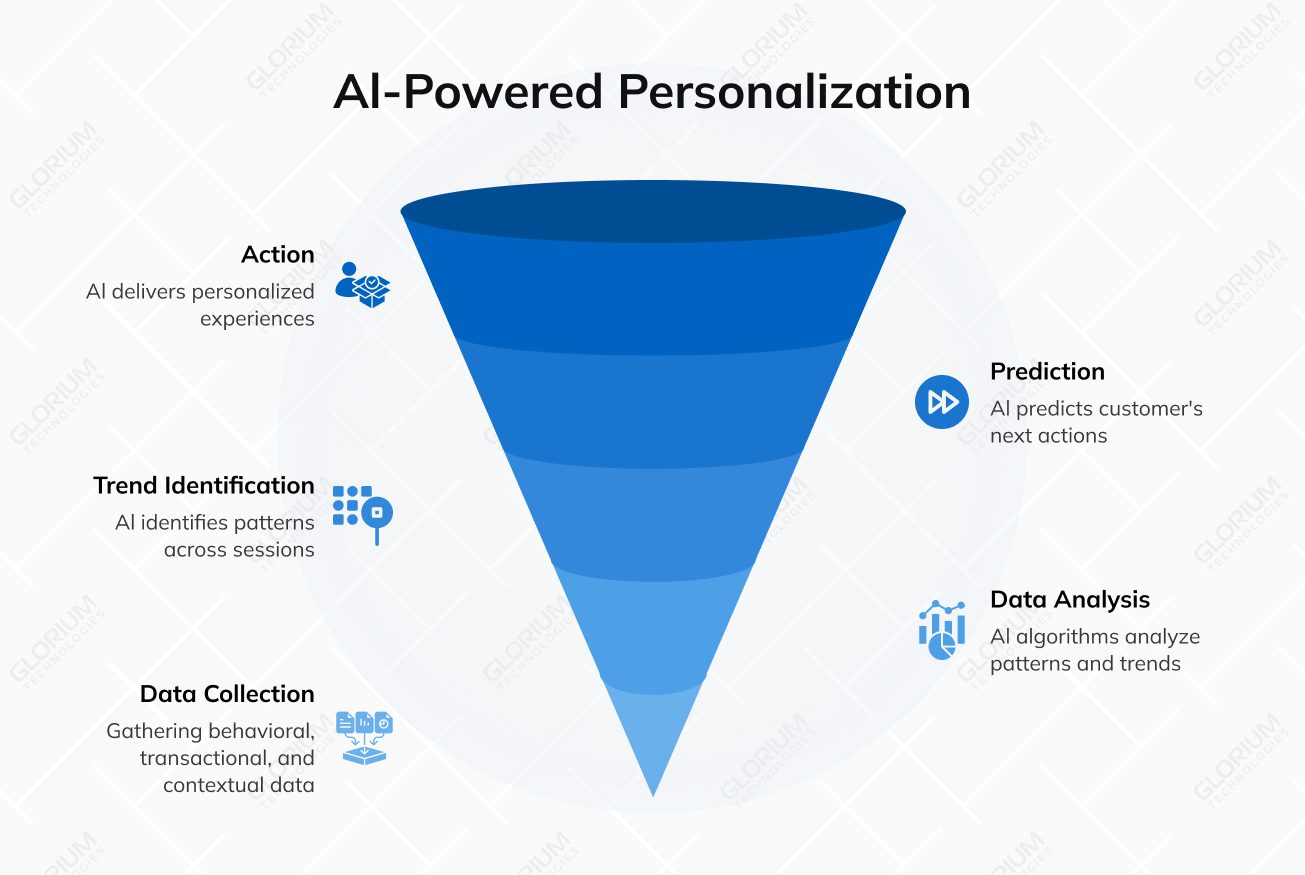
Behavioral, transactional, contextual, product, and customer data should be collected at all points of customer interactions and processed in real time. That’s why a customer data platform (CDP) – a software system that unifies and keeps all your user data in one place – is crucial here. Without a CDP, your personalization efforts will likely remain siloed and disappointing to shoppers.
Once AI algorithms have processed data from your CDP, the next stage – called data filtering – occurs. That’s when the data is refined to optimize the outputs of a recommendation system based on pre-set criteria. Depending on which filtering criteria you use, AI-driven personalization can be enabled through 3 major recommendation methods:
Some of the biggest names in eCommerce have already adopted predictive personalization in their apps and websites. Let’s see how it has panned out for early adopters with some AI personalization examples.
The “Customers Also Bought” section at the bottom of your product page is a good add-on, but personalized product recommendations deliver more individualized value. These include everything from item discovery suggestions guided by consumer preferences and customer segmentation to seasonally relevant products that pair well together to cross-sell recommendations in carts.
Product recommendations can work wonders for the average order value (AOV) and eCommerce sales. That’s what Amazon has already shown us: 35% of its total sales stem from AI-driven suggestions.
In commerce, you have to repeatedly optimize pricing for customer retention. Using AI models for this purpose pays off. With AI-driven dynamic pricing, you can lower or raise prices in real time depending on what’s currently going on in the market, how strong the demand for a particular product is, and how likely your competitors are to lure your customers away.
Dynamic pricing is market-driven and beneficial for revenue maximization. Even though it’s easier to adopt online, dynamic pricing is also making its way into the brick-and-mortar retail space alongside electronic shelf labels. For example, Chinese retail chain Hema Fresh has boosted sales by 15% since starting to price its products dynamically.
If your eCommerce platform returns zero results just because a shopper made a mistake in their query, no sales will happen. The good news is that AI-powered search systems are real. They adapt to each user’s queries at the individual and context levels, thanks to natural language processing, to provide more relevant results as part of personalized search experiences.
Etsy is one brilliant example of adopting personalized search to enhance the relevance of search results to user preferences.
Email marketing can be perfectly coupled with AI-driven personalization. You may want to use AI algorithms to set personalized email campaigns in motion and tailor your emails based on the items your customers are interested in. That’s how you can then provide them with personalized reminders, offers, or discounts.
eCommerce companies can’t go wrong by following Walmart’s suit. The retail giant has strategically succeeded by integrating AI personalization into its email marketing to see conversion rates up by 215% and click-through rates up by 15%.
A lot of digital ink has been spilled on chatbots, but agentic AI-driven chatbots deserve to make even more headlines. Agentic AI is an autonomous form of artificial intelligence that extends its capabilities beyond rule-based responses. When acting as a chatbot, agentic AI can recommend the best product fits for shoppers during live shopping sessions, guide them through the purchasing process, and help repeat buyers plan for reordering.
Chatbots aside, agentic AI can take on other roles for hyper-personalized shopping experiences. Take Sephora, a retailer that has implemented AI agents for virtual try-ons and reaped the fruits of countless brand mentions and happy customers.
AI-driven personalization can have a ripple effect on your eCommerce company’s revenue. According to a recent study, businesses that have deployed AI to deliver personalized interactions see revenue upswings of up to 40% alongside customer satisfaction gains of up to 20%. These come from improved relationships with brands, stronger engagement, and higher conversion rates driven by hyper-personalization.
Another study reveals a bunch of increased key performance indicators for eCommerce companies jumping on the personalization bandwagon, including:
Looking to deploy AI for personalized messaging or push notifications? That’s a sensible move, since AI-friendly eCommerce companies can expect to see their marketing ROI up by 10-30%. It just works when the way you connect with your customers feels individualized.
All these gains are interconnected. As you personalize your marketing and shopping journeys, you’re better positioned to lower your CAC, which increases your marketing ROI and results in a healthier bottom line.
If you’re ready to get started with personalization, plan for 3-6 months before your customers can plunge into tailored experiences. The specific timeline will depend on whether you have unified customer data, what exactly you’re personalizing, and the AI platform you choose.
Here’s a typical roadmap your team will need to follow:
Effective AI-powered personalization should cover the whole eCommerce journey. That’s why you want to enable real-time data trackers across all customer touchpoints, including your website, eCommerce app, and email. New touchpoints and data sources can be integrated later to keep your model’s performance all-encompassing.
Next, you set up APIs. Common integration points include on-site widgets, search systems, email, and chatbots, depending on where personalization is executed. Once integrated, you want to track how your model performs and evaluate its predictive accuracy over time. Retraining is perfectly normal, whether you’re dealing with ‘predictive decay’ or adjusting your personalization strategy to seasonality.
If you seek custom models, have top AI/ML talent, and are well-positioned to use clean data, building your own AI personalization stack makes sense. This way takes more time and higher technical complexity, but it rewards you with proprietary ownership and granular control.
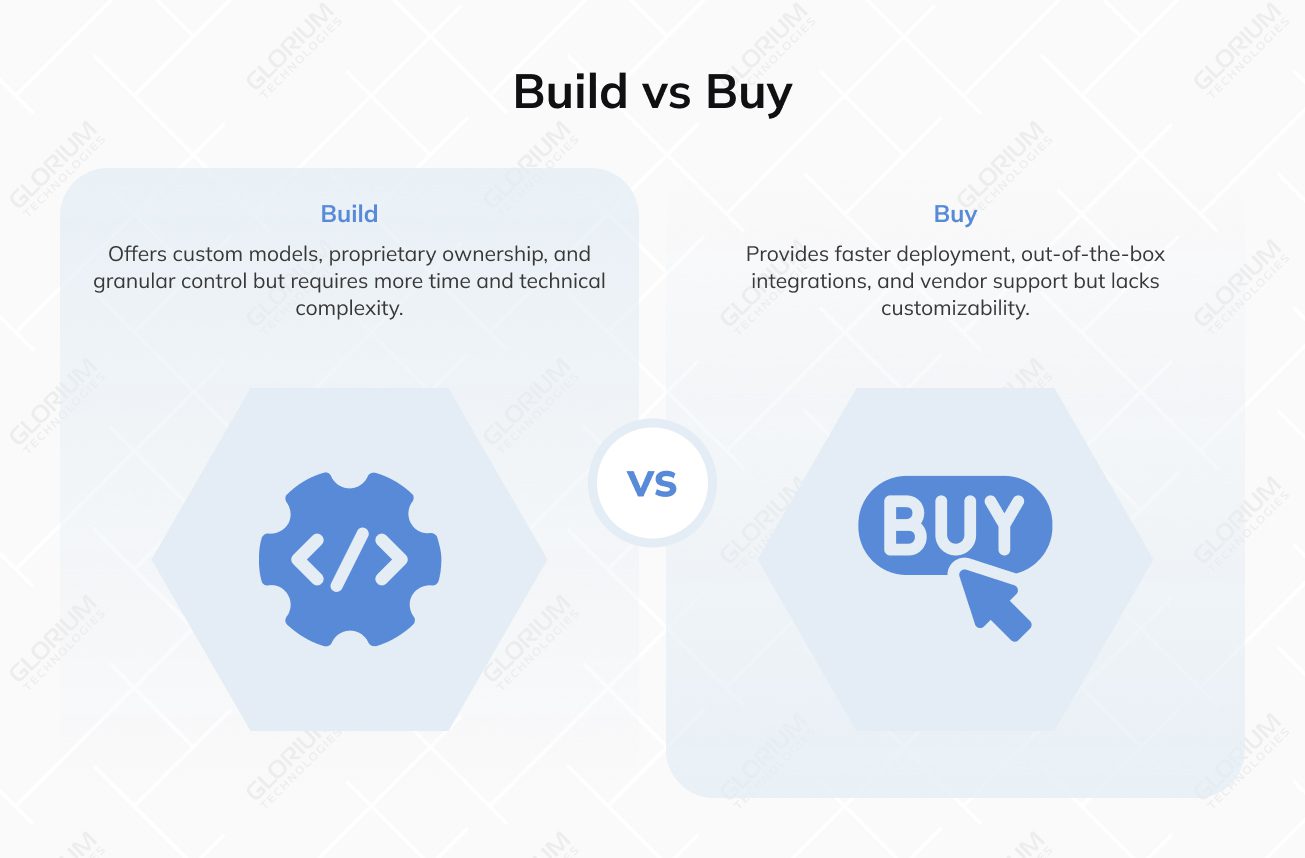
The buy decision – or teaming up with a vendor platform – is better for those seeking faster deployment without additional hires. It comes with out-of-the-box integrations and vendor support to save you the trouble.
If you’re leaning toward an AI platform rather than building things on your own, you can go with Amazon Personalize, Salesforce Einstein, Bloomreach, Nosto, or Dynamic Yield. These are highly reputable personalization platforms that make safe options for eCommerce companies.
Selecting the right AI platform is a pivot point for your eCommerce strategy. While the underlying technology remains consistent, each provider caters to different business scales, tech ecosystems, and marketing priorities.
| Amazon Personalize | Salesforce Einstein | Bloomreach | Nosto | Dynamic Yield | |
| Core focus | Real-time recommendations and rankings | CRM-centric personalization | Search and product discovery | End-to-end personalization | End-to-end personalization |
| Data integration | AWS-native | Salesforce ecosystem | Multi-source ingestion | Commerce-centric data | Broad connectors |
| Real-time scoring | Yes | Yes | Yes | Yes | Yes |
| Search personalization | Via integrations | With AI search add-ons | Top-rated | Basic | Advanced |
| Email personalization | Via integrations | CRM-linked | Good | Good | Good |
| Experimentation support | Using AWS services | Built-in | Yes | Limited | Strong |
| Scalability | Best | Excellent | Excellent | Good | Excellent |
Your choice should be dictated by your existing tech stack and your team’s internal capabilities. For instance, if you are already deeply embedded in the AWS or Salesforce ecosystems, staying within those “walled gardens” can significantly reduce integration friction. Conversely, if your goal is to bridge the gap between complex search queries and product discovery, a commerce-first platform like Bloomreach or Dynamic Yield often provides more out-of-the-box maturity.
Implementing AI personalization for an eCommerce platform isn’t a walk in the park. The process means you’ll have to deal with several challenges before, during, and after the rollout.
In the US, data privacy is a matter of concern for 86% of people. Dealing with such widespread public concern is exacting for all organizations, let alone those that are supposed to collect plenty of consumer data to feed into AI models. On top of that, there are CCPA and GDPR requirements to fulfill.
To ensure data privacy and compliance, eCommerce companies should unconditionally stick to the principles of privacy-by-design, data minimization, and consent management. You have to embed data protection into all your AI implementations, collect the bare minimum of personal data, and obtain users’ approvals for data collection and processing.
Consumers may not want to part ways with their data. Frequent opt-outs and inadequate tracking are detrimental to data quality, leading to poorly personalized experiences unless addressed.
To deal with this challenge, you should invest in your customer data protection mechanisms to reduce opt-outs and use as many trackers as legally and sensibly possible to avoid data gaps.
You may encounter the cold-start problem when using collaborative filtering behind your recommendation engine. This issue means your recommender can’t deliver personalized suggestions because it lacks sufficient insights into past purchases, new users, or new products.
The easiest way to handle the cold-start problem is to switch to an AI engine that uses content-based or hybrid filtering.
There’s always a risk of social biases and stereotypes creeping into machine learning algorithms and their reasoning. The bias-laden, unchecked training data is to blame.
To avoid inaccurate recommendations due to algorithmic bias, ensure your training data covers all your customer groups without prejudice or distortions. You should also arrange for human specialists to perform regular audits.
Your AI-driven personalization efforts may backfire if you take things too far. Overly intrusive or excessive personalization chips away at customer loyalty and encourages your audience to turn to your competitors.
“There’s a limit to what should be personalized, and there’s a gray line between being helpful and being creepy. ”
Suruchi Shukla, AI-Powered Personalization in eCommerce: What’s Next?
To avoid crossing the line, personalize only when it adds value. Let customers select the personalization level they’re comfortable with and continuously conduct A/B tests.
Data collection and model training costs can have a crippling effect on any company’s budget. The more you experiment with personalization, the more noticeable the effect.
To keep costs predictable, define the goals of your data usage and AI personalization project early on and deploy models for one use case at a time.
AI is taking the lead for a business advantage in eCommerce. 69% of those who have implemented the technology – in one form or another – report significant revenue boosts. It’s no wonder 51% of eCommerce businesses are among the AI adopters for personalization.
Yet, there’s always room for improvement. In 2026, all eyes should be on these 5 trends:
Personalizing your customers’ shopping journeys for increased CLV and AOV is easier with an experienced partner like Glorium Technologies. We have 15+ years of experience in software development and digital transformation, and a proven track record of building success stories for clients with AI-driven solutions.
Interested in how we make that happen? Explore some of our case studies:
Connect with Glorium Technologies to start personalizing shopping experiences and become the most customer-focused eCommerce company.
It depends on machine learning algorithms and your use cases. A ballpark figure for an AI system to accurately anticipate customer needs and deliver personalized experiences is tens of thousands of user interactions. Your training data should cover purchase history, browsing behavior, and product attributes.
The cold-start problem occurs when a newly implemented AI system can’t provide individualized suggestions or other anticipated personalization benefits because it has insufficient data on customers, past purchases, or products. Solving this problem requires content-based or hybrid filtering to mitigate the lack of initial data.
Yes. When budgets are limited, eCommerce businesses can adopt AI personalization modularly using platforms like Amazon Personalize, Salesforce Einstein, Bloomreach, Nosto, and Dynamic Yield. These platforms fit small and large retailers and offer usage-based pricing.
Dynamic pricing is when you dynamically raise or reduce prices for all customers in response to market signals (e.g., supply, demand, inventory levels). Personalized pricing, on the other hand, is about charging different customers different prices based on behavioral data and value signals.
AI models are prone to model drift in all industries, including eCommerce. To maintain your model’s predictive analytics and decision-making power, you should arrange for weekly or monthly retraining. More frequent retraining may be necessary if user behavior patterns, customer needs, or business objectives change.
Amazon Personalize is an ML service that builds customizable recommendation systems based on your data. You supply Amazon Personalize with browsing history, purchase behavior, inventory management, and other data to get personalized product recommendations, customer segments, and rankings in return.
Algorithmic bias makes balancing personalization with fairness harder. To prevent this issue, you can set up a monitoring committee comprising human specialists from various backgrounds, use diverse training data, and carefully check your AI model’s outputs against defined business constraints and ethical guidelines.