






Top 15 Healthcare Software Development Companies and Tomorrow’s Unicorns (2026 Update)
Updated July 31, 2026

 Summarize in ChatGPT
 Summarize in ChatGPT
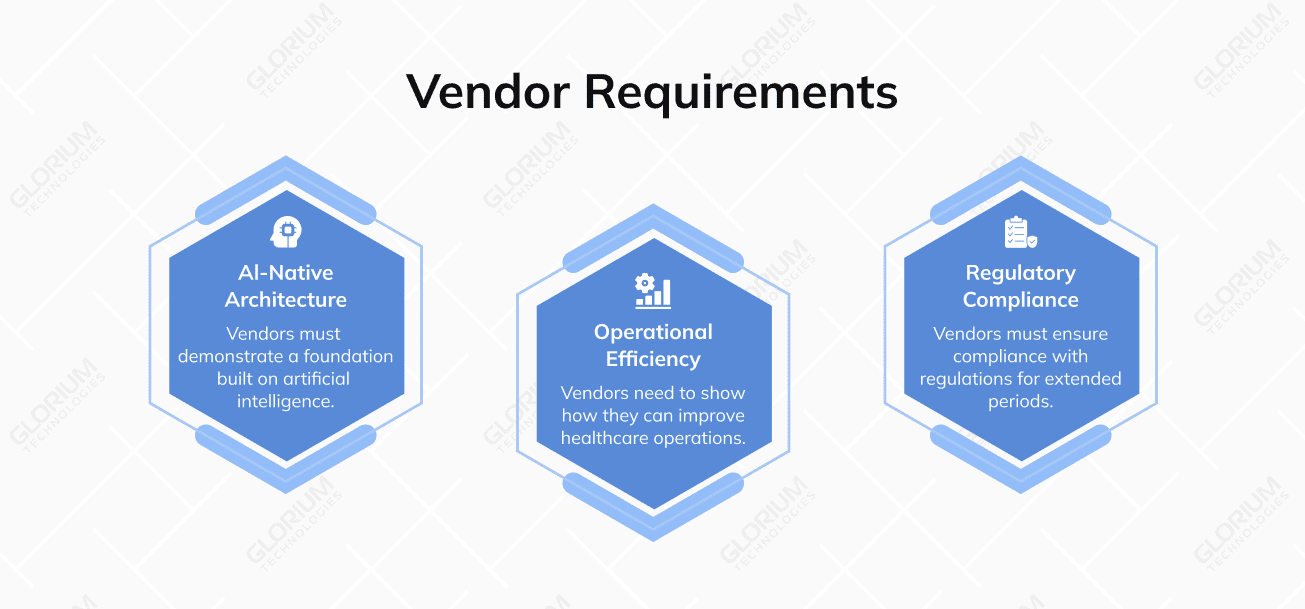
The healthcare industry has stepped into 2026 with a sharper appetite for technology than at any point in the last decade. Gartner’s April 2026 forecast says global IT spending will grow 13.5% this year, with the fastest acceleration coming from technology and healthcare. That money is flowing toward vendors who can prove three things: AI-native architecture, operational efficiency, and regulatory compliance for years after the contract closes.
A capable vendor now shapes patient outcomes and how well healthcare organizations hold up under audit. A weak one, on the other hand, quietly drains both budget and trust. Are you choosing a partner this year and willing to separate marketing gloss from delivery capability? We’ve reviewed 15 healthcare software development companies doing the most credible work in 2026.
Content
The healthcare tech buyer in 2026 has little in common with the buyer in 2023. Three years ago, the industry was riding a wave of novelty. Innovation budgets were generous, procurement teams were ready to approve experimental pilots, and simply having “AI-powered” on a feature list was enough to win a contract.
It’s 2026, and healthcare organizations are under unprecedented operational pressure and demanding hard, measurable returns on every line item. They don’t want to hear about potential but see the proof in clinical workflows, administrative hours saved, and bottom-line impact.
Deloitte’s 2026 Global Health Care Outlook reports that health system leaders are allocating up to 14% of their technology budgets to cybersecurity tools and processes. In other words, they’re putting security spending on par with GenAI and digital health platforms. That budget signal tells you which vendors win contracts in 2026: the ones who can demonstrate enterprise-grade security, not just a shiny AI demo.
According to CB Insights, 14 new unicorns appeared last year. And every single one of those billion-dollar companies has AI at its core. This massive influx of capital is fueling a powerful second tier of well-funded challengers, ready to disrupt the established giants.
The ranking below moves from #15 up to #1. Position is based on the most recent reported annual revenue, weighted by breadth of healthcare-specific solutions and recent strategic moves.
As you read through, you will notice pure-play healthcare technology firms sitting alongside diversified IT services giants like Wipro, Cognizant, and TCS. That mix is intentional. While healthcare is just one segment of many for these global integrators, they manage a massive share of the software development and managed services contracts for the world’s largest health systems. Rather than a head-to-head feature comparison, think of this list as a strategic market map of the forces shaping healthcare IT today.
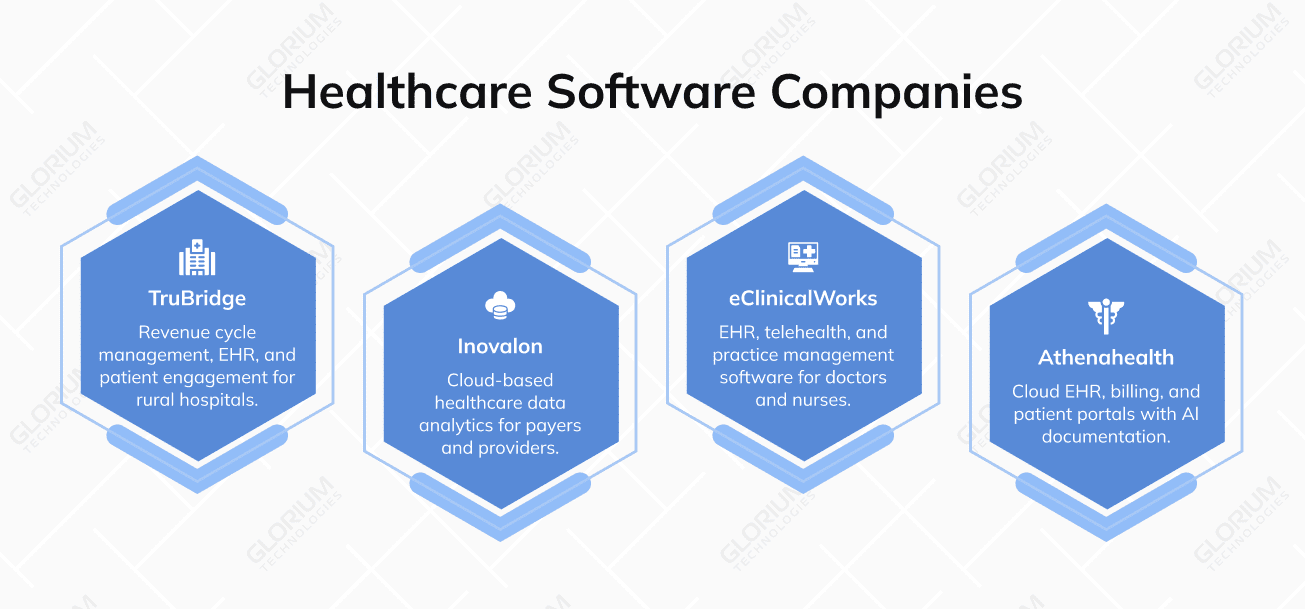
TruBridge is now trading on Nasdaq as TBRG and runs out of Mobile, Alabama. The company was known as Computer Programs and Systems, Inc., or CPSI, until its 2024 rebrand. The FY2025 revenue is reported to be $346.8 million, according to its 10-K filing. Its current portfolio covers revenue cycle management, electronic health records, and patient engagement tools built specifically for rural and community hospitals. TruBridge serves more than 1,500 community and rural hospitals.
Founded in 1998 in Bowie, Maryland, Inovalon is now one of the well-known cloud-based healthcare data analytics for payers and providers. It has been privately held since the 2022 buyout by Nordic Capital and Insight Partners, and now its annual revenue is estimated to be approximately $826.4 million. The company’s population health analytics provides actionable insights that inform and accelerate patient care and business decisions for over 50,000 active, licensed customers. Recent focus has shifted toward real-world evidence and quality measurement for value-based care contracts.
Founded at the dawn of electronic health records in Westborough, Massachusetts, eClinicalWorks came out to reduce paperwork in the healthcare sector. The company supports more than 180,000 doctors and nurses, as well as over 800,000 medical practitioners, with its EHR, telehealth platform, and other practice management software. eClinicalWorks does not publicly disclose precise financial filings, but industry estimates and historical growth patterns indicate its annual revenue is approximately up to $1.5 billion.
The company started as the “Athena Women’s Health” birth center in San Diego. It’s been owned by Bain Capital and Hellman & Friedman since 2022. The platform covers cloud EHR, billing, and patient portals, with a 2026 push into ambient AI documentation and prior authorization automation. It connects 170K+ providers and submits over 315M claims per year. The company’s annual revenue is estimated to be approximately $2.5 billion.
R1 RCM partners with more than 1,000 US healthcare providers on end-to-end revenue cycle work. It covers patient access, coding, and back-office billing for many of the largest hospital networks. The company is now scaling its AI-driven operating platform, Phare OS, and growing its global delivery footprint with a new office in Hyderabad. R1 RCM’s Government Reimbursement, Extended Business Office, and Underpayment Recovery services were recognized with several 2026 Best in KLAS awards. Revenue for the year is between $2.5 billion and $2.6 billion.
Veradigm serves over 330,000 healthcare providers and approximately 180 million patients. Its solutions include cloud and professional EHR, practice management, revenue cycle management, patient engagement, and enterprise platforms. The company was named a KLAS 2026 Points of Light Award winner for a collaborative effort that integrated payer-derived social determinants of health (SDOH) data directly into provider EHR workflows. The company has a market capitalization of about $506 million.
Epic Systems anchors the US EHR market with patient records covering more than 280 million people and estimated annual revenue near $5.7 billion. The company earned a spot on the TIME100 Most Influential Companies list thanks to its clinical AI and API-based data sharing work. New releases include an AI scribe, a contextual visit assistant, and a 2026 sandbox toolkit that lets health systems orchestrate custom AI agents inside Epic.
Wipro’s healthcare and life sciences practice includes payer platforms, medical billing, and legacy systems modernization for large hospital chains. Founded in 1945, Wipro is based in Bangalore, India. The unit is dedicated to integrated care delivery, connected care platforms, and AI-powered automation. Wipro is also deploying agentic AI, machine learning, and AI-enabled robotic arms in drug discovery, patient monitoring, and medical device innovation. The company makes about $10.5 billion in revenue annually.
Philips’s strategy for 2026 is focused on AI-enabled radiology, intensive care decision support, precision diagnostics, and hospital-at-home models to address staffing shortages and cost pressures. The company got FDA clearances for its Verida spectral CT and Rembra CT platform, won a tender for up to 15,000 home-care patients per year in Region Stockholm, and launched the Titanion ultra-high-gradient MRI. Philips reported Q1 2026 total group sales of $4.51 billion, an increase of 4% in comparable sales.
GE HealthCare, a spin-off from General Electric in January 2023, sells imaging hardware, medical device software, and a growing pharmaceutical diagnostics line, with its Edison digital platform underpinning an AI strategy. Q1 2026 revenue hit $5.1 billion, up 7.4% year-over-year. The company presented new CT, MRI, and molecular imaging systems at ECR 2026, while at the HIMSS Global Health Conference in Las Vegas, it showcased its AI portfolio, including the STRATUM data tool.
Payer modernization, claims processing, and patient management platforms are among the healthcare offerings from Cognizant. The company actively invests in agentic AI for prior authorization. It homes in on platform-led performance in care management, intelligent claims processing, and digital patient engagement. Cognizant secured the #1 spot in the Care Management Solutions (Payer) category in the 2026 Best in KLAS report. In February 2026, the company announced a partnership with Palantir to build ontology-driven AI for healthcare workflows. Plus, it reported $5.41 billion in revenue for Q1 2026.
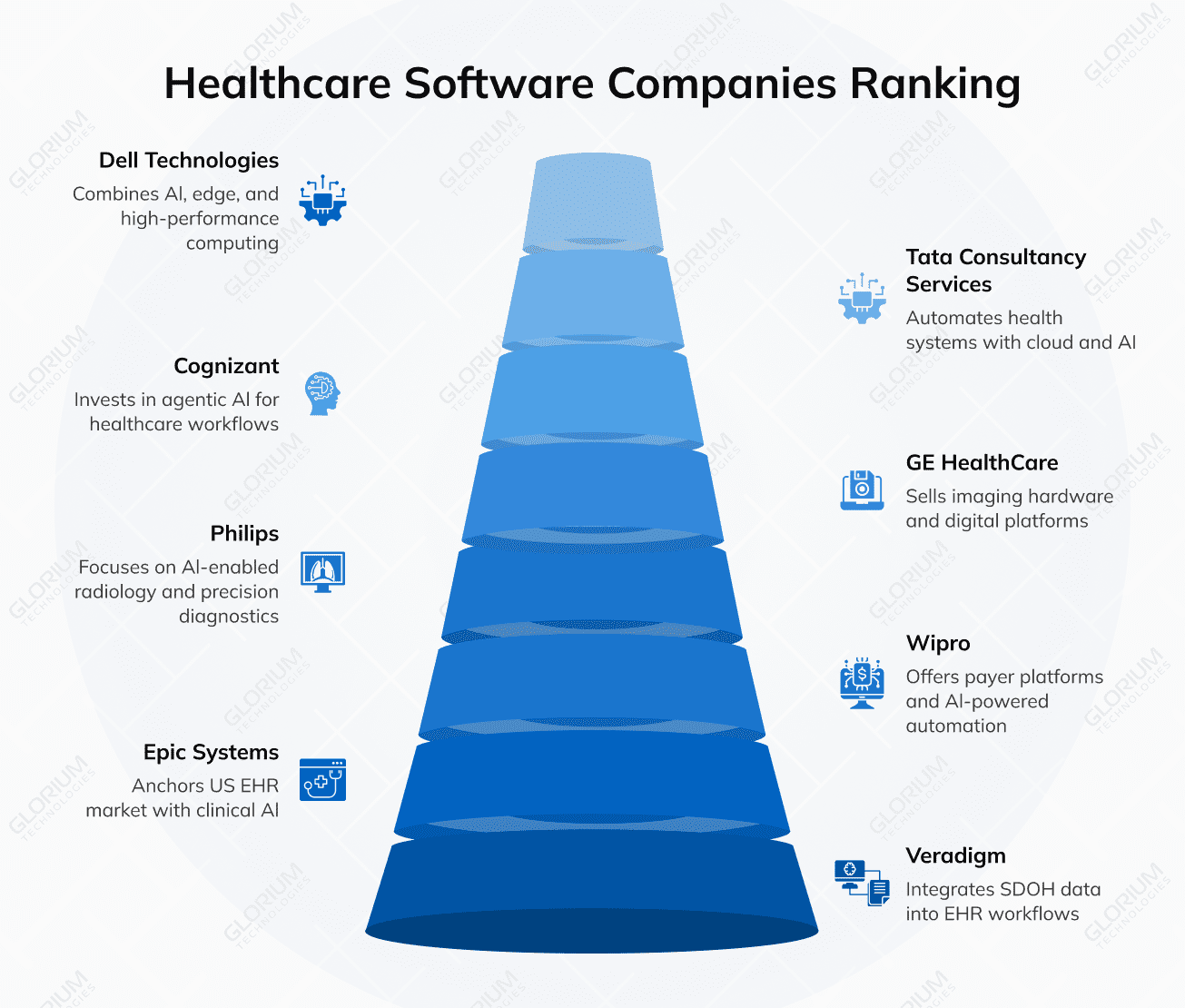
TCS has large-scale software engineering, population health, and public health automation programs for government health systems in India, the UK, and the Middle East. The NHS Supply Chain selected TCS for a five-year deal to modernize core business systems using cloud and AI. The firm embeds agentic AI into pharma regulatory affairs and patient support, decentralizes clinical trials through its TCS ADD platform, and was named a market leader by Everest Group and HFS Research. Its annual revenue is around $30.01 billion.
Dell’s healthcare business includes data security, cloud infrastructure for electronic health records, remote patient monitoring edge devices, and digital pathology storage, with hosting partnerships with leading EHR vendors. Its 2026 focus is at the intersection of agentic AI, edge computing, and high-performance computing for drug discovery, clinical diagnostics, and personalized medicine. Dell rolled out Deskside Agentic AI for local workflow automation that preserves data sovereignty and powers the Cambridge University biomedical cloud. The company reported a record full-year revenue of $113.5 billion.
Optum combines care delivery, pharmacy benefits, and its technology arm Optum Insight, supporting payers, providers, and life sciences customers in 50 states across the US. The company is executing a “back to basics” strategy in 2026 that reduces its medical network and redefines the economics of pharmacy. Optum Rx has implemented a transparent pricing model that eliminates spread pricing, and Optum Real, built with Google, is reducing demand on call centers. Optum Match technology connects patients with providers based on communication style and clinical needs. Optum reported first-quarter 2026 revenue of $104.7 billion (sum of Optum Health, Optum Rx, and Optum Insight segment revenues).
McKesson reported FY2026 full-year revenue of $403.4 billion, up 12% year-over-year. The company’s growth is driven by oncology and multispecialty, biopharma services and prescription technology solutions. The company is also preparing to spin off its medical-surgical division into an independent business. Its Prescription Technology Solutions segment connects patients, pharmacies, and providers to improve therapy affordability. Meanwhile, the oncology unit provides community practices with tools such as the Practice Insights QCDR to measure quality and patient outcomes.
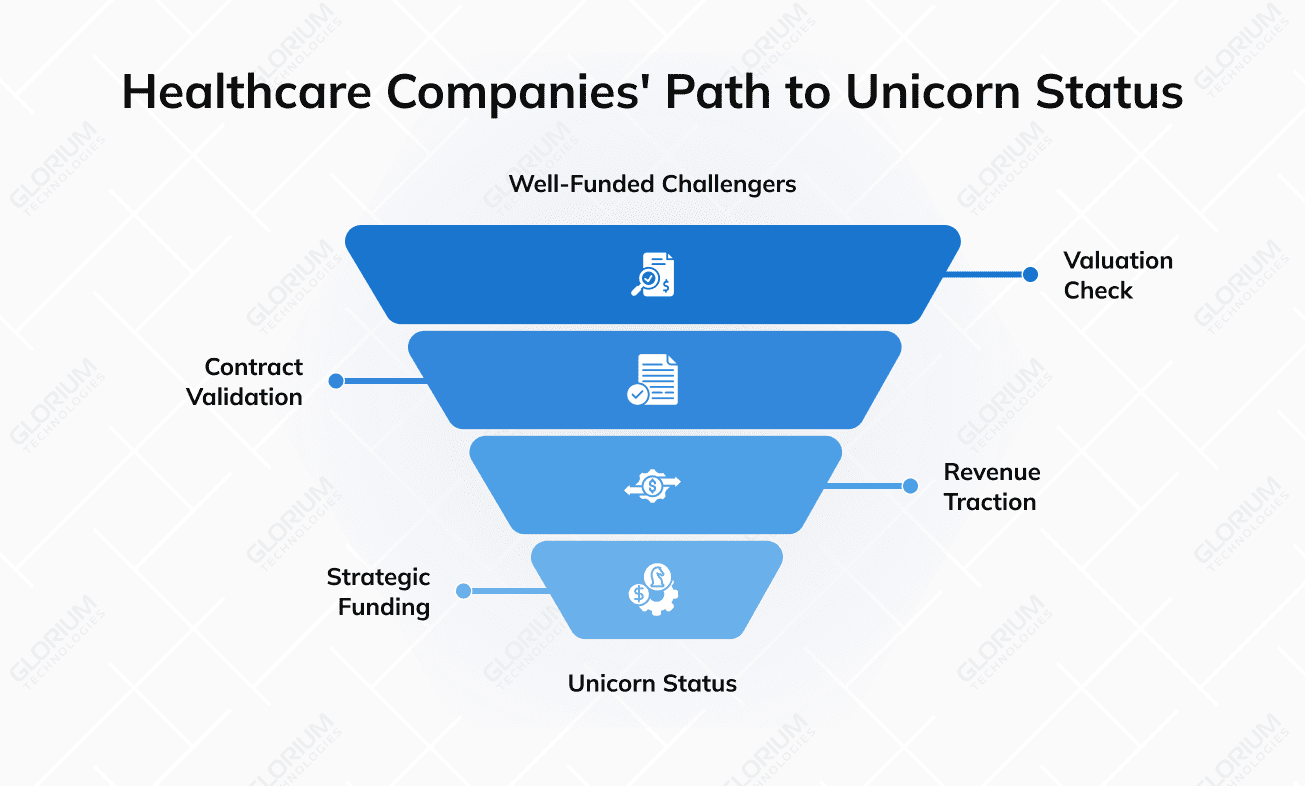
Outside the top 15, there is a layer of well-funded challenger healthcare companies that the next few years will likely see join the billion-dollar club. The criteria here are simple: a valuation between $300 million and $900 million, real contracts with named healthcare providers, and disclosed revenue traction.
Three candidates worth watching are:
Revenue tells you who is large, but it does not tell you who is good. The vendors winning 2026 procurement cycles share a small set of traits that you can verify during evaluation, independent of brand recognition or sales pitch polish.
These traits are visible in working products:
Generative AI has officially hit the mainstream, with more than 80% of leaders surveyed saying their organizations have deployed at least one user-facing application. The companies pulling ahead are the ones that can pair an AI roadmap with strong project management and maintain strict compliance discipline that hospitals demand.
For mid-market healthcare providers worldwide and medical device manufacturers, the right partner often is not the largest vendor on this list. It is a software development company with deep domain knowledge and audit-ready engineering practices.
Legacy giants are now consolidating power through acquisitions and AI retrofits, while a fresh wave of venture-backed challengers is reshaping the middle tier. Picking a partner now has long consequences for patient care, financial performance, and your standing with regulators.
If you are building custom healthcare software development projects, modernizing legacy systems, or scoping a new medical software development initiative, the size of the vendor matters less than their domain depth.
Glorium Technologies partners with digital health founders, medical professionals, and enterprise health systems to build compliant, AI-ready solutions. Browse our healthcare case studies to see how we have delivered for teams like yours.
Costs vary widely. A focused MVP typically lands between $40,000 and $200,000. Mid-scale platforms run from $300,000 to $900,000. Enterprise deployments with deep regulatory and integration scope can exceed several million. Use the Glorium Technologies cost calculator for a bespoke estimate.
EHR vendors offer licensed platforms with limited ceilings on customization. Custom software development partners develop to your specific clinical workflows, patient data needs, and integration needs.
Medical device software has to meet a higher bar than most healthcare projects. You are working under FDA 510(k), IEC 62304, and EU MDR, which means structured risk management, traceable requirements, and full validation. A specialist partner takes care of medical device regulations and verification work from day one, so your submission package is ready when development ends.
Telehealth platforms focus on the live encounter, covering video visits, scheduling, e-prescribing, and patient intake. Broader healthcare solutions go wider, touching patient data management, billing, and clinical workflows. If you need both, custom healthcare software solutions can connect your telemedicine platforms to your EHR and revenue cycle without forcing you onto a one-size-fits-all product.
Focused MVP development may last four to six months. Some full hospital management systems or AI-based healthcare solutions that call for clinical data analysis may take as long as twelve to eighteen months. When you have a team that uses reusable components for custom medical software development and a proven track record on similar projects, your timeline shortens.
You want a team that has shipped inside live clinical environments and understands healthcare regulations from the first sprint. Ask about HIPAA compliance, HITRUST, and SOC 2 posture, prior healthcare software projects, and how they staff AI-powered healthcare solutions. A good partner also gives you honest healthcare software development costs upfront.
Agentic AI, ambient documentation, and edge computing are transforming healthcare operations. You’re seeing real impact in revenue cycle automation, clinical decision support, and remote monitoring. Off-the-shelf platforms may not always be the answer, and custom solutions using these emerging technologies can be more flexible.