









A Practical Guide to Insurance Software Development for Modern Carriers
Updated July 31, 2026

 Summarize in ChatGPT
 Summarize in ChatGPT
Check almost any carrier, and the same bottlenecks turn up in the same places. A claim waits in a queue while an adjuster clears a backlog. An underwriter retypes the same figures from one screen into the next. A policyholder calls for an update that should already be waiting on their phone. That friction drains money every quarter, and customers feel it just as sharply as the finance team does. For insurance carriers, bolting on one more tool rarely clears the blockage because the real fix is software shaped around how an insurer actually works.
The global insurance software market reached roughly $14.14 billion in 2025 and is set to grow to $20.41 billion by 2031, a 6.31% CAGR. That investment is chasing three things at once: speed, accuracy, and a cleaner customer experience.
Content
Insurance runs on workflows spanning sales, risk, finance, and regulation. Custom insurance software development builds and connects the systems that move work through those insurance operations. The scope reaches from a single claims tool to a full digital backbone that handles a policy from quote to renewal. The right scope depends on the gaps a carrier needs to close and the products it wants to sell.
Insurance software earns its place by solving specific, recurring problems across the value chain. A handful of use cases show up on nearly every project, and most carriers start with one or two before connecting the rest:
Packaged platforms cover common ground well. They struggle when a product is unusual, when rating logic is proprietary, or when distribution runs through embedded channels. Custom insurance software development delivers tailored solutions in exactly those spots, earning its keep where standard tools fall short. The table below maps four common paths against the situations they suit.
| Approach | Best fit | Trade-offs to weigh |
| Off-the-shelf platform | Standard lines with common workflows and limited differentiation | Fast to deploy, harder to tailor to niche products or unusual rating logic |
| Configured core suite | Mid-size carriers modernizing policy and claims at once | Vendor roadmap drives the pace, and configuration has ceilings |
| Custom insurance software | Unique products, embedded distribution, or proprietary risk models | Higher upfront effort, full ownership of the roadmap, and the data |
| Hybrid build | Carriers keeping stable cores while building differentiating layers | Integration discipline matters; clear API contracts are a must |
A stable policy core, paired with custom-built claims and customer-experience layers, is a common and sensible setup, with integrations stitching the insurance workflows together.
Customers want the same smooth digital service they get from any tech company, while regulators demand tighter reporting, and thin margins call for lower operational costs. Custom software addresses all three at once, and the returns show up in numbers that finance teams track.
McKinsey research found that UK insurer Aviva deployed more than 80 AI models in its claims domain, cutting liability assessment time for complex cases by 23 days, improving routing accuracy by 30%, and reducing customer complaints by 65%. McKinsey also notes that AI can cut underwriting costs by up to 30% and lift underwriter productivity by 50%, with some decisions dropping from days to roughly 12 minutes, sharpening every customer interaction along the way.
Custom systems pull from telematics, IoT sensors, third-party feeds, and internal records to score risk with more signals than legacy tools allow. Machine learning and data analytics power fraud detection that manual review tends to miss, which protects both the loss ratio and honest policyholders. Stronger risk management of this kind keeps pricing accurate and payouts fair.
Glorium Technologies has built this kind of predictive capability before. The same engineering muscle sits behind our real estate churn prediction system, where a machine learning pipeline estimates the probability of tenant churn and explains which factors drive it. The pattern carries straight over to insurance risk and retention scoring.
Policyholders compare their insurer against every smooth digital service they use, from banking apps to ride-hailing. Self-service portals, instant quotes, real-time claim status, and clear communication turn a stressful moment into a manageable one and lift customer satisfaction. A customer relationship management layer ties these touchpoints together, driving customer engagement and personalized services across the journey. The payoff shows in renewal rates, referrals, and a lower cost to serve each policy.
The insurtech market reached $19.06 billion in 2025 and is projected to reach $132.71 billion by 2034, a 24.1% CAGR, with North America holding about 48% of the market. Carriers that lead this digital transformation now position themselves where the growth is heading.
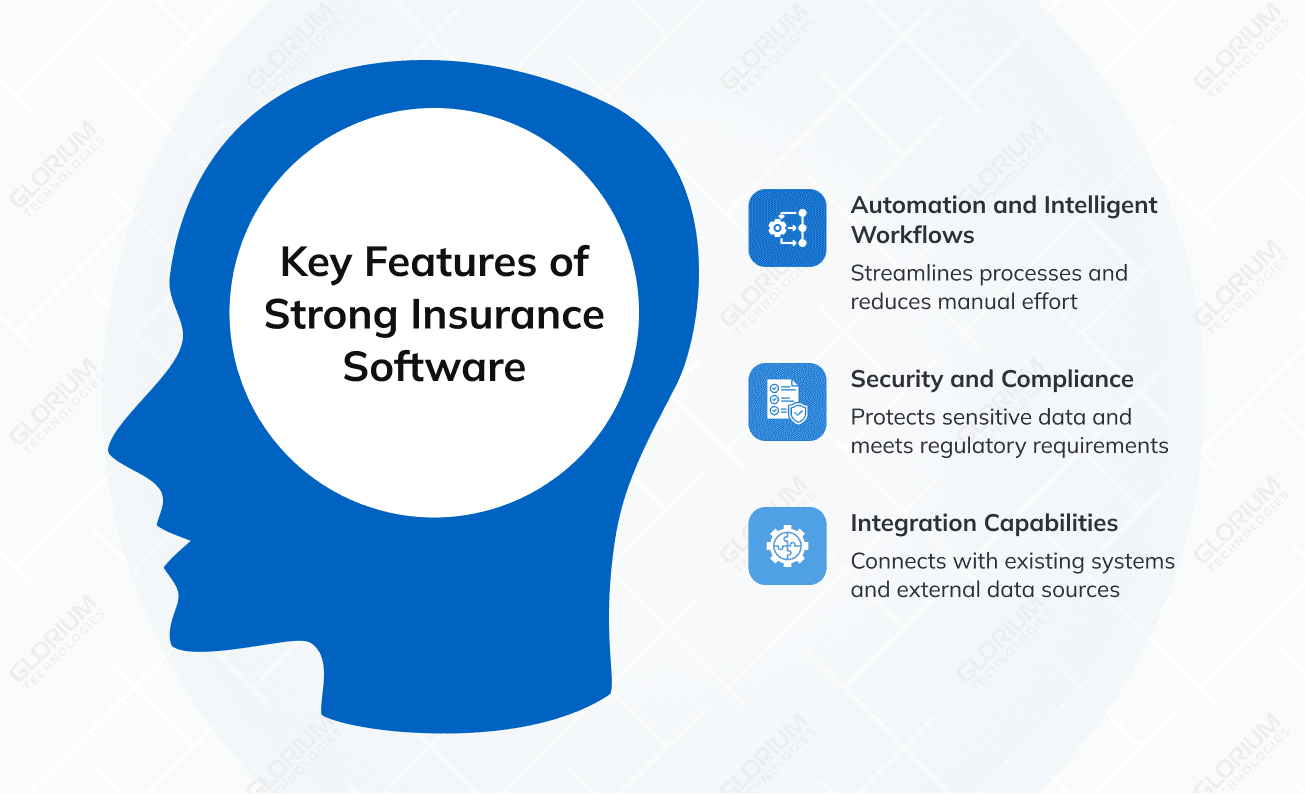
A capable platform shows its quality in detail. Certain features separate custom insurance software that merely runs from insurance solutions that move the business forward. The list below reflects what high-performing carriers ask for most.
Straight-through processing handles standard cases end-to-end, while edge cases route to the right specialist automatically. Document extraction reads insurance documents such as medical records, police reports, and applications, then feeds clean data into the workflow. Automation of this kind speeds claims processing, frees insurance professionals for higher-value judgment calls, and is where the cost savings and operational efficiency gains concentrate.
Insurance data is sensitive and heavily regulated. Strong systems bake in encryption, role-based access, multi-factor authentication, and detailed audit logs from day one, which guard customer data against data breaches. Open APIs let the platform connect to existing systems, payment processors, and external data sources without fragile workarounds. Regulatory compliance reporting runs as a feature, not an afterthought.
Global Growth Insights shows that around 48% of insurers face integration issues with legacy systems and 51% cite data security limitations when modernizing. Designing for security and clean integration from the first sprint avoids the costly retrofits that catch carriers who treat these as later-stage add-ons.
A programming policy should confirm the software does what you promise, so it’s “not going to be buggy” and won’t “corrupt their system.”
Ryan Hanley, Founder & President, Rogue Risk
Budget is usually the first question and the hardest to answer in one line. The cost of insurance software development solutions depends on scope, complexity, integrations, and the engagement model. A standalone claims module anchors the low end, while a connected suite of policy, claims, and billing anchors the high end. Agreeing on scope and budget up front keeps a project honest.
A few factors move the number more than anything else. Naming them upfront helps leaders plan a realistic budget rather than chase a single figure.
The way a carrier hires development talent affects both cost and control. Each model suits a different stage and risk appetite.
A dedicated team tends to give the strongest results on a multi-system build, since the group carries context across modules and releases. Glorium Technologies offers flexible engagement models, including a dedicated development team and software team extension, so the structure matches the work.
Software development for regulated lines carries hidden dependencies, so a clear sequence keeps scope, budget, and timeline aligned and sets up modern insurance software that lasts.
Document how work moves today, where it stalls, and what a better path looks like. This discovery work maps the business processes, rules, exceptions, and integrations that shape the build. Skipping it is the most common reason projects drift off schedule.
Decide where packaged insurance software solutions fit and where custom software solutions pay off. A hybrid shape often wins, keeping a stable core while building the differentiating layers in-house or with a partner. The earlier table offers a starting frame for that call.
Domain experience changes outcomes. Insurance software development companies that have shipped regulated, data-heavy products will spot risks before they become rework. Glorium Technologies brings that depth across fintech and insurance software development, with secure payment systems, risk management, and risk analytics among our core strengths.
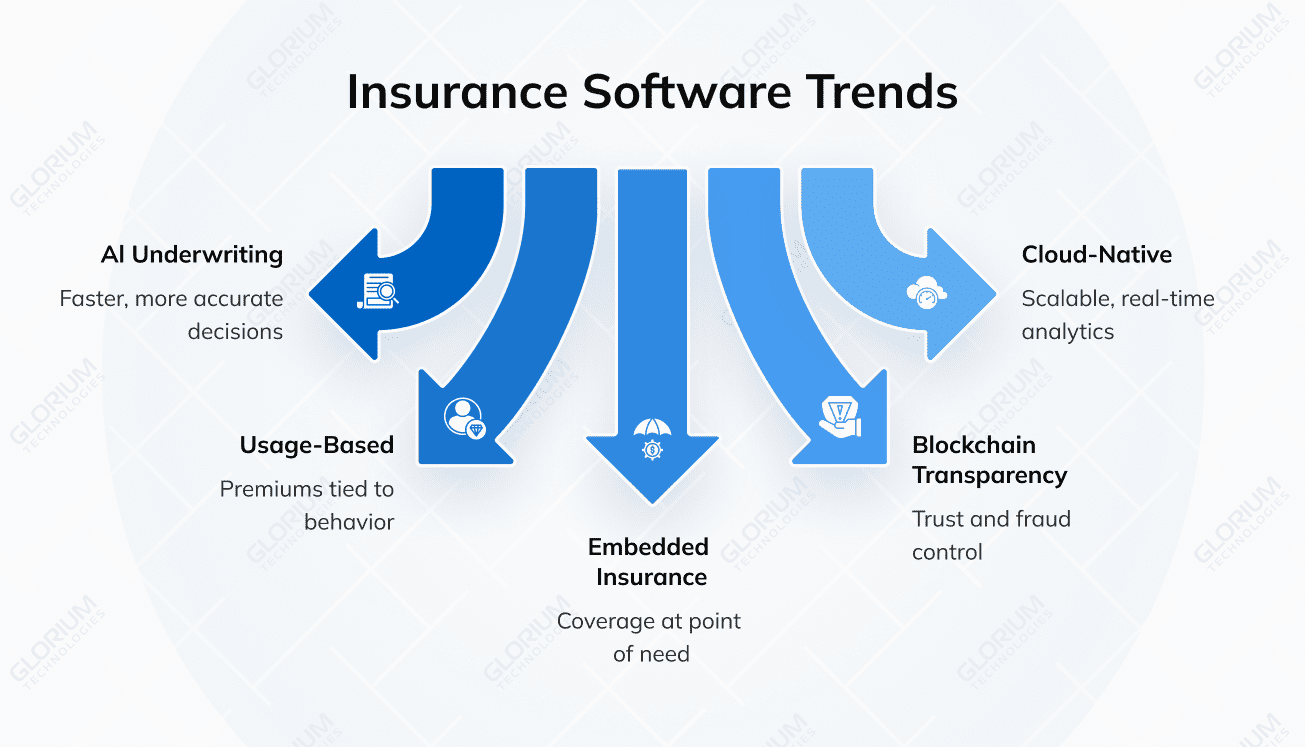
The next few years favor carriers who build for flexibility. Several trends across the insurance industry are moving from pilot to standard practice, and each one rewards systems designed to absorb change. The sections below pair each shift with a number that shows how fast it is arriving.
Artificial intelligence is reshaping the two functions at the core of insurance. Underwriting that once took days now resolves in minutes, and AI-driven claims processing handles routing, pricing, and fraud detection with little manual input.
McKinsey estimates that AI could create about $1.1 trillion in annual value for the insurance industry by 2030, and projects that more than 90% of pricing and underwriting for individual and small-business policies will be automated by then.
Pricing is shifting from broad averages toward what a customer actually does. Telematics, mobile apps, and connected devices let insurers tie premiums to real behavior, which is the engine behind usage-based insurance.
The usage-based insurance market reached roughly $30.31 billion in 2025 and is forecast to hit $69.18 billion by 2031, a 14.76% CAGR. Software that ingests telematics and prices in real time is the foundation for any product here.
Coverage is increasingly sold at the point of need. A traveler buys protection at checkout, a buyer adds device cover with a phone, and a driver gets motor insurance bundled into a car deal.
Analysts value the embedded insurance market at about $144.62 billion in 2025, with projections reaching roughly $2.07 trillion by 2035, a 30.47% CAGR. API-first platforms are the price of entry for this channel.
Trust and fraud control remain at the center of every claim. Shared, append-only ledgers let carriers, reinsurers, and administrators cross-check records, while smart contracts settle parametric claims in minutes and tighten claims management end to end.
The blockchain in the insurance market was valued near $930 million in 2025 and is projected to reach $6.96 billion by 2031, a 39.85% CAGR, against insurance fraud that inflates global claims by more than $40 billion a year.
Flexibility starts with the underlying architecture. Cloud-native systems and managed cloud services scale on demand, run real-time data analytics, and free capital that legacy mainframes lock up.
Cloud delivery accounted for roughly 65% of insurance software revenue in 2025 and is expanding at a 10.26% CAGR through 2031. A cloud-first approach keeps a carrier ready for every trend above.
Insurance products depend on trust, speed, and accuracy. Building the software behind them calls for a partner who understands regulated data, complex workflows, and the possible risks. Glorium Technologies has delivered secure, scalable products since 2010, earning a place on the Inc. 5000 list of the fastest-growing private companies in America across several years.
Our teams combine engineering depth and insurance industry expertise with real domain experience in fintech and insurance, machine learning, and legacy modernization. We work through flexible engagement models, from a dedicated development team to focused delivery, so the partnership fits how you want to build. Our insurance software development services help insurance providers across the full lifecycle, from discovery and risk modeling to compliant deployment and ongoing support.
Ready to scope your project with people who have built this before? Contact Glorium Technologies for a commitment-free consultation, and we will map your fastest path to a working, compliant product.
A focused claims or portal module can ship in a few months, while a full custom platform with several connected core systems often runs nine to eighteen months. A discovery phase that maps workflows and integrations gives the most reliable estimate, since hidden legacy dependencies are the usual cause of delay.
Yes, and most projects require exactly that. Modern builds use APIs and middleware to connect new modules to legacy policy or billing cores, so a carrier can modernize in stages rather than replace everything at once. Clear API contracts and a phased migration plan keep the existing book running during the transition.
Requirements vary by region and line of business. Common ones include data protection rules such as GDPR, solvency and reporting frameworks like Solvency II and IFRS 17, and local insurance authority mandates. A partner with regulated-industry experience builds these checks into the system and the audit trail rather than patching them in later.
For standard lines with common workflows and little need for differentiation, a packaged platform can be faster and cheaper to launch. The trade-off shows up when a carrier wants unique products, proprietary rating, or embedded distribution. A hybrid approach, keeping a packaged core and building custom layers on top, often gives the best of both.
The answer depends on how often you build. Hiring and retaining in-house software developers makes sense when custom software development is a constant need, and the roadmap never ends. For a single platform or a fixed window, software development companies give faster access to specialists who have shipped similar software solutions before. Many insurance teams blend the two, keeping a small internal core for product decisions while a partner handles delivery and ongoing support. The deciding factors are time-to-market, the depth of regulated experience you need, and how predictable your pipeline of work is.
Accuracy comes from the data a model can reach. Custom platforms unify a carrier’s data infrastructure and connect to third-party data sources such as credit bureaus, telematics, and weather feeds, which gives underwriters a fuller picture of each risk. Tighter pricing follows, and that precision flows through related insurance processes like claims management and policy renewal. The same connected data also feeds customer relationship management and reporting, so insurance carriers price insurance coverage in line with real exposure rather than broad averages. For an insurance business competing on margin, that edge compounds across the whole book.