








Top It Outsourcing Trends, Statistics, and Forecasts for 2026
Updated May 14, 2026

 Summarize in ChatGPT
 Summarize in ChatGPT
Something real has shifted in how companies think about IT outsourcing, and it’s worth understanding the shift before diving into the tactics. The global IT outsourcing market reached $600.93 billion in 2024 and is projected to reach $1.345 trillion by 2034. That growth isn’t being driven by companies trying to cut headcount. It’s being driven by businesses that have genuinely figured out what the right outsourcing partner can deliver: speed to market, access to specialized expertise they can’t hire fast enough, and the ability to stay competitive in technology areas where building in-house just isn’t practical.
The trends in IT outsourcing that matter today are about how companies use external service providers to build real capability, protect core business functions, and move faster than competitors who are trying to do everything internally. If your outsourcing strategy hasn’t been revisited in the past year or so, this breakdown is a good place to start.
Content
Back in 2020, around 70% of organizations cited cost reduction as their primary reason for outsourcing. By 2024, that number had dropped to 34%. The global IT outsourcing market didn’t shrink; it grew at a CAGR of 8.2%, but the motivation behind it changed significantly.
What replaced cost at the top of the list? Access to specialized expertise, faster time to market, and the ability to scale IT operations without the delays of conventional hiring. These are practical business needs. And they explain why companies are increasingly outsourcing even when cost savings aren’t the central argument.
The services outsourcing market reflects this maturation. Software development, cloud infrastructure management, and managed services account for the bulk of spending, and all three are growing. The outsourcing market was valued at $402.02 million in 2024 and is projected to grow by USD 147.82 million at a CAGR of 4.7% from 2025 to 2030.
“We are selling manpower while the world is buying outcomes — and that is the mindset gap. The future belongs to vertical solution architects, experts in proposing industry-level problem solutions.”
Aluk Barta, digital marketing and business consultant
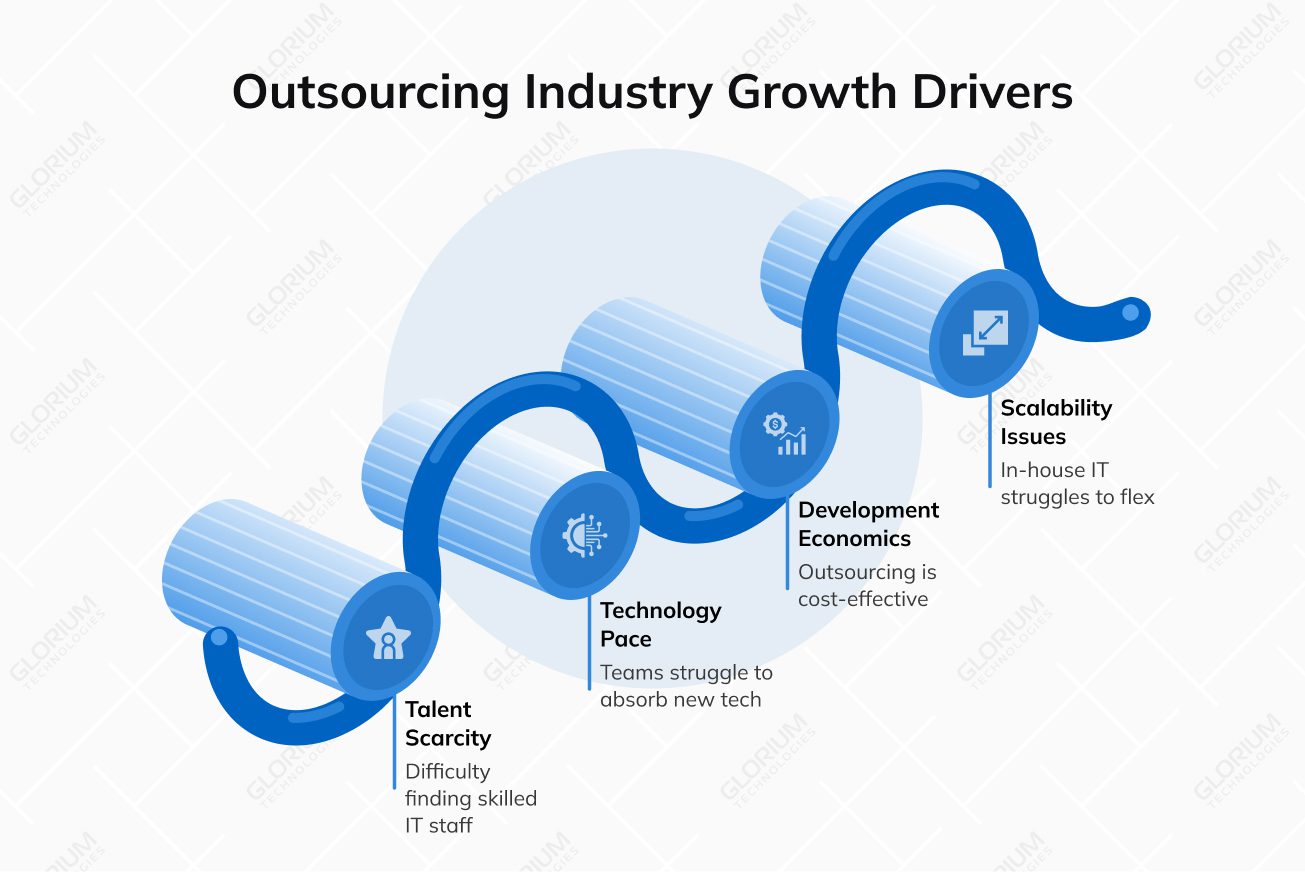
A few factors drive continued growth in the services outsourcing market, and they’re worth naming clearly because they define which outsourcing strategies actually work right now:
The practical case for outsourcing specific IT functions hasn’t weakened in many areas; it’s gotten stronger. Here’s what’s actually happening at the operational level.
Access to a global talent pool means pulling from specialized networks that don’t exist in most local markets. Experienced external service providers can contribute to the software development process far more quickly than a company building capacity from scratch. For businesses in regulated sectors, working with a partner who already understands HIPAA, GDPR, or ISO compliance removes a significant burden from internal teams and lets them focus on their core competencies rather than compliance overhead.
The other thing that’s changed is the depth of what outsourcing firms can offer. It’s not just development bandwidth anymore. The leading outsourcing companies now provide technology services that span the entire product lifecycle: strategy, design, development, QA, security, cloud infrastructure, and ongoing support. Businesses that engage serious outsourcing partners aren’t just plugging gaps; they’re genuinely extending what their product teams can do.
Where outsourcing consistently adds the most value in 2026:
These aren’t emerging trends in the abstract sense. They’re patterns already visible in how real outsourcing engagements are being structured. Some have been building for three or four years and are finally hitting their stride. Others are more recent but moving fast.
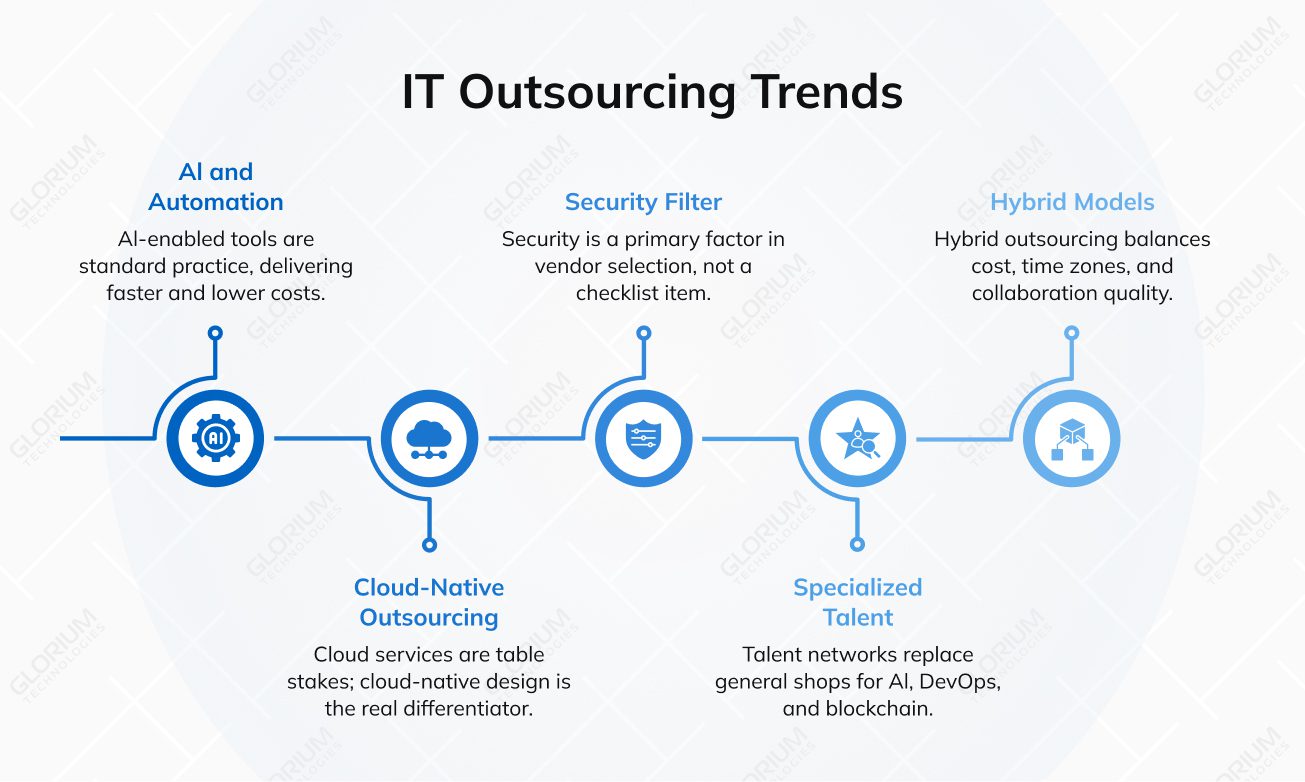
AI-enabled tools have moved from pilots to standard practice at most serious outsourcing firms. Code generation, automated testing, and infrastructure monitoring — providers are using these tools to deliver faster and often at lower cost. The real question when evaluating outsourcing partners isn’t whether they use AI anymore. It’s how deeply those tools are embedded in their actual delivery workflow, not just listed in a sales deck.
For businesses looking to bring AI software development into their roadmap, outsourcing software development is often the fastest realistic path. Building those capabilities in-house takes time most companies don’t have. Leveraging specialized expertise from an experienced external provider is the more practical route.
Intelligent automation and robotic process automation are also becoming standard inside business process outsourcing relationships. The global RPA market stood at $3.79 billion in 2024 and is projected to hit $30.85 billion by 2030. Providers embedding RPA into their service delivery cut error rates, speed up turnaround times, and free human teams for higher-judgment work. This directly changes the economics of outsourcing contracts: automation-heavy delivery models simply have different cost profiles than labor-heavy ones.
Cloud services and cloud infrastructure management are table stakes. What actually matters now is whether a provider is genuinely cloud-native: designing and building applications for cloud environments from the start.
Companies that haven’t made this move are running at a real delivery and cost disadvantage. Outsourcing software development to partners with deep cloud expertise offers a practical shortcut to close that gap. The software development outsourcing trends visible today make clear that cloud-native capability is the minimum expectation, not an advanced feature.
Data security and data protection have moved from checklist items to primary factors in how companies choose outsourcing partners. 75% of executives now rely on third-party vendors for some form of cybersecurity support. Security services account for roughly 42% of companies’ total risk management costs.
Every outsourcing relationship expands your data perimeter. Vendors with access to sensitive systems need to meet the same standards you’d hold internal staff to. Security-focused outsourcing services are among the fastest-growing segments of the market right now, largely because businesses are making security a non-negotiable filter rather than something to negotiate on at the end of a commercial discussion.
The practical implication: conversations about certifications, incident response procedures, and data protection obligations need to happen at the start of vendor evaluation, not after a contract is signed.
This is one of the more significant outsourcing industry trends of the past couple of years. General-purpose development firms handle routine work well enough. But businesses building in AI, DevOps, blockchain, or advanced data analytics need outsourcing partners with real, verifiable depth in those specific areas.
This is driving strong growth in flexible IT staff augmentation models. Companies access specialized expertise on demand rather than locking into long-term contracts with broad, undefined scope. For startups and scale-ups, this flexibility often makes the difference between shipping on schedule and spending months hunting for local talent that simply doesn’t exist.
Leveraging specialized expertise through targeted outsourcing is also how many businesses protect their core business. Instead of spreading internal engineering teams across every problem, they concentrate internal talent on core competencies, the product decisions, and proprietary work that define the business, and bring in specialists for everything else.
Purely offshore or purely onshore outsourcing is increasingly the exception. Hybrid outsourcing, combining teams across geographies to balance cost, time zone overlap, and collaboration quality, has become the dominant structure for mid-size and larger organizations.
In practice, a small nearshore or onshore outsourcing layer manages stakeholder communication and strategic direction while an offshore team handles core development work. Costs stay manageable, collaboration quality remains, and the setup is more resilient to disruption than concentrating everything in one location.
The services outsourcing models and services outsourcing trends companies act on are more varied and deliberate than they were even three years ago. One-size outsourcing strategies are giving way to arrangements designed around what each engagement actually needs.
Location decisions in IT outsourcing have gotten more deliberate. The old approach, find the cheapest available location, manage communication gaps later, is giving way to something more considered. Companies now weigh time zone overlap, collaboration quality, data protection requirements, and risk distribution when deciding where to place outsourcing relationships.
These regional outsourcing industry trends say a lot about what businesses actually value when they’ve moved past the cost-only mindset.
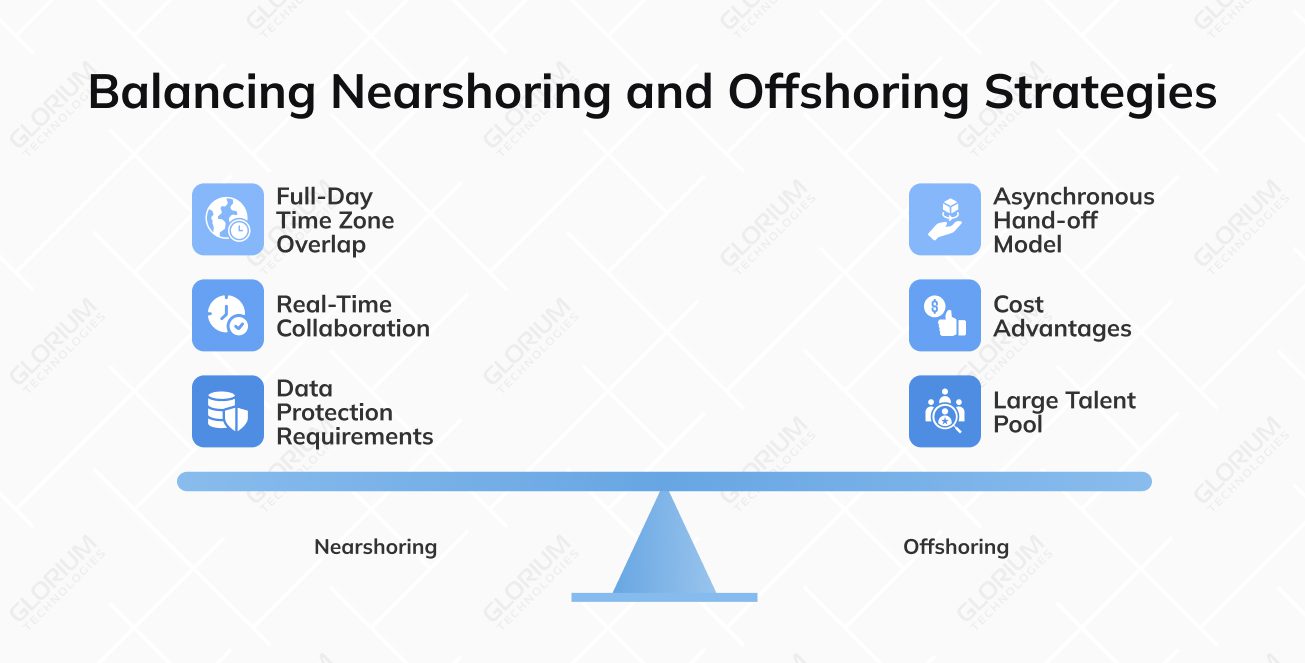
Nearshoring has grown noticeably over the past few years. Eastern Europe has been a consistent beneficiary of this shift, with Poland, Ukraine, and Romania among the most active destinations for Western European and North American companies. Latin America is also rising fast, particularly for US-based businesses, where working with a team in Buenos Aires or Mexico City means genuine full-day overlap rather than the asynchronous hand-off model that purely offshore arrangements often rely on.
Real-time collaboration is the main driver. Working with a partner in the same or adjacent time zone is practically more useful for anything requiring close coordination, and onshore outsourcing or nearshore arrangements are increasingly favored for exactly that reason.
Offshore outsourcing continues to dominate the overall market. India holds a 17.58% global market share and remains the top destination for software development outsourcing, customer support, and managed services. The Philippines holds 13.5%, primarily in customer service and voice-based support.
The offshore segment is expected to post the fastest CAGR through 2030, driven by cost advantages and a large talent pool in AI, cloud computing, and data engineering. Offshore outsourcing is evolving as providers in those markets invest in the emerging technologies clients now demand.
Nearshoring and offshoring aren’t competing choices. Most sophisticated outsourcing strategies use both nearshore for high-collaboration functions, offshore for work that can run more independently.
Understanding how outsourcing plays out in your specific sector matters when evaluating what to hand off. The dominant patterns vary significantly by industry.
| Industry | Primary outsourcing focus | Key driver |
| Banking, financial services, and insurance (BFSI) | Cybersecurity, compliance, digital banking | Regulatory complexity and fraud prevention |
| Healthcare | Infrastructure management, data analytics, compliance | HIPAA/GDPR requirements, patient data security |
| Retail and e-commerce | Cloud platforms, customer support, analytics | Seasonal scaling, omnichannel demands |
| Manufacturing | ERP systems, IoT infrastructure, supply chain tools | Process automation and system integration |
| Technology | Specialized dev talent, QA, DevOps | Speed to market, skill gap filling |
The BFSI sector remains the largest spender on IT outsourcing, accounting for roughly 30% of total expenditure, about $155 billion in 2024. Healthcare is the second-largest at approximately $120 billion. Both sectors consistently rank compliance and data protection above cost when selecting outsourcing providers.
For technology companies themselves, software development outsourcing trends point toward increased use of specialized external teams for QA, AI integration, and DevOps—functions where the talent market is competitive enough that building purely in-house is a meaningful risk to delivery timelines.
Staff augmentation adds external specialists directly to an existing internal team. The client retains full control over the work. Best for businesses that need specific technical skills quickly and want to keep oversight in-house rather than delegating management to a vendor. Glorium Technologies’ staff augmentation services typically place engineers within two to four weeks.
Dedicated development teams accumulate context and improve as the engagement matures. Better suited for longer-term product builds where consistent team composition genuinely matters. Glorium Technologies’ dedicated development teams work this way.
Managed services outsource entire IT functions under a service agreement with defined SLAs and performance metrics. Cloud infrastructure management, security monitoring, and technical support are common examples. The provider takes responsibility for outcomes. The global managed services market exceeded $344 billion in 2024 and is expected to exceed $500 billion by 2028.
Project-based development delivers a defined product against a fixed scope and timeline. Works well for contained builds: a new application, a migration, a specific integration. The tradeoff is that context doesn’t carry forward between phases the way it does with a dedicated team. For complex or multi-phase work, the gaps in continuity can add up.
Good outsourcing strategies don’t begin with a shortlist of providers. They begin with clarity about what you actually need from external service providers, then work backward to who can deliver it.
A few things that consistently separate good vendor selection from the kind that ends in friction:
The most common challenges in outsourcing aren’t about vendor technical ability—they’re about governance. According to Deloitte, 55% of organizations cite lack of benefit tracking as their top outsourcing challenge. Other persistent issues:
None of these requires pulling back from outsourcing. They require governance: clear ownership, documented business processes, and regular reviews that keep relationships productive rather than running on inertia.
A few longer-horizon outsourcing trends shaping the next phase of the industry are worth tracking now, particularly for anyone making multi-year strategy decisions.
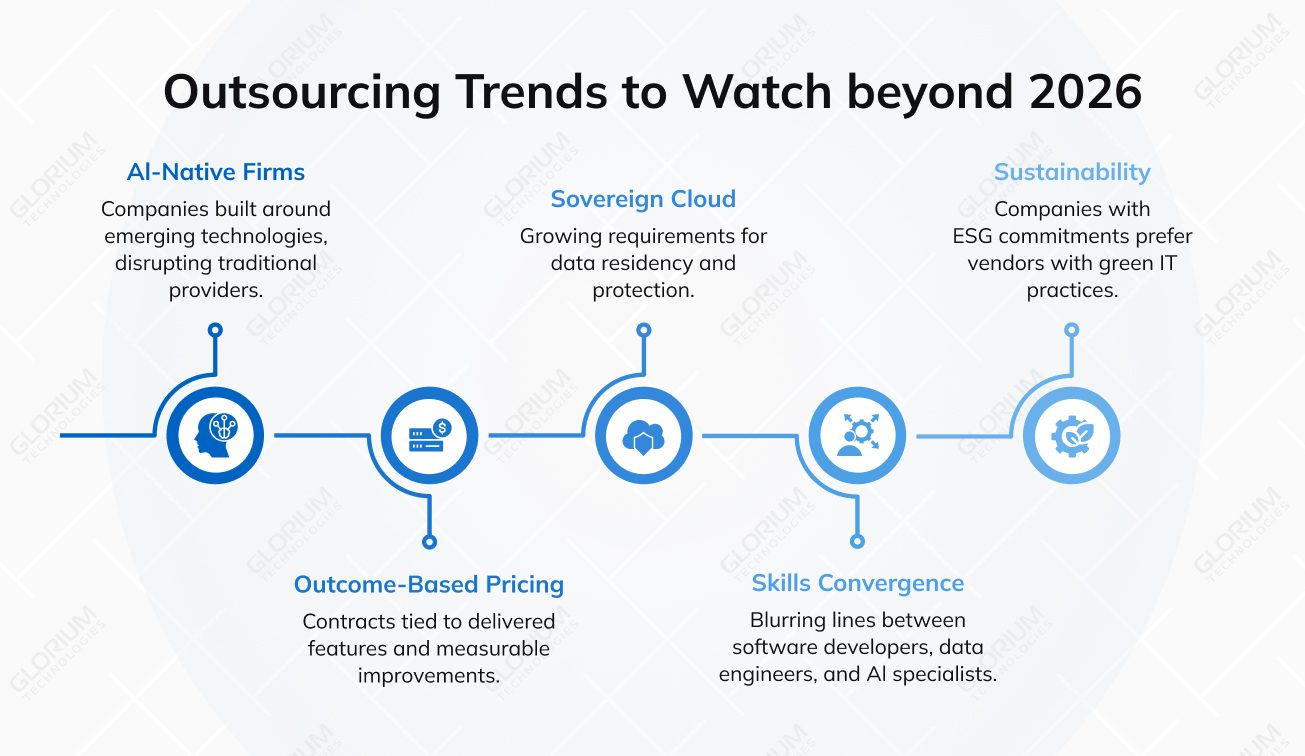
A genuinely AI-native outsourcing firm is built around emerging technologies from the ground up, with delivery models, team structures, and cost structures designed around AI from the start. These firms are still maturing, but they’re already attracting clients who want faster cycles and leaner engagements, and they’re positioned to put real pressure on more traditionally structured outsourcing companies as they scale.
Contracts tied to delivered features, performance benchmarks, or measurable business improvements are becoming more common across the outsourcing industry. For clients, this changes the risk equation significantly: spend follows results. For vendors, it rewards efficiency. Outsourcing contracts structured this way tend to produce sharper scope definitions, clearer success criteria, and more accountable partnerships on both sides.
Regulatory divergence between regions is pushing a growing number of businesses, particularly in healthcare, finance, and the public sector, toward outsourcing providers that can operate data infrastructure within specific geographic boundaries. Navigating overlapping data protection frameworks across multiple jurisdictions has become complex enough that where a vendor hosts and processes data is now a selection criterion in its own right.
The line between software developers, data engineers, and AI specialists is blurring as technology stacks grow more integrated. Teams comfortable across these areas, like those combining machine learning services with core software development, are increasingly valuable to clients managing work that spans all three disciplines. Outsourcing firms investing in cross-disciplinary teams will carry a real competitive advantage in the services outsourcing market over the next few years.
Environmental criteria are beginning to appear in outsourcing procurement, particularly at companies with formal ESG commitments. Providers that can demonstrate energy-efficient infrastructure and responsible supply chain practices are gaining preference when technical and commercial proposals are otherwise comparable. It is still in the early stages and moving from a secondary consideration to a legitimate selection factor.
Glorium Technologies helps businesses move faster on software development without the overhead of building everything in-house. With over 15 years of cross-industry delivery, we work as a hands-on outsourcing partner, aligning technical execution with real business needs, so your team can focus on core competencies while we handle the build.
Start exactly where you are. If you need to extend your team quickly, staff augmentation connects you with pre-vetted engineers who slot into your existing workflow within weeks. If you’re building a product from the ground up, a dedicated development team gives you a stable, focused group that accumulates context and improves over time. If you need specialized depth in AI, data, or cloud, our AI software development services and data science consulting bring that expertise into your product directly. In every case, the engagement is scoped around clear deliverables and performance metrics.
Explore our case studies to see how this plays out in practice. In one engagement, we built a full-featured B2C PropTech platform for buying and selling homes from scratch, delivering a responsive front-end with a mapping system, detailed search filters, and investment modelling tools that the client’s industry received as one of the most cutting-edge solutions in the market. In another, a client in a data-intensive domain moved from fragmented manual processes to a consolidated analytics infrastructure that significantly reduced reporting time and error rates.
Ready to revisit your outsourcing strategy for 2026 or extend your team with engineers who can contribute from week one? Book an intro call, and let’s figure out the right starting point together.
We hold ISO 27001 certification for information security management and operate under HIPAA and GDPR compliance frameworks. For every engagement, data protection obligations, access controls, and incident response procedures are written directly into the contract. This matters most for healthcare and fintech clients, but it’s how we work with every business we partner with.
Our teams use AI-enabled tools across the development cycle: code generation, automated testing, performance monitoring, and predictive analytics. For clients building AI-native products, we offer dedicated AI software development services and machine learning expertise as core components of the engagement.
Three main services outsourcing models: staff augmentation for adding specific technical skills to an existing team, dedicated development teams for longer-term product builds, and project-based development for defined-scope deliverables. Many clients start with one model and shift to another as their business needs evolve. We’re structured to support that transition without starting over.
For most staff augmentation and dedicated team engagements, we match and onboard engineers within two to four weeks. For clients with tighter timelines, we’ve moved faster. Flagging urgency early lets us plan resourcing from the start rather than working against a deadline.
AI-native outsourcing firms are disrupting traditional delivery models, outcome-based pricing replacing hours-based contracts, sovereign cloud requirements growing in regulated industries, and the rising value of cross-disciplinary teams that combine software development, data engineering, and AI expertise. These trends are shaping how outsourcing contracts are being structured today.