









Healthcare Revenue Cycle Management: 5 Challenges and How to Solve Them
Updated September 11, 2026

 Summarize in ChatGPT
 Summarize in ChatGPT
Revenue cycle management in healthcare is the financial process that turns delivered patient care into collected payment. For most healthcare organizations, that process is also where patient revenue quietly disappears. Benchmarking data covering 2,300 hospitals and 350,000 physicians put net revenue leakage across US providers at $48.4 billion in 2025, more than 25% higher than the year before.
Much of that loss traces back to a short list of repeatable process failures at specific points in the cycle, which means much of it is recoverable.
If you run finance at a hospital, manage a practice, or build billing software, this guide covers the ground you need. We explain what healthcare revenue cycle management actually is, walk the revenue cycle management process stage by stage, then dig into the five challenges costing providers the most money right now.
Content
Healthcare revenue cycle management, usually shortened to RCM, is the financial process healthcare organizations use to track a patient account from the first appointment request through to the final payment. Revenue cycle management covers every administrative and clinical function that captures, manages, and collects revenue for the medical services delivered.
The healthcare revenue cycle consists of seven core steps in most descriptions, running from patient registration through to patient collections. We use eight below, because prior authorization has grown complicated enough to deserve a line of its own.
The term often gets used interchangeably with medical billing, but the scope is broader. Medical billing is the act of preparing and submitting claims to a patient’s insurance company. Medical coding connects the two, translating healthcare services into standardized billing codes. Revenue cycle management includes all of it, from verifying insurance coverage before a visit to appealing a denied claim eight weeks later.
The healthcare revenue cycle connects clinical operations with financial performance. A missed field at patient registration becomes a claim denial three weeks later, and a vague clinical note becomes one of the billing errors that triggers an audit. Every downstream financial outcome starts as an upstream data decision.
Effective revenue cycle management produces consistent cash flow and timely reimbursement from insurance providers, with a lower administrative burden, since fewer staff hours go into chasing insurance claims that should have paid on the first pass. Patient satisfaction improves alongside it, because a confusing bill undoes trust that clinical staff worked to build. Revenue capture at each stage is what underwrites financial stability, and what lets an organization invest in patient care instead of rework.
Rising healthcare costs across the healthcare industry explain why the market has grown so quickly. Grand View Research valued the global hospital revenue cycle management market at $82.0 billion in 2023 and projects $117.3 billion for 2026, reaching $184.4 billion by 2030.
The same logic applies well beyond hospitals. Physician practices, ambulatory surgery centers, diagnostic labs, and home medical equipment suppliers all run a revenue cycle, and smaller organizations feel the squeeze first. McKinsey’s 2025 RCM survey found cost to collect rising for 44% of organizations under $500 million in net patient service revenue, against 33% of those above $5 billion.
The healthcare revenue cycle consists of eight linked stages. Each either protects revenue or lets it slip, and the expensive failures start early: registration, eligibility verification, and prior authorization occupy the first three rows below and drive a disproportionate share of what goes wrong at the end.
| RCM process step | What happens | Where revenue leaks |
| Patient registration and scheduling | Demographics, contact details, and insurance information are captured | Typos and stale patient data trigger downstream rejections |
| Insurance eligibility verification | Coverage, benefits, and patient responsibility are confirmed with the payer | Coverage checked too late, or not rechecked before the visit |
| Prior authorization | Payer approval is secured for services that require it | Missing or expired authorization on the date of service |
| Charge capture | Clinical services are recorded as billable charges | Unbilled services never make it onto the claim |
| Medical coding | Documentation is translated into CPT, HCPCS, and ICD-10 codes | Codes that lack documentation support or miss specificity |
| Claim submission | The claim is scrubbed and routed through a clearinghouse to the payer | Format and edit failures cause rejections before adjudication |
| Payment posting | Insurance payments and adjustments are reconciled against services provided | Underpayments posted without review and never recovered |
| Claim denials and patient collections | Denials are appealed, and remaining patient balances are billed | Denials written off unappealed, patient balances aging out |
Where the revenue cycle hurts depends on who you are. A regional health system usually feels payer contract complexity first, while a small physician group loses more to patient balances nobody has time to chase. The five below show up at both ends of that range.
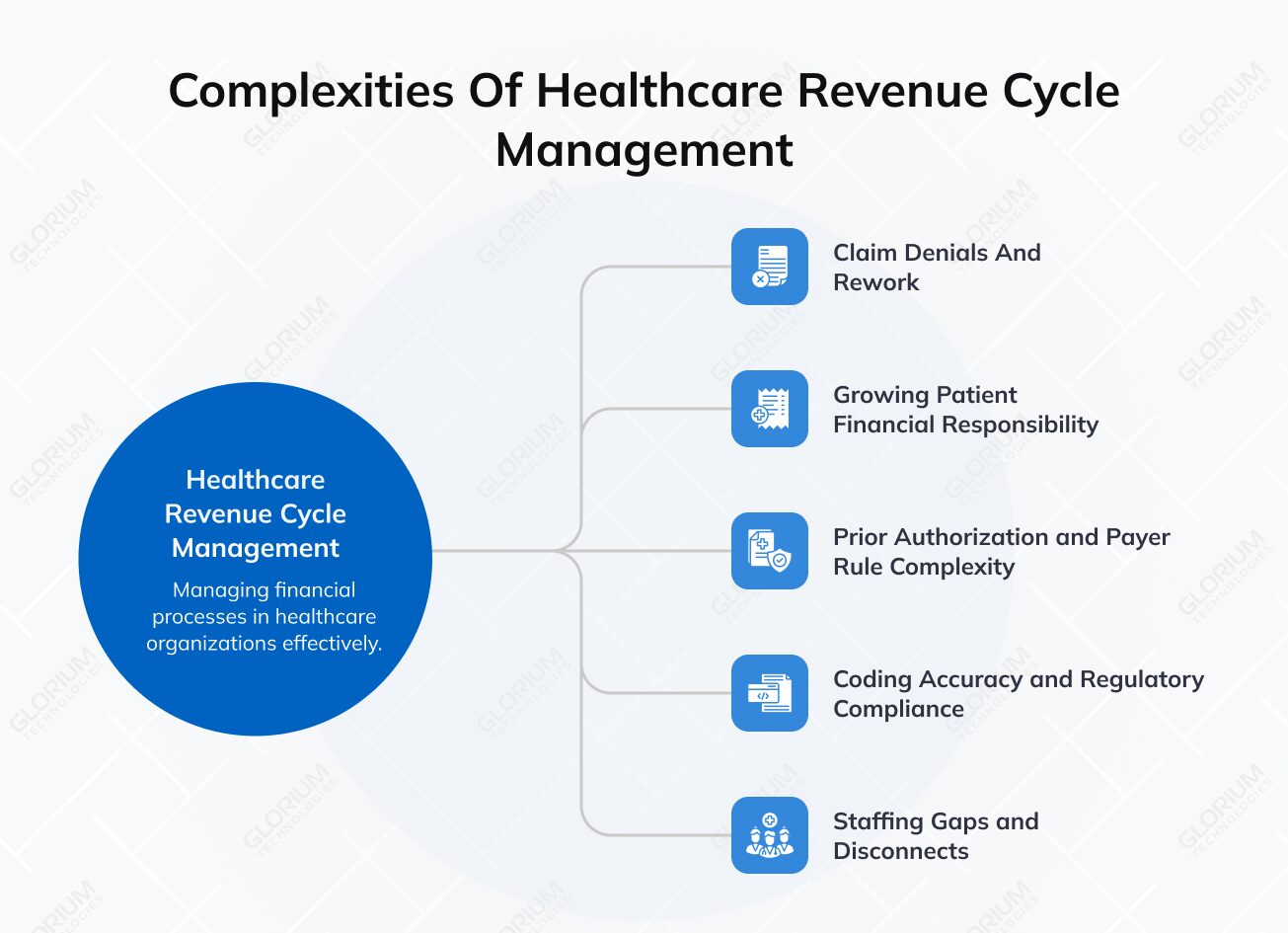
Denials begin at claim submission and end in rework. Premier’s national survey of hospitals and health systems put the administrative cost of adjudicating claims at $25.7 billion in 2023, a 23% jump over the prior year, with the cost per denied claim rising from $43.84 to $57.23. Roughly 70% of those claim denials were eventually overturned and paid, so much of that spend bought nothing but delay.
Most of that cost is avoidable. The Healthcare Financial Management Association (HFMA) reports that roughly 90% of denials are preventable, with nearly half tied to front-end functions: patient registration, insurance verification, and authorization management.
The gap is infrastructure rather than awareness. McKinsey found 64% of RCM leaders saying their organizations lack the infrastructure to prevent claim denials, while those with dedicated, standardized prevention processes reported a 47% appeal success rate against 37% for ad hoc teams. Claims denial management has become a permanent function at many healthcare providers rather than an occasional clean-up task.
High-deductible plans have shifted more of the healthcare costs onto patients, so patient billing now accounts for a larger share of patient revenue than it did a decade ago, and patient payments arrive later. Collecting payments from patients is also harder than collecting from insurance companies. Among McKinsey’s respondents, 85% expected the out-of-pocket share to keep rising and 76% expected self-pay bad debt to grow with it.
Collection data already reflects that shift. The yield on insured patient balances fell from 45.1% to 42.4% between 2024 and 2025, even as patients became contractually responsible for a larger share of the bill.
Point-of-service collections are the lever that works for healthcare providers. Top-quartile organizations collected 28.4% of patient payments at the point of service, against a median of 16.4%, and that gap in patient payments compounds across every account. A clear price estimate before the visit, payment plans, and a card on file all move that number. Once a patient leaves the building, known balances start competing with rent and groceries, and outstanding balances cost more to collect with every statement cycle. Discussing the financial aspects of care before treatment is what turns them into timely payments.
Financial assistance belongs in the same conversation. Screening for eligibility early, rather than after patient accounts have aged 120 days, moves the right patients into charity care or a structured plan instead of bad debt. Patient billing works better when it starts from what someone can actually pay.
Home medical equipment billing makes this unusually hard, because one account can carry payments from a customer, an insurer, and a patient at once. When our long-term client came to Glorium Technologies, the requirement was an automated billing platform for HME/DME providers handling all three payer streams in one system. The result was a paperless ecosystem that filled the client’s sales pipeline and helped them become a category leader.
Prior authorization volume keeps rising, and each of a provider’s insurance companies maintains its own coverage policies, documentation standards, and turnaround expectations. Every variation is another way claim submission can fail, and another reason insurance claims stall. Staff ends up tracking patient eligibility, medical necessity documentation, and authorizations across a dozen portals. McKinsey found escalated reimbursement issues took 36 days to resolve on average, with only 43% ending favorably for the provider.
The regulatory picture is shifting here. Under the CMS Interoperability and Prior Authorization final rule (CMS-0057-F), affected payers have had to issue decisions within 72 hours for urgent requests and seven calendar days for standard ones since January 1, 2026. Required FHIR APIs, including a Prior Authorization API, must run in production by January 1, 2027. CMS estimates roughly $15 billion in savings over ten years.
For providers, that timeline is an opportunity. Organizations whose systems already speak HL7 and FHIR will be able to submit authorizations electronically and read status back automatically, while those on manual workflows will keep paying staff to refresh payer portals.
Medical coding connects clinical documentation to the claim, and errors there are expensive in both directions: undercoding gives away earned revenue, while overcoding invites audits and repayment demands.
Selecting appropriate medical codes under shifting healthcare regulations is skilled work. Coders operate against annually updated CPT and ICD-10 code sets, payer-specific edits, and clearinghouse rules that reject claims before a payer ever sees them. Layered on top are CMS regulations and the No Surprises Act, which requires a good faith estimate for uninsured and self-pay patients and lets them dispute a final bill that exceeds it by $400 or more. CMS also tightened hospital price transparency requirements for 2026, with enforcement of the revised rules beginning that April.
Healthcare regulations shift, and payers and providers often read the same guidelines differently. Coding discrepancies drove 18% of poorly resolved payer escalations in McKinsey’s survey, which helps explain why 56% of leaders named documentation and coding accuracy an automation priority.
The skills the revenue cycle needs are changing faster than teams can hire for them. HFMA describes a shift away from healthcare professionals who know payer rules by memory and toward staff who work comfortably with analytics and automation.
Underneath the skills question is an older structural problem. Registration staff rarely see what happens to an account after it leaves their queue, so a habit that takes 40 seconds at the desk and produces a denial costing far more to unwind never gets corrected. Cross-training front-end teams on the full cycle changes that.
Specialist scarcity shows up on the software side too. When Glorium Technologies took on VitalWare’s medical coding application, a mid-revenue cycle tool hospital staff use for coding, billing, and regulatory lookups, the blocker was talent rather than architecture: the product ran on a legacy front-end framework with almost no experienced developers on the market. We trained and assigned a dedicated four-person team who rebuilt it over two years.
Improving revenue cycle management follows a consistent sequence: measure the healthcare revenue cycle, move problem-solving upstream, then automate the work that no longer needs a human. The payoff is a lower administrative burden and steadier patient payments.
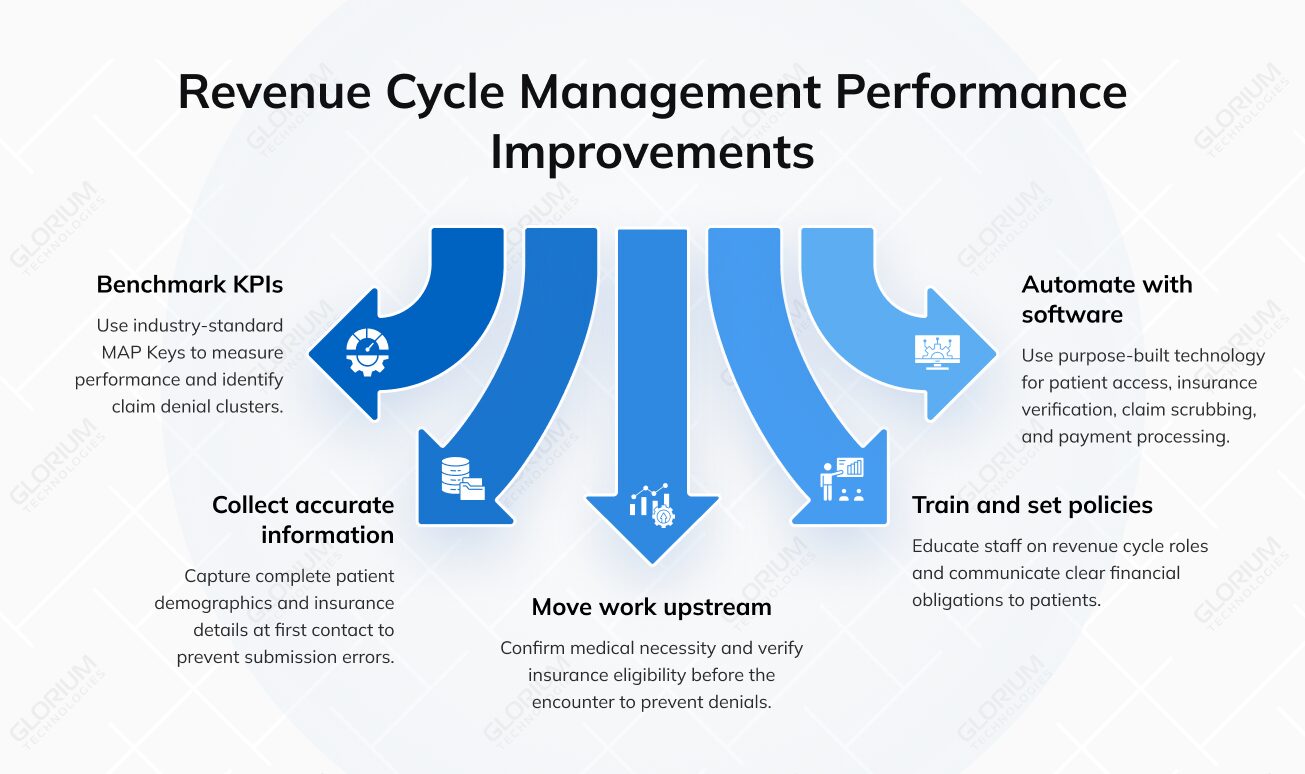
HFMA publishes MAP Keys, a set of 29 industry-standard key performance indicators for the revenue cycle, each with a defined equation and data source. These are the key performance indicators most healthcare organizations benchmark against. Five carry most of the diagnostic weight:
Segment each metric by payer, service line, and denial reason code. A blended 11% denial rate hides the one payer running at 22%. Reviewing patient accounts this way turns revenue cycle performance into something a team can act on, because it shows exactly where claim denials cluster.
The cheapest fix in the healthcare revenue cycle happens at the front desk. Capture complete demographics, medical history, and insurance information at first contact, then confirm coverage with the patient’s insurance company before the visit rather than after it. Accurate patient information at patient registration prevents most of the medical claims submission errors that resurface weeks later as denied claims. Billing patients correctly starts here, not at the statement, and submitting claims cleanly the first time depends on it.
Prevention and recovery work best as one system rather than two disconnected teams: confirm medical necessity before service, verify insurance eligibility before the encounter, route discrepancies into a named work queue with an owner, and review denied claims by root cause so findings reach the people whose work produced them. Preventing claim denials protects cash flow more cheaply than any appeal.
Every team member should understand how their role fits the wider revenue cycle, not only their own step. That awareness reduces manual billing errors more reliably than another round of process documentation. Money conversations are also the part of the job front-desk teams get the least training for, which makes it a coaching question rather than a technology one.
On the patient side, clear policies work better than improvised ones. Communicate financial obligations at scheduling, explain patient responsibility in writing, offer payment plans for larger balances, and make it easy to pay from a phone. Patient communication about financial responsibility does more for collecting payments than any collections script, because most late payments come from confusion rather than refusal.
Purpose-built revenue cycle management technology absorbs volume that would otherwise need headcount. A capable platform typically covers:
Most organizations now run a mix of both. McKinsey found 60% of leaders expecting to change their outsourcing approach within three years, three-quarters of whom plan to expand it, while only 6% expect to pull work back in-house because of new technology.
| Model | Best fit | Strengths | Trade-offs |
| In-house | Large systems with mature billing teams and existing technology | Full control, direct patient communication, institutional payer knowledge | Fixed salary and training costs, exposure to turnover, ongoing tech investment |
| Outsourced | Practices and mid-size providers facing staffing gaps | Access to specialist coders, scale on demand, vendor-side technology | Less direct control, transition complexity, contract and performance risk |
| Hybrid | Most organizations in practice | Keep patient-facing work internal, send coding or A/R follow-up out | Requires clear SLAs and integrated data flow between teams |
Healthcare providers who outsource well report steadier cash flow and fewer claim denials, largely because specialist teams see more payer patterns than any single in-house billing department can. The gain shows up in overall financial performance rather than in headcount savings alone.
The decision rarely comes down to cost alone. Ask which of your revenue cycle processes genuinely require institutional knowledge, which are rule-driven enough to hand off, and whether your systems can share patient and financial data with a partner without manual exports. Governance matters more than the model: among organizations planning to bring work back in-house, 75% named vendor performance management as their biggest gap. Either way, financial stability depends on someone owning the numbers.
Glorium Technologies has spent more than 15 years on healthcare software development, with HIPAA-compliant engineering, HL7 and FHIR integration, and experience across medical billing platforms, EHR systems, and hospital management solutions. Medical billing, coding, and claim submission are where most of that work lands.
Most of the problems above come down to data that does not move cleanly between systems. Our teams work on that layer: real-time eligibility checks, claim scrubbing built against the edits your clearinghouse applies, and payment posting that reconciles against services provided rather than a summary file.
The goal is the same in each case: claims paid in a timely manner, with less manual work behind them. Whether you need a custom RCM product built from scratch, an existing system modernized ahead of the 2027 FHIR API deadlines, or a dedicated development team to extend your engineers, we can scope the work with you.
Contact us to walk through your revenue cycle with our healthcare team.
Front-end wins such as automated insurance verification usually show up within one or two billing cycles, because denials tied to coverage errors stop appearing almost immediately. Denial rate and net days in A/R improvements take two to three quarters, since they depend on staff adoption and on claims already in flight clearing adjudication. Payment processing gains land somewhere in between. Glorium Technologies sequences releases around that curve, shipping eligibility and registration changes first so the earliest measurable wins arrive while the rest of the build continues.
Most healthcare organizations target 95% or higher on first-pass acceptance at claim submission. Anything below 90% usually points to one broken input rather than a broad process problem: a registration field, a payer edit that was never configured, or a clearinghouse rule that changed without notice.
If your specialty mix is simple and your payer panel is small, the billing module inside your electronic health record system is often enough. Practices with heavy prior authorization requirements, multiple entities, or complex payer contracts tend to outgrow it and need a dedicated platform or a custom layer on top. Glorium Technologies builds both, and the discovery phase usually starts by mapping which of your denials your current EHR billing module could never have caught.
Denial prevention crosses departments, so it works best with one accountable owner and a standing cross-functional review. Patient access, coding, and clinical documentation each control part of the outcome, and patterns keep recurring if nobody owns the loop between the write-off and the process that caused it. Software supports that owner rather than replacing them, which is why the denial dashboards Glorium Technologies builds tag every write-off with the upstream step that produced it.