







Product Launch Strategy from A to Z
Updated April 28, 2026

 Summarize in ChatGPT
 Summarize in ChatGPT
Launching a new product is exciting, but the terrain is unforgiving. According to recent research, approximately 90% of startups fail, while 10% close within the first year, and around 70% shut down in 2–5 years. Only one in ten lasts in the long run. Experience helps, but it doesn’t flip the odds: first-time founders succeed about 18% of the time, those with a prior failure about 20%, and product teams with a previous win around 30%.
With this in mind, a full-scale launch is a real test of your strategy, your market knowledge, and your ability to deliver. A good plan helps you answer the tough questions early on, such as who this product is really for, why they should care, how you’ll reach them, and what success should look like after product launch day.
This guide walks through that thinking in a structured way. You’ll see how to turn vague ambition into a clear product launch process roadmap, how to avoid the most common traps that sink good ideas, and how to use metrics and feedback for continuous improvement after the first release. The goal is simple: help your product team launch with more confidence, less guesswork, and a much better chance of staying in that small group of products that actually stick.
Content
A product launch strategy is a clear and actionable plan for entering a market. It names your target audience, states the perceived value, and sets the story you will tell. It also decides when and where you show up so the right people hear it at the right time.
The strategy aligns the coordinated efforts of product, sales, support, and marketing teams, before, during, and after go-live. Each department knows its role, the assets to ship, and the signals to watch. That coordination turns a launch event into product adoption and early growth.
Launching “on impulse” invites confusion, missed timing, and wasted spend. In turn, a written product launch strategy prevents that by creating alignment, clarity, and measurable progress across marketing and sales teams. Here are some of its key benefits:
Together, these elements turn a product launch from a one-off spike into a repeatable growth motion, which is the outcome your source advocates.
Glorium Technologies uses interactive prototypes to make launches safer and faster. For example, recently we worked on a visitor-management system. We created a clickable flow for ID checks and pass issuance that lets new users test the journey, shaping a lean scope and a clear run-of-show for day one. Another project Glorium Technologies worked on is a retirement-plan platform. A Figma prototype demonstrated that complex data could be read and utilized in seconds, facilitating cleaner navigation and copy. It helped to cut the risks of product revisions and fixes in the final stage.
A product launch strategy and plan aren’t the same things, yet they go hand in hand. The strategy sets direction: it clarifies the market you’re entering, the target audience, the value promise you’ll make, and the outcomes that define success. The launch plan turns that direction into motion: it sequences the work, assigns owners, chooses channels, and sets dates and budgets so teams execute one coherent story. See the difference below:
| Product Launch Strategy | Product Launch Plan | |
| Primary Job | Defines the why, who, and what of the product launch | Defines the how, when, and where of execution |
| Scope | Product vision, goals, positioning, segments, and success criteria | Tasks, timelines, channels, budgets, assets, responsibilities |
| Timespan | Longer-term guidance for market entry and early growth | Short- to mid-term roadmap that operationalizes the strategy |
| Focus | Market insight, problem–solution fit, value proposition, core messaging | Campaign calendar, enablement, content/creative, ops, and QA |
| Key Question | “Are we launching the right thing to the right people?” | “How do we launch it smoothly, on time, and effectively?” |
| Update Rhythm | Changes when new evidence shifts direction | Adjusts frequently as dates, assets, and logistics evolve |
| Typical Artifacts | Positioning doc, segment briefs, value prop, KPI framework | Run-of-show, channel plan, asset checklist, sprint/Gantt board |
Lead with strategy so the product launch plan doesn’t veer off course. Use the plan to coordinate day-to-day execution across product, marketing, sales, and support, and to adapt gracefully to timing or resourcing changes without rewriting the value story. When decisions stall, return to the strategy’s success criteria for the target audience, then let the plan follow. This separation ensures the product launch remains calm, intentional, and measurable from the initial announcement through post-launch iterations.
For a new launch to go well, you need to define a clear set of procedures that turn research into execution and early growth. When multiple teams follow the same plan, the story stays consistent, even when things get challenging. The five stages below provide that path, from discovery to post-launch learning, so that you can move with intent rather than urgency.
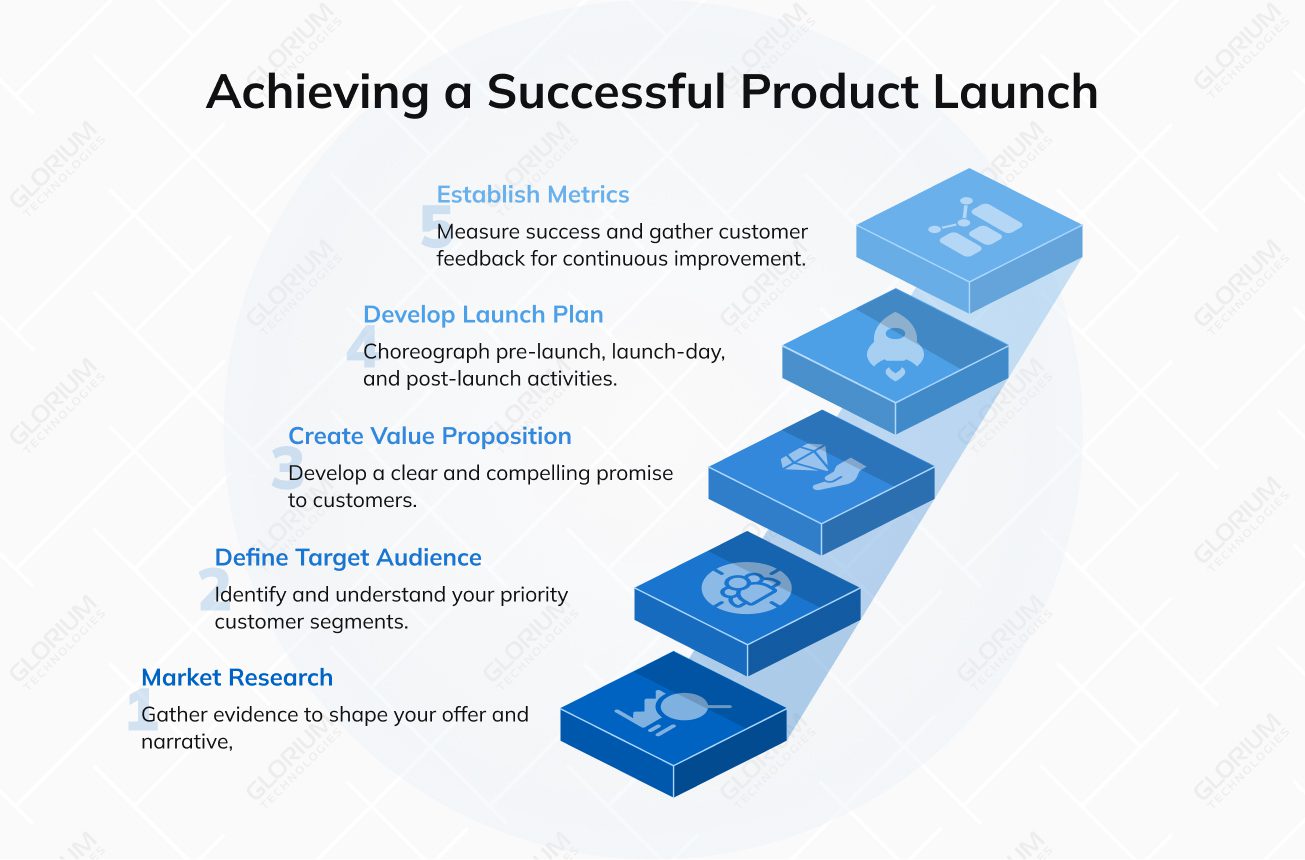
Start by swapping opinions for evidence. Meet prospective users to understand the problem, their workarounds, and what “better” means to them. Map current alternatives, typical prices, and switching costs. Note any regulatory or seasonal factors that could affect timing. Run small, fast tests, interviews, short surveys, and lightweight landing pages before code and budget ramp up. The goal is straightforward: approach a target customer with an offer and a story grounded in facts.
Translate your findings into a few priority segments defined by target customer needs and context. Document jobs-to-be-done, common triggers, likely objections, and buying paths for each. This clarity keeps features focused, narrows channel selection, and makes creative work specific enough to land on the first read. It also helps you say “not now” to attractive but distracting edge cases. A shared view of “who this is for” is the quickest way to align product, marketing, sales, and support before product launch day.
Turn the strategy into a concise promise that potential customers can easily repeat. State the outcome you deliver and the few reasons to believe it. Use plain language to ensure that key messages are consistent across the site, in PR, in ads, and in sales materials, thereby reaching your target audience effectively. Test the value proposition with real prospects. Refine until it is clear, credible, and easy to remember. Make this statement the foundation for all launch content.
Organize the work into three phases. Before launching the product, run a small beta test, produce core assets, train support and sales teams, and line up key partners. On launch day, update the site, publish PR, start paid campaigns, and trigger in-product prompts. After launch, send onboarding sequences, collect customer feedback, schedule success check-ins, and run second-wave campaigns. Assign owners and dates. Write clear go/no-go checks. Maintain a concise risk log with straightforward contingencies. Share a single source of truth so that all team members move in step.
“Email marketing is considered irreplaceable in launches. The majority of revenue from every launch comes from email marketing, not social media links or ads. In the most recent launch, well over 50% of revenue came from email.”
Alex Cattoni, How To Have A Successful Product Launch: My 4-Step Process
Define what “good” means before release and instrument it: track customer acquisition, activation, adoption, conversion, retention, and payback from day one. Pair the numbers with interviews, quick surveys, ticket themes, and in-product signals. You should review them on a tight schedule, then ship small fixes and notify users about the changes.
A product launch defines success before going live and measures it from the very first day. Pick a small set of metrics that show early value, quality, and growth. Review them on a weekly cadence, make decisions quickly, and ship minor fixes fast. That rhythm turns a product launch from a spike into a learning system.
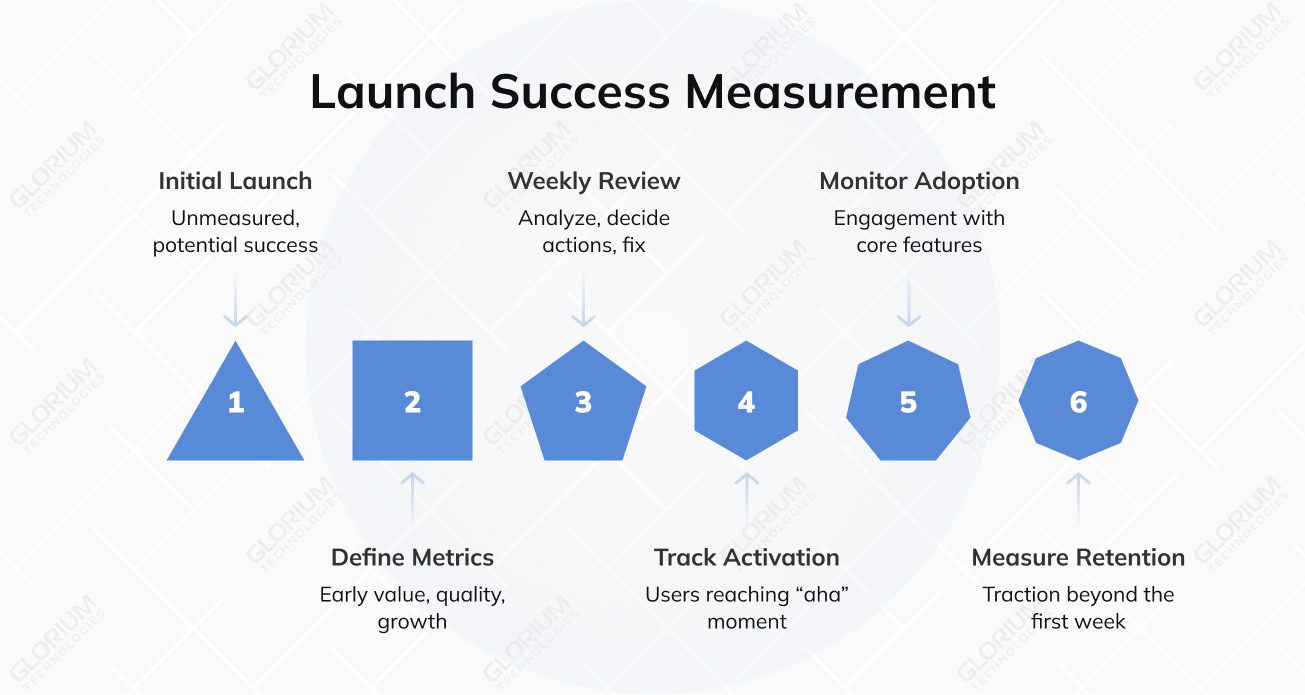
Activation rate shows how many new users reach the “aha” moment in a set window, such as the first seven days. Tie it to clear events that prove value, like connecting a data source or completing a first workflow. Segment by channel and persona to identify who activates the fastest and where onboarding breaks down. Improve activation with fewer steps, clearer copy, and a single guided path to value.
Feature adoption indicates whether people utilize the features that matter. Track two or three hero features and link their usage to outcomes to prove value. If adoption drops, adjust names, placement, tooltips, and empty states. Add gentle, in-product nudges that guide through hands-on experience.
Retention at 7/30/90 days proves traction beyond the first week. Important note: for users considered “retained,” they should complete a meaningful action, rather than a simple login. Plot cohort curves and observe how they move as onboarding, pricing, or messaging changes. If 7-day retention drops, fix time-to-value; if 30/90-day retention drops, invest in habit-forming moments, reminders, and deeper use cases.
Conversion rate (trial–paid or lead–user) turns interest into revenue or active usage. Break it down by source, segment, and offer, then test pricing, packaging, and paywalls in small, controlled changes. Provide sales and success with clear paths for stalled trials, and make the upgrade path obvious within the product. A single confusing step can erase weeks of awareness work.
Customer acquisition cost (CAC) and payback measure acquisition efficiency. Calculate CAC by channel, so you can allocate budget to what works. Track payback in months to recover CAC on gross margin, and aim for a window that fits your runway. Shorter payback periods free up cash for second-wave campaigns, enabling faster iteration.
Tickets for support and sentiment disclose risk and quality before metrics go haywire. To spot trends and areas for development, keep an eye on the number of tickets, the time it takes to receive a response, the resolution time, and recurrent topics. To monitor mood, combine that with CSAT or NPS. Close the loop with release notes that show your attention to detail, tag tickets by feature and root cause, and address the top offenders each week.
Set baselines in beta or pilot, then set week-one and month-one targets you can actually hit. Define each metric precisely, including event names, time windows, and denominators, to ensure reports match across teams. Pair dashboards with a handful of user session reviews and short interviews, and let both shape the next sprint.
Measured this way, a product launch becomes a steady loop: instrument, learn, adjust, and communicate. The cross-functional teams stay aligned, prospective customers feel the product is improving, and momentum compounds beyond day one.
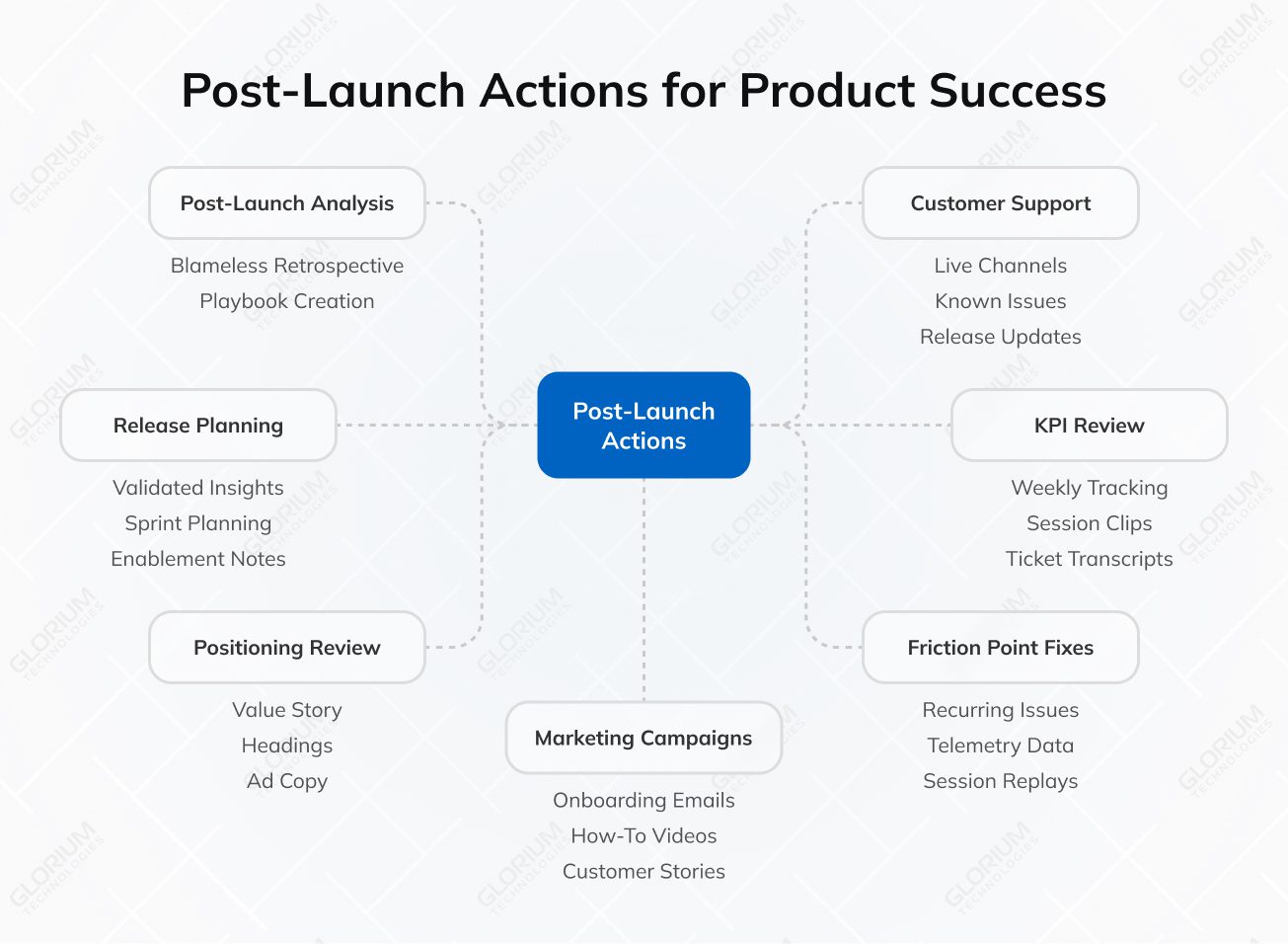
A successful product launch quickly shifts from “announcement” to “improvement.” The goal in the first weeks is to support early adopters, learn what’s working, and turn that knowledge into visible upgrades. Keep the loop tight: support → measure → fix → communicate, so momentum compounds.
“When critics respond negatively after a product launch, their feedback is strategically useful; it helps refine our understanding of the original design questions. Critics who don’t like it are really saying it wasn’t for them, which clarifies who it is for and what it should be.”
Glorium Technologies helps teams move from idea to adoption with less noise and more evidence. With over 15 years of cross-industry delivery, we run a streamlined, stage-gated product launch program that ties spend to data and decisions to clear success metrics. You get one partner aligning market research, product launch strategy, build, and go-to-market, so momentum grows after release instead of fading.
Start exactly where you are. If you need a lean first build, Glorium’s MVP development services turn a validated concept into a secure, focused release. If you’re shaping the path to market, product development strategy defines segments, positioning, channels, and a run-of-show for product launch and the first 90 days. If assumptions need proof, product research services pressure-test demand and pricing with new customers before you scale spend. In every case, the program sets “go/adjust/stop” gates, orchestrating the right events from day one. It converts early feedback into visible improvements, such as pricing, onboarding, messaging, or positioning.
Explore our case studies to see how a disciplined product launch sets the stage for scale. In one program, a working prototype for NFT/SFT campaigns validated demand and early product-market fit within 3–4 months before heavy spend.
Want the same clarity for your product launch? Strategy implemented, metrics interpreted, and next moves decided? Book an intro call, and let’s navigate toward a successful product launch.
Work in stage-gates. Fund discovery and validation first, then unlock the bulk only if predefined signals (e.g., activation ≥ X%, qualified pipeline ≥ Y) are met. You should also maintain a 10–15% contingency for potential surprises. Split spend across build and enablement, go-to-market, and learning (analytics, market research, testing) so you can course-correct without stalling. Tie every budget line to a decision you’ll make if the metric moves (or doesn’t).
Current customers, warm partner referrals, and niche communities where your target audience already compares tools could be your beta users. Define who qualifies (role, use case, tech stack), cap the cohort to maintain a clean signal, and offer clear incentives (early access, credits, roadmap input). Run a simple cadence (15–30 minutes, same questions, same day each week), and log everything in one place. Close the loop publicly: “You said X, we changed Y.” That’s how you turn testers into advocates.
Use willingness-to-pay interviews to set an initial floor and ceiling. Review trial-to-paid metrics, discounting, and payback every week. If conversion is healthy but payback slips, adjust packaging before changing the headline price. Read win/loss notes to learn which benefits resonate. Small, targeted tweaks paired with clearer value messaging usually outperform big resets.
Plan early for data residency, consent, and retention (GDPR/CCPA), and ensure every claim matches what your product and processes can actually support. Localize currency, taxes/VAT, formats, support hours, SLAs, and onboarding tailored to local workflows. You should also validate requirements with counsel and carry them through your sales materials and contracts.
Have an event schema that everyone understands, product analytics tied to those events, UTM/attribution that actually works, session replay, feature flags, a status page, and a communication plan. Define “activated” in concrete product actions and QA the dashboards with a small pilot before product launch. Add lightweight VOC: in-app micro-surveys and a single inbox for qualitative notes.
Choose Glorium Technologies when you want a partner who owns strategy and delivery. We connect research, positioning, pricing, and channel planning to real execution. That includes MVP builds, analytics, sales and support enablement, and post-launch iteration. Work runs on stage-gated, metric-driven playbooks, so spend follows evidence. We’ve been recognized by Inc. 5000, Clutch Top 1000, and IAOP Global Outsourcing 100, among others. Our record spans 150+ shipped products, 80+ awards, and 99% client satisfaction. Regulated work is covered by ISO 13485 and HIPAA experience.
Outsourcing provides you with repeatable product launch frameworks, neutral research, and additional execution capacity without diverting your core team from Business as Usual (BAU). You test faster, avoid blind spots, and protect the first 90 days, when minor fixes have the most significant impact on activation and retention. Your team keeps control, while Glorium Technologies fills the gaps and accelerates the rhythm.