






PoC vs Prototype vs MVP: Key Differences, Use Cases, and How to Choose the Right Approach
Updated April 28, 2026

 Summarize in ChatGPT
 Summarize in ChatGPT
Proof of concept, minimum viable product, and prototype are not solely development stages; those are different types of functional products (artifacts) developed with distinct goals and possessing distinct scopes and output fidelity. That is why it is essential not to use them interchangeably and to understand the business logic behind each of them.
The question of successful products that meet market demand becomes crucial in this context, as 90% of all startups fail in the long run, and business owners must utilize all their knowledge to succeed. When should you stick to PoC, prototype, or MVP development, and why? Let’s discover the answers and learn the key differences here.
Content
PoC has nothing in common with full-scale development and is aimed at a different target audience: stakeholders and investors. It is mainly an internal project created to test a conceptual or technical hypothesis before the team commits to it. A successful PoC demonstrates the idea’s technical feasibility and initiates the process of further strategic planning and decision-making. It validates assumptions and ensures secure funding of the project, without wasteful spending and irrational allocation of resources.
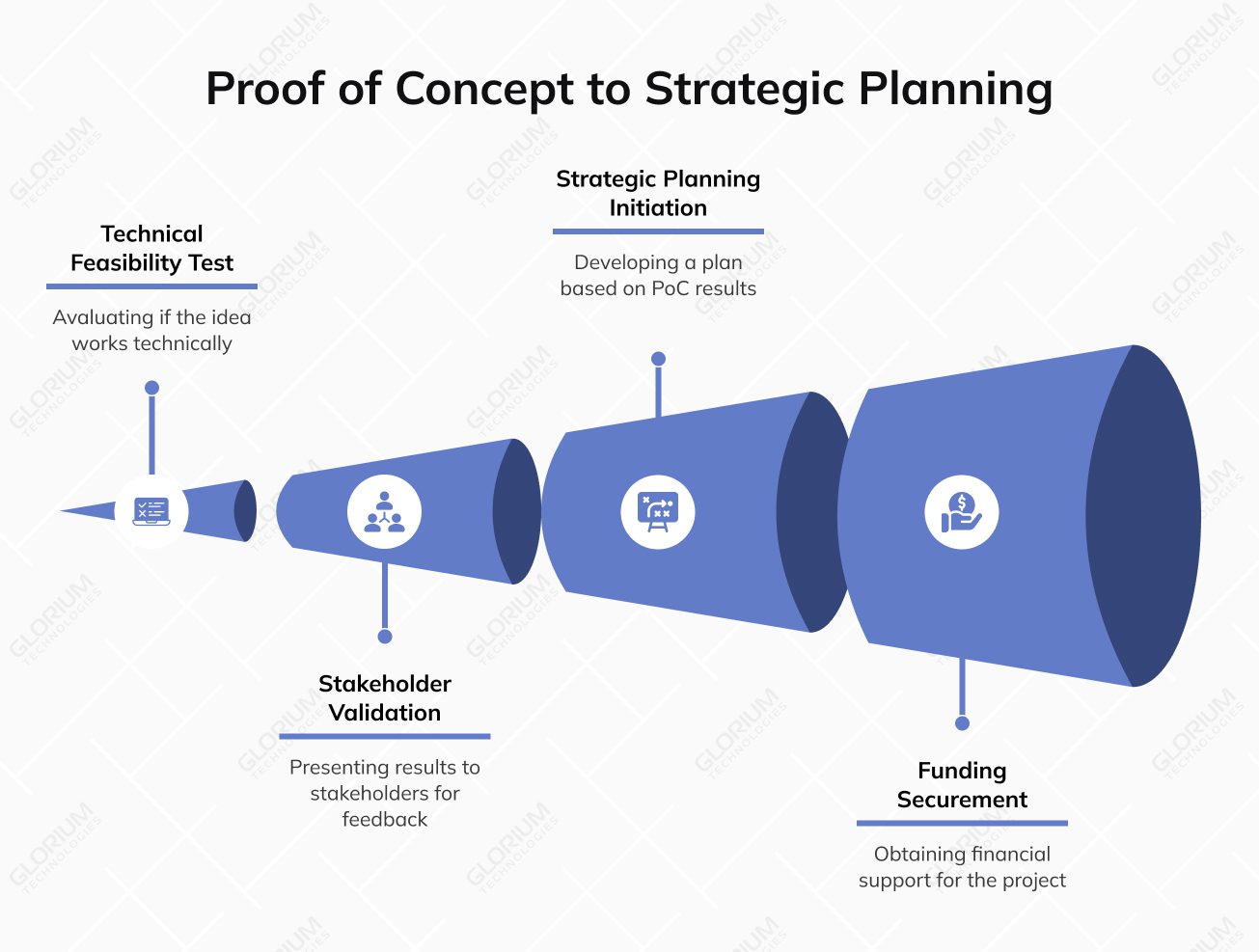
Proof of concept is an ideal choice in the initial stages of project validation, when you need to check whether the product idea is viable, minimizing development costs as much as possible. A good example is using PoC with novel and original services, for instance, AI-based tools. The primary reason for the failure is that the final product did not meet business expectations. Thus, we can highlight several main causes for using proof of concept.
In short, proof of concept is your go-to if you are considering new technologies to use or niches to expand to. It is necessary to help you, stakeholders, and investors understand whether the idea is worth the time and money, and whether it is realistic at all.
Here are some examples of projects where you can use proof of concept to test ideas, design concepts, and understand the technical and usability issues to expect if you proceed with product development and start gathering feedback from real users.
| Example Project | Description |
| New algorithm testing | Develop a limited functionality version using minimal resources. It aims to demonstrate that the new approach or concept is viable before it is integrated into the product. |
| API integration | Write the basic version of the script that connects the needed resource with an API. The goal is to check whether two systems can operate together. |
| New staffing model | Implement the schedule or work model changes only for a small team to assess whether they will impact productivity or employee satisfaction. |
| Crowdfunding campaign | Verify that intended users are not only theoretically interested in but also willing to pay for the product. |
Glorium Technologies can develop a proof of concept to mitigate risk and allocate significant resources needed for development appropriately across various projects. PoC was created for a 3D medical imaging software to ensure that it is technically possible to convert a raw 2D medical image into a 3D model. Proof of Concept also validated whether multiple property listings APIs can be integrated with the all-in-one application for real estate trading. Such an approach helped us and our clients ensure that their projects are actually viable and that software development makes sense even before the teams get started.
A prototype represents only the core features of a product; it is needed for design validation and to simulate the real-user experience. While PoC helps to understand whether the idea is realistic and worth investing in, a prototype focuses on the user interface and experience, essential features, and core functionality. User feedback becomes crucial at this stage; however, the prototype is only tested by the QA specialists and limited groups of real-life users drawn from the potential target audience. This helps to identify additional technical challenges before the product hits the market and address them.
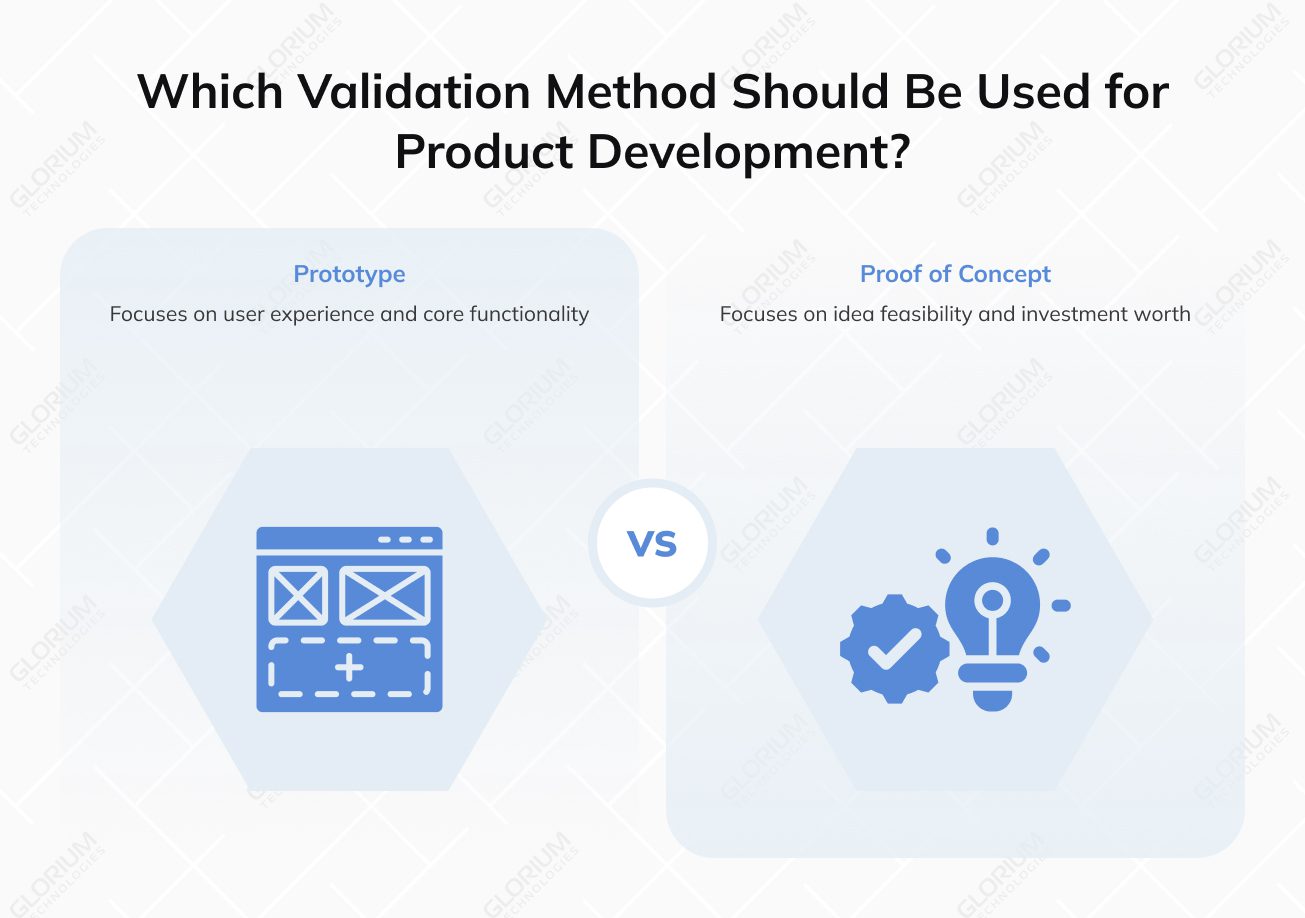
A prototype becomes a reasonable time and money investment when you need to validate whether the product is functional and usable. It enables you to refine features that require improvement before the full-scale development process commences. Generally, it makes sense to highlight several practical reasons for developing a prototype.
A prototype is your go-to if you have already passed the early stages of project planning and validation. It is an iterative development phase where you need to confirm whether your product’s design is viable, or if there are some functional, convenience, and interface changes to be made to help it better meet its target users’ expectations.
“Prototypes are simply opportunities to try something out, test an idea, or explore a curiosity – with the goal to maximize learning from minimum investment”
Prototypes can be used in various industries and for different products to gain an early understanding of how the product development process should unfold and what aspects to pay extra attention to.
| Example Project | Description |
| eCommerce | Create a prototype of the new checkout page and test whether the new design and interface solutions reduce the cart abandonment rate. |
| Medical devices | A prototype of a new medical device will help doctors and users estimate the convenience and practicality of using it during specific procedures. |
| Software | A mockup of a banking app’s payment flow to see how convenient and intuitive it is to follow, and whether there are any user interaction issues. |
| Electronics | A prototype of the new smartwatch helps assess its size, weight, shape, material, and overall feel when worn. |
With Glorium Technologies, you get an experienced team to build interactive prototypes for your project. A notable example is a visitor management system, which demonstrated the ID validation and pass issuance processes for a single facility before being developed into a full-fledged project. User insights were gathered and utilized to create a strategy for further development. A Figma prototype was also designed for the retirement plan platform to test whether the interface and navigation follow one of the main requirements: make complex financial data easy to assess and use. This minimized the risks of product revisions and fixes on the final stage.
A minimum viable product is the first functional version of a product or service that reaches the market testing stage. It offers all the basic features and is designed to deliver the product’s fundamental value proposition to early adopters. While it is not 100% developed, it is wrong to call MVP incomplete or of poor quality. It is rather an early version of the product, functional and usable, aimed at gathering customer feedback and initiating the build-measure-learn loop. It must collect the maximum amount of both negative and positive feedback from real users. This guarantees that further development will be based on the realistic market demand and customer expectations.
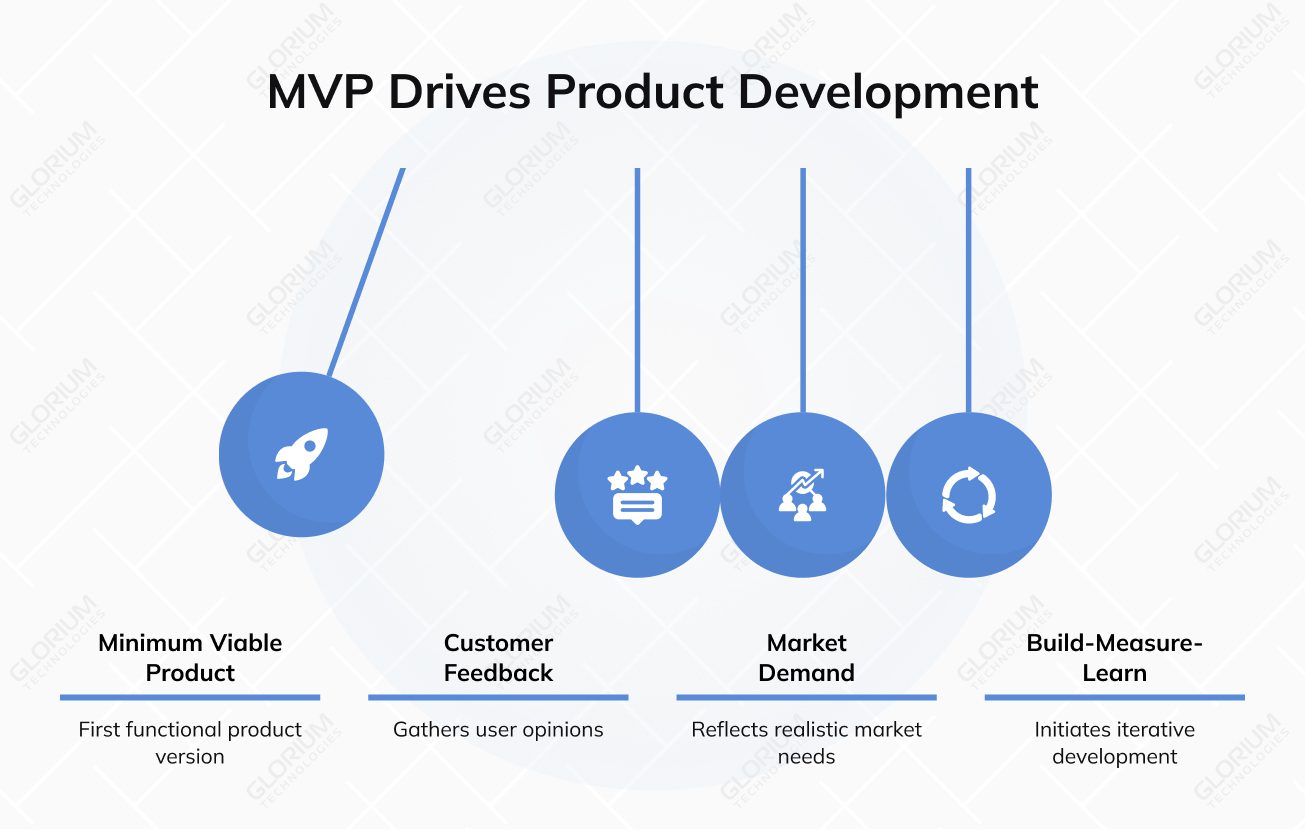
Develop a minimum viable product to determine whether your project will gain popularity among its potential target users. In some way, it can be called user testing; however, not of the full-fledged product but rather of its early version. Here is a list of practical reasons to stick to the MVP:
Stick to MVP development when you operate in the conditions of extreme uncertainty, and understand that you do not have enough data to prove that your product will hit the market, but you have a feeling that it has potential. Gather data and make well-weighted decisions based on the feedback from early adopters.
A minimum viable product can be helpful in any industry. It makes the most sense, though, to develop an MVP when you are not familiar with the market, operate in the conditions of extreme uncertainty, and require real-user feedback to decide in what direction to move further.
| Example Project | Description |
| Cloud storage | A popular cloud storage service issues a video explaining all the suggested and expected features, even without developing an actual functional software. |
| Transportation | A mobile phone app that allows users to request a car to their location in a couple of clicks. It is available in only one city. |
| SaaS marketing | A landing page that describes the product, provides relevant screenshots if possible, and includes a call-to-action button, which directs users to a mockup pricing page. |
| Social media | A basic version of the social media app can be developed and then modified depending on what users liked about it and what features they used the most. |
Glorium Technologies has already developed dozens of MVPs for different clients worldwide and can undoubtedly be called an expert in this sphere. It is worth highlighting the creation of the minimum viable product for a company specializing in property renovation. This early version consolidated all the renovation projects into a single dashboard, regularly updated them, and provided a centralized hub for all documentation. It also enabled suggestions for future workflows based on experience. This version has passed the market validation procedure and is now ready for further development.
Check the table of main differences between proof of concept, prototype, and minimum viable product to get a quick insight into what your choice should depend on. Although MVP has almost become a must for startups (more than 70% do not launch without it), this does not mean you should ignore other types of products.
| Feature | Proof of concept | Prototype | Minimum viable product |
| Primary Objective | Validate technical feasibility – is it generally possible to implement this idea? | Validate design/usability – should the project be done this way? | Validate market viability – will the potential customers use the product and pay for it? |
| Result | An internal and often non-functional project or experiment | Tangible, simulated, or partially functional model | A functional version of the product was released to the market |
| Scope | A narrowly focused process of verifying a single technical idea or hypothesis | Core features and front-end design elements | Minimal set of features required to deliver the core value of the product |
| Target Audience | Stakeholders and investors | QA specialists and a limited group of target users acting as demo testers | Real customers |
| Output | A go/no-go decision on the project, and empirical proof of its viability | A refined design blueprint or mockup, sometimes with the basic features | Validated learning, feedback, and marked revenue |
| Key Risk Mitigated | Technical and financial resource waste | Usability issues and poor customer fit | Full-scale market failure |
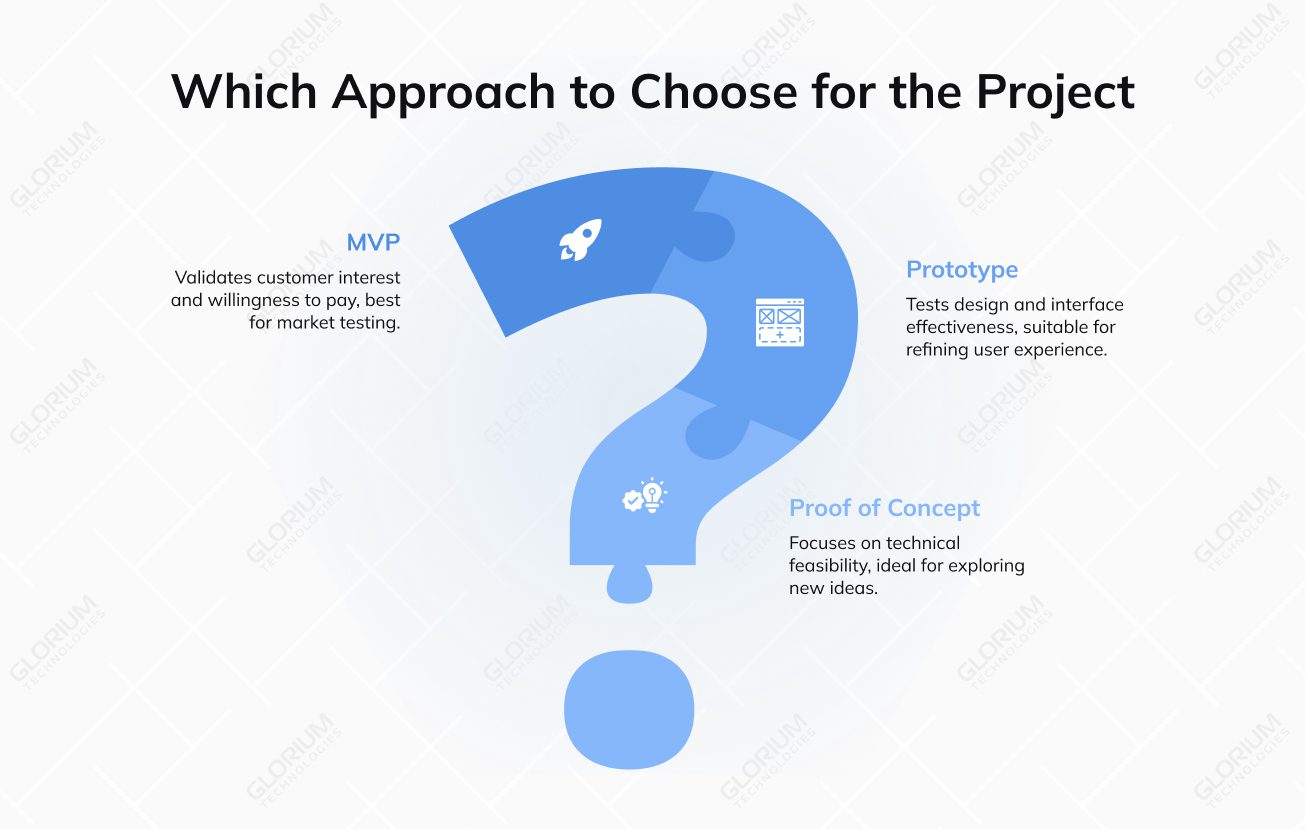
Choosing between a PoC, MVP, or prototype entirely depends on the risks your project faces. If you have an idea or concept in mind and your primary question is about technical feasibility, start with a Proof of Concept to explore whether it is technically possible to build it. If you already know it is, and you need to test the design concepts, features, convenience, and effectiveness of the interface, proceed with a prototype. Finally, if you need to demonstrate that real customers will be interested in the product and willing to pay for it, you should launch an MVP and gather feedback. In any situation, the best approach is the one that minimizes immediate investments and maximizes validated knowledge, which is necessary to build a full-fledged product.
By partnering with Glorium Technologies, you get a disciplined and data-driven approach to product validation from a team with 15+ years of experience in building PoCs, prototypes, and MVPs for various industries. With us, you will eliminate the risks of overinvesting resources into projects that are technically impossible to implement or products that lack market viability. You will receive a comprehensive and well-designed strategic framework that will help you advance your idea and vision.
Are you seeking a guided, fast-tracked, and data-backed path to market acceptance and scale, so you can focus on your vision while we handle the complexity? Ready to turn uncertainty into profitability and great ideas into feasible products? Reach out today to schedule your strategic discovery session and ensure you start building your successful future right now.
Proof of concept would be the best choice in this case. It is narrowly focused on validating only one particular technical hypothesis, which allows it to be delivered quickly and at the lowest cost. In such a way, you will not waste your resources on a non-viable idea or on a product that is technically impractical or even impossible. If PoC fails, you can quickly switch to proving another idea without significant time or money losses.
You can book a strategic discovery session with us, which will help us identify risks and clarify your goals. If the biggest question is technical feasibility, we will recommend a PoC; to review the user experience, you will get recommendations and assistance with a prototype. Finally, if market acceptance is the thing that requires review, MVP will be your go-to. Additionally, you will receive the best recommendations and a detailed development plan to satisfy your investors from an experienced team with a vast and successful portfolio.
MVP is the best to initiate the feedback loop and gather the most reliable data from the real users. This includes conversion rates, revenue, and feature usage. Thus, you will be able to make well-informed decisions based on real market demand and gain a clear understanding of what the subsequent development stages should entail.
With Glorium Technologies, you are not only getting an experienced team of analysts and developers to work on your project. You get a guided and strategic partnership with minimal risks and a proven record of delivering compliant proofs of concept, prototypes, and MVPs. You will have your goals assessed and, based on them, provided with recommendations on which technical artifact is best suited for your current situation and what should be done to avoid resource waste.