







Top SaaS Pricing Models to Boost Revenue and Sustain Growth
Updated April 28, 2026

 Summarize in ChatGPT
 Summarize in ChatGPT
In 2024, the global SaaS market surpassed the $266 billion mark and is on track to approach $1,131.52 billion in 2032, with solid but slower growth compared to the hypergrowth years preceding it. At the same time, private SaaS companies report a median annual recurring revenue (ARR) growth of around 25%, indicating that most players are no longer merely “riding the wave” and must work to retain every point of net revenue growth. Pricing has become one of the few levers you still have complete control over.
The landscape is also getting more complex. Recent benchmarks indicate that over 40% of SaaS companies changed their prices in 2024, either by raising or lowering headline numbers, introducing new pricing tiers, or hiding certain plans from the main pricing page. Around 78% now prefer value-based SaaS pricing strategies, and many run hybrid SaaS pricing models that combine per-user, per-feature, and usage charges.
For founders and product leaders, the question is no longer “Which price feels right?” but “Which pricing model fits our product, motion, and customer needs, and how do we evolve it over time?”
This article walks through the popular SaaS pricing models in use today, how they support (or block) revenue and growth, and how to choose the right mix for your stage and go-to-market. We’ll examine flat-rate, tiered, per-user, usage-based, hybrid, and other pricing models.
Content
SaaS pricing refers to the method of charging for ongoing access to a cloud-based product that continually evolves. Instead of a one-time license and a big upfront payment, you sell a recurring service. Customers pay for something that stays up, stays secure, and keeps improving: features, uptime, support, and performance.
Under the hood, most SaaS pricing models are based on a few fundamental decisions. You choose how often you bill customers: monthly, annually, or on multi-year terms. You define a price metric, which is the unit that links what you charge to how people use the product, such as users, seats, projects, API calls, storage, transactions, and so on. You also decide how to package features and limits into plans. Those three levers together determine how revenue grows as customers roll out the product, add new teams, and push more of their work through it.
Because revenue is recurring, SaaS pricing sits at the center of your unit economics. The numbers on your pricing page must work in multiple directions simultaneously. They need to feel clear and reasonable to buyers. They need to support healthy margins and a sensible Customer Acquisition Cost (CAC) payback. They also need to leave room for expansion, so successful customers can spend more without feeling penalized. A “small” discount that becomes standard can quietly destroy customer lifetime value. A clever price metric that doesn’t align with how customers perceive value can hinder adoption or mislead customers into the wrong tier.
Teams often use the terms “pricing strategy” and “pricing model” interchangeably. They are connected, but answer different questions. A simple way to think about it is this: your pricing strategy explains why you charge the way you do, and your pricing model defines how that charge actually works in practice.
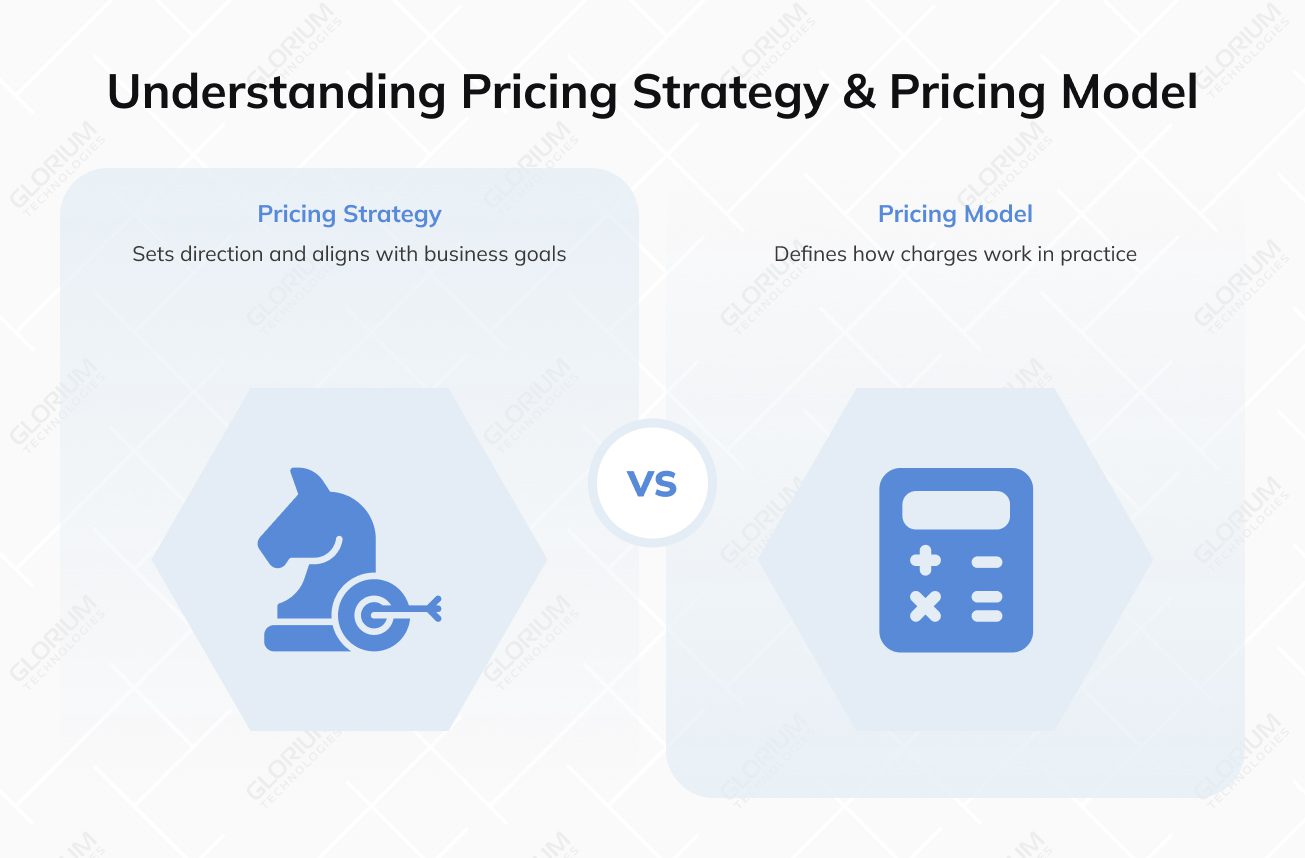
A right pricing strategy lives at the business and positioning level. It ties pricing decisions to your goals, your target market, and how those customers perceive value. When shaping a strategy, you decide whether to lean on value-based pricing, benchmark yourself against competitors, or anchor pricing around your costs.
A model is more operational. It is the pricing structure you use to turn that pricing strategy into invoices and line items. If your plan is value-based and focused on team collaboration, you might use a per-user or per-active-user model that scales with the number of users. If your strategy is outcome-driven for an infrastructure or data product, a usage-based or transaction-based model may be more natural because value grows with volume. If you serve very different customer segments, you might combine multiple pricing models.
Look at the difference between the SaaS pricing strategy and the pricing model in the table below:
| Pricing strategy | Pricing model | |
| Core question | Why do we charge this way? | How do we charge for value? |
| What it is in practice | Business approach that links pricing to goals and positioning | An economic mechanism that defines the unit and structure of payment |
| Who mostly owns it | Leadership, product, finance, GTM | Product, finance, engineering |
| Typical examples | Value-based, competitor-based, cost-plus, penetration, premium, PLG-focused | Per-user, per-active-user, flat-rate, usage-based, transaction-based, hybrid |
| How often does it change | Rarely (directly) | Occasionally (requires build) |
| What customers notice most | Indirectly, through messaging and sales conversations | Clearly, in how the bill is calculated |
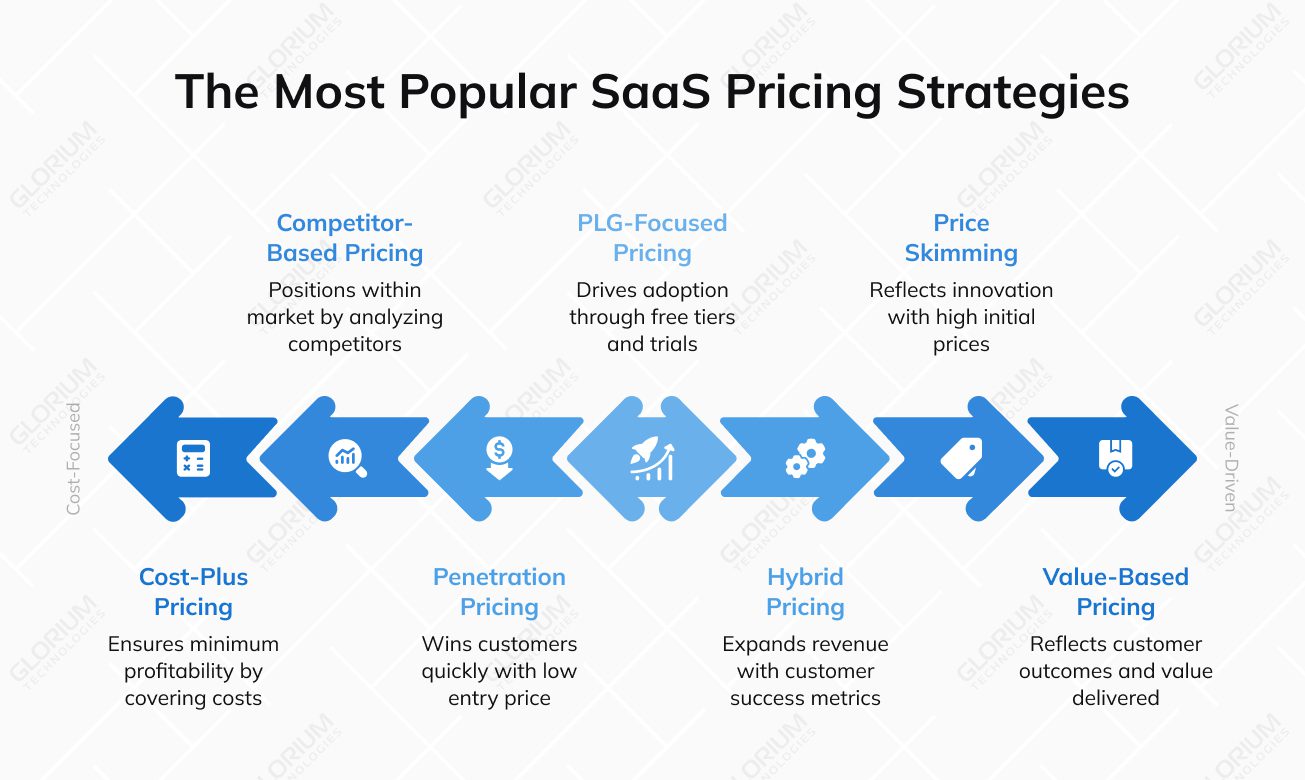
Pricing strategy is the high-level story behind your numbers. It shapes which customers you attract, how fast revenue grows, and how your product is perceived in the market. The SaaS pricing strategies below are the ones most SaaS company founders actually use when they move from “what should we charge?” to a repeatable model:
“Negative churn is crucial for success in long-term SaaS companies, requiring expansion revenue to exceed churn losses. The lesson from serving on the board of HubSpot was that starting with one product at one price point ($6,000 per year, or $500 per month) meant there was no way to generate any expansion revenue. To secure this, SaaS companies must implement variable pricing axes. This can involve introducing different editions, charging for users, or, as HubSpot did, basing pricing on a metric like the number of leads stored, a better indicator of software value. For an early-stage startup, however, having variable pricing is a secondary thing that can be introduced later once the business is running and up and running.”
David Skok, The SaaS business model & metrics: Understand the key drivers for success
SaaS pricing models are how an abstract strategy turns into real numbers on a pricing page. They decide what gets metered, how revenue scales as customers grow, and how easy it is for people to understand what they are buying. Below, we outline the common SaaS pricing models, including examples, strengths, and trade-offs to consider.
A flat-rate pricing model means one product, one set of features, and one recurring price. The customers pay a fixed monthly price, regardless of usage or team size. This model works best for focused products with a narrow, clearly defined use case and relatively similar customer profiles.
Examples: Basecamp, a project management and team collaboration platform, uses flat-rate pricing for larger teams. For $299 per month when billed annually, a company gets access to all features for all employees, without per-user fees.
Pros:
Cons:
Tiered pricing model offers multiple plans at different price points, each with its own limits and feature sets. Prospects choose the tier that matches their size, complexity, and budget. Tiered model suits products that serve several segments, from small teams to large enterprise companies.
Examples: Dropbox, HubSpot, Mailchimp, most modern B2B SaaS products.
Pros:
Cons:
Per-user pricing ties revenue directly to the number of people with licensed access. As more users join inside a customer’s organization, the bill scales in a linear, predictable way. This model fits collaboration, CRM, productivity, and many line-of-business tools.
Examples: Salesforce, Microsoft 365, Zoom, many sales and CS platforms.
Pros:
Cons:
Per-active-user pricing is a variation of per-seat pricing where a company can invite many users, but only pays for those who are active in a given billing period. This approach solves the classic problem of buying a large bundle of seats and then discovering that a good share of them never log in.
Example: Stripe Connect lets platforms pay a fixed fee for each monthly active account. Additionally, the platform determines its own pricing and retains its own fees.
Pros:
Cons:
Usage-based pricing links spend directly to product usage, such as API calls, events, data volume, or compute time. Bills rise as customers push more volume through the system. This model fits infrastructure, data, and communication products where value scales with throughput.
Examples: Zapier is a good example of this approach, where pricing is organized into tiers and scales with the number of automated tasks a customer runs each month.
Pros:
Cons:
Feature-based pricing organizes plans around which capabilities are included. Entry plans cover essentials, while higher pricing plans unlock advanced analytics, security, automation, or integrations. This model is suitable for products that have a clear distinction between basic and advanced functionality.
Examples: ActiveCampaign, a platform for marketing automation, email marketing, and customer support, uses a feature-based pricing model. Customers can start with core functionality and move to higher plans as their business grows or they need more advanced capabilities.
Pros:
Cons:
Freemium pricing offers a free tier with meaningful but limited value, complemented by paid plans that provide additional value. The free plan drives awareness, sign-ups, and product familiarity, creating a pool of users who may later convert.
Examples: Slack and Canva are classic examples of the freemium pricing model. Both offer a solid free tier to attract and onboard users, then unlock more advanced features, limits, and tools on paid plans to drive upgrades and maximize revenue.
Pros:
Cons:
Hybrid SaaS pricing models combine several of the structures above into one coherent system. A typical pattern is a base platform fee plus per-user, usage, and add-on components, all under one contract.
Examples: Most of the examples above use some form of hybrid pricing. Buffer is a clear case, where the final price depends on both the chosen pricing plan and the number of social channels a customer connects to.
Pros:
Cons:
AI-based SaaS changes the economics of pricing because every query, API call, or model run consumes noticeable compute and energy, not just storage or basic server time. Traditional per-user pricing often fails here: heavy users can drive costs far beyond what a simple license fee covers, so revenue and usage drift out of alignment.
Outcome-based pricing and token-based pricing address this gap in distinct ways. Outcome-based pricing ties fees to precise business results such as qualified leads, fraud prevented, or hours saved, which makes spend easier to justify for enterprise buyers but requires reliable ways to track and attribute impact. Token-based pricing, popularized by LLM and AI API providers, charges for input and output tokens (or similar units), with volume tiers and model-based rates so that higher-intensity usage and more expensive models are priced accordingly.
In practice, AI SaaS often blends these ideas rather than copying classic models of SaaS companies. A base platform fee may cover access and support, while token-based charges reflect raw model consumption, and outcome-based components are layered into higher tiers or enterprise contracts. This kind of hybrid approach keeps costs under control, aligns price with both usage and value, and avoids the trap of “all-you-can-eat” plans that become unprofitable as AI workloads scale.
Your SaaS pricing model is a core growth lever that shapes how revenue comes in, how potential customers perceive your product, and how easily the business can scale. Thoughtful decisions early on give you a stronger foundation for future releases and any price changes you introduce later.
Well-designed, effective SaaS pricing models help revenue grow in a controlled and sustainable manner. Clear tiers, meaningful add-ons, and sensible increases on higher-value plans make it easier to capture more value from customers who rely on your product the most. When plans are aligned with real usage patterns and different customer segments, power users can move up instead of churning or staying on underpriced contracts. For example, introducing a premium plan with advanced features and priority support can boost profitability without requiring a constant influx of new customers.
A pricing model is often one of the first touchpoints potential customers see. A simple, transparent structure reduces hesitation, helps buyers quickly identify the right plan, and keeps sales and onboarding conversations focused on outcomes rather than confusion over limits. Options like a freemium model, trials, or clear entry tiers can make it easier for new users to start and then grow within the product, rather than hitting a ceiling and leaving. When pricing feels fair and understandable, it supports both acquisition and long-term retention.
Pricing works best when it reflects the value customers actually get from the product. Using value-based pricing logic, even if the final model is a mix of approaches, helps buyers feel they are paying for outcomes. This alignment enhances conversion rates, fosters healthier customer feedback, and provides teams with a clearer explanation of why a plan costs what it does. It also makes discussions about new features or price adjustments more grounded, because both sides can refer back to the business impact.
A flexible, future-ready pricing model enables easier growth into new and diverse customer segments and target markets without the need for constant reinvention. Add-ons, usage-based elements, and segment-specific packages allow you to serve small teams, mid-market companies, and enterprises from the same core product. As the offering matures, you can adjust tiers, limits, or modules instead of replacing the entire pricing strategy. In practice, this means pricing supports expansion and market entry, rather than hindering them.
Pricing works best when you treat it as part of running the business. Your product evolves, your costs shift, and customers discover new ways to utilize what you build. A simple review rhythm helps you keep prices close to reality, rather than relying on guesses made two years ago.
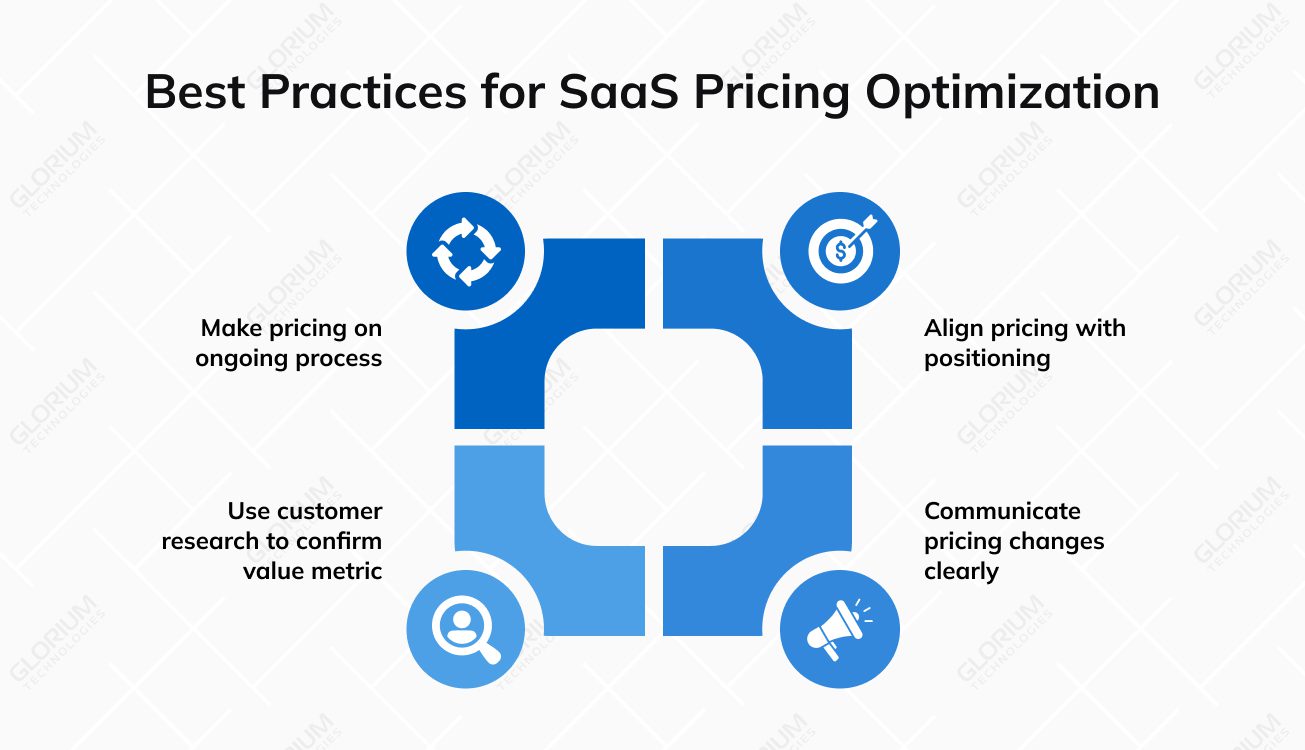
Think of pricing as something you maintain. Set a regular cadence for review, for example, once or twice a year, and treat it like any other product or strategy check-in. Examine how plans evolve, where deals falter, and what sales and customer success teams observe in conversations. Sometimes you will adjust details. Sometimes, you will confirm that prices are still valid.
Many SaaS companies’ pricing problems come from charging for the wrong thing. Discuss with customers how they measure success with your product and what features they use most frequently. Ask which limits feel reasonable and which feel random. Combine those conversations with simple surveys or brief pricing interviews. When your value metric aligns with how customers perceive value in their own business, upgrades feel natural, and price discussions feel more grounded.
“A compelling thought starter is to explore what would happen if you were more aggressive than you think necessary, such as increasing the price by 10%, 20%, 50%, or even 100%. Testing these increases, even with a small set of deals or sales reps, is the best way to understand the price elasticity in the market truly.”
Customer stories are essential, but they must align with the data to be effective. Look at upgrades, downgrades, expansion, and churn by cohort and segment. See where customers reach their limits, which pricing plans they tend to avoid, and where heavy users tend to cluster. If many accounts cancel when they reach a particular threshold, the transition to the next plan may be too abrupt. If large customers remain on your smallest tier, you may be undercharging or packaging features incorrectly. This kind of view helps you change the right parts rather than reshaping everything at once.
Price increases and structural changes are sensitive, even when they are justified. You can reduce friction with straightforward communication. Give customers early notice, explain what is changing and why, and show precisely how it affects their current plan. Where it makes sense, offer a grace period, temporary grandfathering, or a clear path to upgrade that actually improves their experience. People may not welcome higher prices, but they will tolerate them much better if they feel informed and respected.
Pricing should align with the story you tell about the product and the way you present it. A product-led, self-serve motion needs visible plans, low friction at entry, and predictable costs. An enterprise-first motion can support higher Annual Contract Values (ACVs) and more custom packaging, but still benefits from a consistent logic that sales can explain in one slide. The same applies to the brand. A “premium, mission-critical” position does not lend itself to aggressive discounting or random exceptions. When the SaaS pricing model aligns with your positioning and go-to-market strategy, it reinforces trust.
Glorium Technologies has spent over 15 years building and scaling SaaS products, delivering more than 150 solutions for startups and enterprises. With around 200 specialists across the US and Europe, our pricing and monetization work is always tied to real product architecture, billing flows, analytics, and hands-on experience in MVP development and ongoing SaaS development services. Our team holds core quality and security certifications like ISO 9001 and ISO 27001. It works with platforms such as AWS, Microsoft, Odoo, and Stripe, which helps keep your pricing ideas realistic and implementable from day one.
In a SaaS pricing engagement, our team helps you understand where your product really creates value and which metrics make sense for monetization, whether that is seats, usage, outcomes, AI consumption, or a mix. That insight translates into a clear pricing model and plan structure, aligned with your billing stack and go-to-market strategy, and supported by tracking, allowing you to see how pricing affects conversion, churn, and expansion.
If you’re looking for a pricing system that is structured, testable, and ready to grow with your SaaS business, reach out to us to schedule an intro call and receive a clear guide to SaaS pricing tailored to your business.
Glorium Technologies has been building and scaling SaaS products for over 15 years, with more than 150 solutions launched for startups and enterprises. About 200 specialists keep pricing work tied to real product, billing, and analytics. With ISO 9001/27001 and strong partnerships with platforms such as AWS, Microsoft, Odoo, and Stripe, Glorium is well-positioned to support serious, revenue-critical SaaS products.
First, Glorium helps clarify how your product creates value, analyzes customer data, and defines which metrics are most natural to customers, such as seats, usage, or outcomes. Then, different pricing models, such as per-user, usage-based, tiered, or hybrid, are compared against your margins and growth goals, and turned into clear plans, limits, and add-ons. Engineers and architects can also help integrate this into metering, billing, and dashboards, ensuring the new pricing structure runs smoothly and is easy to track.
The new pricing structure can first be introduced to new customers or defined segments, and existing customers can either retain their current terms or receive transparent, well-explained options to transition. Glorium Technologies helps design these experiments, configure billing systems, and set up dashboards that track conversion, ACV, churn, and expansion for each variant. Based on the results, pricing and packaging are refined until performance is stable and potential customers clearly understand the change.