







Robotic Process Automation in Healthcare: Benefits, Use Cases, and Implementation in 2026
Updated July 8, 2026

 Summarize in ChatGPT
 Summarize in ChatGPT
A hospital billing clerk still spends a good part of every shift copying the same patient details between an intake form, an EHR system, and an insurance portal. None of that work requires judgment. That kind of task rewards patience, and patience is exactly what automation solutions do better than people. That gap between routine data entry and the clinical decisions that actually need human oversight is where robotic process automation in healthcare has found its place.
This guide is for hospital administrators, revenue cycle leaders, and IT decision-makers who want a clear picture of what RPA in healthcare actually automates, where it delivers measurable returns, and what tends to derail a rollout. You will find the core use cases across the healthcare industry, the honest challenges of implementing RPA in a regulated healthcare sector, and a practical view of what a rollout involves. Healthcare organizations are under constant pressure to do more with the same staff, and robotic process automation gives them a proven way to claw back hours without touching clinical judgment.
Content
Robotic process automation uses software bots to handle repetitive, rule-based tasks that a person would otherwise complete by hand. In a hospital or clinic, that means bots that log into systems, read forms, move health data between platforms, and trigger the next step in a workflow without a person clicking through each screen.
RPA in healthcare differs from a full IT overhaul. Bots work on top of existing systems through the same interfaces a staff member would use, so a health system does not need to rip out its EHR system or rebuild its billing platform to benefit. That non-invasive quality is part of why adoption has grown so quickly among healthcare organizations that cannot afford long, disruptive IT projects.
The technology took hold in healthcare because the industry runs on paperwork. Patient records, claims, referrals, and compliance documentation multiply constantly, and much of that volume is structured data that follows predictable patterns. According to Grand View Research, the global medical automation market was valued at $52.09 billion in 2024 and is projected to reach $88.11 billion by 2030, growing at 9.26% annually.
The appeal of RPA in healthcare comes down to a short list of outcomes that show up across nearly every deployment: fewer errors, faster processing, and staff who spend less time on paperwork and more time on patients. The table below breaks down the most common benefits.
| RPA Benefit | What Changes in Practice |
| Reduced administrative burden | Bots handle data entry, form-filling, and record updates that once consumed staff hours every shift |
| Faster revenue cycles | Claims move through eligibility checks, coding, and submission without manual handoffs |
| Lower operational costs | Fewer full-time staff are needed for purely clerical, routine tasks |
| Improved sensitive data accuracy | Bots follow the same steps every time, cutting the transcription errors common in manual entry |
| Reduced staff burnout | Automating mundane tasks gives healthcare professionals more time for direct patient care |
| Stronger regulatory compliance | Automated processes create timestamped audit trails that support HIPAA and other reporting requirements |
According to Deloitte, RPA and cognitive automation can execute high-volume transactional processes roughly 15 times faster than a human worker, while reducing errors and time spent on rework by 70% to 99%. That single statistic explains why so many healthcare organizations start their automation journey with claims processing and revenue cycle management, two areas where volume and precision both matter.
The efficiency gains extend past the back office. When bots absorb the administrative processes that once ate into a clinician’s day, doctors have more time, which increases patient satisfaction. A scheduling bot that resolves conflicts and sends reminders around the clock does more for patient experience than any single staff member could manage during an eight-hour shift. These gains are why healthcare organizations increasingly treat RPA as part of a broader digital transformation strategy, one where operational efficiency compounds into better patient outcomes over time.
Robotic process automation touches nearly every corner of a healthcare organization, from the front desk to the back office. Each use case below shares a common thread: high transaction volume, repeatable steps, and a real cost to human error, which makes it easier to prioritize a rollout instead of trying to automate everything at once.
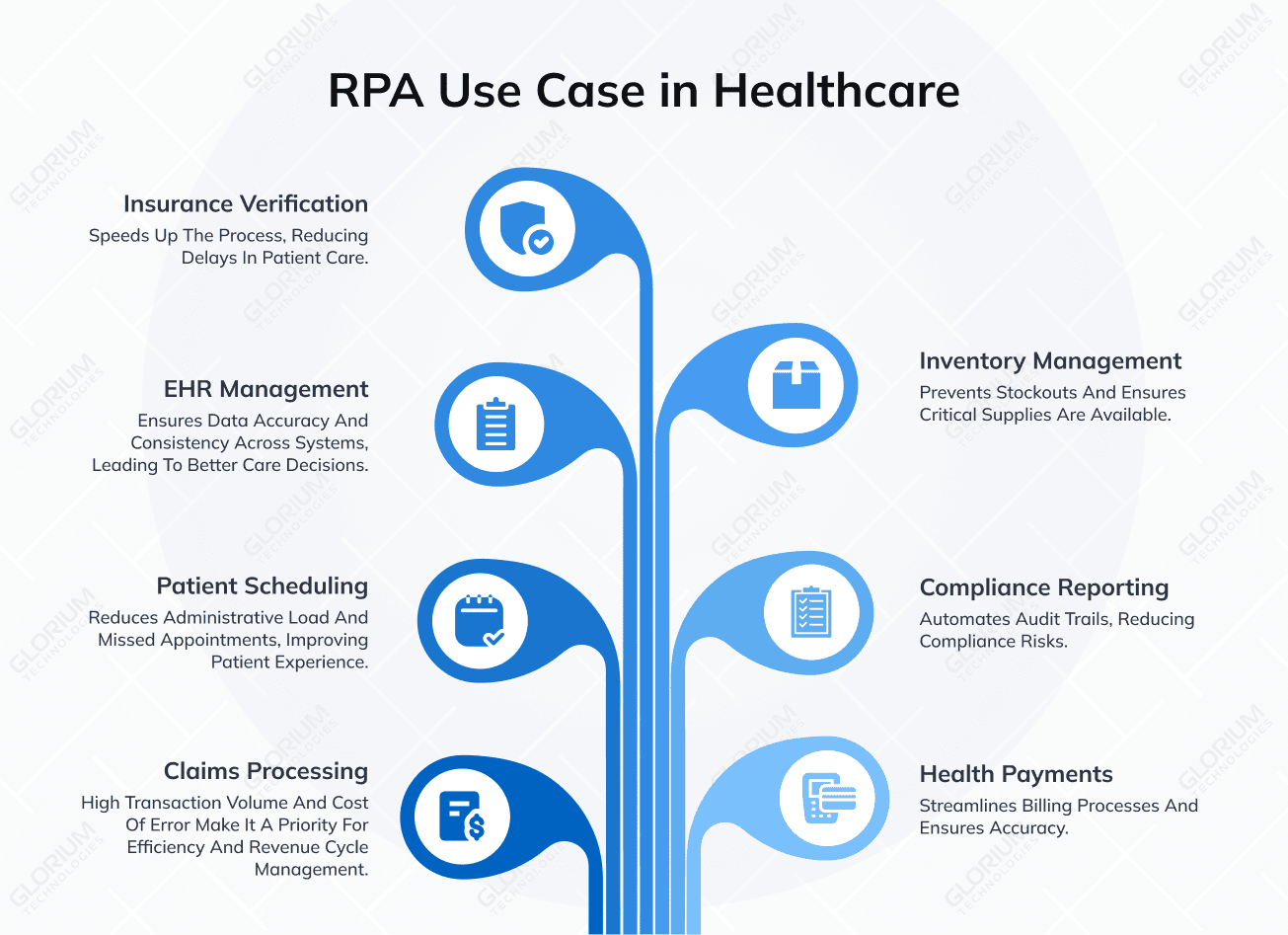
Claims processing involves entering, validating, and submitting large volumes of structured data, and a single mistake can delay payment for weeks. RPA bots pull patient and procedure information from the EHR system, check it against payer rules, and submit claims without a person retyping the same fields across multiple screens. This shortens the revenue cycle and reduces the denials that come from simple data mismatches.
Revenue cycle management benefits from automation at nearly every stage: registration, insurance eligibility verification, charge capture, coding, submission, and payment posting. When bots handle the repetitive parts of that chain, billing teams can focus on the exceptions and appeals that actually need human judgment.
Booking, rescheduling, and confirming appointments is a constant administrative load for front-desk staff. RPA bots can read intake forms, check doctor availability, and place patients into the right time slot based on diagnosis, location, and insurance provider. Automated reminders sent by text or email cut down on missed visits, which matters because no-shows carry a real cost for any clinic running on a tight schedule.
Automating patient scheduling also smooths intake for new patients, who often arrive with paperwork that needs to be captured accurately before their first visit. Bots that extract information from these forms and route it into the right queue reduce the administrative burden on healthcare staff during a stage of the patient journey where first impressions matter. The same logic extends to referral management, where bots track incoming referrals and schedule the first appointment without a staff member manually re-entering details from a fax or PDF. Fewer manual steps in scheduling appointments and coordinating patient interactions means fewer chances for something to fall through the cracks.
Healthcare organizations juggle patient data across departments that rarely share a single unified system. RPA bots move data between disconnected platforms, syncing electronic health records so that a lab result entered in one system appears correctly in another without a staff member retyping it. This kind of data management work is invisible when it goes well and costly when it does not, since inconsistent patient records can lead to delayed or incorrect care decisions.
Bots also help with structured data extraction from referral letters, discharge summaries, and other documents that feed into medical records. Paired with optical character recognition, RPA pulls relevant fields from scanned forms and populates the EHR system directly, cutting the administrative data entry that consumes so much staff time.
Verifying insurance eligibility before a visit or procedure is one of the most repetitive tasks in a healthcare organization, and delays here directly affect patient care. RPA bots log into payer portals, confirm coverage details, and flag discrepancies automatically, cutting the time staff spends on hold with insurance companies.
The prior authorization process, often cited as one of the most frustrating parts of healthcare administration, benefits the same way. Bots gather the clinical documentation a payer requires, submit the request, and track its status, reducing the back-and-forth that delays care.
Hospitals and clinics rely on a steady supply of medical materials, and running short on something basic can disrupt patient care. RPA bots monitor inventory levels for medical supplies, place orders automatically when stock drops below a threshold, and reconcile purchase orders against deliveries. This kind of automated process removes the manual counting and reordering that used to fall on already stretched clinical staff, and it supports patient safety by making sure critical supplies never quietly run out.
The healthcare industry stays under constant regulatory scrutiny, and regulatory compliance requires documentation that is both accurate and easy to retrieve. RPA bots generate timestamped audit trails automatically as they complete each step, giving compliance teams a ready-made record instead of one assembled under deadline pressure. This lowers the odds of a costly compliance gap going unnoticed, and it helps healthcare systems protect patient information by tightening access logs and reducing the manual handling that creates security gaps.
Medical billing shares the same traits as claims processing: high volume and strict formatting rules that payers enforce without exception. RPA solutions built for billing pull charge data from clinical documentation, apply the right codes, and route invoices for review before submission, giving billing teams a consistent, auditable process across different healthcare environments.
Robotic process automation on its own is powerful for structured data and predictable rules, but it hits a wall when a task requires reading unstructured data, like a handwritten note or a free-text discharge summary. This is where combining RPA with artificial intelligence and machine learning changes what automation can handle.
Natural language processing lets a bot read unstructured clinical text and pull out the relevant fields instead of requiring a person to do that translation first. A bot enhanced with machine learning can also learn to flag anomalies in medical data, such as a claim that looks like it might be denied before it is even submitted. This kind of intelligent automation needs far less human intervention to stay accurate, and the quality data flowing into downstream systems helps clinicians enhance patient care instead of second-guessing the numbers in front of them.
The market reflects this convergence. Grand View Research projects the laboratory and pharmacy automation segment, much of which now runs on AI-enhanced bots, to grow at 11.51% annually through 2030, the fastest rate in the broader medical automation market. Health systems that started with basic RPA for claims processing are increasingly layering machine learning on top of it to handle unstructured data that pure RPA could never handle.
Glorium Technologies has direct experience combining these approaches. For a healthcare platform serving parents and homeschoolers, we built an AI-based RPA platform using JavaScript and the OpenAI API to automate campaign workflows end-to-end: cleaning raw data, sorting it into relevant segments, extracting key insights, and generating content tailored to the audience. The tool cut the cost per post by up to 50% while keeping output consistent, a clear example of structured automation paired with intelligent extraction, turning scattered inputs into usable output without forcing a team to change how it works.
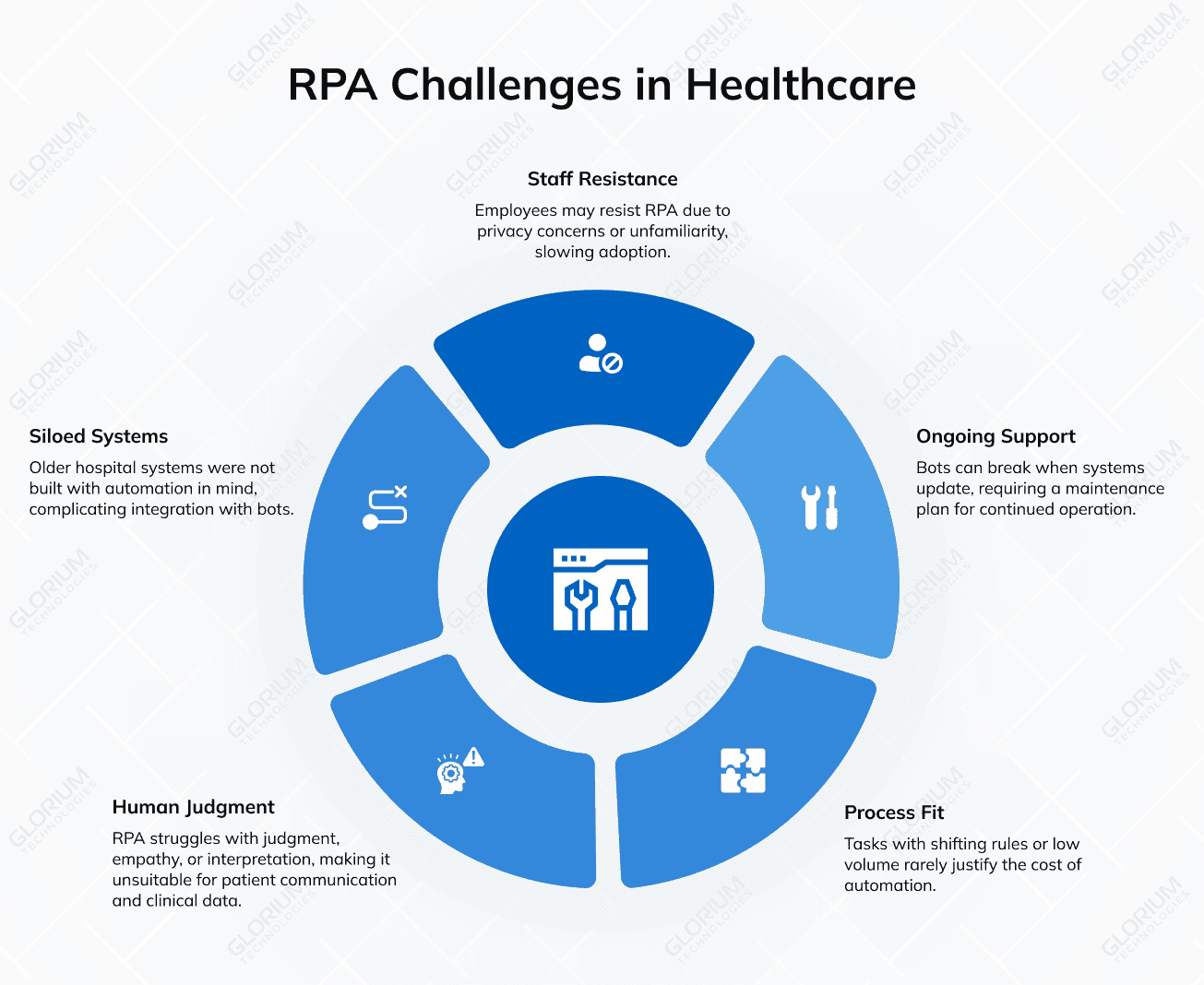
RPA is not a plug-and-play fix, and organizations that treat it that way run into the same problems. Knowing these challenges ahead of time separates a pilot that stalls from one that scales.
None of these challenges are reasons to avoid RPA. They are reasons to plan carefully, start with repetitive administrative tasks, and bring frontline staff into the conversation early rather than presenting automation as something imposed on them.
Not every administrative process is suitable for automation. A process should be repetitive and follow a consistent pattern each time it runs, since variation makes automation harder to build and maintain. Processes should also change infrequently, as a workflow restructured every few months forces constant reconfiguration of the bots built to handle it. The biggest returns come from automating high-volume tasks, since time saved compounds quickly when a bot runs the same steps thousands of times a week.
Claims processing, insurance eligibility verification, and patient intake score well against all three criteria, which is why they show up so often as the starting point for healthcare RPA projects. A narrow pilot on one of these processes gives an organization real data on ROI before committing to a wider rollout.
Every healthcare organization that has explored automation runs into the same tension: the promise of RPA is straightforward, but the execution runs into legacy systems, compliance requirements, and staff who need to trust a new healthcare operations workflow before they adopt it.
Glorium Technologies has spent more than 15 years building software for healthcare organizations where HIPAA compliance and clinical accuracy are requirements from day one. Our team has delivered custom RPA and AI-driven automation tools, along with integrations that connect bots to the EHR systems healthcare providers already depend on, giving hospitals and clinics automation that fits their existing infrastructure.
Ready to see where RPA could save your team the most time? Contact us today to talk through your specific workflows and get a clear plan for your first pilot.
RPA follows fixed rules to execute repetitive tasks, such as moving data between two systems in the same sequence every time. AI, including machine learning and natural language processing, handles judgment-based work like interpreting unstructured text or flagging anomalies. Many healthcare automation projects now combine both, using RPA to execute steps and AI to handle the parts that require interpretation.
Revenue cycle and billing teams tend to see the fastest, most measurable wins because claims processing involves high transaction volume and structured data with clear rules. A successful pilot there builds the internal case for expanding automation into scheduling, records management, or compliance reporting.
RPA takes over specific repetitive tasks rather than entire job functions. Staff who previously spent hours on data entry or claims follow-up typically shift toward exception handling, patient communication, and other work that still requires human judgment. Most healthcare organizations reallocate freed-up time rather than reduce headcount.
A focused pilot on a single process, such as insurance eligibility verification, can go live in a few weeks to a couple of months. Enterprise-wide rollouts across multiple departments and systems typically take six months to a year, with most of that time spent on integration testing and staff training rather than building the bots themselves
Beyond the initial build, organizations should plan for bot maintenance, license fees for the RPA platform, and periodic updates when connected systems change their interface. A realistic budget also includes staff time for monitoring bot performance and handling exceptions that fall outside the automated workflow.
No. RPA automates repetitive tasks like data entry or scheduling. Healthcare involves countless judgment calls that stay with the care team: diagnosis, treatment adjustments, and the personalized treatment plans that depend on a clinician’s read of the patient. Automating tasks around the edges of care, rather than the care itself, is what frees clinicians to spend more time on those decisions instead of less.
Most healthcare organizations pair RPA with their existing systems: EHR platforms, billing software, and HR tools that manage employee data all connect to bots through the same interfaces staff already use. Because healthcare services span so many departments, from registration to discharge, software solutions built for RPA usually integrate incrementally, automating one workflow at a time. This approach is also central to reducing operational costs, since organizations see savings accumulate as each new workflow comes online rather than waiting on a single large rollout.